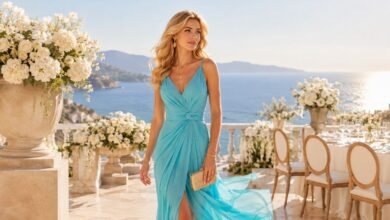
Semi Formal vs Cocktail Wedding Attire: What’s the Real Difference?

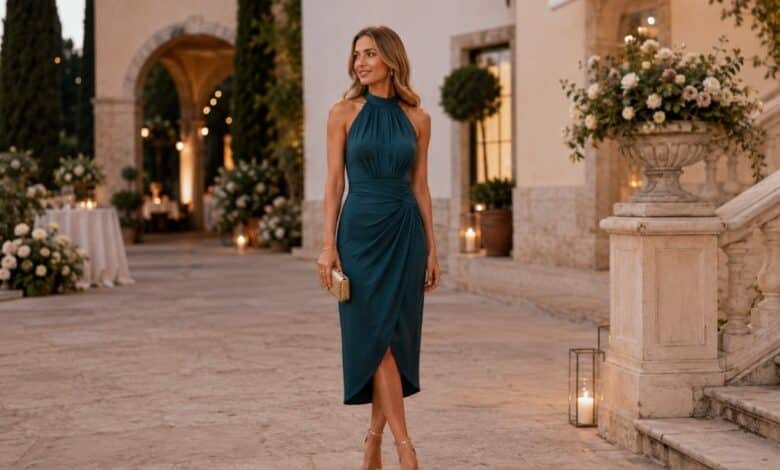
Semi-formal vs cocktail wedding attire is exactly the kind of invitation puzzle that makes a normal closet feel personally hostile. Both dress codes mean “please dress nicely.” Neither requires a full gown. Both can include midi dresses, polished shoes, pretty bags, satin, crepe, suits, and jewelry. The difference is the energy.
Cocktail is usually dressier, sharper, more evening-ready, and a little more social. Semi-formal is polished, graceful, and slightly calmer. Think “champagne at a city hotel” versus “beautiful dress at a refined ceremony where Aunt Linda will absolutely notice your shoes.”
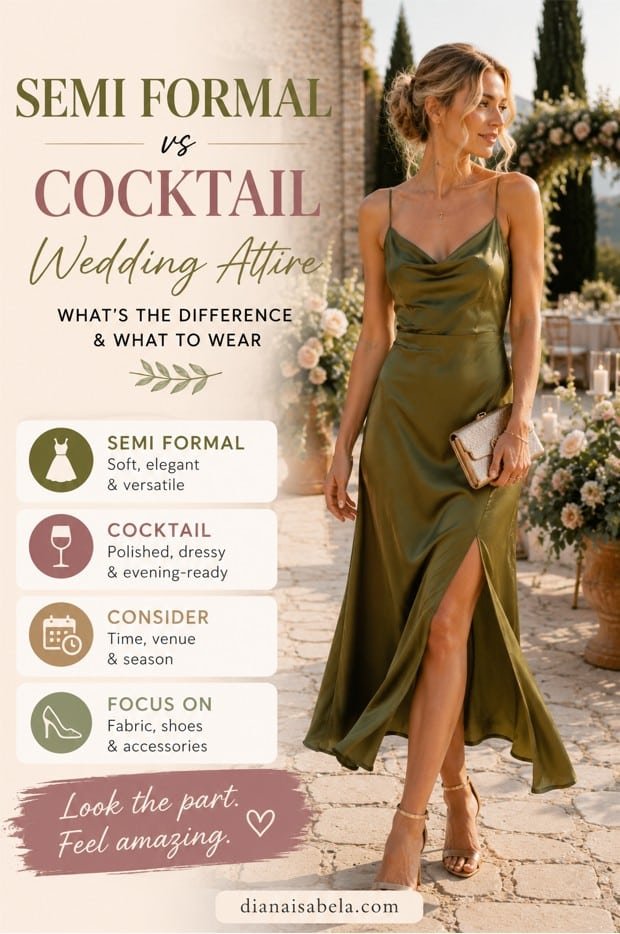
Quick answer: cocktail wedding attire is usually dressier than semi-formal wedding attire. Semi-formal is polished but more flexible, especially for daytime, outdoor, garden, countryside, or family weddings. Cocktail is sharper, more festive, and more evening-ready, especially for hotels, restaurants, rooftops, city venues, and candlelit receptions.
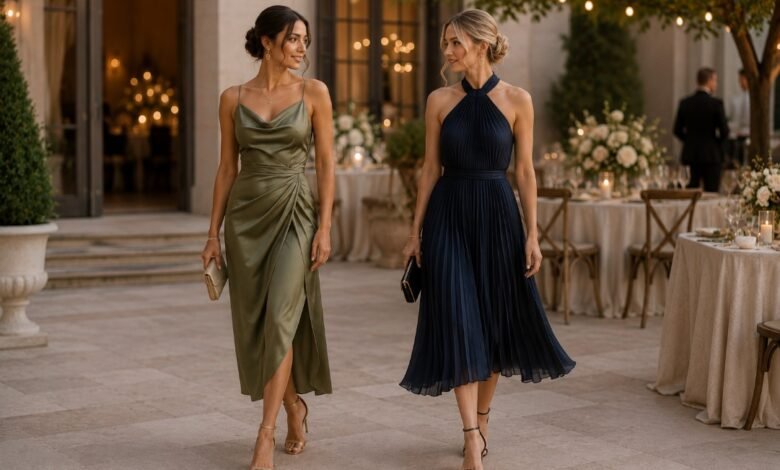
Diana’s useful translation: if the outfit feels like it wants a martini glass in the photo, it is probably cocktail. If it feels like it wants a ceremony chair, a pretty dinner, and a tasteful compliment from someone’s grandmother, it is probably semi-formal. Not scientific. Extremely useful.
The real difference in plain English
Cocktail wedding attire is festive and polished. It usually fits evening receptions, city weddings, hotel cocktail hours, rooftop parties, chic restaurant weddings, galleries, candlelit dinners, and celebrations where the couple wants guests to look dressed-up but not gown-level formal. A cocktail dress can be midi, tea-length, knee-length, ankle-length, or a refined mini if the setting allows it.
Semi-formal wedding attire is slightly softer and more flexible. It is still dressed-up, but it does not have to feel party-forward. Semi-formal works beautifully for afternoon ceremonies, garden venues, elegant churches, country clubs, vineyards, family weddings, and dinner receptions that need polish without full evening drama.
The clean answer is: semi-formal is elegant but flexible; cocktail is polished with more party energy. The messy answer is that couples use these words differently, venues change everything, and invitations sometimes act like riddles printed on expensive paper.
Cocktail attire says
“Come dressed for the celebration.” It likes stronger silhouettes, a little shine, sharper shoes, a mini bag, and an outfit that feels ready for drinks, dinner, and dancing.
Semi-formal attire says
“Come dressed with taste.” It likes pretty midi dresses, softer fabrics, elegant shoes, and an outfit that feels respectful for both ceremony and reception.
The tiny formality ladder nobody prints on the invitation
Cocktail and semi-formal sit close together, which is why people mix them up. The easiest way to separate them is to look at the mood, not just the dress length.
Relaxed but polished. The dress can be simple if the styling is finished.
Pretty, respectful, ceremony-friendly, and polished without becoming too party-coded.
More festive, sharper, and social. The outfit should feel ready for evening celebration.
More elegant and elevated; long dresses and stronger evening fabrics enter the chat.
Semi-formal vs cocktail: the practical comparison
This is the part to screenshot mentally. Not because dress codes are laws, but because they are social hints. The outfit should answer the hint without overperforming.
Polished, pretty, guest-appropriate, a little softer, often easier for daytime, outdoor, garden, or family weddings.
Dressier, sharper, more evening-ready, more refined, often with a stronger shoe, fabric, or accessory moment.
Knee-length, midi, tea-length, polished maxi, soft ankle-length, dressy separates, or elegant jumpsuits can work.
Midi is safest. Tea-length, knee-length, polished mini, sleek ankle-length, or a refined jumpsuit can work.
Chiffon, crepe, polished cotton blends, soft satin, florals, pleats, lace, and elevated linen blends.
Satin, silk, crepe, velvet, jacquard, lace, subtle sequins, polished knit, and more structured fabrics.
Block heels, refined flats, wedges, sandals, slingbacks, polished low heels, especially for outdoor venues.
Heeled sandals, pumps, slingbacks, kitten heels, dressy flats, metallic shoes, or sleek evening shoes.
Pretty but calmer: pearl earrings, delicate gold jewelry, small bag, soft hairstyle, and shoes that fit the venue.
More intentional: clutch, metallic sandals, statement earrings, sleek hair, stronger lipstick, or a sharper evening bag.
Going too casual: sundress, jersey, beachy linen, casual sandals, big tote, or “nice brunch” energy.
Going too nightclub, too shiny, too revealing, or too formal with full-gown drama.
For a deeper explanation of the softer side, use the guide to semi-formal wedding guest dresses. For the dressier side, the page on cocktail wedding guest dresses is the better next step.
Dress length: where the confusion usually begins
For cocktail attire, midi and tea-length dresses are excellent. Knee-length can work if the dress looks elevated. A polished mini can be appropriate at some cocktail weddings, especially city, rooftop, restaurant, or fashion-forward receptions — but the word is polished. Not club. Not “my ex might be there.” Not a dress that needs four friends and a prayer when you sit down.
For semi-formal, midi is the safest. Knee-length can work when the fabric is dressy. A soft ankle-length dress can also be lovely, especially for evening, cooler seasons, garden settings, or family weddings. Mini dresses are trickier for semi-formal because the dress code is less party-oriented; if you go short, keep the neckline, fabric, and styling more refined.
Long dresses can work for both, but they should not accidentally become black tie. A sleek ankle-length slip dress can be cocktail. A soft maxi can be semi-formal. A dramatic gown with a train, heavy beading, and red-carpet energy is probably too much unless the invitation points toward formal or black tie optional.
Midi, tea-length, knee-length, sleek ankle-length, or a refined mini with excellent fabric and controlled styling.
Midi, knee-length, soft ankle-length, polished maxi, or a tea-length dress that feels pretty without too much drama.
Floor-length gala gowns for cocktail, casual sundresses for semi-formal, and any mini that looks like it has a nightclub reservation.
A refined midi dress works for both dress codes when the fabric, shoe, bag, and jewelry are adjusted to the venue.
The invitation is flirting with clues
Do not just read the dress code. Read the whole invitation like your best friend sent you a mysterious voice note. Time, venue, season, and wording all matter.
Lean cocktail if the venue is city, hotel, rooftop, restaurant, gallery, or club-like. Add richer color and a sharper shoe.
Lean semi-formal unless the invitation clearly says cocktail. Softer fabric, lighter color, and elegant accessories usually work.
Semi-formal often feels safer. Keep the dress polished, but avoid anything too short, loud, or reveal-heavy.
Cocktail is probably the assignment. This is where satin, jacquard, a chic clutch, and sharper heels make sense.
Fabric: cocktail likes shine, semi-formal likes grace
Fabric is the secret gossip of wedding guest dressing. It tells people whether your dress understands the room before you even find your table card.
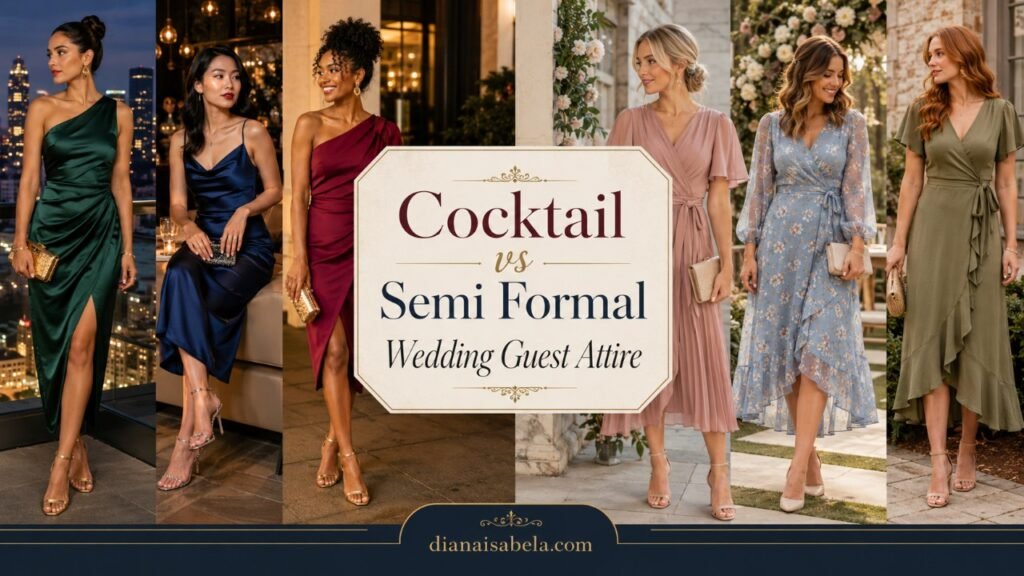
Cocktail attire can handle more sheen, structure, texture, and drama: satin, jacquard, lace, crepe, velvet in cooler months, polished taffeta, silk, a sculptural one-shoulder fabric, or a dress that holds shape. Semi-formal prefers fabrics that are still dressed-up but less nightlife-coded: chiffon, crepe, soft satin, polished cotton blends, refined florals, lace in gentle colors, pleats, and draped fabrics that look elegant rather than flashy.
That does not mean cocktail must be shiny or semi-formal must be plain. A crepe midi can move either way. A satin dress can work for both. The styling decides the final mood.
Works for both. For cocktail, go sleeker, richer, or sharper. For semi-formal, soften it with color, length, and calmer accessories.
The friend who behaves everywhere. A crepe midi can be cocktail with heels and a clutch or semi-formal with softer styling.
More semi-formal by nature, especially in garden, church, daytime, and family settings. Cocktail chiffon needs sharper styling.
Very cocktail-friendly because it adds structure and visual interest without needing sequins to shout.
Works when it is guest-safe, colored, and not bridal. White lace is still not invited unless the couple asked.
Usually too relaxed for both unless the wedding is daytime and the dress is very structured and beautifully styled.
Venue decides what your dress should whisper
The same black satin midi can feel perfect at a city cocktail wedding and slightly too sharp at a soft garden ceremony. The venue is not background scenery. It is part of the dress code.
Cocktail wins. Try satin, black, navy, jewel tones, a sculptural neckline, and a small evening bag.
Semi-formal is usually prettier. Think floral midi, chiffon, soft crepe, block heels, and jewelry that catches light quietly.
Either can work. Cocktail if it feels like evening drinks; semi-formal if it feels like family dinner with candles and speeches.
Cocktail feels natural. Choose a dress that can handle wind, stairs, photos, and people holding tiny expensive glasses.
Semi-formal often reads more respectful. Bring coverage if the dress has thin straps, an open back, or a dramatic neckline.
Semi-formal with a polished edge usually works. Elegant midi, slingbacks, pearls or gold earrings, and no chaos.
Warm colors, olive, rust, burgundy, floral prints, pleated dresses, and practical shoes that do not sink into gravel.
Cocktail usually fits the room. Try a clean silhouette, strong color, sharp shoe, and one artful accessory.
Shoes and bags: where the outfit becomes obvious
Cocktail shoes can be a little sharper: heeled sandals, pointed pumps, sleek slingbacks, metallic heels, sculptural kitten heels, or platforms if the dress and venue can handle them. The bag should be small and deliberate — clutch, mini top-handle, satin pouch, beaded bag, pearl bag, polished shoulder bag, or something that clearly belongs to evening.
Semi-formal shoes can be softer and more practical: block heels, low sandals, slingbacks, dressy flats, wedges for grass, or elegant kitten heels. A semi-formal bag should still be small, but it does not need to sparkle like it has a secret nightlife career.
The shoe test is weirdly accurate. If the shoes are casual, the outfit usually becomes semi-formal at most. If the shoes are sleek, dressy, or evening-ready, the outfit starts leaning cocktail. A black satin midi with casual sandals becomes confused. A simple dress with refined slingbacks and a clutch can suddenly look much more polished.
Block heels, dressy flats, wedges, low heeled sandals, slingbacks, and polished sandals, especially for outdoor or daytime weddings.
Heeled sandals, pumps, metallic heels, kitten heels, slingbacks, satin shoes, and sleek evening flats.
Small shoulder bags, soft clutches, mini top-handles, refined woven bags, or simple polished evening bags.
Clutches, satin pouches, beaded bags, metallic mini bags, pearl bags, structured top-handles, or sharper evening bags.
Outfit formulas when you want the answer fast
Sometimes you do not need a lecture. You need someone stylish to say, “Wear this, not that.” So here.
Black satin midi + metallic heels + drop earrings
Clean, festive, and safe for hotel, city, rooftop, or evening receptions.
Rose chiffon midi + block heels + pearl earrings
Pretty, ceremony-friendly, and perfect for garden, church, country club, or afternoon weddings.
Emerald jacquard tea dress + slingbacks + mini clutch
Structured enough for cocktail, but not dramatic enough to look like you mistook it for black tie.
Navy crepe midi + nude sandals + soft low bun
Elegant, calm, and socially fluent. The dress equivalent of knowing exactly when to leave the after-party.
Plum slip dress + black slingbacks + sculptural earrings
Evening-ready without becoming formal. Perfect when the reception feels city, candlelit, or restaurant-based.
Sage floral midi + block heels + small gold hoops
Soft, polished, and appropriate for garden, vineyard, daytime, or family-centered weddings.
Color: cocktail can go richer, semi-formal can go softer
Cocktail loves black, navy, emerald, wine, cobalt, berry, chocolate, plum, metallic accents, and stronger pinks when the cut is refined. Semi-formal looks beautiful in sage, dusty blue, rose, mauve, lavender, navy, soft green, terracotta, gentle florals, and warmer neutrals that do not drift into bridal white.
Both dress codes still avoid white, ivory, cream, bridal champagne, and pale lace unless the couple specifically requests it. Yes, even if the dress is “technically beige.” If you need a courtroom defense for the color, the color is guilty. For the broader rule line, check the guide on wedding guest dress etiquette.
Women’s outfits: how the same dress can move between both codes
A dress is rarely only semi-formal or only cocktail. Styling pushes it one way or the other. A floral midi with block heels and soft jewelry may feel semi-formal. The same silhouette in satin with metallic sandals and a clutch can feel cocktail.
This is useful because you do not always need a completely different dress. Sometimes you need a different shoe, bag, hairstyle, fabric choice, or beauty direction.
For semi-formal, choose softer fabric or print. For cocktail, choose satin, crepe, lace, darker color, or a sharper neckline.
For semi-formal, keep it softer and less shiny. For cocktail, add a polished sandal, jewelry, sleek hair, and a small clutch so it feels finished.
For semi-formal, florals are easy. For cocktail, choose a darker print, sleeker cut, richer fabric, or more refined accessories.
For semi-formal, it can be softer and more relaxed. For cocktail, the tailoring needs to be sharper and the accessories more evening-ready.
Men’s outfits: the difference is mostly polish
For men, the two codes overlap a lot. A suit works for both. The difference is color, fabric, shoes, tie, and how sharp the whole thing feels.
Semi-formal can allow lighter suiting, no tie depending on the venue, softer colors, loafers, and a slightly easier mood. Cocktail usually prefers a sharper suit, better shoes, a more deliberate shirt, and sometimes a tie or pocket square — especially for evening.
Men’s quick guide
Suit or polished jacket and trousers, dress shirt, refined loafers or dress shoes, optional tie depending on venue.
Tailored suit, dress shirt, polished shoes, stronger accessory choice, and a more evening-ready finish.
Navy, gray, tan, light blue, brown, olive, or lighter suiting for daytime and outdoor weddings.
Navy, charcoal, black, deep green, burgundy, chocolate, or darker suits that feel sharper for evening.
Time of day changes the answer
Evening makes everything dressier. A 6:30 p.m. cocktail wedding in a hotel does not ask the same thing as a 2 p.m. semi-formal garden ceremony. Even if the dress codes sound close, the lighting changes the outfit.
Daytime usually softens the look: lighter colors, less shine, gentler fabrics, practical shoes, and more natural styling. Evening sharpens it: satin, deeper colors, metallic accessories, cleaner silhouettes, darker suits, and more deliberate finishing.
If the invitation is vague but the wedding is after 5 p.m. in a polished venue, lean cocktail. If the wedding is daytime, outdoor, garden, family-centered, or ceremony-heavy, lean semi-formal unless the invitation clearly says otherwise.
What people get wrong
The most common mistake is treating cocktail and semi-formal as interchangeable. They overlap, but they do not have the same personality. Cocktail wants more celebration. Semi-formal wants more balance.
Semi-formal does not mean everyday. Avoid casual sundresses, jersey, denim, flip-flops, large totes, beachy linen, and anything that looks like errands.
Cocktail is festive, not clubwear. Avoid very tight minis, extreme cutouts, sheer panels, and anything that feels more velvet rope than wedding reception.
A full gown, train, heavy beading, or red-carpet drama can look too formal unless the invitation or venue clearly points higher.
Grass, sand, churches, rooftops, restaurants, ballrooms, and vineyards all change what semi-formal or cocktail should look like.
A large day tote can make both dress codes look unfinished. Choose a smaller bag that belongs to the outfit.
Both dress codes still avoid white, ivory, cream, pale lace, and bridal-looking champagne unless the couple specifically requests it.
For the bigger boundary list — especially white, ivory, overly casual pieces, and attention-stealing choices — the guide to what not to wear to a wedding is the safer reference.
The easiest decision method
When you are standing between two outfits, do not ask “Which one is prettier?” Ask which one matches the wedding better.
Choose softer fabric, practical shoes, movement, and polish without too much evening shine.
The invitation says cocktail, the time is evening, or the venue has a more elevated reception feel.
Choose a polished midi, richer color, and better accessories so it does not feel too daytime.
Add richer fabric, darker color, sleeker shoes, a clutch, and more evening-ready styling.
A refined midi dress, small bag, polished shoes, and intentional jewelry can survive many unclear dress codes.
Do not go too casual, too bridal, too revealing, too black-tie, or too nightclub.
Slightly polished reads respectful. A little extra effort is usually safer than looking underdressed.
Dramatically overdressed reads confused. Do not bring black-tie drama to a soft semi-formal wedding.
When it starts feeling too elevated, check the formal line
If the wedding venue feels especially grand, the invitation is very elegant, or the couple says “cocktail” but everything else says luxury evening, compare the outfit with formal wedding guest dresses. That helps you avoid being the only person dressed for a relaxed terrace dinner in a room full of gowns and tuxedos.
On the other side, if your semi-formal outfit starts looking too much like something you would wear to brunch, upgrade it. Better shoes, a smaller bag, jewelry, a dressier fabric, and styled hair can move the look into the right zone without making it cocktail.
Final answer: cocktail is usually the dressier sibling
Semi-formal and cocktail wedding attire overlap, but cocktail usually asks for more polish. Semi-formal can be softer, lighter, and more flexible. Cocktail tends to be sleeker, sharper, and more evening-aware.
The best guest outfit reads the room. Venue, time, season, invitation style, and couple energy matter more than obsessing over the label. If the wedding says semi-formal, look elegant and finished. If it says cocktail, add more polish and party energy. If the invitation is vague, choose the outfit that feels respectful, comfortable, and clearly wedding-ready.
That is the whole secret: not too casual, not too dramatic, not too bridal, and definitely not dressed like you gave up halfway through the mirror check.
Do not let two similar dress codes bully your closet
For semi-formal, choose polish with grace: a refined midi, elegant jumpsuit, soft fabric, practical shoes, and a small bag. For cocktail, choose polish with more celebration: satin, crepe, jacquard, a sharper shoe, an intentional clutch, and a slightly stronger beauty direction.
If the dress feels like it belongs to the room, respects the couple, photographs well, and lets you sit, walk, eat, and dance without drama, you probably solved the dress-code riddle.
FAQ
What is the difference between semi-formal and cocktail wedding attire?
Semi-formal wedding attire is polished but a little more flexible, while cocktail attire is usually dressier, sharper, and more evening-ready. Cocktail often calls for more refined fabrics, shoes, and accessories.
Is cocktail attire dressier than semi-formal?
Usually, yes. Cocktail attire generally feels more polished and party-ready than semi-formal, especially for evening weddings, hotels, restaurants, rooftops, and city venues.
Can I wear the same dress for semi-formal and cocktail attire?
Sometimes. A midi dress, slip dress, jumpsuit, or polished floral dress can work for both depending on styling. Softer accessories lean semi-formal, while dressier shoes, a clutch, and refined jewelry can make the same outfit feel cocktail.
What should women wear for semi-formal wedding attire?
Women can wear a polished midi dress, knee-length dress, dressy maxi, elegant jumpsuit, or refined separates. The outfit should look wedding-appropriate but not overly formal.
What should women wear for cocktail wedding attire?
A satin midi, sleek slip dress, dressy mini, crepe dress, lace midi, elegant jumpsuit, or polished separates can work. Cocktail attire usually needs more refined shoes, a small bag, and intentional accessories.
Do men need a suit for semi-formal or cocktail wedding attire?
A suit is a safe choice for both. For semi-formal, a lighter suit or polished jacket and trousers can work. For cocktail, a sharper suit, dress shirt, polished shoes, and possibly a tie or pocket square are usually better.
Can I wear a long dress to a semi-formal wedding?
Yes, if the dress is not too formal or gown-like. A soft maxi or ankle-length dress can work for semi-formal weddings, especially outdoor or evening events, as long as the styling is not black tie.
Can I wear a long dress to a cocktail wedding?
Yes, but choose a sleek long dress rather than a dramatic gown. A satin slip, column dress, or ankle-length cocktail dress can work if it does not look too formal for the event.
What shoes work for semi-formal vs cocktail attire?
Semi-formal can include dressy flats, block heels, wedges, low heels, or polished sandals. Cocktail usually leans toward heeled sandals, pumps, slingbacks, kitten heels, metallic shoes, or more refined dressy flats.
What should I avoid for both semi-formal and cocktail weddings?
Avoid denim, flip-flops, casual cotton dresses, beachwear, large day bags, bridal-looking colors, overly revealing outfits, and full ballgown-level formalwear unless the invitation clearly says otherwise.