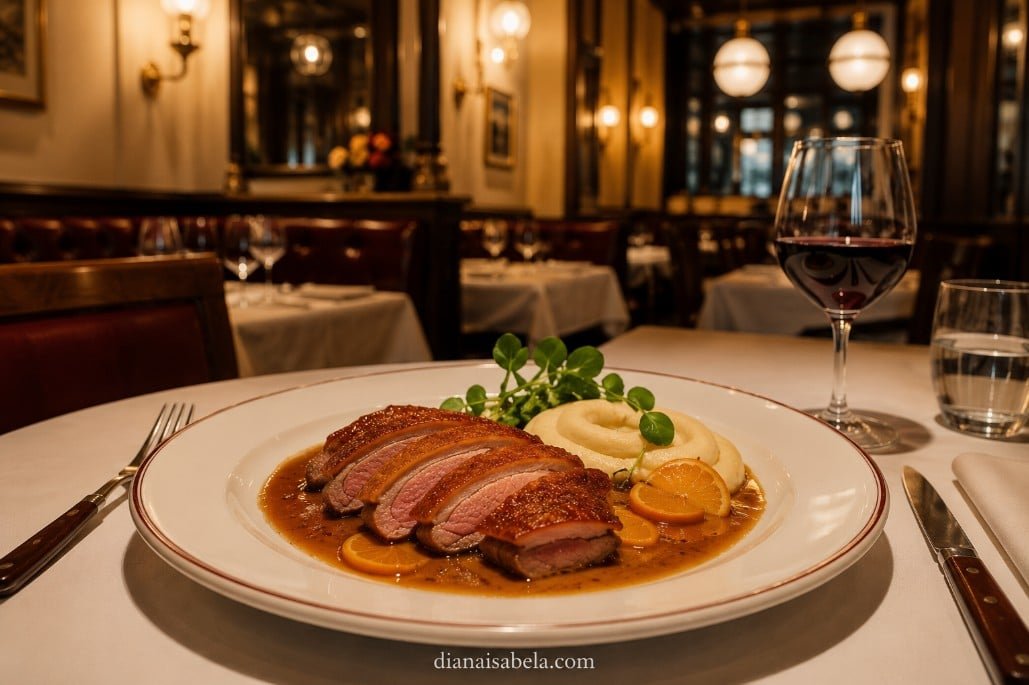
Duck à l’orange is one of those dishes whose reputation somehow became older than the dish itself. Say the name and I immediately imagine burgundy banquettes, polished silver, beautiful low lighting and somebody ordering Cognac with the confidence of a person who has never once looked at a credit-card statement. But the more restaurant menus I looked through, the less this felt like culinary archaeology.
Duck à l’orange is still being cooked across the United States. Some restaurants protect the old roast-duck-and-orange-sauce idea almost intact. Others use magret, confit, sous-vide breast, satsuma, black garlic or a modern gastrique. In Tampa Bay, there is even a restaurant with a dedicated current menu page for its half-duck version. In Miami, you need to know the correct day of the week. In Napa, the menu itself suggests a Pinot Noir to drink beside it.
So if you are searching for the best duck à l’orange near you, this guide is built around the question I would actually want answered before getting dressed and driving across town: where can I order it now, what exactly will arrive, how much does it cost, and is this a restaurant I should call before making the duck the entire reason for dinner?
Where Can You Find Duck à l’Orange in the U.S.?
The first useful thing to know is that duck à l’orange is not distributed evenly. You can search ten French restaurants in one city and find none, then discover a dedicated half-duck entrée in a suburban dining room twenty miles away. That is why I do not want this guide to become a list of famous cities. The dish matters more than the zip code.
Traditional French restaurants are still the safest place to begin because roast duck and sauce work naturally inside that kitchen vocabulary. But the most interesting current examples are not always the most traditional. Chicago’s Gavroche uses confit, satsuma and black garlic. Napa’s Carpe Diem combines seared breast with duck leg confit. Next Bistro in Texas works with duck breast, orange liqueur and sherry vinegar. Those plates are not identical, and pretending they are would make the guide less useful.
There is one more pattern worth remembering: the most useful answer is not always the nearest place that appears when you type the dish name. A restaurant may have an old menu indexed years after the dish disappeared. Another may serve it only on Mondays. A third may call a completely modern confit plate “à l’orange.” I would rather know those differences before making a reservation.
Tampa Bay: The Local Duck à l’Orange Search I Would Not Ignore
Tampa Bay surprised me. When a dish has such an old-school French reputation, it is easy to assume the strongest answers will live in Manhattan or some candlelit Los Angeles institution. Instead, Palm Harbor gives us one of the most direct current restaurant answers in this entire guide.
If you are in Tampa, Clearwater, Palm Harbor, Dunedin, Safety Harbor or the northern Pinellas side of the bay, this is where I would start checking before planning a much longer drive.
Diana’s read: The more I looked at Tampa Bay, the more Massimo’s stopped feeling like a side note. This is exactly what I want when somebody searches for a specific restaurant dish: not a five-year-old review that happens to contain the word “duck,” but a dedicated current menu page showing the dish, the preparation and the price. And I like the half-duck format. If I am driving across the bay for a French classic, I am not offended by a plate that behaves like dinner.
Diana’s read: This is exactly where a useful food guide has to resist pretending the internet is permanent. The plate sounds lovely and extremely readable — half duck, green beans, orange, Grand Marnier gastrique — but it was explicitly presented as a July special. That makes Bascom’s a very good lead and a terrible place for me to promise that your duck is waiting tonight. Call.
If Tampa Bay is home: I would start with Massimo’s because the dish is currently documented as a regular menu item, then check whether Bascom’s has brought its seasonal version back. I’m keeping Palm Harbor, Clearwater, Tampa and St. Petersburg together in a dedicated guide to duck à l’orange around Tampa Bay.
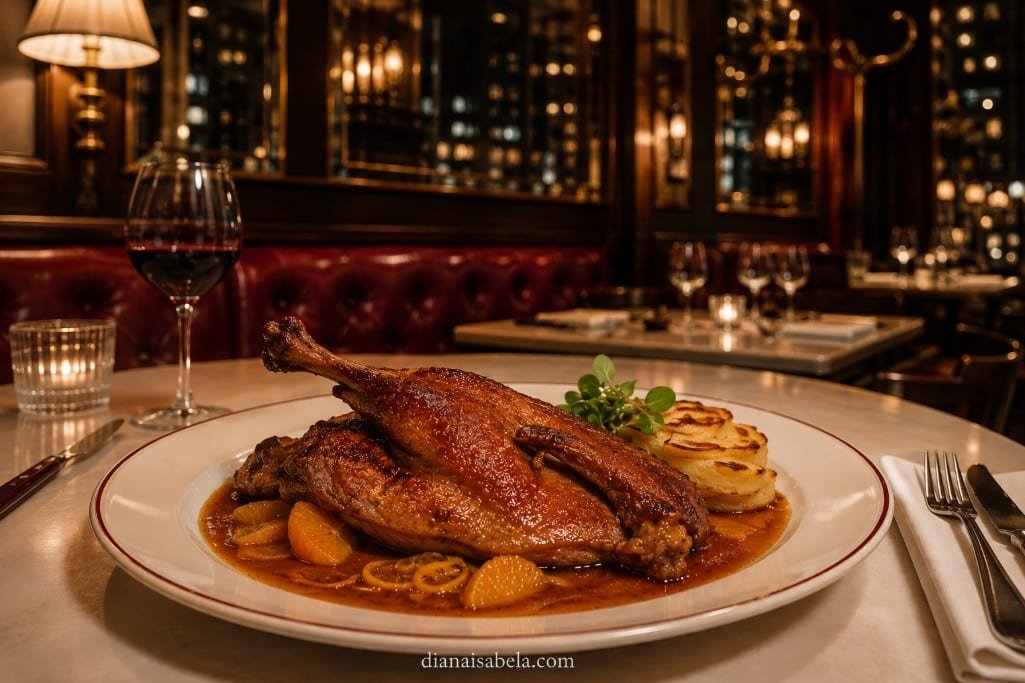
New York City: Where Duck à l’Orange Feels Fashionable Again
New York is where the dish makes the most sense as fashion history. It had a glamorous era, became overly familiar, spent some time being treated like something everyone’s parents ordered, and now finds itself surrounded by younger restaurants rediscovering French dining because perhaps we all finally remembered that a good sauce and a beautiful room are allowed to be fun.
I am not imagining that revival. New French restaurants in New York have been consciously returning to dishes like lobster thermidor and duck à l’orange, while established brasseries continue serving the classics without acting as if they require an ironic footnote.
Diana’s read: The detail I like most here is “duck jus.” Candied orange sounds glamorous, but duck jus tells me the sauce still knows what side of dinner it belongs on. If somebody asked me to explain the classical logic of duck à l’orange before we started debating bergamot and calamansi, this is the kind of menu description I would show them.
New York deserves much more space than one national guide can give it. There are old-school rooms, newer French restaurants and modern citrus-driven interpretations that belong in different categories rather than one ranking. I’m separating them properly in my guide to duck à l’orange in New York City.
Chicago: Where I Start Thinking About Technique
Some dishes make me think about mood first. Duck makes me think about heat.
Growing up around a chef does that to you. Eventually “crispy skin” stops sounding like decorative menu language and starts sounding like a test. Was the fat actually rendered? Did the breast rest? Is the sauce hiding something? Is the kitchen treating sweetness as balance or as camouflage?
Diana’s read: This is the plate that most clearly explains why I do not want “authentic” to become a synonym for “unchanged.” Confit shifts the duck texture. Satsuma changes the citrus. Black garlic gives the dish another kind of sweetness and darkness. Endive adds bitterness. There are a lot of ideas here, but at least they seem to be arguing about the same central problem: how do you make rich duck feel vivid rather than exhausting?
I’m keeping the city’s traditional and modern choices separated in my Chicago duck à l’orange guide, because ranking confit with satsuma against a roast half duck as if they were identical products would be silly.
South Florida: Rich Duck and Citrus Make More Sense Here Than I Expected
I would not have automatically called duck à l’orange warm-weather food. But the more I think about the construction of the dish, the less strange Miami feels. Rich duck needs something bright enough to keep the second bite as interesting as the first. Citrus is doing exactly that job.
Diana’s read: Pastis is the perfect example of why “near me” restaurant searches need more than addresses. You can have the right restaurant, the right city and the right craving, then arrive on Thursday. For this plate, Monday is practically part of the recipe.
Diana’s read: This is the kind of plate that does not need a supporting cast of five side orders. Mushrooms bring earthiness, potatoes give the sauce somewhere useful to go, and the half-duck format gives you a more generous range of texture than a neat row of breast slices.
I’m keeping the Miami-area search, weekly specials and nearby South Florida options together in my guide to duck à l’orange around Miami.
California: One State, Two Completely Different Ideas of the Dish
California gives me exactly the contrast I want from a national guide. In Santa Clarita, Le Chêne preserves a traditional restaurant grammar where roast duck comes with a choice of classic sauces. In Napa, Carpe Diem builds one plate from both seared breast and confit leg. Same phrase on the menu; completely different evening.
Diana’s read: I love that the menu places orange beside Amaretto, cranberry and green-peppercorn versions of roast duck. It feels almost like a tiny lesson in old restaurant sauce culture: the bird stays recognizable while the sauce changes the personality.
Diana’s read: Breast plus confit is almost a design exercise. Same material, different construction. One side of the plate lets you judge skin and doneness; the other gives darker, softer leg meat. I also appreciate a restaurant willing to put a wine pairing directly beside the dish instead of leaving every guest to perform sommelier theatre from memory.
Southern California has enough separate restaurant history that I’m treating it independently in my Los Angeles duck à l’orange guide.
Texas: Proof That Duck à l’Orange Is Not Only a Coastal-City Thing
One reason I wanted this guide to become national rather than a predictable New York–Los Angeles list is that useful examples keep appearing in places that do not fit the cliché.
Diana’s read: Sherry vinegar is the phrase that makes me stop. Orange liqueur tells me where sweetness and perfume may come from; vinegar tells me somebody is thinking about the counterweight. That tension is the entire reason the dish works when it works.
I would not create a thin city guide around one restaurant just to manufacture geography. If more convincing duck à l’orange inventory appears around Dallas–Fort Worth, Austin, Houston or San Antonio, Texas deserves its own deeper page. Until then, this is exactly where the national guide earns its keep.
What About Washington, Boston and San Francisco?
They still belong on my watch list, but I want their dedicated guides to do more than repeat the same restaurant names that circulate through old menu databases.
Washington, DC
The city has exactly the kind of brasserie and hotel-dining ecosystem where duck à l’orange can appear, disappear and return as menus change.
I’m keeping the research separate in finding duck à l’orange in Washington, DC.
Boston
Cold-weather dining and the city’s French restaurant tradition make Boston a natural fit, but I want current availability to be clearer than a collection of historical menu sightings.
That work lives in my Boston duck à l’orange guide.
San Francisco
The Bay Area is particularly interesting when chefs reinterpret the French classic rather than reproduce it, which makes “what counts?” almost as important as “where is it?”
I’m tracking that separately in modern duck à l’orange in San Francisco.
A rule I am keeping
I would rather wait until a city gives us enough current restaurant evidence than publish a page where every recommendation ends with “maybe call and ask.” A city guide should make choosing dinner easier.
How Much Does Duck à l’Orange Cost at a Restaurant?
Among the current individual restaurant dishes in this guide, I found prices from roughly the mid-$20s to just above $50. That is useful as a snapshot, but it is not a meaningful national “average.” A confit leg in Chicago, a half roasted duck in Palm Harbor and breast-plus-confit in Napa are not the same portion and should not be compared as if you were choosing between identical boxes of cereal.
| Restaurant | Location | Duck style | Price | Availability |
|---|---|---|---|---|
| Gavroche | Chicago, IL | Confit leg | $25 | Current menu |
| Next Bistro | Colleyville, TX | Duck breast | $31 | Current listing |
| Massimo’s | Palm Harbor, FL | Roasted half duck | $39 | Current menu |
| Pastis Miami | Miami, FL | Plat du jour | $46 | Monday |
| Casimir | Boca Raton, FL | Half roasted duck | $46.50 | Current menu |
| Carpe Diem | Napa, CA | Breast + confit | $48 | 2026 dinner menu |
| Balthazar | New York, NY | Brasserie entrée | $49 | Current dinner menu |
| Le Chêne | Santa Clarita, CA | Roast duck | $52 | Current dinner menu |
| Bascom’s | Clearwater, FL | Roasted half duck | Confirm | Recent seasonal special |
These are menu prices observed during this August 2026 update. Restaurants can change dishes, portions and prices without notice, and ordering-platform prices can differ from dining-room prices.
The useful version of “best near me” is not the closest restaurant that once mentioned duck online. It is the place currently serving the style of duck you actually want to eat.
What Is Duck à l’Orange, Exactly?
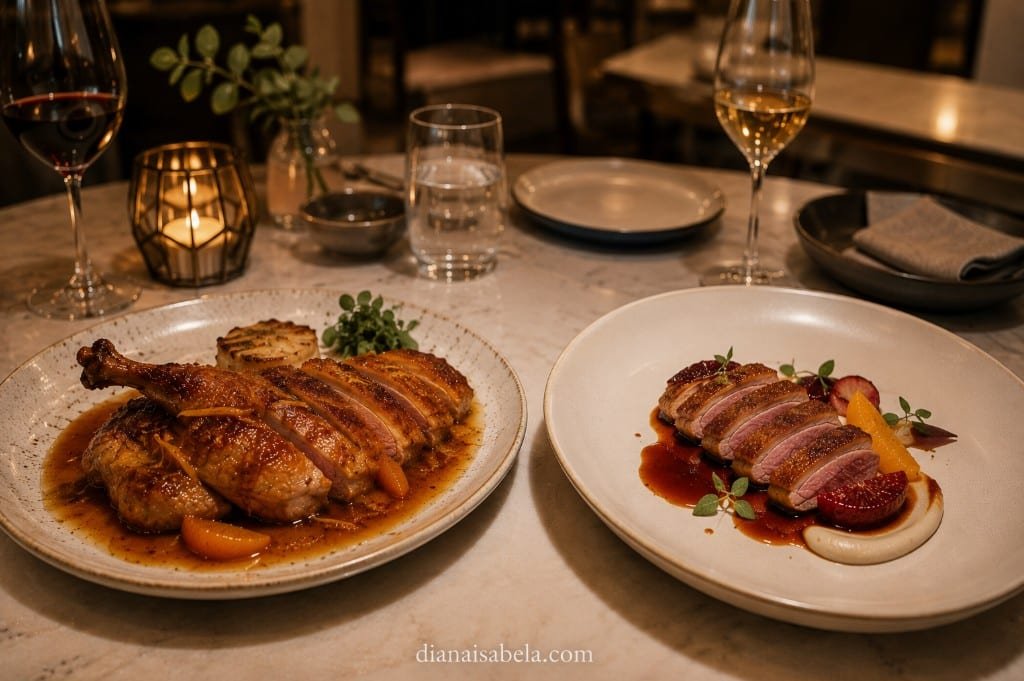
At its core, duck à l’orange is a French duck dish built around contrast. Rich duck meets orange. Sweetness meets acidity. Roasted flavor meets citrus perfume. In the classical French tradition, the dish is closely associated with canard à la bigarade and the logic of bitter-orange sauce.
That word “bitter” matters. The dish was never interesting because cooks discovered that oranges can be sweet. The interesting part is controlling sweetness so it sharpens the duck instead of turning dinner into jam with poultry underneath.
Classical sauce construction can bring caramelized sugar, vinegar, orange, stock or jus and bitter citrus together. Modern chefs may reach the same destination through completely different tools: satsuma, blood orange, calamansi, orange liqueur, gastrique, reduced jus, fermented elements or even black garlic.
The duck itself can also change. You may see a whole roast bird, half duck, magret, sliced breast, confit leg or two preparations on the same plate. All can participate in the same idea, but they do not create the same eating experience.
If you want the culinary history and terminology without trying to absorb it between restaurant addresses, I explain it separately in what duck à l’orange actually is.
Classic Duck à l’Orange vs the Modern Restaurant Version
I do not believe classical food needs to spend eternity behind museum glass. I love museums, obviously, but dinner should still be alive.
The better question is whether a reinterpretation understands what it is changing.
I am completely fine with chefs changing the citrus. I become much less generous when the duck itself disappears behind the concept. It reminds me of redesigning an archival dress: change the fabric, cut the hem, exaggerate the proportion, remove the nostalgia — wonderful. But if you never understood the construction, you are not really reinterpreting it. You are just borrowing the name.
What Should Duck à l’Orange Taste Like?
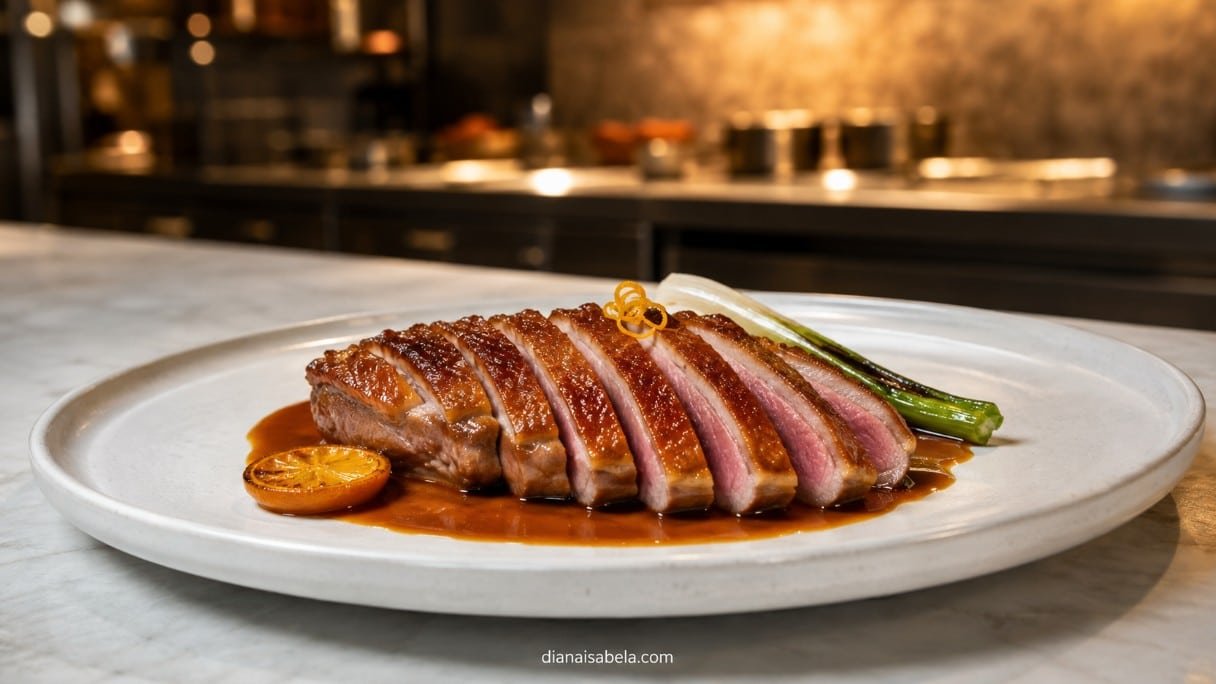
Good duck à l’orange should taste rich, savory, citrusy, gently sweet, acidic and sometimes slightly bitter — but none of those words should feel like a separate button somebody pressed.
The duck comes first. It has a deeper flavor and much more fat than chicken, which is exactly why proper cooking matters. Well-rendered skin can become crisp while the meat remains juicy. Browning brings roasted, almost nutty depth. Then the orange sauce changes the rhythm of the bite.
Citrus oil gives aroma before you even taste it. Acid cuts through fat. Sweetness rounds sharp edges. Bitterness stops the citrus from becoming childish. Duck jus or stock pulls everything back toward the meat.
That is why the best versions can feel surprisingly bright despite being undeniably rich. The dish is not interesting because duck and orange taste naturally identical. It is interesting because they push against one another.
If you are deciding whether this is even a dish you would enjoy, I go much further into the sensory side in what duck à l’orange should taste like.
The Skin Tells Me More Than the Orange Slice
Growing up around a chef made me suspicious of plates where the sauce receives all the applause. A beautiful reduction can elevate properly cooked meat. It cannot travel backward through time and fix duck that was badly rendered.
For the full practical checklist, see how I judge whether duck à l’orange is actually good.
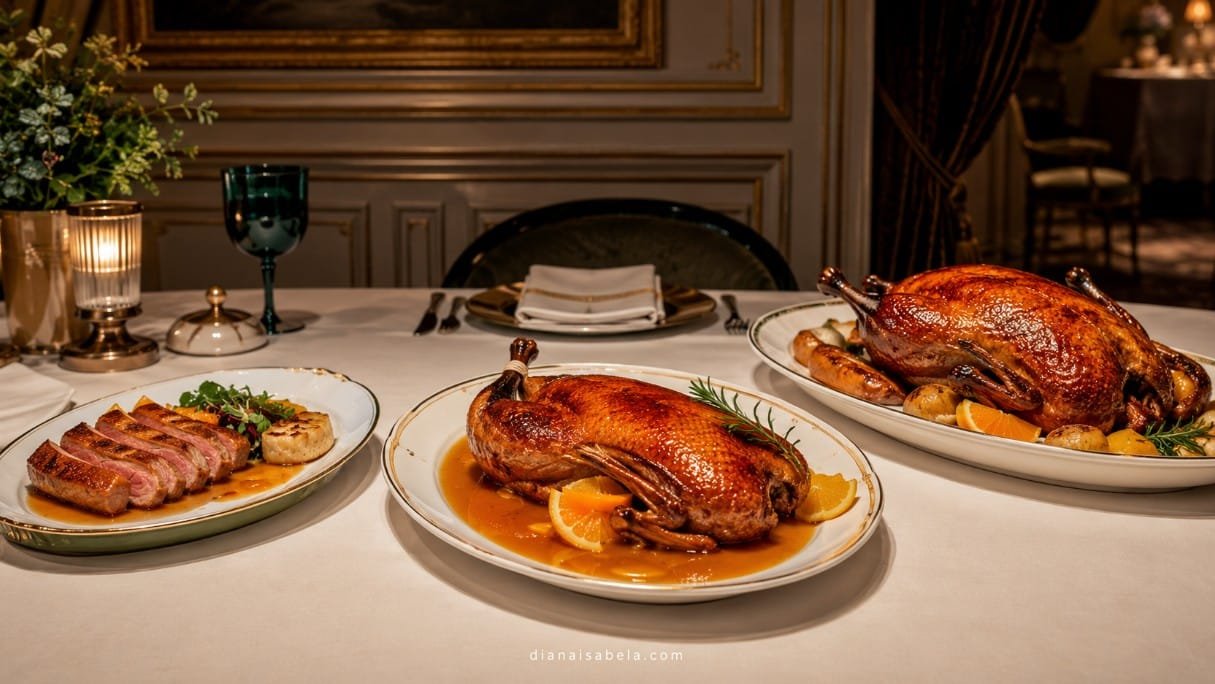
Breast, Half Duck or Whole Duck? The Name Does Not Tell You the Portion
This may be the most useful thing to understand before comparing restaurant prices. “Duck à l’orange” can describe dinners that barely resemble one another in size, texture, preparation time or service.
Then there is confit. Gavroche’s version proves how far the texture can move while the à l’orange idea remains. Confit gives darker meat, softer texture and a deeper cooked character. It asks you to judge something different from the pink center of a breast.
Carpe Diem makes the distinction particularly easy to understand because it puts seared breast and confit leg on the same plate. You can literally taste two interpretations of the same bird without changing chairs.
Which Duck à l’Orange Should You Choose?
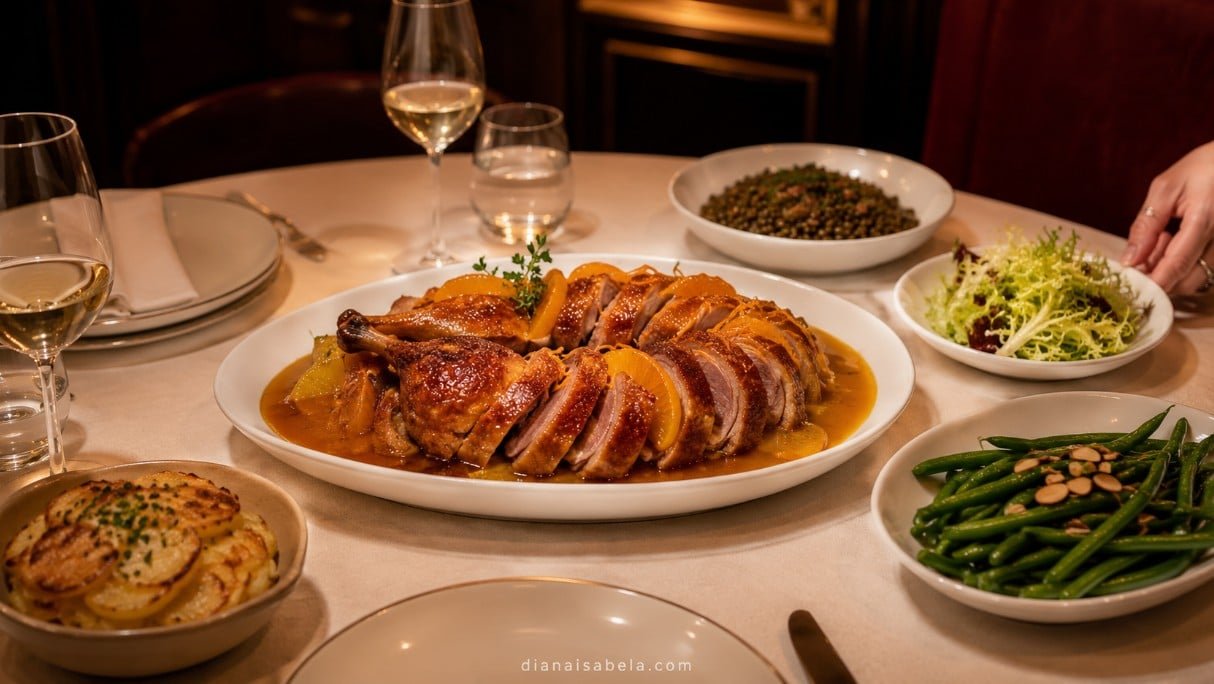
What Should You Eat With Duck à l’Orange?
Duck à l’orange already gives dinner a lot to manage: rich meat, rendered fat, sauce, citrus, acidity, some sweetness and often a fairly substantial portion. I do not think the rest of the plate needs to audition for attention.
A potato that knows when to stop
Pommes purée are almost unfairly good at catching duck sauce. Pommes Anna or crisp roast potatoes are useful when the duck itself is very soft and you want another clean texture. What I would not automatically do is stack cream, butter, gratin and another sweet glaze beside a bird that is already rich enough to have opinions.
Something green
Haricots verts make sense because they interrupt richness without starting another argument. Broccoli and broccolini can do the same. Bitter greens are even more interesting when the sauce leans sweet.
Gavroche’s seared endive is a great example of a vegetable performing a real job. The bitterness is not there because someone owned beautiful tweezers. It pushes back against the duck, foie gras, black garlic and fruit.
Something earthy
Wild rice, lentils, mushrooms, celery root and parsnip all give duck a darker background. Balthazar uses wild rice; Casimir uses mushrooms and potatoes; Carpe Diem uses parsnip purée. Different kitchens, same useful idea: citrus becomes brighter when it has something earthy underneath it.
Something fresh when dinner starts feeling serious
Fennel, chicory or a lightly dressed bitter salad can make the second half of a rich dinner much happier. I would take that over another sugary vegetable glaze almost every time.
I’ve built the complete plate in my guide to what to eat with duck à l’orange. And if this has escalated into an entire French evening — onion soup, steak frites debates, profiteroles and all — my French bistro food guide is the natural next table.
Is Duck à l’Orange Supposed to Be Sweet?
Yes, sweetness can belong in the dish. No, sweetness should not be the only personality in the room.
The old bigarade logic is interesting because caramel and orange meet acid, bitterness and savory duck flavors. Modern restaurants can push the sweet side with orange liqueur, candied orange, mandarin or a lacquer, but the plate needs resistance.
Next Bistro’s sherry vinegar is a perfect example. Orange liqueur tells you where perfume and sweetness can enter; vinegar tells you somebody remembered to leave an exit.
Plan the Dinner: Reservations, Timing and How Long You May Wait
Finding the restaurant is only half of planning duck à l’orange. The other half is making sure the dish will actually be there when you arrive — and understanding that not every duck preparation moves through a restaurant kitchen at the same speed.
When I Would Book Ahead
If duck à l’orange is simply one choice on a large regular menu and you live ten minutes away, normal reservation logic is fine.
If you are driving from Tampa to Palm Harbor, crossing Manhattan, planning an anniversary dinner or arranging the evening specifically around the duck, I would reserve rather than gamble on a walk-in.
A Weekly Special Needs a Different Plan
Pastis Miami currently attaches its duck à l’orange to Monday. Bascom’s brought its Clearwater version back as a July special. Those are completely different forms of availability.
If a menu attaches the duck to a weekday, holiday, month or special event, confirm it before leaving home.
Does Duck à l’Orange Take Longer?
Sometimes, but there is no honest universal waiting time. Breast, confit, half duck and whole roast duck have different preparation systems, and much of the work may happen before you ever sit down.
The useful question for a large roast or sharing bird is: “Does the duck require advance notice or extra preparation time tonight?”
I Would Not Make Closing Time My Duck Experiment
This is preference rather than restaurant law, but if I am ordering a dish that depends on careful skin, resting and a finished sauce, I want a normal dinner reservation rather than arriving when the room is already emotionally putting on its coat.
Dinner is more fun when nobody feels as if they are racing the mop bucket.
What I would ask when calling
For the full restaurant-language version, including doneness, sauce questions and what menu terms actually mean, I’ve made a separate guide to ordering duck à l’orange without guessing.
What Should You Drink With Duck à l’Orange?
This is where I become much more interested than I expected. Duck is rich enough to handle red wine, but orange sauce changes the assignment. Acidity, fruit, sweetness and sometimes bitterness mean the best drink needs to work with the sauce as well as the meat.
I would not automatically order the biggest red bottle on the page just because duck is dark meat. This is one of those dishes where elegance usually wins.
Pinot Noir has acidity to refresh the palate after duck fat without burying the citrus under huge tannins. Burgundy is the obvious French direction, but Oregon and California Pinot can work beautifully too. Carpe Diem’s current Napa menu actually pairs its duck à l’orange with a Carneros Pinot Noir, which makes the idea wonderfully concrete rather than theoretical.
If the duck moves toward black garlic, confit, pepper, char or a deep jus, I would consider a restrained Syrah. The important word is restrained. I do not want the wine entering dinner like a nightclub sound system while the orange sauce is trying to speak.
A fuller Pinot Gris can have enough body for duck while still feeling fresh, and Riesling can be especially useful when the sauce carries noticeable sweetness. High acidity keeps both from feeling sleepy beside the bird.
Bubbles and acidity are excellent tools against rich duck. I especially like this direction when the plate is lighter, more citrus-forward or built around blood orange rather than a dense dark sauce.
Dry sparkling tea, unsweetened black tea, mineral water with a restrained citrus peel or a low-sugar herb-and-citrus spritz can all make more sense than a sweet mocktail. The dish already has orange. Your glass does not need to shout “orange!” back at the plate all evening.
I love a cocktail before duck à l’orange. I am much less convinced that dinner needs to taste like orange while my glass is also screaming orange at me. A dry aperitif, Champagne cocktail or French 75 can be lovely before the meal; Cognac or Armagnac makes more sense to me after it.
I’m giving the drinks their own space in my full guide to wine, cocktails and non-alcoholic drinks with duck à l’orange.
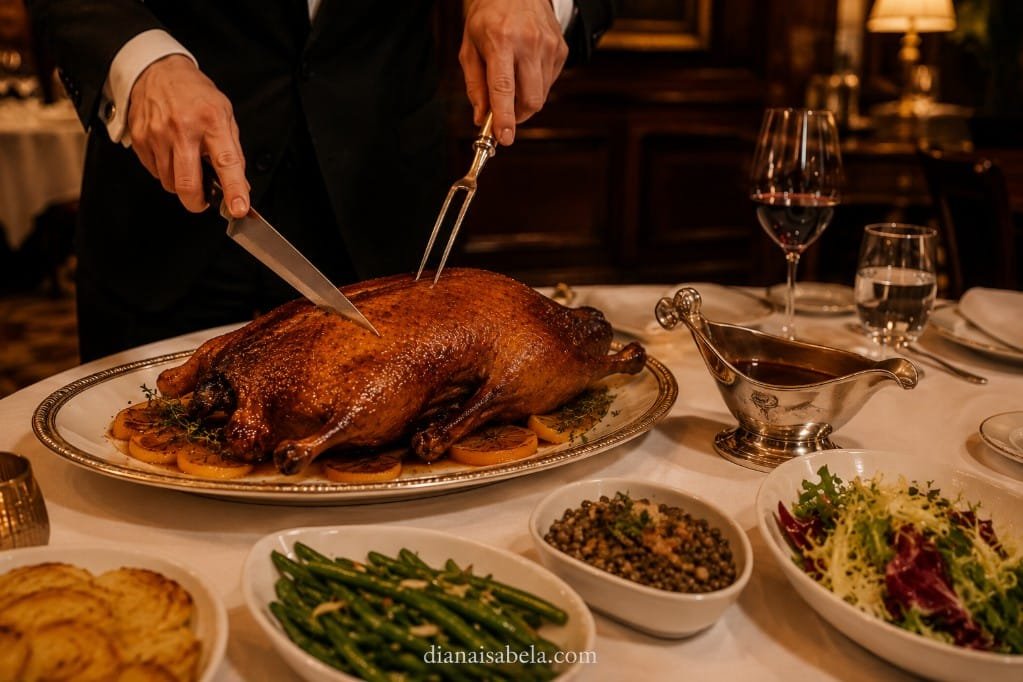
Why a Whole Duck Feels Like a Completely Different Dinner
A whole bird changes the emotional scale of the meal. Duck breast on a plate is an entrée. A burnished whole duck arriving on a platter is an event before anybody picks up a carving knife.
That theatrical quality belongs to the old appeal of restaurant duck. The kitchen has to manage different parts of the bird, resting matters, carving matters, sauce service matters, and suddenly the dining room participates in work that normally disappears behind the pass.
It is also why I dislike simplistic price rankings. A $31 breast and an expensive whole-duck presentation are not competing in the same event. Sometimes the higher price is buying more food. Sometimes it is buying more technique, labor, service and spectacle. Sometimes it is buying theatre you do not actually care about.
All three are legitimate answers. The useful thing is knowing which answer you are paying for.
A Little Duck à l’Orange History Without Turning Dinner Into Homework
Duck with fruit is older than the modern French restaurant, and the origin story is much less tidy than the romantic versions make it sound. The familiar tale that neatly hands orange duck to France through Catherine de’ Medici is often repeated, but culinary history is rarely kind enough to fit into one charming anecdote.
The more useful French thread is canard à la bigarade and the development of bitter-orange sauce within classical cuisine. Over time, French cooking codified the relationship between duck, citrus, caramelized sweetness, acidity and savory stock or jus.
By the twentieth century, duck à l’orange became one of those dishes that could signal proper French restaurant luxury almost immediately. And then success did what success often does: the dish was copied, simplified, sweetened, overused and eventually treated as hopelessly old-fashioned.
Fashion does the same thing. A silhouette is beautiful, then popular, then everywhere, then embarrassing. Years later, somebody younger finds an original piece in an archive and realizes the design was never the problem. The problem was twenty years of terrible copies.
I think duck à l’orange is living through that kind of return.
The interesting restaurants are not pretending it is still 1965. They are looking at the construction — rich duck against bright citrus, sweetness against bitterness, perfume against roast flavor — and deciding which parts deserve to come forward.
Why Modern Chefs Keep Coming Back to Duck and Citrus
Duck gives cooks an unusually large vocabulary. Skin can render until crisp. Breast can stay rosy. Legs can be confited. Bones make stock. Fat can roast vegetables. The meat has enough character to survive sauces that would completely overpower chicken.
Citrus is equally flexible. Sweet orange is only one language. Satsuma can be softer and more aromatic. Blood orange brings darker fruit. Mandarin changes the perfume. Calamansi adds sharpness. Bergamot can smell almost floral.
Once you stop thinking of “orange” as one flavor, the dish stops looking like a fixed old recipe and starts looking like a system.
What I do not want is innovation by noun accumulation: duck, orange, yuzu, truffle, miso, flowers, foam, smoke, gold leaf — please, everybody go home. A plate does not become modern because the menu sentence becomes exhausting.
The modern version I want is the one where every new element has a reason to exist.
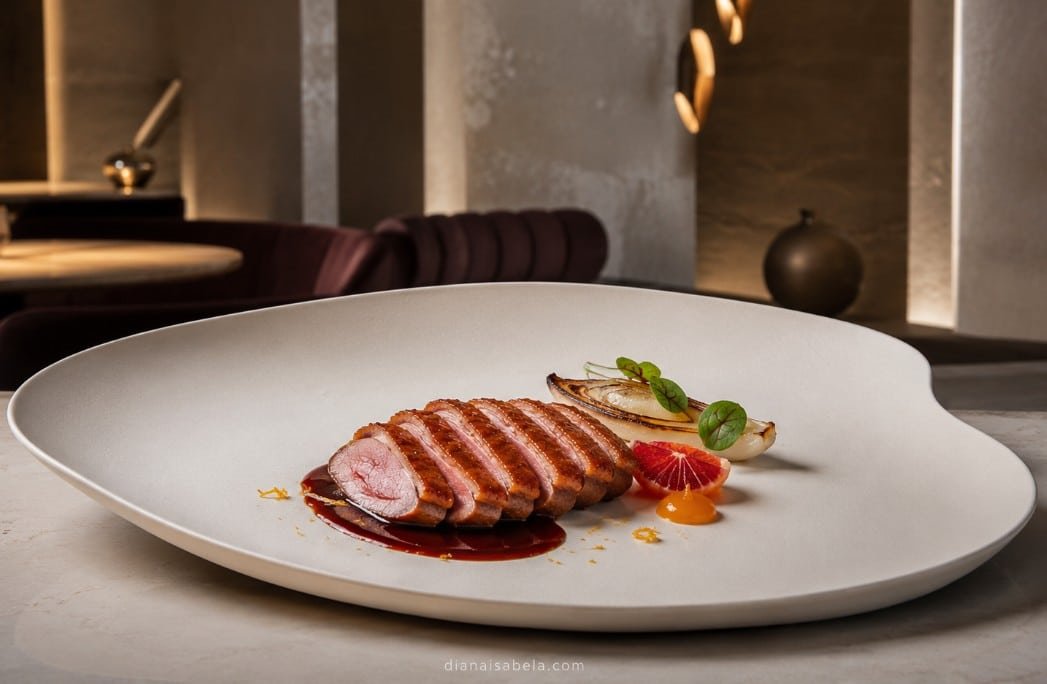
The Versions I’m Most Curious to See Next
Blood orange makes sense if a chef wants deeper fruit and color. Bergamot makes sense when aroma matters. Calamansi makes sense when sharper acidity is needed. Black garlic can create dark sweetness without simply pouring more sugar into the sauce. Bitter endive can become part of the balance rather than a decorative green thing placed on an empty part of the plate.
My favorite reinterpretations have the confidence of good design. You see the new shape immediately, but underneath it you can still recognize the pattern.
That is what makes the current return of duck à l’orange more interesting to me than simple nostalgia. I do not need everybody to recreate one canonical restaurant plate forever. I want chefs to understand why the original contrast worked and then make a decision.
If You Want to Make Duck à l’Orange at Home
A restaurant plate can make this dish look deceptively calm: sliced duck, glossy sauce, citrus, vegetables. At home, several technical clocks start running at the same time.
Skin needs time to render. Breast meat can overcook quickly. A whole bird complicates the relationship between breast and leg. Sauce needs reduction without collapsing into sugar. Citrus zest needs fragrance without too much pith. And just as the duck wants to rest, the sauce decides it would like your full attention.
That is exactly why I like it as a cooking project. It teaches you something. You start paying attention to rendered fat, temperature, acidity and sauce consistency rather than simply following a timer and hoping dinner has good intentions.
I’m keeping the actual kitchen method in my duck à l’orange recipe so this restaurant guide does not become half directory, half cookbook and excellent at neither.
Questions People Ask Before Ordering Duck à l’Orange
Know a Duck I Should Add to This Map?
Restaurant menus move far too quickly for any food guide to pretend it is permanently finished. If there is a French bistro, neighborhood dining room, hotel restaurant, steakhouse or completely unexpected little place in your city making a duck à l’orange worth crossing town for, I genuinely want to know about it.
Send me the restaurant name, city, address, what the menu calls the dish and the current price if you have it. I especially love reader photos that show the things menus cannot explain properly — the actual portion, how crisp the skin looks, whether the sauce covers the bird or sits underneath it, and what the restaurant feels like when the plate arrives.
And if your family makes duck with orange differently, send me that too. Recipes, sauce tricks, old menu memories, strange citrus experiments, restaurant discoveries and corrections are welcome at info@dianaisabela.com.
I want these guides to become a more useful map of the delicious cities we are all exploring together — not one of those restaurant lists that quietly becomes wrong while nobody is looking.
Where can I find duck à l’orange near me?
Start with French brasseries, classic French restaurants and chef-driven bistros. Current examples in this guide include restaurants in Palm Harbor, New York City, Chicago, Miami, Boca Raton, Santa Clarita, Napa and Colleyville. Check the current menu before traveling because the dish can be permanent, seasonal or available only on a certain day.
Where can I find duck à l’orange near Tampa or Clearwater?
Massimo’s Eclectic Fine Dining in Palm Harbor currently lists a partially boneless roasted half Duck á l’Orange for $39. Bascom’s Chop House in Clearwater also featured a roasted half duck à l’orange as a July 2026 anniversary special, so call Bascom’s to confirm whether it is currently available.
Is duck à l’orange still served in restaurants?
Yes. Traditional restaurants still serve roast-duck versions, while modern kitchens use duck breast, confit, sous-vide cooking, satsuma, black garlic, gastriques and other contemporary variations. It is less common than steak frites, but it has not disappeared.
How much does duck à l’orange cost at a restaurant?
The current individual dishes checked for this guide range from roughly the mid-$20s to just above $50. Prices are difficult to compare directly because one restaurant may serve confit leg, another duck breast and another half a roasted duck. Whole birds and sharing preparations can cost considerably more.
Is duck à l’orange supposed to be sweet?
Some sweetness is normal, but a balanced sauce should also have acidity, savory duck flavor and often a slightly bitter citrus edge. Orange should brighten the richness of the duck rather than turn the plate into a sweet glaze with meat underneath.
What does duck à l’orange taste like?
A good version combines rich savory duck, roasted or crisp skin, fragrant citrus, acidity and controlled sweetness. Classical preparations can have a bitter-orange character, while modern versions may use different citrus fruits or more contemporary sauce techniques.
How long does duck à l’orange take at a restaurant?
There is no universal waiting time because duck breast, confit, half duck and whole roast duck are prepared differently and restaurants complete much of the work before service. If you are ordering a whole bird or a limited special, ask whether it requires advance notice or additional preparation time.
Should I make a reservation for duck à l’orange?
Reserve if the dish is the main reason for your visit, especially for weekend dinner, a special occasion or a restaurant that is far from you. If duck à l’orange is listed as a weekly or seasonal special, confirm availability when you book.
What wine goes best with duck à l’orange?
Pinot Noir is a versatile starting point because its acidity works well with rich duck without overpowering citrus. Pinot Gris, Riesling and dry sparkling wine can also work well when the sauce is more aromatic or sweet. Darker savory interpretations can handle a restrained Syrah.
What is the difference between duck à l’orange and orange duck?
Duck à l’orange belongs to a French culinary tradition centered on duck with a balanced orange-based sauce. Orange duck is a broader phrase and may refer to very different preparations, including Asian and Chinese-American sweet-and-sour dishes. Similar names do not mean the plates are interchangeable.