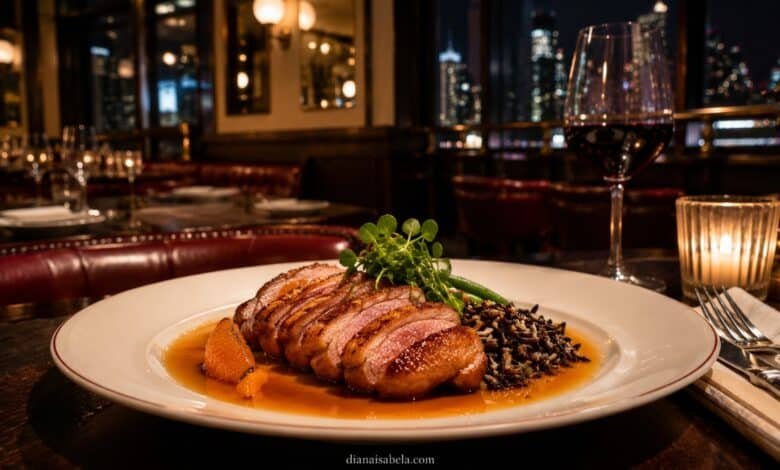
New York has an amusing relationship with French food. Every few years the city decides butter, Burgundy, white jackets and sauces are either hopelessly old-fashioned or the chicest things anybody has ever seen. Duck à l’orange has somehow survived all of those mood swings.
Right now, you can eat three remarkably different versions of the same idea without leaving Manhattan: Balthazar gives you the grand SoHo brasserie interpretation, Château Royale turns the dish into a very New York conversation between old dining-room glamour and modern citrus, and Brasserie Cognac Américain serves duck breast with Grand Marnier sauce and pomme purée in Midtown. Three restaurants. Three neighborhoods. Three completely different reasons to order duck.
That is why I do not want this to become another “Top 10 French restaurants” list assembled from old menu pages. If you are actually looking for duck à l’orange in New York City, the useful questions are more specific: Who is serving it now? Is it breast or a larger roast portion? Is the sauce classical or modern? What does it cost? Which old search results should you stop trusting? And which restaurant suits the evening you actually want?
Where Can You Order Duck à l’Orange in New York City Right Now?
My strongest current Manhattan starting points are Balthazar in SoHo, Château Royale in Greenwich Village and Brasserie Cognac Américain near Bryant Park. All three are useful for different reasons, and I would not flatten them into a fake ranking.
Balthazar is the easiest one to understand if the words “French brasserie” already create a picture in your head. Château Royale is more interesting if you want to see why duck à l’orange is suddenly relevant again rather than merely available. Brasserie Cognac Américain makes sense if you are in Midtown and want a straightforward breast-based plate without turning the search into a downtown expedition.
For the broadest classic-brasserie feeling: duck jus, orange, wild rice and the kind of room that makes French food feel completely at home.
For the most overtly modern revival: old New York French glamour, a current $57 duck entrée and a version built around much more adventurous citrus.
For a clean restaurant answer: duck breast, Grand Marnier sauce and pomme purée, close to Bryant Park and the New York Public Library.
If you are outside New York, I keep the wider restaurant map in my nationwide guide to finding duck à l’orange. This page stays stubbornly New York because New York has enough of its own duck drama already.
Three Duck à l’Orange Plates, Three Completely Different New Yorks
I like that the best current options do not feel interchangeable. If they did, there would be no reason for a guide; I could give you three addresses and go read a novel.
Instead, each restaurant says something different about why this dish survives.
Balthazar says a classic can simply remain a classic. It does not need a comeback speech every time somebody orders it.
Château Royale says an old dish can become exciting again when the chef remembers what made it glamorous and then refuses to treat the recipe like sacred furniture.
Brasserie Cognac Américain says there is still pleasure in writing “duck breast, Grand Marnier sauce, pomme purée” on a menu and letting guests immediately understand the evening.
Those are three very New York attitudes: institution, reinvention and accessibility.
And because I grew up around a chef, I cannot help noticing that they also create three different technical questions. With one, I am watching the relationship between jus and orange. With another, I want to know how multiple citrus flavors affect the richness of the breast. With the third, I am thinking about how Grand Marnier sweetness meets mashed potato and whether the sauce remains bright enough to keep the plate awake.
Balthazar: The Brasserie Version I’d Use as a Reference Point
Diana’s read: If somebody told me they had never eaten duck à l’orange and wanted to understand the dish before exploring more theatrical versions, Balthazar would make sense to me. The ingredient I keep circling is not candied orange. It is duck jus. That tells me the kitchen is starting from the bird and bringing citrus into the sauce, rather than constructing an orange glaze and asking duck to stand underneath it.
Balthazar also solves a practical problem: you do not have to build the entire evening around an obscure weekly special. The current dinner menu lists the dish directly, and the restaurant serves dinner seven nights a week.
That matters in New York. A dish can be wonderful and still be a terrible recommendation if you need to decipher an Instagram Story from last Tuesday to know whether it exists.
Why the wild rice interests me
Wild rice is a darker, nuttier partner than the mashed-potato route. I like that because orange sauce already has sweetness and perfume. A side with earthiness gives the plate somewhere else to go.
It also makes Balthazar’s version useful as a reference point against Brasserie Cognac Américain. One gives you wild rice; the other gives you pomme purée. The duck may carry the same French name, but the supporting textures change the entire experience.
Who I would send here
I would choose Balthazar if you want the room to be part of dinner but do not want the dish itself to become an intellectual exercise. It is also the most convenient of these options if your evening already involves SoHo, Nolita or downtown shopping and you want dinner to feel glamorous without requiring a costume change in a hotel bathroom.
And yes, Balthazar is famous enough that you are paying for some mythology along with the plate. New York restaurants do this constantly. Sometimes the mythology is exhausting. Sometimes the mythology is fun. I think the trick is knowing which part of the bill you are emotionally agreeing to.
Château Royale: The Duck That Explains Why French Food Feels New Again
Diana’s read: This is the restaurant I would choose if the question were not merely “Where can I eat duck à l’orange?” but “Why are people interested in duck à l’orange again?” The whole concept is built around looking at New York French dining history without embalming it. That makes the duck part of a larger idea rather than a random retro entrée.
When Château Royale opened, its duck à l’orange was described as sliced, crispy-skinned duck breast with a sauce using calamansi, bergamot and blood orange. The current official menu still lists Duck à l’Orange, now at $57, although it does not spell out every citrus component on the menu page.
That distinction matters. I do not want to pretend a restaurant dish is chemically frozen in the form critics tasted at opening. Kitchens evolve. Garnishes change. Suppliers change. Sauces get adjusted. A current menu confirms the dish exists; an opening description tells us how the restaurant originally thought about it.
Why those citrus choices are interesting
Classic orange gives sweetness and perfume. Blood orange can make the fruit darker and slightly more dramatic. Calamansi brings sharper acidity and a flavor that can feel somewhere between lime, mandarin and sour orange. Bergamot is almost perfume in fruit form — floral, bitter and intensely aromatic.
Put them together and you have a very different idea from “orange sauce.” You are effectively designing layers of citrus the way a fashion designer might layer several versions of one color instead of using a single flat swatch.
That is the sort of modern cooking I enjoy when it has discipline. More ingredients do not automatically mean more intelligence. But using different citrus varieties because they each solve a different part of the flavor balance? That is a reason.
The restaurant itself matters here
Château Royale is not pretending to be a little provincial French inn. It is very specifically playing with New York’s memory of glamorous French restaurants: the white jackets, the townhouse, the dining room upstairs, the martini cart, the rich sauces, the dishes that once announced an occasion before anyone had opened the wine list.
I love that because New York food is often most interesting when it stops pretending the city has no memory.
There is a strange cultural amnesia that happens in fashion and restaurants. A generation rejects something because it belongs to its parents. Then another generation discovers the original version and realizes the bad copies were the problem, not the idea itself.
Duck à l’orange is having that exact moment.
Brasserie Cognac Américain: The Midtown Version That Makes the Decision Easy
Diana’s read: This is the easiest plate to visualize before you sit down: breast, orange liqueur sauce, mash. I like that clarity. Grand Marnier can give orange sauce both sweetness and aromatic depth, but it also means the kitchen needs enough acid and savory structure to stop the plate from becoming soft-on-soft and sweet-on-rich.
Brasserie Cognac Américain opened in 2026 with chef Michael Lomonaco and a menu deliberately built around recognizable French brasserie dishes through a New York-American lens. Duck à l’orange sits beside onion soup, escargots, steak frites and beef bourguignon rather than appearing as one eccentric historical reference.
That changes the mood of ordering it.
At Château Royale, I would probably think about the history and reinterpretation before the plate arrived because the restaurant invites that kind of attention. At Cognac Américain, I would be more inclined to order the duck because it sounds good with mashed potatoes after a long day in Midtown.
Both are valid reasons to eat dinner.
The Grand Marnier question
Grand Marnier is orange liqueur, which means the sauce potentially gains sweetness, alcohol-derived aroma and a deeper candied-orange character. That can be gorgeous with duck because fat carries aroma so well.
It can also go wrong if the sauce becomes heavy and sweet while the pomme purée adds even more softness.
This is where I pay attention to the first few bites. Does acid appear somewhere? Does the duck skin give enough texture? Does the sauce taste savory underneath the orange?
A dish can look extremely classical and still fail because all of its textures and flavors move in one direction.
So Which New York Duck à l’Orange Should You Choose?
I would not choose by “best restaurant” first. I would choose by the dinner I want.
If I had friends visiting New York and only one of them cared obsessively about duck à l’orange, I would not force the whole table into an elaborate comparative tasting mission. I would look at what else everyone wants from the night.
Are we shopping downtown and want to stay in SoHo? Balthazar.
Do we want the restaurant itself to feel like the reason we went out? Château Royale.
Are we coming from the library, Grand Central, Midtown offices or a Broadway-adjacent afternoon and want dinner to be elegant but logistically painless? Cognac Américain.
New York becomes much easier when you stop pretending every dinner needs to be the objectively “best” dinner and start asking whether it is the right dinner for that particular night.
A Neighborhood Strategy Is More Useful Than Chasing One Plate Across Manhattan
One of the least romantic things about restaurant advice is also one of the most important: geography.
New Yorkers already understand this instinctively. Visitors often do not.
A restaurant that looks eight miles away on a map can turn a beautiful evening into an accidental transit project. If duck à l’orange is only one part of your plan, choose the neighborhood first.
Balthazar makes sense if your day already lives downtown. Build the evening around walking, shopping, galleries or a later drink rather than commuting elsewhere just to prove commitment to poultry.
Château Royale is the stronger destination restaurant of the three. This is the one I would choose when the room, drinks and whole sense of occasion matter as much as the duck.
Cognac Américain is the practical choice around Bryant Park, Fifth Avenue and the New York Public Library. Useful before or after a Midtown event without adding an entire downtown chapter to the evening.
There is a glamorous version of New York where everyone crosses three neighborhoods effortlessly in heels, appears at every reservation exactly on time and never gets trapped in a subway car with no air conditioning.
I enjoy that version in films.
For actual dinner, I plan geographically.
Some New York Duck à l’Orange Search Results Are Already Out of Date
This is the part of local restaurant research that irritates me enough to become useful.
Old menus do not disappear politely when restaurants close. Old articles continue ranking. Reservation platforms preserve menu language. Search snippets can make a restaurant look current long after the dining room has changed concept, changed chef or stopped existing.
For duck à l’orange in New York, that matters because several historically relevant names can still surface.
How Much Does Duck à l’Orange Cost in New York City?
Among the three strongest current Manhattan options I checked, the dish sits in the low-to-high $40s and upper $50s: $43 at Brasserie Cognac Américain, $49 at Balthazar and $57 at Château Royale.
I would resist turning those three numbers into a fake citywide average. The preparations and restaurants are too different.
A $43 breast with pomme purée is not automatically “better value” than a $57 plate in a destination restaurant. It may be a better value for you, which is a much more useful distinction.
New York pricing is partly about food and partly about the room. SoHo institution pricing, Greenwich Village destination pricing and Midtown brasserie pricing reflect different experiences even before the sauce touches the plate.
Then remember the rest of dinner exists.
An appetizer, side, wine, cocktail, dessert, tax and gratuity can turn a $43 entrée into a dramatically different evening. That is not a reason not to go. It is a reason not to pretend entrée price is the entire budget.
What Should a Good New York Duck à l’Orange Taste Like?
If the orange is the only thing you can describe afterward, I think something has gone wrong.
Duck should taste rich, savory and distinctly duck-like. Properly rendered skin should bring crispness and browned depth. Breast meat, when served pink, should stay juicy. A larger roast portion may offer several textures at once. Confit would create yet another experience.
The orange sauce then needs to behave more like contrast than decoration.
Acid cuts the fat. Citrus oils give perfume. Sweetness rounds sharp edges. Bitterness can stop the fruit from becoming simplistic. Jus or stock makes the sauce belong to the bird.
That balance is why I am not especially interested in arguing whether the “correct” duck à l’orange should be exactly this sweet or exactly that bitter. Restaurants work with different citrus, different reductions and different cuts of duck.
The more useful test is whether every bite invites another one.
Rich food fails when the first bite is exciting and the fourth bite feels like homework.
If you want the flavor anatomy before choosing which style sounds right for you, I have a separate guide to what duck à l’orange should taste like.
The Little Things I’d Watch Once the Plate Arrives
I cannot tell you from a menu whether your particular duck breast will be perfectly rendered at 8:17 p.m. on a Friday. Anyone claiming that from a laptop is writing fiction.
But I can tell you what I pay attention to once the dish arrives.
First: the skin
Duck skin needs actual rendering, not merely browning on the surface. The annoying thing is that a plate can photograph beautifully while hiding a thick soft layer of unrendered fat underneath.
I want crispness on top and a controlled fat layer beneath.
Then the meat
For breast served pink, dryness is an obvious warning. For roast duck, I care about whether the different parts retain texture rather than becoming uniformly tough. For confit, tenderness matters more than rosy color.
Then the sauce
I want orange aroma without neon-orange sweetness. I want gloss without syrup. I want enough savory character that the sauce makes sense with duck rather than merely happening to be orange-colored.
Then everything else
Are the sides doing something useful?
Wild rice can make fruit taste brighter. Pomme purée can make sauce feel more luxurious. Bitter vegetables can break up richness. An acidic salad can reset the palate.
Every component does not need to be flashy. In fact, dinner becomes exhausting when every garnish arrives demanding its own review.
I have the full diagnostic version in my guide to judging a good duck à l’orange.
Do You Need a Reservation for Duck à l’Orange in NYC?
If the duck is the main reason you are going, I would reserve.
That is not because every restaurant requires impossible planning. It is because New York adds unnecessary variables to an already specific craving: popular dining rooms, weekend demand, theater schedules, weather, traffic, tourists, late meetings, special menus and the mysterious citywide phenomenon where every human being suddenly wants a 7:30 p.m. reservation on the same Thursday.
Will the duck take longer to cook?
There is no honest universal restaurant wait time.
A breast can be integrated into regular service. A confit leg may have been through hours of cooking before dinner begins and require relatively little finishing. A half duck or whole bird can work completely differently depending on the kitchen.
If a restaurant offers a large roast or whole-duck preparation, the useful question is: “Does the duck need to be ordered in advance?”
For the three main current Manhattan dishes here, I would not invent a special cooking-time estimate that the restaurants themselves do not provide.
Precision is useful only when it is real.
What Would I Drink With Duck à l’Orange in New York?
New York makes this particularly fun because the restaurant itself can change the answer.
A Balthazar dinner practically begs you to look at Burgundy. Château Royale has a whole theatrical drinks personality. Brasserie Cognac Américain currently lists Burgundy Pinot Noir by the glass alongside Champagne, white Burgundy and other French-friendly choices.
I would start with the sauce, not with a generic rule that dark meat equals red wine.
My safest starting point. Enough acidity for duck fat, enough red fruit and earthiness to work with roast flavors, and usually less tannic aggression than Cabernet.
A very New York answer and not merely a glamorous one. Acidity and bubbles are excellent against rich duck, particularly when the citrus treatment feels bright rather than dark and sticky.
Worth considering when orange sweetness is pronounced. High acidity and aromatic fruit can match citrus more elegantly than forcing a heavy red into the conversation.
I love the idea of Château Royale’s martini ritual before dinner. With the duck itself, however, I would usually move toward wine unless I specifically wanted the cocktail to remain part of the experience.
I have a much fuller pairing guide — including cocktails and genuinely useful non-alcoholic options — in what to drink with duck à l’orange.
How I’d Build the Rest of the Dinner
This is where restraint becomes sexy.
Duck à l’orange is not a shy entrée. It already brings richness, fat, fruit, sauce and usually a fairly serious portion. I do not need onion soup, foie gras, gratin, duck, cheese and chocolate all competing to see which one can make me cancel breakfast.
If I were at Balthazar
I would probably start lighter than my instincts want me to. Oysters or a crisp salad make more sense to me before duck than stacking another buttery starter underneath it.
The wild rice already gives the main plate enough substance, so I would not automatically add pommes purée simply because I am in a French restaurant and potatoes look emotionally available.
If I were at Château Royale
This is where discipline becomes much harder because the menu is full of things that sound like a plot against moderation: foie gras, bone marrow, caviar, langoustine, beurre blanc.
I would choose one indulgence, not audition the whole dining room.
The duck already belongs to the richer side of the menu. A lighter first course or seafood starter creates better rhythm than turning every course into an arms race.
If I were at Cognac Américain
The pomme purée is already on the duck plate, so I would think green before starch. A salad or vegetable starter keeps the dinner from becoming too soft and beige — a sentence that applies equally well to food and interior design.
Dessert?
Yes, if I still want it.
I refuse the idea that elegant dining requires ordering dessert when your body has clearly filed a formal complaint.
If dinner has been balanced well, something light, bitter, coffee-forward or fruit-driven can make sense. If I have spent two hours eating cream and duck fat, I am perfectly comfortable ending with espresso and dignity.
For the broader logic of navigating this kind of menu, my existing French bistro food guide is the more expansive version of this conversation.
Why Duck à l’Orange Suddenly Looks So New York Again
This is the part I find most interesting because it has almost nothing to do with orange.
New York’s French restaurant scene is having another cultural turn. For years, a certain kind of status dining leaned heavily Italian: pasta, red sauce reinterpreted luxuriously, Italian wine, the theatrical casualness of a room where everybody appeared to have accidentally become beautiful over rigatoni.
Now French food feels culturally available again.
Not “French” as a strict museum reconstruction. French as an aesthetic and technical language: sauces, brasserie rooms, butter, Champagne, old dishes, martinis, white jackets, roast chicken, offal, soufflés, plush dining rooms and the confidence to serve something people used to call dated.
Château Royale is almost comically perfect for this moment because its entire concept is interested in New York’s vanished French restaurants. It borrows not just French culinary memory but specifically New York French culinary memory.
That distinction matters.
New York has never simply imported Paris. It metabolizes everything. French food here becomes French-American, French-New York, power-lunch French, downtown French, theatre-district French, French food filtered through immigrant chefs, local produce, Wall Street money, fashion people, artists and diners who think nothing of eating Japanese breakfast and steak au poivre on the same day.
Duck à l’orange fits this moment because it carries enough history to be recognizable but enough technical structure to survive reinvention.
The old version had baggage
For many diners, duck à l’orange eventually became shorthand for a certain kind of heavy old restaurant cooking: sticky sauce, overly sweet fruit, formal rooms, dishes that seemed designed for an era when nobody feared butter and everybody had apparently agreed never to discuss cholesterol at dinner.
That caricature contains just enough truth to be dangerous.
Bad versions did become too sweet. Old restaurant cooking did sometimes value richness simply because richness signaled luxury. A dish copied often enough can lose the exact balance that made the original convincing.
But that is not a reason to abandon the entire idea.
The new version understands contrast better
Look at Château Royale’s citrus choices. Calamansi brings sharpness. Bergamot brings bitterness and perfume. Blood orange brings fruit and color. That is not simply “more orange.” It is a chef taking apart what orange sauce is supposed to accomplish and reconstructing the effect with more precise tools.
That kind of cooking feels modern because it makes the original logic clearer rather than hiding it.
It reminds me of fashion archives. The most boring revival copies the visible thing: same hem, same buttons, same color, same styling.
The interesting revival asks why the silhouette worked and then builds something new from the proportion.
Food deserves the same intelligence.
And sometimes the classic does not need fixing
This is why Balthazar belongs in the same story.
Not every old dish needs a TED Talk.
Sometimes a brasserie can simply serve duck with orange, wild rice and jus because people still enjoy duck with orange, wild rice and jus.
I love experimentation. I also love cooks with enough confidence to leave a good idea alone.
Is NYC the Best Place in America for Duck à l’Orange?
If you mean “Does New York currently have the most interesting concentration of different restaurant contexts for the dish?” I think it has a very strong argument.
You can compare an iconic brasserie, a deliberately nostalgic-modern French destination and a new Midtown French-American restaurant without leaving Manhattan.
That gives New York something more interesting than quantity.
It gives you contrast.
But I would not declare the entire American conversation finished. Tampa Bay has Massimo’s serving a partially boneless roasted half duck for $39. Chicago has Gavroche doing confit with satsuma and black garlic. Napa has breast and confit together. South Florida has multiple forms of the dish.
New York is not the only city cooking duck à l’orange.
It may simply be the easiest city in which to understand why the dish has more than one life.
What I Would Do If All Three Restaurants Were Fully Booked
I would not panic-order “orange duck” from the first delivery result and pretend the evening had remained conceptually intact.
First, I would check whether any current French special has appeared elsewhere. Duck à l’orange moves on and off prix-fixe menus, restaurant-week menus and seasonal specials frequently enough that another good option may exist that week.
Second, I would decide whether I care more about duck or more about the French dinner.
If I care about duck, I might choose another excellent duck preparation — confit, magret, roast breast — and save à l’orange for another evening.
If I care about the French dinner, I would go to a good brasserie and order something it actually cooks every night rather than forcing a restaurant to satisfy a dish fantasy it never promised.
Third, I would make the reservation for the following week.
New York is one of the few places where postponing dinner by seven days does not constitute culinary tragedy.
Questions About Finding Duck à l’Orange in New York City
Did I Miss a New York Duck Worth Crossing Town For?
New York menus change almost faster than I can keep restaurant tabs open. If you find a duck à l’orange in Manhattan, Brooklyn, Queens, the Bronx or Staten Island that belongs in this guide, send it to me.
I am especially interested in places where you have actually seen the current menu or ordered the dish recently. Send the restaurant name, neighborhood, price, what kind of duck it was, and anything you noticed about the sauce. Was it classic orange? Bitter? Very sweet? Blood orange? Grand Marnier? Was the skin genuinely crisp or merely photogenic?
Reader photographs of both the dish and the restaurant are welcome too. And if you know a tiny French place that the internet keeps overlooking, those are exactly the tips I love.
Write to me at info@dianaisabela.com. The point is not to build a frozen “best of New York” list. I want this to become a living little map of the city’s duck obsession, improved by people who actually care enough to notice what is on the plate.
Where can I get duck à l’orange in New York City?
Current Manhattan options include Balthazar in SoHo, Château Royale in Greenwich Village and Brasserie Cognac Américain near Bryant Park. Menus can change, so check the current dinner menu or call before making a special trip for the duck.
How much does duck à l’orange cost in NYC?
Among the current Manhattan options checked for this guide, Brasserie Cognac Américain lists its duck breast à l’orange for $43, Balthazar lists Duck À L’Orange for $49, and Château Royale lists the dish for $57. These are different preparations and restaurant experiences, so price alone does not make them directly comparable.
Which NYC restaurant is best for classic duck à l’orange?
Balthazar is my clearest starting point if you want a recognizable French-brasserie interpretation. Its current version is served with wild rice, orange segments, candied orange and duck jus, which keeps the sauce connected to the savory duck rather than treating it as a simple sweet glaze.
Where can I find a modern duck à l’orange in New York?
Château Royale is the most interesting modern-revival option in this guide. Its current dinner menu still lists Duck à l’Orange, and the version introduced when the restaurant opened used calamansi, bergamot and blood orange to reinterpret the classic citrus profile.
Does Brasserie Cognac Américain serve duck à l’orange?
Yes. Its June 2026 menu lists Duck à l’Orange for $43, prepared with duck breast, Grand Marnier sauce and pomme purée. The restaurant is located at 462 Fifth Avenue near Bryant Park.
Do I need a reservation for duck à l’orange in NYC?
I recommend reserving if the dish is the main reason for your dinner, particularly for popular weekend times. For seasonal or special-menu versions, confirm that the duck is available when you book because old menus and search results can remain online after a dish changes.
How long does duck à l’orange take at a New York restaurant?
There is no universal wait time. Duck breast, confit, half duck and whole roast duck use different preparation systems, and restaurants complete much of the cooking work before service. If a restaurant offers a whole or large roast duck, ask whether it requires advance notice.
What wine should I order with duck à l’orange?
Pinot Noir is a versatile starting point because its acidity works well with rich duck without overwhelming citrus. Champagne can be excellent with brighter versions, while Riesling or another aromatic high-acid white can make sense when the sauce has noticeable sweetness.
Is Le Coucou currently serving duck à l’orange?
The current official Le Coucou menu checked for this guide lists a summer duck-breast preparation with cherries and almonds rather than duck à l’orange. Older menu databases may show an à l’orange dish, which is why checking the restaurant’s current menu matters.
Is duck à l’orange the same as orange duck?
No. Duck à l’orange belongs to a French culinary tradition centered on rich duck and a balanced orange-based sauce. Orange duck is a broader term that can describe very different dishes, including Asian and Chinese-American sweet-and-sour preparations.