Los Cuatro Golpes sounds wonderfully straightforward. If Los Tres Golpes has three hits, surely the next plate simply adds one more and everyone goes home knowing exactly what happened.
Dominican breakfast, being far more interesting than a spreadsheet, does not cooperate quite that neatly.
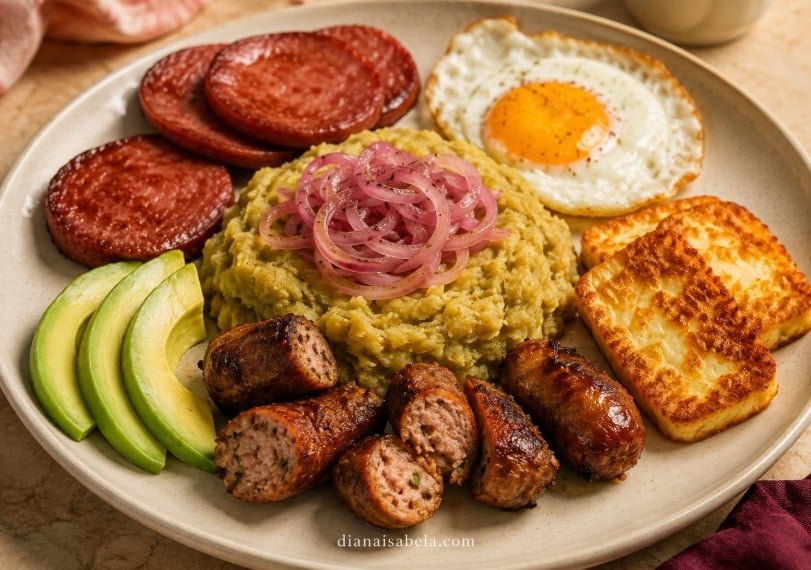
The foundation is clear. Mangú sits in the center or alongside the plate, usually with those bright vinegary red onions that somehow manage to keep fried salami, fried cheese and fried egg from becoming too much of a good thing. Those three foods are the classic tres golpes: Dominican salami, queso frito and egg.
The fourth golpe is where the terminology gets interesting. In some Dominican food traditions and modern restaurant menus, longaniza is added as the fourth fried component. In other descriptions, avocado is the extra that turns three hits into four. You can therefore order something called Los Cuatro Golpes in two places and receive plates that are cousins rather than identical twins.
For this longaniza guide, that ambiguity is not an inconvenience to hide. It is exactly the useful thing to know. If a menu says “Cuatro Golpes,” the name alone may not tell you whether your fourth addition is a crisp piece of aromatic Dominican sausage or several cool slices of avocado. Ask what the restaurant means. Breakfast will survive the question.
Los Cuatro Golpes is a variation of the Dominican breakfast Mangú con Los Tres Golpes. The classic three golpes are fried Dominican salami, queso frito and fried egg served with mangú. The fourth component is not completely standardized: many restaurant versions add Dominican longaniza as the fourth golpe, while some traditions use avocado. Check the menu or ask the restaurant what its “fourth hit” includes.
First, keep the original three hits straight
Before adding anything, the classic formula needs to be clear. Mangú is the base: green plantains boiled and mashed until soft, typically served with Dominican-style red onions. Beside it come three fried foods with completely different personalities.
The classic foundation
The salami, cheese and egg are the three golpes. Mangú holds the breakfast together but is not itself counted as one of the hits.
If you want the original plate explained before adding a fourth component, start with my complete guide to Los Tres Golpes.
The fourth golpe does not have one universally agreed identity
This is the part worth remembering. Los Tres Golpes has a much clearer standard formula than Los Cuatro Golpes. Once a fourth component is added, usage starts to vary.
Longaniza
Many Dominican breakfast menus treat fried longaniza as the missing fourth hit. The plate then includes both Dominican salami and longaniza alongside queso frito, egg and mangú.
This version makes intuitive sense because the fourth item behaves like another golpe: it is another substantial fried component with its own texture and flavor.
Avocado
Some Dominican descriptions instead call avocado the fourth golpe. In that interpretation, the three fried components stay exactly the same and avocado becomes the additional element.
This produces a very different plate: creamier and fresher rather than more meaty.
Neither variation gives us permission to declare every other use “wrong.” Food names often become flexible when they leave the original household and move through cafeterias, restaurants, neighborhoods and generations.
The practical lesson is easier: when you see Cuatro Golpes on a menu, read the ingredients rather than assuming the fourth item.
When longaniza is the fourth hit, breakfast becomes considerably louder
Adding longaniza to the classic three gives you two completely different Dominican sausage textures on the same plate.
Fried salami comes in dense rounds with broad browned faces. Longaniza has a casing and seasoned meat filling, usually bringing more obvious garlic, herb and pork character. Even before the egg and cheese enter the discussion, the two sausages are already doing different jobs.
What the longaniza adds
More aromatic seasoning. Dominican longaniza commonly brings garlic, oregano, pepper and citrus-seasoned pork flavor.
A different bite. Instead of another dense salami slice, you get casing, rendered edges and a juicier sausage interior.
Another fried texture. This makes the plate more indulgent, which also makes mangú and acidic onions even more useful.
This version is particularly interesting because longaniza does not replace salami. Both appear. You can therefore compare them within the same breakfast rather than treating them as interchangeable Dominican sausages.
If you want to understand why they behave so differently on the fork, see my longaniza vs Dominican salami comparison.
If avocado is the fourth hit, the plate moves in the opposite direction
Longaniza makes Los Cuatro Golpes richer. Avocado makes it calmer.
That may sound obvious, but it completely changes the logic of the breakfast. The classic plate already contains fried meat, fried cheese and fried egg. Adding another sausage increases salt, pork fat, browning and chew. Adding avocado contributes none of those things.
This may be why both versions feel plausible despite being so different. They solve opposite desires. One says, “I would like another fried Dominican sausage, please.” The other looks at everything already in the skillet and quietly brings avocado.
I respect both instincts.
Los Tres Golpes vs Los Cuatro Golpes is not just a question of quantity
If longaniza is the fourth component, the change is substantial enough that I would think about the plates differently rather than simply calling one a larger order.
Los Tres Golpes
Core: mangú + salami + queso frito + fried egg.
The breakfast already has one meat, one cheese and one egg. The textures remain varied without doubling the sausage component.
Cuatro Golpes with longaniza
Core: mangú + salami + queso frito + fried egg + longaniza.
The addition gives you two Dominican sausage styles and substantially increases the savory, fried character of the plate.
If the fourth golpe is avocado instead, the comparison changes completely: the classic three stay untouched, but the plate gets a fresh creamy addition rather than another fried component.
So “four is bigger than three” is technically true and culinarily unhelpful. The identity of number four matters.
Longaniza earns its place because it does not taste like salami
A plate with two sausages sounds redundant until you actually look at the textures. Dominican salami and Dominican longaniza share porky, savory territory, but their structures are very different.
This is why longaniza with mangú works even outside Cuatro Golpes. The soft plantain gives the aromatic sausage a mild background without hiding its casing or seasoning. I explore that specific relationship in my longaniza frita with mangú guide.
The longaniza version has five textures competing for four inches of plate
That sounds like criticism. It is mostly admiration.
Think about what happens when the full longaniza version is fresh. Mangú is soft and warm. Salami is dense and browned. Queso frito is firm with a golden exterior. The egg can be crisp around the edge but soft at the yolk. Longaniza adds casing and a juicy meat filling.
Instead of putting everything on one fork, rotate the plate
Each combination makes another component easier to notice. A fork loaded with all five foods may be impressive, but eventually breakfast becomes one highly committed flavor rather than several distinct ones.
The onions matter more as the plate grows. Acid is already valuable with Los Tres Golpes; once longaniza joins salami, cheese and egg, it becomes almost editorial supervision.
Before ordering Cuatro Golpes, ask what number four is
This is one of those rare restaurant questions that can genuinely change the entire meal.
I would also check whether the mangú comes with onions and whether avocado is already included separately. A restaurant can easily serve a plate containing both longaniza and avocado while still using its own naming convention.
The name gives you a clue. The ingredient list gives you breakfast.
If longaniza is the fourth hit, do not make every bite a five-car pileup
I would taste the longaniza and salami separately first. This is especially useful if Dominican sausage traditions are new to you because having both on the same plate gives you an unusually good side-by-side comparison.
The name becomes much easier once you stop demanding one universal plate
For the longaniza lover, the version with salami, queso frito, egg and longaniza is arguably the more interesting breakfast because it puts two Dominican sausage traditions directly beside each other. For someone already looking at all that fried food and wondering who invited another sausage, avocado may feel like inspired diplomacy.
If your goal is specifically to find the longaniza itself rather than chase breakfast terminology, continue with my guide to finding Dominican longaniza across the United States.
What is the fourth golpe where you grew up?
This is exactly the kind of food detail I love because one tiny phrase can reveal a whole family or neighborhood tradition. Maybe Cuatro Golpes has always meant longaniza in your house. Maybe avocado is obviously number four and you cannot believe we are discussing it. Maybe your favorite cafeteria serves both, or there is a completely different breakfast variation everyone in your neighborhood recognizes immediately.
If you have a Cuatro Golpes story, family breakfast tradition, menu photo, longaniza variation, favorite Dominican cafeteria or a plate I should know about, write to me at info@dianaisabela.com. I would genuinely love to hear how your version is built. These little differences are where food becomes much more interesting than a fixed definition — and together we can make this Dominican breakfast guide richer, clearer and considerably more delicious.
What is Los Cuatro Golpes?
Los Cuatro Golpes is a variation of the classic Dominican breakfast Mangú con Los Tres Golpes. The traditional three golpes are fried Dominican salami, queso frito and fried egg. A fourth component is added, but its identity can vary.
What is the fourth golpe in Los Cuatro Golpes?
There is not one completely universal answer. Many Dominican restaurant versions use fried longaniza as the fourth golpe, while some Dominican food traditions refer to avocado as the fourth addition. Check the specific menu to see which version is being served.
Is longaniza part of Los Cuatro Golpes?
It can be. A common version adds Dominican longaniza to the traditional combination of salami, queso frito and fried egg, so the breakfast contains both salami and longaniza with mangú.
Can avocado be the fourth golpe?
Yes. Some Dominican sources use Los Cuatro Golpes for the classic three fried components served with mangú plus avocado. This is why the name alone does not always identify the fourth ingredient.
What is the difference between Los Tres Golpes and Los Cuatro Golpes?
Los Tres Golpes has a clearer traditional formula: Dominican salami, queso frito and fried egg served with mangú. Los Cuatro Golpes adds another component, often longaniza or sometimes avocado depending on the restaurant or tradition.
Does Los Cuatro Golpes include both salami and longaniza?
When longaniza is being used as the fourth golpe, yes. In that version, longaniza is added to the traditional salami rather than replacing it. Because restaurant formulas vary, check the menu before ordering if you specifically want both sausages.
Is mangú one of the four golpes?
No. Mangú is the mashed green plantain base served with the golpes. The numbered hits refer to the accompaniments served with it rather than to the mangú itself.
What should I ask when ordering Los Cuatro Golpes?
Ask what the restaurant includes as its fourth golpe. If you are specifically looking for Dominican longaniza, ask whether the plate contains longaniza and whether it is served in addition to salami.
What does longaniza add to a Cuatro Golpes breakfast?
Longaniza adds a different sausage texture and seasoning profile from Dominican salami. Its casing, seasoned pork filling and browned edges create more aromatic flavor and a distinct bite beside the softer mangú.