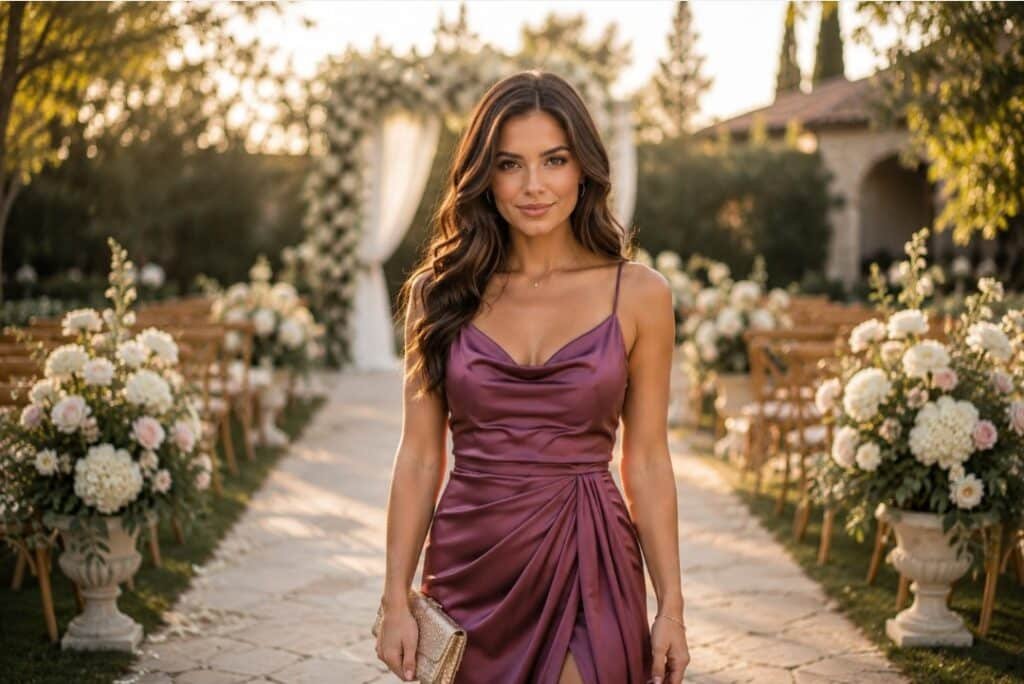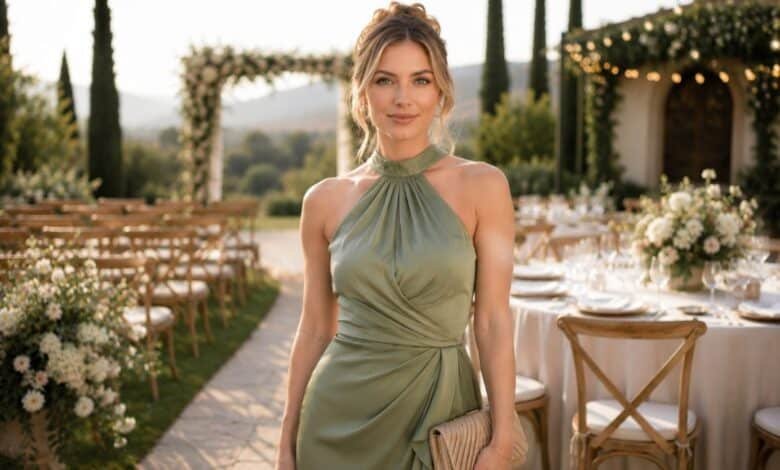
The venue is the first clue. The dress code is only half the story.
Choosing a wedding guest dress by venue is not about memorizing fashion rules like a panicked bridesmaid before final exams. It is about reading the location: the ground, the light, the formality, the weather, the ceremony setting, and the kind of photos the couple will probably take. The same dress can look perfect in a hotel ballroom, awkward in a church, chaotic on a windy rooftop, and completely unserious on a gravel vineyard path.
Why venue-first dressing works
A wedding invitation may say “semi-formal,” “cocktail,” or nothing helpful at all — a personal favorite category of chaos. But the venue tells you what the outfit needs to survive. A beach ceremony gives you sand and sun. A church gives you formality and coverage questions. A barn gives you gravel, wood floors, and rustic texture. A rooftop gives you wind and skyline photos. City hall gives you architecture, daytime polish, and a very specific “not bridal, not office” line.
This is why the best wedding guest outfits are not chosen in isolation. They are chosen in context. You are not just wearing a dress; you are wearing it on grass, stone steps, a terrace, a chapel aisle, a vineyard path, a hotel rooftop, or a courthouse hallway. The venue is not background decoration. It is part of the outfit.
The five questions to ask before choosing the dress
Before you think about color or accessories, solve the practical puzzle. These five questions will save you from almost every wedding guest outfit mistake.
What will I be walking on?
Grass, gravel, sand, stairs, stone, decking, carpet, and city sidewalks all change the shoe and hemline. The ground is never a minor detail.
Will the ceremony require more coverage?
Churches, chapels, traditional venues, and family-heavy ceremonies may call for covered shoulders, a higher neckline, or a layer.
Is the wedding outdoors, indoors, or both?
A garden ceremony followed by indoor dinner needs a dress that handles sunlight and still feels polished at the reception.
What happens after sunset?
Vineyards, rooftops, beaches, and countryside venues can cool down fast. A beautiful layer can be the difference between chic and shivering.
How formal is the setting visually?
Marble, chandeliers, city architecture, rustic wood, sand, or backyard string lights all send different style signals.
Could this look too bridal in photos?
White, ivory, cream, pale champagne, and some silver satin can look innocent at home and bridal in bright venue light.
Dress code tells you the level. Venue tells you the execution.
A cocktail dress is not one universal object. Cocktail for a rooftop can be sleek satin and city heels. Cocktail for a garden can be a romantic midi and block heels. Cocktail for a church might need a wrap or sleeves. Cocktail for a beach wedding might need a softer fabric and sandals that do not look ridiculous near sand.
Venue-by-venue: what changes the outfit
Here is the practical version. Not “wear a dress.” Obviously. The real question is which dress, with which shoes, and what detail will make it feel right for that location.
Garden weddings love romantic dresses, soft color, and shoes that can handle grass. Florals, chiffon, crepe, wrap midis, and tea-length silhouettes work beautifully. Avoid stilettos that sink and prints that fight the flowers. For deeper styling, use the full garden wedding guest dresses guide.
Beach weddings need breathable fabrics, movement, and shoes that make sense near sand. Think airy but polished, not casual vacation cover-up. Avoid heavy gowns, stiff tailoring, and heels that belong on hotel marble. More detail: beach wedding guest dresses.
Church ceremonies usually call for more respectful styling: covered shoulders, tasteful necklines, elegant midis, and layers that do not feel like an afterthought. The dress can still be beautiful, just not overly bare. Full guide: church wedding guest dresses.
Backyard weddings are relaxed, but not careless. Choose polished comfort: floral midis, soft wrap dresses, dressy sandals, block heels, and fabrics that feel pretty without looking overdressed. Full guide: backyard wedding guest dresses.
Barn venues often mean gravel, wood, rustic texture, and a line between charming and costume. Terracotta, navy, dusty blue, floral, and satin-with-restraint can work. Avoid anything too cowgirl unless the couple truly asked for western. Full guide: barn wedding guest dresses.
Vineyards want wine-country polish: romantic color, stable shoes for gravel, fabric that looks good at golden hour, and a layer for cooler air. Olive, burgundy, bronze, floral, navy, and dusty rose feel natural here. Full guide: vineyard wedding guest dresses.
Destination weddings add packing, climate, wrinkles, travel shoes, and multi-day events. Choose fabrics that travel well, shoes that match the location, and outfits that can handle heat, villas, beaches, cities, or resorts. Full guide: destination wedding guest dresses.
City settings need polish. City hall is civil ceremony chic: structured, clean, not bridal. Rooftops need wind-smart styling, terrace-friendly shoes, and evening energy. Compare city hall wedding guest dresses with rooftop wedding guest dresses.
Shoes are the venue translator
You can often identify whether an outfit understands the venue by looking at the shoes. Thin stilettos on grass, casual sandals at a formal church ceremony, heavy platforms on sand, office flats at city hall — the shoes reveal everything.
The best wedding guest shoes are not always the most dramatic ones. They are the shoes that let you walk normally, stand through the ceremony, move through the reception, and still look like the outfit was styled on purpose.
Shoe logic by location
How to adjust formality without changing the whole outfit
Sometimes the dress is almost right, but the venue asks for a different level. You do not always need to start over. You can move the outfit up or down with fabric, shoes, jewelry, bag, and layers.
Make it more formal
Add a structured clutch, refined heels, polished jewelry, sleeker hair, and a fabric with more depth: satin, crepe, jacquard, or silk blend.
Make it softer
Choose lower heels, romantic hair, a lighter bag, softer color, delicate jewelry, and fabric with movement rather than stiffness.
Make it practical
Adjust the shoe, hemline, and layer before anything else. A perfect dress with impossible shoes is not perfect. It is a trap.
Fabric should match the setting, not just the season
Outdoor venues usually prefer fabric with movement and some real-world tolerance. Indoor formal venues can handle sharper structure and more delicate shoes. Traditional ceremonies often benefit from crepe, jacquard, or refined sleeves. Destination weddings need fabrics that travel well and resist wrinkles.
Natural light is another secret test. A thin fabric that looks fine in your bedroom can become clingy or transparent outdoors. A shiny pale satin can look bridal in sun. A heavy gown can feel dramatic in a ballroom and exhausting in a garden.
Color changes by venue light
Beach light makes pale colors look even paler. Church interiors can make very dark outfits feel severe unless softened with accessories. Gardens make florals and soft colors feel natural, but too much print can compete with the setting. Rooftops and city venues can handle deeper colors, metallics, and sleek black more easily.
When in doubt, choose color that clearly stays away from bridal white and photographs well in the venue’s main light: midday sun, chapel shade, golden hour, candlelight, or city night.
The biggest venue-dressing mistakes
Most mistakes happen when the outfit is chosen for an imaginary room instead of the actual wedding. A dress can be gorgeous and still be wrong for the floor, weather, ceremony, or vibe.
Do not do this
Do this instead
For the broader rules — color, modesty, formality, and guest etiquette — use the wedding guest dress etiquette guide. If your outfit is questionable in a way you cannot quite name, compare it with what not to wear to a wedding.
Venue outfit formulas that rarely fail
These are not strict uniforms. They are starting points that understand the venue before the styling gets fancy.
Garden or backyard
Floral or soft-color midi, block heels, small bag, delicate jewelry, and hair that can handle a little breeze.
Beach or resort
Breathable dress, refined sandals, lightweight jewelry, and fabric that moves without looking like a cover-up.
Church or chapel
Midi dress, elegant sleeve or wrap, refined shoes, and a neckline that feels respectful without becoming dull.
Barn or vineyard
Romantic midi, stable heels or polished boots, earthy or wine-country color, and a layer for cooler evening air.
City hall
Structured midi, sleek jumpsuit, or refined suit set with polished shoes and a bag that does not look like work.
Rooftop
Sleek dress or jumpsuit, secure heels, wind-smart fabric, evening jewelry, and a layer that feels intentional.
Where the main wedding guest dress guide fits
If you are still deciding between silhouettes, dress codes, seasons, and general wedding guest rules, start with the full wedding guest dresses guide. That is the main hub. This venue guide is the next step: it helps you take a good guest outfit and make it correct for the actual location.
The strongest look usually comes from combining both: the main guest-dress rules plus the venue’s specific demands. That is how you end up with an outfit that feels stylish, comfortable, respectful, and completely at home in the setting.
The right wedding guest dress should look like it belongs there.
A beautiful dress is not enough if it fights the venue. The right dress understands the ground, weather, ceremony mood, lighting, dress code, and the couple’s setting. It lets you walk, sit, dance, take photos, and enjoy the wedding without becoming a full-time outfit manager.
Choose the venue first. Then choose the dress. That tiny order change is how wedding guest style starts looking effortless — even when you secretly did all the smart work in advance.

FAQ
How do you choose a wedding guest dress by venue?
Choose a wedding guest dress by looking at the venue first: ground surface, weather, ceremony setting, formality, lighting, and whether the event is indoors or outdoors. Then adjust the dress length, fabric, shoes, color, and accessories to match the location.
What wedding guest dress should I wear to an outdoor venue?
For an outdoor venue, choose a dress that works with grass, gravel, sand, sun, wind, or cooler evening air. Midi dresses, secure wrap dresses, polished jumpsuits, controlled maxis, and stable shoes are usually safer than dragging hems or thin stilettos.
What should I wear to a church wedding as a guest?
For a church wedding, wear a respectful, polished outfit such as a midi dress, elegant sheath, refined wrap dress, or dress with sleeves. Avoid overly revealing necklines, very short hemlines, and anything that looks too bridal.
What shoes should I wear for different wedding venues?
Wear block heels or wedges for grass, flat or low sandals for sand, stable heels for gravel, polished flats or slingbacks for city venues, and refined heels or flats for church ceremonies. The shoe should match the ground, not just the dress.
Can I wear the same dress to different wedding venues?
Yes, but you may need to style it differently. A midi dress can work for a garden, church, city hall, or rooftop wedding if you change the shoes, layer, bag, jewelry, and hair to match the venue.
What colors work best for wedding guest dresses by venue?
Gardens suit soft colors and florals, beaches suit airy shades and coastal tones, vineyards suit wine, olive, bronze, and rose, city venues suit navy, black, espresso, and sleek neutrals. Avoid white, ivory, cream, and pale champagne unless approved by the couple.
How formal should a wedding guest dress be if there is no dress code?
If there is no dress code, use the venue as your guide. A hotel or rooftop usually needs more polish, a backyard may be relaxed but still dressed, a church asks for respectful elegance, and a beach wedding usually needs lighter fabrics and practical shoes.
What is the biggest mistake when choosing a wedding guest dress by venue?
The biggest mistake is choosing a dress only because it looks pretty, without considering the actual venue. Wrong shoes, dragging hems, flimsy fabric, poor coverage, or a color that photographs bridal can make the outfit feel wrong for the setting.