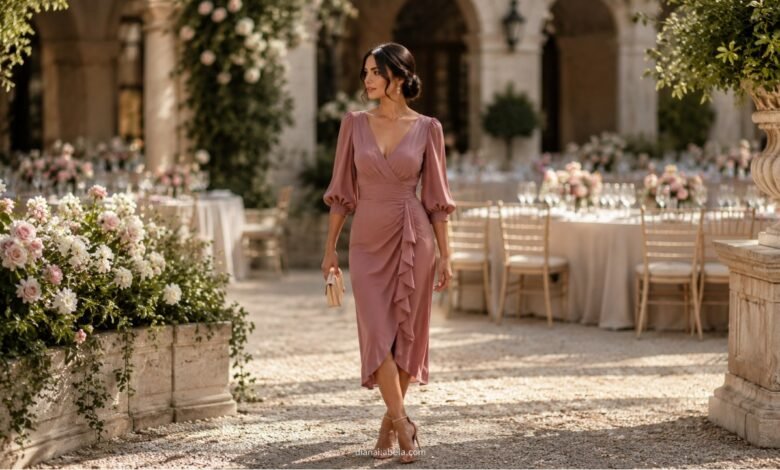
What not to wear to a wedding is not about boring rules. It is about avoiding the outfit that makes people whisper before the cake is cut. Wedding guest style has a strange little tension: you want to look beautiful, but not bridal; stylish, but not attention-hungry; relaxed, but not careless; formal enough, but not like you misunderstood the room.
The best answer is not fear. It is taste. This guide explains what not to wear to a wedding, what to choose instead, and how to read the invitation, venue, season, dress code, and photo context before your outfit becomes the main character for the wrong reason.
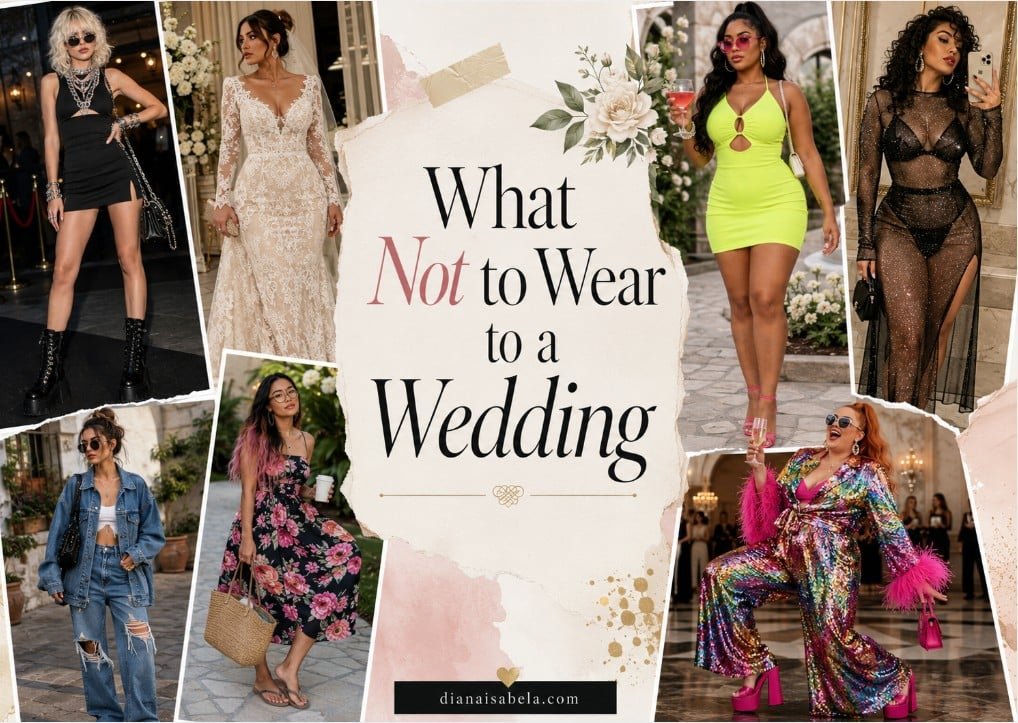
Quick answer: do not wear white, ivory, cream, bridal-looking lace, anything too revealing, anything too casual, denim, flip-flops, everyday sneakers, large daily bags, or an outfit that ignores the dress code. Also avoid clothes that look like clubwear, beach cover-ups, office basics, costume styling, or anything that could compete with the bride or pull focus from the couple.
White, ivory, cream, bridal lace, pale satin, veils, trains, tiaras, or anything that photographs like a wedding dress.
Denim, flip-flops, gym fabrics, beach cover-ups, wrinkled basics, large totes, or clothes that look like errands.
Neon, huge logos, extreme sparkle, clubwear, costume styling, giant tulle moments, or outfits that dominate photos.
Shoes that sink, dresses you cannot sit in, fabrics that turn sheer, and outfits that need constant management.
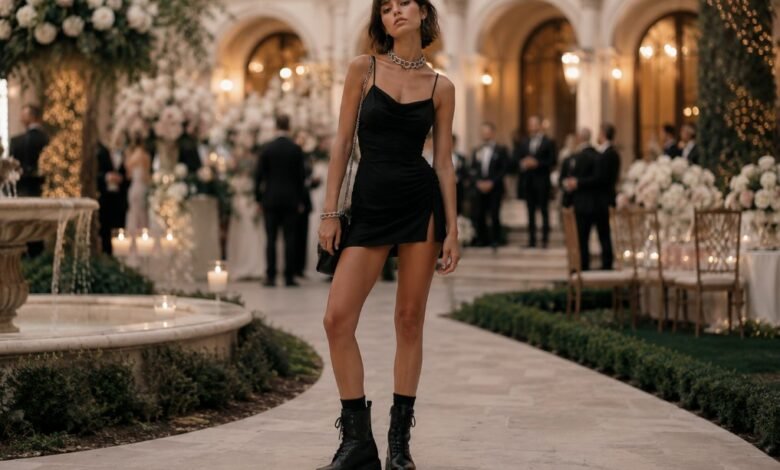
The simplest rule
If the outfit distracts from the couple, disrespects the dress code, creates practical problems, looks bridal, or belongs at a completely different event, do not wear it. A wedding guest outfit should support the atmosphere, not hijack it.
The stylish rule
Do not dress like you are trying to disappear either. Wedding guest style is not punishment. You can wear color, print, shape, texture, shine, and personality. The art is knowing when the outfit says “chic guest” and when it says “I have made several questionable decisions in satin.”
Start with the invitation, not the dress
Most wedding guest outfit mistakes happen because someone falls in love with a dress before reading the event. The invitation gives you more information than it seems: dress code, venue, time of day, season, formality, and sometimes even the couple’s style. A black-tie optional evening wedding at a hotel is not asking for the same outfit as a casual backyard ceremony in July.
Before deciding what not to wear, decide what the wedding is asking for. If you are still comparing levels of formality, the main wedding guest dresses guide is the best place to check the broader dress code universe first. This page is the outfit veto list: the quiet alarm bell for white dresses, too-casual looks, overdone styling, bad shoes, denim, bridal colors, and anything that turns wedding photos into evidence.
Diana’s guest rule: a good wedding outfit should say three things at once: I made an effort, I understood the setting, and I am not auditioning for the role of mysterious second bride.
The four ways a wedding outfit goes wrong
There are many specific mistakes, but most of them fall into four categories. Once you understand these, dressing becomes much easier.
White, ivory, pale lace, bridal satin, veils, pearl overload, or anything that photographs like it belongs to the bride.
Denim, flip-flops, gym fabrics, wrinkled basics, beach cover-ups, or clothes that look like a regular Saturday.
Neon, giant logos, extreme sparkle, costume drama, or anything that fights the wedding instead of joining it.
Shoes that sink, dresses you cannot sit in, fabrics that turn sheer, or outfits that need constant management.
Do not wear white, ivory, cream lace, or anything bridal-adjacent
This is the obvious rule because it is still the most important one. Avoid white, ivory, cream, bridal champagne, pale lace, white floral dresses with a mostly white base, and anything that could look bridal in photos. Even if the bride is modern, even if the dress is “not really white,” even if you found it on sale and the universe seemed to approve — choose something else.
The issue is not that the bride owns every pale color in the universe. The issue is that weddings are symbolic, photographed, emotional events. A pale satin slip dress may look harmless at home and bridal beside flowers, candles, and a ceremony arch. A white lace midi may look romantic on a hanger and suspicious in a group photo. Wedding photography softens colors, and pale dresses often photograph lighter than expected.
Also be careful with ivory floral bases, cream embroidery, pale blush that looks almost white, and champagne satin that photographs bridal. A guest should not need to explain the color under cross-examination. If people have to debate whether it is white, it is too close.
White lace midi
Even if the cut is simple, white lace is too close to bridal language. It photographs wedding-dress-adjacent.
Blue, sage, pink, floral, or navy midi
You keep the pretty dress mood without stepping into bridal territory. Add pearl earrings or a champagne clutch if you want softness.
Ivory satin slip dress
It might look chic at dinner, but at a wedding it can look too bridal, especially in photos or candlelight.
Rose, olive, navy, burgundy, or blue dress
Use champagne, gold, pearl, or ivory accessories if you want softness. Keep the main dress color clearly non-bridal.
Mostly white floral dress
A floral print does not automatically make a white base safe. In photos, the dress may still read white.
Colored floral dress
Choose a floral with a blue, green, pink, black, navy, or warm-toned base so the dress clearly reads guest.
If you are unsure about pale metallics, champagne, or ivory-adjacent colors, use the specific champagne wedding guest dresses guide before taking the risk. Champagne can work, but only when it does not behave like bridal white.
Do not ignore the dress code
A dress code is not a decoration on the invitation. It is the couple telling you what visual world they are creating. Showing up underdressed can look careless; showing up overdressed can feel attention-seeking or disconnected. The aim is not to be technically correct in isolation. The aim is to look right in the room.
If the invitation says semi formal, avoid treating it like a picnic. If it says casual, avoid arriving in a heavy evening gown. If it says black tie optional, remember that “black tie” is still the reference point. For example, the difference between casual wedding guest dresses and semi formal wedding guest dresses is exactly where many guest mistakes happen.
What not to wear by dress code
The same item can be fine for one wedding and wrong for another. A floral sundress might be perfect for casual garden vows and too relaxed for a formal hotel reception. A black satin gown may be elegant for black tie optional and too dramatic for a backyard lunch.
Do not wear gym fabrics, denim unless invited, flip-flops, beach cover-ups, wrinkled basics, or anything that looks like errands.
Do not wear a plain everyday sundress without polish, office clothes, heavy gowns, or shoes that look too casual.
Do not wear casual cotton, denim, club minis, office sheaths, or black-tie-level gowns that overpower the room.
Do not wear floor-length gala gowns, beachy sundresses, very casual maxis, or extremely short party dresses.
Do not wear casual prints, cheap jersey, daytime sundresses, or anything that looks too relaxed for an elegant setting.
Do not focus only on “optional.” Avoid casual cocktail dresses, cotton florals, office dresses, or anything too daytime.
Do not wear heavy gowns, thin stilettos, poolside cover-ups, or fabrics that fight sand, wind, sun, and movement.
Do not wear shoes that sink, fragile hems that drag, overly pale florals, or anything too stiff for an outdoor setting.
The “but it is expensive” excuse does not work
An expensive dress can still be wrong. A designer white dress is still white. A costly mini can still be too revealing. A luxury shoe can still be absurd on grass. A dramatic gown can still overpower a casual ceremony. Taste is not the price tag; taste is reading the room.
“It is not really white,” “the bride will not care,” or “it is casual but expensive” are usually signs the outfit is already risky.
A wedding is long. If you cannot sit, walk, hug, eat, and dance comfortably, the dress will become your evening project.
Club dresses, office dresses, beach vacation outfits, and red-carpet drama each have their place. Not every place is a wedding.
The guest can be stylish. The guest should not become the visual headline of someone else’s ceremony.
Do not dress like the wedding is a regular Saturday
Too casual is one of the most common wedding guest mistakes because people confuse “not formal” with “barely trying.” Casual wedding does not mean beach errands. Semi-formal does not mean office outfit. Backyard wedding does not mean whatever was already on the chair. Even relaxed weddings deserve polish.
If the wedding is relaxed, aim for easy but intentional: a printed midi, wrap dress, polished jumpsuit, soft maxi, dressy sandals, small clutch, and jewelry that looks chosen. Casual can still be graceful. It just should not look accidental.
Jeans, denim jackets, denim skirts, denim dresses, and denim jumpsuits are usually too casual unless the couple specifically asks for denim or the wedding has a very relaxed western or ranch theme.
Everyday sneakers usually make a wedding outfit look unfinished. Some fashion sneakers can work for an extremely relaxed party, but dressy flats, slingbacks, sandals, or low heels are safer.
Flip-flops make almost every wedding outfit look unfinished. Foam slides look like hotel breakfast. Choose polished sandals or flats instead.
Linen can be beautiful, but wrinkled linen can look like you were folded into a suitcase and emotionally abandoned. Steam it, press it, or choose a linen blend that behaves better.
A work blouse and pencil skirt may be neat, but weddings need celebration. Add color, texture, jewelry, better shoes, or a softer fabric so the outfit does not look corporate.
For destination weddings, breezy is good. Transparent, flimsy, or poolside is not the same as wedding guest style.
Do not wear denim unless the couple specifically says so
Denim deserves its own warning because people keep trying to make it happen at weddings. Denim is almost always too casual for a wedding. This includes jeans, denim skirts, denim dresses, denim jumpsuits, and denim jackets that become the most visible part of the outfit.
There are rare exceptions: a very relaxed ranch wedding, a western-themed celebration, a casual after-party, or an invitation that clearly mentions denim. Otherwise, leave it out. If you want relaxed texture, choose something softer and more wedding-aware: a linen-blend midi, cotton poplin dress, floral wrap dress, soft crepe dress, or polished jumpsuit. The outfit can feel easy without looking like ordinary weekend clothes.
Do not confuse memorable with distracting
A wedding is not the worst place to have style. Actually, it is one of the best. But the outfit should not fight the couple, the dress code, the venue, the bridal party, and the photographer in one dramatic scene. There is a difference between a beautiful statement and a dress that enters the room ten seconds before you do.
Statement pieces are safest when the rest of the outfit is edited. If the color is bold, keep the silhouette cleaner. If the fabric shines, keep jewelry calmer. If the earrings are dramatic, let the neckline breathe. A stylish guest knows when to stop adding.
Very low necklines, extreme cutouts, sheer panels, ultra-mini lengths, and very tight clubwear can feel wrong at many weddings. Choose one elegant feature, not a full scandal syllabus.
Sequins can work for evening or black-tie events, but full disco-ball energy at a daytime garden wedding can look out of place.
Huge ball skirts, trains, bridal-style tulle, and dramatic gowns can look like you are trying to join the ceremony from the wrong side.
Do not dress like a costume unless the couple asked for a themed event. A nod to the venue is chic. A full character study is not.
Large logos and obvious branding can make the outfit feel more like a campaign than a celebration. Weddings are not billboards with cake.
Do not wear anything too revealing for the setting
This is not about making wedding guest style boring. It is about proportion and context. A low neckline can be beautiful. A high slit can be elegant. A backless dress can be stunning. The trouble starts when everything happens at once: very short, very tight, very sheer, very low, very high slit, and very difficult to sit in.
Choose one focal point. If the neckline is dramatic, keep the length calmer. If the dress has a slit, make sure it behaves when walking and sitting. If the back is open, choose a more refined front. If the fabric is sheer, check it in daylight and flash. A wedding is not the best place for clothing that requires constant negotiation.
Religious ceremonies, family-heavy weddings, traditional venues, and cultural celebrations may call for more coverage than a rooftop cocktail party. That does not mean your outfit has to be dull. It means the styling should know where it is.
Do not wear fabrics that betray you in photos
Some fabrics look acceptable in a bedroom mirror and then behave terribly under wedding lighting. Thin clingy jersey, cheap shiny satin, overly transparent chiffon, stiff lace, unlined fabrics, and fabric that wrinkles instantly can make the outfit look less polished than it felt at home.
Weddings involve sunlight, flash, candlelight, movement, sitting, standing, and many photos from angles you did not personally approve. Better choices include crepe, chiffon with lining, quality satin, velvet for winter, pleats, organza details, structured cotton blends for relaxed weddings, and floral fabrics that move well. The goal is not perfection. The goal is fabric that behaves like it knows it was invited.
It can cling in the wrong places and look too casual unless the cut and fabric quality are excellent.
Good satin is gorgeous. Bad satin reflects light like an argument. If it wrinkles, pulls, or shines unevenly, skip it.
Check the dress in daylight, not just soft bedroom lighting. Wedding photos are not forgiving.
Cotton can work for casual weddings, but it needs shape, polish, and intentional accessories. Otherwise it can look like a day dress that got lost.
Do not wear loud colors or prints that dominate the photos
Bright color is not automatically wrong. A coral dress, emerald gown, cobalt midi, or pink floral can be beautiful. The problem is color that overwhelms the wedding’s visual tone: neon, extremely loud prints, giant logos, or patterns so aggressive they make every group photo look like a campaign for your personality.
If you love strong color, choose a refined silhouette. If the print is bold, keep the accessories quiet. If the wedding is formal, avoid prints that feel too tropical, childish, or daytime casual. If the wedding is very soft and romantic, choose color that adds energy without shouting over the couple’s palette.
Neon green, highlighter pink, giant logos, huge contrast prints, and anything costume-like.
Coral, berry, cobalt, emerald, marigold, and rich pink in elegant cuts and fabrics.
Sage, dusty blue, rose, lavender, terracotta, navy, chocolate, olive, and muted florals.
Very pale beige, champagne, ivory floral bases, and anything that photographs close to white.
Do not let bad shoes ruin a good dress
Shoes are where wedding guest outfits often fall apart. A beautiful dress with the wrong shoe can look confused. Worse, the wrong shoe can make you miserable. Stilettos in grass, painful heels for a standing ceremony, casual sandals at a formal reception, clunky office pumps with a romantic dress — all of these can sabotage the look.
Flip-flops make almost every wedding outfit look unfinished. Foam slides look like hotel breakfast. Worn sandals drag down a pretty dress. Thin stilettos sink into grass, sand, and garden paths with tragic determination. For outdoor weddings, especially beach or garden settings, the smarter choice is practical but polished. If the wedding is by the ocean, beach formal wedding guest dresses need shoes that respect sand, wind, and uneven surfaces.
Thin stilettos for lawn ceremonies
They sink. You wobble. The outfit loses dignity by step three.
Block heels, wedges, or dressy flats
Still elegant, much more practical, and kinder to outdoor venues.
Everyday black work pumps
Sometimes they are fine, but often they make a wedding outfit look like a meeting that found champagne.
Slingbacks, satin heels, metallic sandals
These feel more festive while still being wearable and elegant.
Huge everyday tote
It may hold your whole life, but it does not belong in most wedding photos.
Small clutch or mini bag
Try satin, pearl, metallic, beaded, structured, or elegant raffia depending on the venue.
For a full guide to finishing pieces, see the wedding guest shoes and accessories guide. A dress can be simple, but the right shoe, bag, and jewelry make it look styled instead of merely worn.
Do not bring the wrong bag
A huge tote, laptop bag, backpack, or bulky everyday handbag can make even a good dress look unfinished. Weddings do not usually require your entire life archive. Choose a small shoulder bag, clutch, mini top-handle, satin pouch, beaded bag, metallic bag, or polished woven piece depending on the dress code.
If you need more items for travel, leave the larger bag in the car, hotel room, or coat check if possible. The bag visible in photos should look like part of the outfit, not a practical confession.
Do not wear a dress that is impossible to live in
A wedding guest outfit has to survive a lot: ceremony seating, walking, standing, hugging, eating, dancing, bathroom logistics, weather, travel, and photos. If the dress only works while standing completely still in a mirror, it is not a dress; it is a still-life arrangement.
Test the outfit before the wedding. Sit down. Walk. Raise your arms. Check the slit. Check the neckline. Look at the back. Try the shoes for more than three minutes. If you are already adjusting it at home, you will be adjusting it all night.
The photo test: before wearing the outfit, imagine standing beside the couple in a group photo. Does your look feel respectful, polished, and guest-appropriate? Or does it look bridal, clubby, sloppy, too loud, too pale, or weirdly casual? The group photo test solves many outfit debates very quickly.
Do not forget the cultural and family context
Some weddings are more traditional than others. Some families care deeply about modesty, color symbolism, religious ceremony etiquette, or formality. Some venues also set the tone before the invitation does. A cathedral wedding, a family estate wedding, a cultural ceremony, and a beach elopement dinner are not asking for the same outfit.
This is where guest style becomes social intelligence. If the wedding is religious, avoid anything too revealing and bring a proper layer. If the wedding is cultural, be careful with colors that may have bridal meaning. If the family is formal, dress a little more polished. If the couple gives a color palette, do not treat it like an optional Pinterest mood board.
If you are unsure, ask someone close to the couple. It is better to send one polite message than to spend the wedding wondering if your outfit is secretly the problem.
What not to wear by wedding setting
Venue matters because the same dress behaves differently in different places. The best guest looks understand the room, the ground, the temperature, and the mood. This is where a perfectly good dress can become the wrong dress — not because it is ugly, but because it belongs somewhere else.
Avoid anything too bare without a layer
Bring a wrap, blazer, shawl, or elegant cardigan if the dress has thin straps, a very low neckline, or an open back.
Avoid stilettos and fragile hems
Grass, gravel, and flower paths are not kind to delicate shoes. Choose block heels, wedges, or polished flats.
Avoid casual fabrics
Thin cotton, jersey, and daytime sundresses can look underdressed in a room with chandeliers and formal tables.
Avoid going too formal
A heavy gown may look disconnected from the setting. Choose polished ease instead of gala drama.
Avoid heavy gowns and thin heels
Sand, wind, and sun need breathable fabrics, practical shoes, and silhouettes that move intelligently.
Avoid looking like work
A simple dress can be perfect, but soften corporate pieces with better shoes, jewelry, a smaller bag, or a more romantic fabric.
Avoid wind-problem outfits
Super light skirts, unsecured wrap dresses, and tiny bags that cannot hold essentials can become annoying fast. Choose movement with control.
Avoid vacation clothes pretending to be formal
Resort style can be elegant, but poolside cover-ups, sheer beach dresses, and flip-flops still look too casual for the ceremony.
Do not forget the season
Seasonal mistakes are subtle. A pale linen dress may look wrong at a winter evening wedding. A black velvet gown may feel punishing at a humid summer garden ceremony. A breezy floral dress may be perfect in May and too light for a formal November reception.
Use fabric and color to respect the season. Spring likes soft color and movement. Summer needs breathability. Fall welcomes texture and warm tones. Winter can handle velvet, satin, deeper shades, elegant sleeves, tights, and actual coats that do not ruin the outfit on arrival.
Wearing a very pale floral dress that photographs mostly white. Choose a colored base, stronger print, or a shade that clearly reads guest.
Wearing heavy fabrics, tight silhouettes, or shoes that cannot handle heat, grass, or outdoor ceremonies.
Wearing a dress that feels too beachy or thin for the season. Add richer color, texture, or a stronger shoe.
Wearing a beautiful dress with a random everyday coat. The arrival layer is part of the outfit too.
Better alternatives when your first outfit feels wrong
Sometimes the dress you planned is almost right, but not quite. Instead of starting over completely, identify the problem. Too white? Change the dress. Too casual? Upgrade accessories. Too revealing? Add a better layer or choose a more balanced silhouette. Too loud? Remove one statement piece. Too formal? Soften the styling.
Switch to blue, green, pink, burgundy, navy, floral, black, or a soft print. Keep pale accessories if you like the romantic mood.
Add better shoes, a smaller bag, earrings, a polished hairstyle, and a dressier layer. Sometimes the dress is fine; the finishing pieces are not.
Balance it with length, a softer neckline, a wrap, a jacket, or quieter accessories. One dramatic element is usually enough.
Choose a calmer shade or simplify everything around it. Minimal jewelry, refined shoes, and a small neutral clutch can soften strong color.
Match the shoe to the venue first, then the dress. Grass, sand, cobblestones, stairs, and long ceremonies all matter.
Add one polished detail: a better earring, softer hair, a satin bag, a metallic sandal, a wrap, or a more intentional lip color.
For broader styling inspiration, the wedding guest outfit ideas guide gives complete looks by mood, venue, dress code, shoes, bags, and accessories.
The final Diana mirror test
Before you leave, ask five questions. Could this look bridal in photos? Does it match the dress code? Does it respect the venue? Can I sit, walk, dance, and hug people without managing the outfit all night? Does it look like I came to celebrate someone else beautifully, not audition for attention?
If the answer is yes, you are probably safe. If one answer feels uncertain, edit the outfit. Change the shoes. Add a layer. Choose a different color. Steam the dress. Swap the bag. Wedding guest style is often saved by one small correction.
The chic guest knows when to edit
What not to wear to a wedding is not a list of joyless restrictions. It is a way to protect the look from obvious mistakes. Avoid bridal colors, careless fabrics, wrong shoes, impossible silhouettes, ignored dress codes, and anything that pulls focus from the couple.
Then choose a dress that feels polished, comfortable, and right for the room. You do not need to erase your style. You just need to dress like someone who understands the day is not centered around your dramatic entrance. That is how a wedding guest looks memorable for the correct reason.
FAQ
What should you not wear to a wedding?
You should not wear white, ivory, bridal-looking lace, anything too revealing, anything too casual, denim, everyday sneakers, large daily bags, or an outfit that ignores the dress code. Also avoid clothes that look like clubwear, beach cover-ups, office basics, or anything that could compete with the bride. A wedding guest outfit should look respectful, polished, and appropriate for the venue and formality.
Can you wear white to a wedding?
In most cases, no. Guests should avoid white, ivory, cream, and bridal-looking pale dresses unless the couple specifically requests it. Even if the dress is not technically bridal, it can still photograph too close to white or look inappropriate beside the bride. Choose another color such as blue, pink, sage, navy, burgundy, green, floral, or black if the wedding setting allows it.
Is it okay to wear black to a wedding?
Yes, black can be appropriate for many weddings, especially evening, cocktail, formal, city, and winter weddings. The key is making the outfit feel celebratory rather than funeral-like. Choose nice fabric, elegant shoes, jewelry, and a small clutch. Black may feel too heavy for some daytime garden or beach weddings, so consider the venue and season.
Can I wear jeans to a wedding?
Usually, no. Jeans are too casual for most weddings unless the invitation specifically says denim is acceptable or the wedding has a very relaxed theme. Even casual weddings usually call for a polished dress, jumpsuit, skirt outfit, or tailored separates. If you want comfort, choose a relaxed midi dress or dressy jumpsuit instead of denim.
Are sneakers okay for a wedding guest?
Sneakers are usually not the best choice for a wedding unless the event is very casual or the couple specifically encourages comfortable footwear. Dressy flats, block heels, slingbacks, metallic sandals, or elegant low heels usually look more appropriate. If you need comfortable shoes, choose polished options rather than everyday sneakers.
What colors should wedding guests avoid?
Wedding guests should usually avoid white, ivory, cream, and colors that look bridal in photos. Some weddings may also have cultural color meanings, so red, gold, or certain symbolic colors may need caution depending on the couple’s background. If the invitation gives a color palette or colors to avoid, follow it. When unsure, choose safer shades like navy, blue, green, pink, burgundy, floral, or black if appropriate.
Is it bad to be overdressed at a wedding?
Being slightly polished is usually better than being underdressed, but being dramatically overdressed can become awkward. Avoid bridal-style gowns, trains, giant tulle skirts, tiaras, or outfits that look more formal than the couple’s event. The goal is to match the dress code while staying clearly in guest territory.
What should I wear instead of a white dress to a wedding?
Instead of a white dress, try a soft blue midi, sage green dress, dusty pink dress, floral dress, navy satin dress, burgundy wrap dress, black cocktail dress, or pastel dress that does not photograph bridal. You can still use champagne, pearl, gold, or ivory accessories if the main dress color is clearly not bridal.
What makes a wedding guest outfit look too casual?
A wedding guest outfit looks too casual when it includes denim, sneakers, flip-flops, large everyday bags, wrinkled fabric, office basics, beach cover-ups, or pieces that look like normal weekend clothes. Even relaxed weddings need some polish. Better shoes, a small clutch, earrings, a steamed dress, and intentional hair can make a simple outfit feel more wedding-ready.
How do I know if my wedding guest outfit is appropriate?
Check the dress code, venue, season, time of day, and cultural context. Then ask whether the outfit is respectful, comfortable, polished, and clearly not bridal. Imagine standing beside the couple in a group photo. If the outfit looks too white, too revealing, too casual, too loud, or too disconnected from the wedding style, choose a better option.