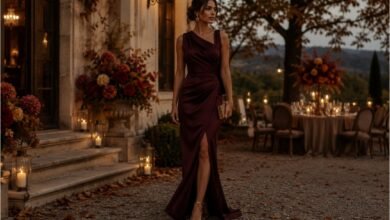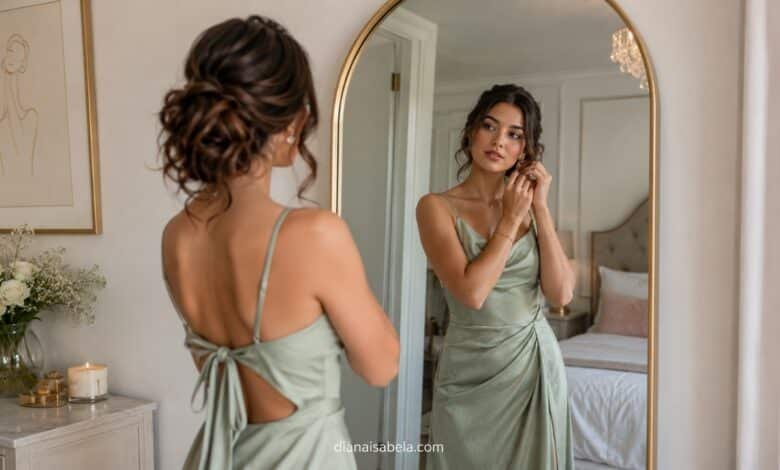
Wedding guest outfit mistakes are rarely loud at first. They whisper in the mirror, then scream in the photos.
The wrong wedding guest outfit does not always look disastrous immediately. Sometimes it looks “cute enough” in your bedroom, “probably fine” in the car, and then suddenly very wrong beside a floral arch, a candlelit table, or a bride’s grandmother who has the judgmental posture of a retired ballet teacher.
The problem is not always the dress itself. It is the relationship between the dress, the venue, the dress code, the shoes, the season, the lighting, the family atmosphere, and the tiny emotional fact that a wedding is not just a party. It is a ceremony with witnesses, cameras, seating charts, and people who will remember your shoe choice with alarming clarity.
First, diagnose the real problem: pretty is not the same as appropriate
A dress can be beautiful and still be wrong for a wedding. This is the part that causes emotional damage in dressing rooms. The mini is cute, but too clubby. The satin dress is elegant, but too bridal in pale champagne. The black dress is chic, but too severe for a morning garden ceremony. The floral maxi is romantic, but too casual for a formal hotel reception. The shoes are stunning, but the wedding is on grass and reality has filed a complaint.
Wedding guest style is about context. The best outfit understands the invitation, venue, season, family mood, ceremony setting, and how much standing you will do before cake. That sounds annoying because it is. But it also saves you from being the person who spends the whole wedding adjusting a neckline, sinking into a lawn, or realizing too late that the “soft cream” dress is basically white in sunlight.
If the invitation is unclear, start with Diana’s guide to what to wear to a wedding as a guest before choosing the outfit. Most mistakes happen because people style for a fantasy wedding instead of the actual one.
Mistake 1: wearing something too close to white
This is the famous mistake because it is the easiest to avoid and somehow still the most dramatic. White, ivory, cream, bridal lace, pale champagne, soft silver-white, and very pale blush can all look dangerous depending on the fabric and lighting. A dress does not need to be pure white to create the wrong impression.
The sneakiest offenders are pale satin, ivory florals, cream crochet, champagne slip dresses, white-based prints, and beige dresses that photograph lighter than they look indoors. Natural light can turn “soft neutral” into “why is she standing near the bride like that?” very quickly.
- Usually avoid: white, ivory, cream, bridal lace, white satin, pale champagne, and white-based floral dresses.
- Be careful with: very pale blush, pale silver, pale butter yellow, ivory backgrounds, and champagne shimmer.
- Safer alternatives: sage, dusty blue, rose, lavender, soft coral, navy, emerald, burgundy, chocolate, or dark florals.
- Photo test: take a picture near a window. If the dress looks close to white in daylight, do not wear it.
Mistake 2: going too casual because the venue sounds relaxed
Beach wedding does not mean beach cover-up. Garden wedding does not mean picnic dress. Backyard wedding does not mean errands outfit with nicer earrings. Casual wedding does not mean careless. A wedding can be relaxed and still expect effort.
The danger pieces are cotton sundresses that look like weekend errands, jersey maxis that feel like travel clothes, casual sandals, denim jackets unless specifically styled well, wrinkled linen without polish, and anything that looks like it would also work for buying iced coffee. A wedding outfit should have a little ceremony in it.
The fix is simple: upgrade one or two elements. Better fabric. A cleaner shoe. A smaller clutch. More polished hair. Jewelry that looks intentional. The outfit does not need to become formal; it just needs to look invited.
Mistake 3: wearing a dress that needs constant supervision
A wedding outfit must survive movement. Sitting, standing, hugging, dancing, walking across grass, leaning for photos, eating dinner, and greeting people you may not know. If the dress only works when you stand at one exact angle with your shoulders arranged by divine intervention, it is not a guest outfit. It is a controlled laboratory condition.
Too revealing does not always mean “too much skin.” Sometimes it means the dress is insecure. Straps slip. Neckline gaps. Slit opens too high. Hem rides up. Fabric clings. Cutout shifts. You spend the day adjusting instead of existing. That is not glamour; that is unpaid outfit management.
- Watch the neckline: it should stay secure when you sit, dance, hug, and lean forward slightly.
- Check the slit: a slit can be elegant, but it should not create a weather emergency every time you walk.
- Test the hemline: sit down before deciding. A short dress can become much shorter in a chair.
- Check the back: open-back dresses can be beautiful, but make sure the fit and undergarments work.
- Move around: if you are already adjusting it after two minutes at home, imagine six hours and a dance floor.
Mistake 4: choosing shoes for the photo, not the floor
Shoes are the betrayal chapter. They look innocent in the box. Then the wedding has grass, gravel, sand, stairs, marble, rain, cobblestones, or a dance floor polished to villainous levels. The wrong shoe can make a beautiful outfit feel wrong because you start walking like someone carrying a secret injury.
Thin stilettos on grass sink. Satin sandals in rain suffer. Heavy platforms can look wrong with delicate dresses. Casual flats can make a formal dress feel unfinished. Boots may work for some fall or western weddings, but they can also overpower a soft dress. Shoes need to match the venue, not just the dress.
Choose block heels, wedges, dressy flats, low heels, or heel protectors. Thin heels and grass are not in love.
Flat sandals, dressy slides, wedges, or barefoot-friendly styling work better than stilettos trying to perform architecture in sand.
Strappy heels, pumps, slingbacks, satin heels, metallic sandals, or elegant platforms can work beautifully.
Choose shoes you can stand in comfortably. A ceremony is not the time to discover your heel hates you.
The shoe should let you move with dignity. Painful shoes do not make the outfit more elegant. They just make you spend cocktail hour searching for chairs like a Victorian ghost.
Mistake 5: ignoring the venue’s personality
Every wedding venue has a mood. A city hotel wants polish. A garden wants softness and practical shoes. A beach wants movement and breathable fabric. A church wants a little restraint. A black-tie ballroom wants formal elegance. A rustic barn wants something polished but not too fragile. When the outfit ignores the venue, the mismatch shows immediately.
The venue is not background decoration. It is part of the dress code. Ignore it, and the outfit may look like it arrived at the wrong address but decided to stay for dinner.
Mistake 6: treating all dress codes like suggestions from a nervous aunt
Dress codes matter. They are not always written perfectly, but they are clues. Cocktail does not mean club. Formal does not mean bridal-party gown. Black tie does not mean any long dress. Semi-formal does not mean casual. Garden party does not mean costume floral. Beach formal does not mean flip-flops with ambition.
If the dress code is unclear, read the venue, time of day, invitation design, season, and couple’s style. A 6 p.m. hotel wedding with black invitations is not asking for the same outfit as a noon garden ceremony with watercolor florals. The more formal the dress code, the more fabric and polish matter.
- Cocktail mistake: going too nightclub or too casual. The safe zone is polished midi, refined mini, satin, crepe, velvet, or structured fabric.
- Formal mistake: choosing a dress that is pretty but not elevated enough. Formal needs better fabric and styling.
- Black tie mistake: wearing a casual maxi and hoping length does all the work. It does not.
- Semi-formal mistake: confusing semi-formal with everyday dressy. It still needs wedding polish.
- Beach formal mistake: either too casual or too ballroom-heavy. The look needs elegance with air.
If the invitation says cocktail, Diana’s cocktail wedding guest dresses guide can help with the line between chic and too-party. If it says black tie or formal, compare the level before buying something that only looks formal in product photos.
Mistake 7: forgetting the outfit will be photographed from every possible angle
Wedding photos are not like outfit photos. You do not control all the angles. Someone will take a picture while you are sitting, laughing, holding a glass, turning sideways, hugging a cousin, dancing, or bending slightly toward a table centerpiece. Your outfit needs to work in real life, not just one mirror pose.
Fabric matters in photos. Cheap satin reflects harshly. Thin fabric can become transparent in sunlight. Black can disappear without texture. Pale colors can look bridal. Busy prints can overwhelm. Wrinkles become visible. Shoes you thought no one would notice somehow become the main character in a group shot.
Take a few phone photos before the wedding. Front, side, sitting, daylight, evening light if possible. This is not vanity. It is research. Diana supports research when it prevents satin-related regret.
Fast fixes when the outfit feels slightly wrong
Sometimes the dress is almost right. Not bad. Just unfinished. Too sweet, too severe, too plain, too casual, too dramatic, too dark, too pale. The fix is usually not buying everything again. It is adjusting the styling so the outfit lands in the correct category.
- If the dress feels too casual: add better shoes, a structured clutch, jewelry, polished hair, or a dressier layer.
- If the dress feels too formal: soften with simpler jewelry, less dramatic hair, lighter shoes, or a less intense bag.
- If black feels too severe: add gold, pearls, metallic shoes, soft waves, a warm lip, or a lighter clutch.
- If pastel feels too sweet: add a sharper shoe, sleek hair, minimal jewelry, or a structured bag.
- If the outfit feels too revealing: add a wrap, choose different undergarments, adjust tailoring, or switch dresses if needed.
- If the shoes are wrong: change them. Shoes are not a small detail when the ground is involved.
For a wider comparison of dress codes, colors, venues, and seasonal outfit ideas, Diana’s main wedding guest dresses guide is the hub to use before the group chat becomes a legal proceeding.
The final mirror interrogation before you leave
Try the full outfit. Dress, shoes, bag, jewelry, layer, hair, makeup. Not separately. Together. A wedding guest outfit is a composition, and one wrong piece can change the mood completely. The beautiful dress with the wrong shoe becomes confused. The elegant black dress with no jewelry becomes severe. The sweet pastel dress with too many delicate details becomes cupcake diplomacy.
Now move. Sit down. Walk. Turn. Lift your arms. Hold the clutch. Put on the coat or wrap. Check the neckline. Check the hem. Check the back. Take a photo. Look at the outfit in daylight. If something annoys you at home, it will become your enemy by the reception.
- Is it clearly not bridal? No white, ivory, cream, pale champagne, or bridal lace confusion.
- Does it match the dress code? Not just “pretty,” but correct for the event.
- Does it match the venue? Shoes, fabric, and formality should make sense with the setting.
- Can you move comfortably? Sit, walk, hug, dance, and breathe like a normal human.
- Does it feel celebratory? Stylish, respectful, and happy to be there.
If the outfit passes those questions, stop changing things. Over-editing is also a mistake. There is a point where fashion preparation becomes a tiny nervous breakdown with earrings.
The real secret: dress for the wedding, not just the mirror
The best wedding guest outfits look beautiful because they understand the whole scene. The couple, the ceremony, the venue, the lighting, the season, the dress code, the ground, the photos, and the fact that comfort is not a luxury. It is the difference between elegance and endurance.
Avoid white. Respect the dress code. Choose shoes for the venue. Test the outfit sitting down. Think about photos. Keep the styling balanced. Let one detail lead. Make sure the dress feels like you, but wedding-ready.
Wedding guest style is not about being invisible. It is about being beautifully appropriate. The kind of appropriate that still gets compliments, but never makes the bride’s aunt lower her glasses. Diana would call that the perfect victory.
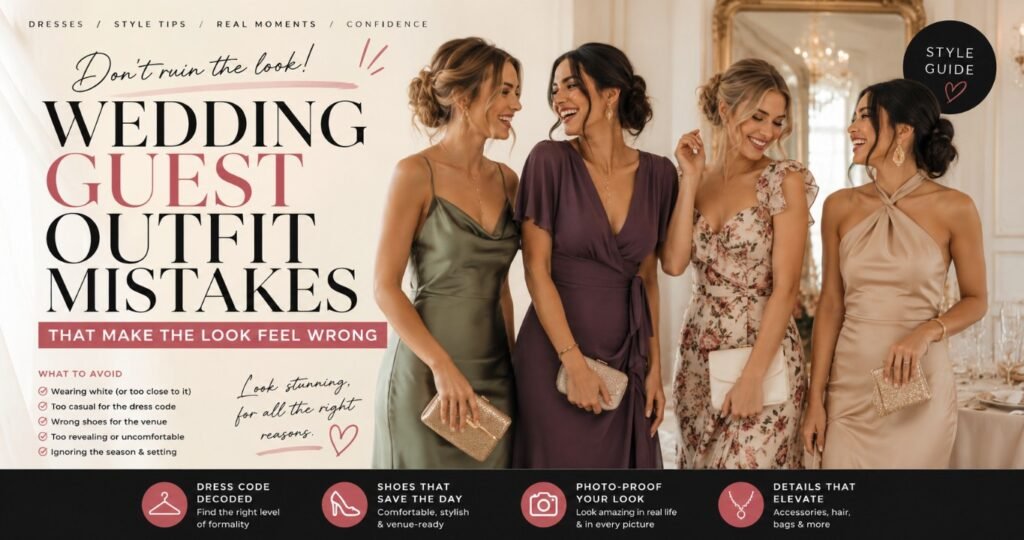
FAQ
What are the biggest wedding guest outfit mistakes?
The biggest wedding guest outfit mistakes include wearing white or ivory, dressing too casually, ignoring the dress code, choosing wrong shoes for the venue, wearing something too revealing, and forgetting how the outfit photographs.
What colors should wedding guests avoid?
Wedding guests should usually avoid white, ivory, cream, bridal lace, pale champagne, and very light shades that photograph close to white. Some cultural weddings may also have specific color traditions to respect.
Can a wedding guest outfit be too casual?
Yes, a wedding guest outfit can be too casual if it looks like everyday wear, beachwear, brunch clothing, or errands styling. Even relaxed weddings usually need polished shoes, better fabric, intentional accessories, and a wedding-ready finish.
What shoes should wedding guests avoid?
Wedding guests should avoid shoes that do not match the venue, such as thin stilettos on grass or sand, casual flip-flops, painful heels, or shoes that make the dress feel less formal than the event requires.
How do I know if my wedding guest outfit is appropriate?
Check whether the outfit matches the dress code, venue, season, and ceremony setting. It should not look bridal, too casual, too revealing, or uncomfortable. Try sitting, walking, and taking photos before the wedding.