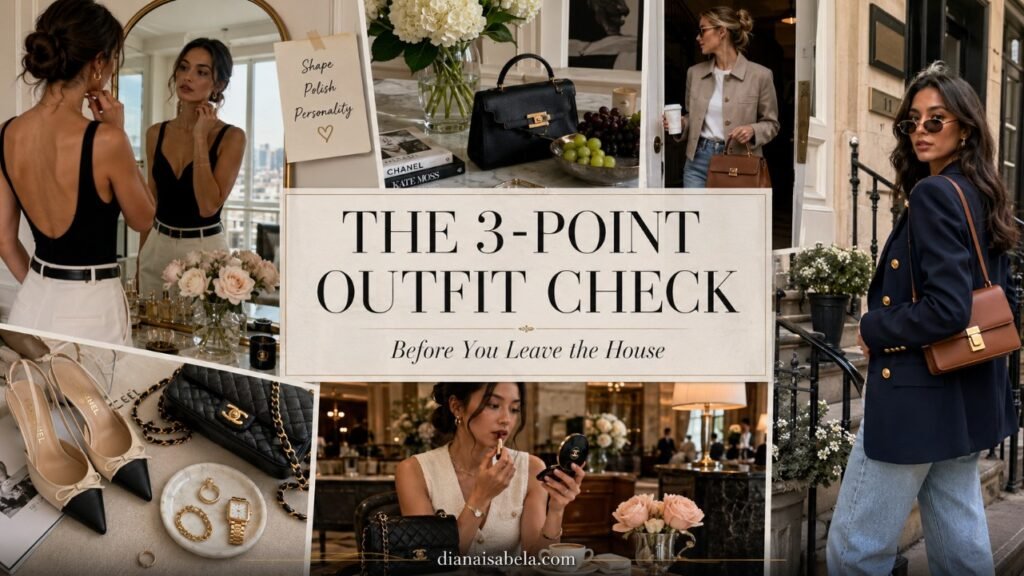
There is a moment every outfit must survive.
Not the shopping cart. Not the mirror selfie. Not the “wait, this could be cute” moment when you are standing in your room with half your closet on the bed and one sock missing for reasons nobody can explain.
I mean the door moment.
You are about to leave. Your bag is in your hand. Your hair is mostly cooperating. Your shoes are on. Someone is probably yelling that it is time to go, which is always when the outfit decides to reveal its true personality. Suddenly the jeans feel wrong. The top is cute but floating. The shoes are fighting the bag. The outfit is not bad, exactly. It is just not finished.
That is where the 3-point outfit check comes in. Not a dramatic closet makeover. Not a full styling crisis. Just three fast questions before you leave the house: Does the shape work? Does it look polished? Does it still feel like you?
The mirror does not need more drama, it needs a system
Most outfit panic happens because we stare at the mirror and ask the wrong question: “Do I look good?”
That question is too big. It invites every insecurity, every trend, every comment someone once made in seventh grade, and every unrealistic outfit photo you saved at midnight. Suddenly you are no longer checking an outfit. You are reviewing your entire identity under bad lighting.
A better question is smaller and much more useful: “What is not working yet?”
Maybe the proportions are off. Maybe the outfit needs one polished detail. Maybe it looks cute but not like your real style. Maybe the shoe is wrong. Maybe the bag is too casual. Maybe the neckline needs earrings. Maybe the hoodie is swallowing the skirt. Maybe the outfit is actually fine and you are just hungry, which is also important fashion information.
The 3-point outfit check gives your brain somewhere to go. Shape. Polish. Personality. Three stops. No spiral.
Diana’s door rule: if an outfit feels almost right, do not destroy it. Diagnose it. Most “bad outfit” moments need one smart edit, not a new personality.
The check should take two minutes
This is not a full closet audit. It is the last little editorial pass before real life gets involved.
Use it when the outfit feels suspicious
You know the feeling. Nothing is technically wrong, but something is whispering from the mirror. The 3-point check helps you fix that whisper before it turns into a hallway, dinner, party, or photo regret.
It works for school outfits, birthday looks, errands, casual weekends, first-date coffee, family events, and those days when you want to look good but cannot emotionally survive trying on twelve more tops.
The 3-point outfit check
- Shape: Does the outfit have balance between loose and fitted, long and short, soft and structured?
- Polish: Does one detail make the outfit look intentional instead of accidental?
- Personality: Does the look feel like you, or are you borrowing someone else’s style panic?
Point one: shape decides whether the outfit makes sense
Shape is the first thing I check because it is usually the reason an outfit feels wrong. Not your body. Not your face. Not your life. The shape.
Clothes create lines. A long top changes the leg line. A bulky hoodie changes the shoulder line. A mini skirt changes the balance of the shoe. Wide-leg jeans need a different top than skinny pants. A big jacket can look cool or swallow the outfit depending on what is happening underneath. Even a cute dress can look unfinished if the shoe weight is wrong.
When the shape is off, you feel it before you can explain it. The outfit looks heavy. Or too tiny. Or too flat. Or like every piece is the same size emotionally. That is when people start adding random accessories, but accessories cannot always save bad balance. Sometimes the outfit needs a tuck. A different shoe. A shorter jacket. Hair pulled back. A belt. A sleeve rolled. One less layer.
Shape is the architecture. If the architecture is confused, the decoration has to work too hard.
When everything is oversized
Try creating one cleaner line. Tuck part of the top, switch to a slimmer shoe, pull hair back, or add a structured bag. Oversized can be stylish, but it still needs a point of control.
When everything is fitted
Add softness or ease. A looser jacket, open shirt, cardigan, relaxed bag, or slightly chunkier shoe can stop the outfit from feeling too tight, too flat, or too “I cannot breathe for style.”
The fastest shape fixes before you leave
Start with the waist. If your outfit feels like one long block, show the waist somehow. That does not always mean a tight top. It can mean a half tuck, a belt, a cropped jacket, a cardigan buttoned at the right spot, or a bag worn higher on the body.
Then check the shoe. Shoes can make a good outfit look confused in five seconds. A delicate outfit with the wrong bulky sneaker can feel heavy. A sporty outfit with a shoe that is too dainty can look like two outfits got merged by accident. A dress with flats can feel sweet, but a boot can make it stronger. Jeans with heels can look polished, but the wrong heel can make them look like a school presentation became a dinner reservation without warning.
Then check the top layer. Jackets, hoodies, cardigans, and button-downs are powerful because they change the outer shape. If the outfit feels unfinished, try adding a layer. If it feels bulky, remove or switch the layer. If it feels boring, roll sleeves, open the jacket, or change the way the collar sits.
Small changes. Big difference.
The half tuck
Best when the outfit feels shapeless but you do not want a full tucked-in look. It gives the waist a clue without becoming strict.
The sleeve roll
Best when a button-down, blazer, or cardigan feels too serious. Showing a little wrist makes the outfit feel lighter and more styled.
The shoe swap
Best when the outfit is close but the mood is wrong. Shoes are often the fastest edit because they decide the whole outfit’s accent.
Point two: polish is the detail that says you meant it
Polish does not mean formal. It does not mean expensive. It does not mean you need to dress like you are meeting your future in-laws at a museum brunch.
Polish means there is one detail that makes the outfit look chosen.
It can be clean shoes. Gold hoops. A belt. A structured bag. A bow. Sunglasses. A slick ponytail. A neat claw clip. A watch. A tiny scarf. A lip gloss that matches the mood. A cardigan buttoned in a pretty way. Socks that look intentional. A bag charm that adds personality without turning the bag into a souvenir shop.
The outfit may be casual, but polish keeps it from looking accidental.
This is where a lot of teen outfits go from “cute clothes” to “cute look.” The clothes are the base. The polished detail is the final click.
The polish problem: too little, too much, or the wrong kind
Too little polish makes an outfit feel unfinished. You have the jeans and the top, but no detail pulls them together. It is like writing a text and forgetting punctuation. People understand it, but it feels rushed.
Too much polish can make an outfit feel stiff. This happens when every detail is trying to be perfect: hair too done, jewelry too matched, bag too precious, shoes too formal, outfit too controlled. Sometimes that works for an event. For everyday style, it can feel like the outfit is afraid of being touched by real life.
The wrong polish is the sneakiest one. That is when the accessory is nice, but it belongs to a different outfit. A romantic bow on a sporty outfit can be cute if done intentionally, but random if nothing else connects. A formal bag with gym sneakers can look cool if the contrast is styled, but strange if the outfit has no bridge between them. A heavy necklace with a delicate top may overpower the neckline.
Polish should support the outfit. Not interrupt it.
Polish questions that save time
- Do my shoes look clean enough for the outfit? Dirty shoes can make a nice outfit look tired.
- Does my bag match the mood? Not the color exactly, the mood.
- Is there one detail near my face? Earrings, hair, sunglasses, or lip color can finish the top half.
- Is the outfit missing structure? Try a belt, blazer, sharper bag, or neater hair.
- Is the outfit too polished for the plan? If you feel overdressed in a bad way, swap one formal piece for something easier.
- Does anything look tired? Lint, wrinkles, peeling bags, bent sunglasses, and sad hair clips quietly lower the whole look.
Point three: personality is what stops the outfit from looking copied
Here is where the outfit becomes yours.
Shape makes it work. Polish makes it finished. Personality makes it memorable.
Without personality, an outfit can be technically fine but forgettable. You can wear the right jeans, right top, right shoes, right bag, and still look like you dressed from a checklist someone else wrote. That is not a disaster. It is just not style yet.
Personality is the small choice that makes the outfit feel connected to you. The red bag when everything else is neutral. The silver jewelry because gold feels too sweet today. The vintage jacket. The bow you wear with sneakers instead of ballet flats. The graphic tee under a blazer. The unexpected sock. The tiny charm. The messy bun because the outfit would look too perfect otherwise. The lip gloss. The headphones. The book bag. The ring stack. The color you always return to.
Personality does not have to be loud. It just has to be honest.
Do not confuse personality with adding a random trend
This is important. A trend is not automatically personality. Sometimes it is just a trend standing in your outfit like it got invited by the algorithm.
If bows are everywhere, your bow still needs to make sense with your outfit. If silver accessories are trending, they still need to work with your colors. If everyone is wearing a certain sneaker, it still needs to belong to your closet. If a micro-aesthetic is popular this week, you do not have to let it walk into your life and rearrange your entire wardrobe.
Personality is not “wear the thing people recognize.” Personality is “wear the thing in a way that feels like you.”
This is where a lot of styling hacks that make outfits feel finished become useful. The hack is not the identity. It is the tool. You still decide what the outfit is saying.
If the outfit feels too basic
Add one personal detail: a better earring, interesting sock, stronger bag, hair accessory, unusual color, layered necklace, or jacket with more attitude. One detail is usually enough.
If the outfit feels too much
Remove the detail that is not connected. If five pieces are trying to be the personality, the outfit has no leader. Let one thing be memorable.
The check works differently for school, weekends, and events
A school outfit needs comfort and repeatability. The 3-point check keeps it stylish without making it too fragile. Shape: can you sit, walk, carry a bag, and survive a full day? Polish: do the shoes, hair, and bag make it feel intentional? Personality: is there one detail that feels like you and not just “school uniform but with panic”?
A weekend outfit can take more risks. Maybe the shape is more dramatic. Maybe the polish is sunglasses and a better bag. Maybe the personality is a bold color, weird shoe, vintage jacket, or dress you cannot wear to school without hearing comments from people who think a hoodie is formalwear.
An event outfit needs the strongest polish. Birthdays, dinners, school dances, family parties, and weddings usually need more attention to fabric, shoes, bag, jewelry, and hair. But the same three points still work. Shape. Polish. Personality.
If you are dressing for something more formal, especially a wedding or dressier party, the polish point matters even more. A simple dress can look beautiful when the accessories, shoes, and finish are right. I would use the same thinking behind making a simple dress look more expensive for events: you do not always need a louder outfit, you need a smarter finish.
The last-minute event rescue
If you are leaving for an event and the outfit feels flat, do not immediately change the whole look. Check the dress or main piece first. Does it need a stronger shoe? A better earring? A cleaner bag? A softer hair shape? A small belt? A more elegant jacket?
Event outfits often fail because the base is fine but the finish is confused. The wrong bag can make a dress look casual. The wrong shoe can make the outfit feel heavy. Too much jewelry can make a pretty neckline look crowded. No jewelry at all can make a simple dress look unfinished.
Fix the finish before you start over.
The 3-point check in real outfit moments
Let’s make this practical, because fashion advice that only sounds good in theory belongs in a very expensive notebook nobody opens.
You are wearing baggy jeans, a baby tee, sneakers, and a hoodie. Something feels sloppy. Shape check: the hoodie and jeans are both loose, so you need one cleaner line. Maybe unzip the hoodie, tuck the tee slightly, or swap to a cropped jacket. Polish check: clean sneakers, hoops, and a structured bag. Personality check: graphic tee, headphones, or a bag charm that feels like you.
You are wearing a skirt, cardigan, ballet flats, and a bow. Something feels too sweet. Shape check: does the cardigan need to be worn open, buttoned, or tucked? Polish check: choose delicate jewelry and clean shoes. Personality check: add one sharper detail, maybe a darker bag or less-perfect hair, so the outfit does not look like it was styled by a cupcake.
You are wearing trousers, a tank, and a blazer. Something feels too grown. Shape check: roll sleeves or choose a softer shoe. Polish check: necklace, bag, neat hair. Personality check: add a playful color, sunglasses, or a sneaker instead of a heel if the plan is casual.
You are wearing a simple dress. Something feels plain. Shape check: does it need a belt, jacket, or different shoe? Polish check: earrings, bag, hair. Personality check: choose one detail that gives the dress a mood: romantic, clean, sporty, dramatic, soft, or cool.
For jeans and a tee
Check the shoe, add one accessory near the face, and decide whether the top needs a tuck or a layer.
For a dress
Check the shoe weight, choose one jewelry focus, and make sure the bag does not make the dress look less special.
For hoodie outfits
Check proportion first. Hoodies look better when the pants, shoes, hair, or bag create some kind of structure.
When the outfit still feels wrong after the check
Sometimes the 3-point outfit check reveals the truth: the outfit is not almost right. It is tired. Or wrong for the day. Or built around one piece you are trying too hard to save.
That is okay.
If shape, polish, and personality all feel difficult, change the base. Do not keep rescuing a look that wants to be left alone. Some outfits are like bad group projects: everyone is technically present, but nothing is working together.
Start over with the piece you actually want to wear most. The jeans. The skirt. The shoes. The jacket. The dress. Build around that one piece instead of trying to force five pieces to become friends.
If this happens often, the problem may not be your styling. It may be your closet. You may have too many statement pieces and not enough connectors. Too many tops that only work with imaginary pants. Too many shoes that are cute but wrong for your real life. Too many pieces bought for a mood that lasted four days.
That is where outfit disasters and how to fix them fast can help, because sometimes the issue is not one outfit. It is a repeating pattern.
The phone camera test is useful, but do not let it bully you
A quick phone photo can show things the mirror misses. It can reveal that the shoes look heavier than you thought, the top is too long, the bag is too small, or the jacket is making the whole outfit lean too formal.
But be careful.
Phone cameras also lie. Angles lie. Lighting lies. A front camera at the wrong height can make a perfectly good outfit look like it was assembled during a mild emergency. Use the photo as information, not a judge with a lifetime appointment.
Take one full-body photo if you have time. Look for shape, polish, personality. Do not zoom in on your face for twelve minutes and forget the actual outfit. That is not styling. That is emotional surveillance.
The comfort check is not optional
A stylish outfit that makes you miserable will eventually betray you. It will show in your posture, your face, your walking speed, and the way you keep adjusting things every thirty seconds.
Can you sit? Can you walk? Can you carry your bag? Can you raise your arms? Can you eat? Can you breathe? Can you survive the temperature? Can you stop thinking about the outfit long enough to live your life?
This is not anti-fashion. This is pro-looking good after hour one.
Comfort does not mean sloppy. A comfortable outfit can be polished. A comfortable outfit can be cool. A comfortable outfit can be romantic, dramatic, sporty, expensive-looking, or school-appropriate. The goal is clothes that support the mood instead of demanding constant management.
The outfit should match the version of you who has to wear it
Not fantasy you. Not saved-folder you. Not “if I lived in Paris and never had to carry a laptop” you.
The real you.
The version of you who has to walk outside. The version who might be cold. The version who may have to sit in a car, stand in a line, eat lunch, go to class, talk to relatives, carry books, or survive a windy sidewalk. The version who does not want to spend the entire day fixing a strap.
Style becomes stronger when it respects real life. The 3-point check is not meant to make your outfit safe and boring. It is meant to make the outfit wearable enough that your personality can actually show.
When you feel physically comfortable and visually clear, you stop babysitting the look. That is when the outfit starts working for you instead of the other way around.
What to do when you have only thirty seconds
There are days when two minutes is luxury. You are late, your hair is doing political commentary, and someone is already by the door.
On those days, use the emergency version.
One: check the shoes. Are they wrong? Change them. Two: check the top half. Does your face need earrings, hair up, sunglasses, or a necklace? Add one. Three: check the waist or outer line. Tuck, untuck, belt, layer, or remove the layer.
That is it.
Shoes. Face. Shape.
This tiny edit saves more outfits than a full closet meltdown. It also keeps you from being the person who says “I have nothing to wear” while standing in front of clothes that are begging for leadership.
Thirty-second school fix
Clean sneakers, small hoops, hair clipped back, hoodie adjusted, bag chosen. Nothing dramatic. Just enough intention to make the outfit look awake.
Thirty-second dinner fix
Better earrings, smoother hair, dressier shoes, smaller bag. The goal is not to become formal instantly. The goal is to look like the plan was always this polished.
The check gets easier when you know your own outfit patterns
After a while, you will notice your usual problems.
Maybe your outfits often need a better shoe. Maybe you buy tops that are cute but hard to layer. Maybe you forget jewelry and then wonder why everything looks plain. Maybe you love oversized clothes but need more fitted pieces for balance. Maybe your bags are too casual for the outfits you want. Maybe you keep trying romantic details when your style actually feels better with sharper ones.
This is good information.
Style gets easier when you stop treating every outfit like a brand-new mystery. If the same issue keeps appearing, solve the pattern. Get the belt. Find the better everyday shoe. Keep earrings by the door. Steam the clothes the night before. Choose a bag that works with more outfits. Build a small accessory zone. Stop buying the top shape that always causes drama.
The 3-point outfit check is not only for the outfit you are wearing today. It slowly teaches you what your closet needs next.
A good outfit has one clear answer
Before you leave, ask yourself: what is the point of this outfit?
Not in a deep philosophical way. We are not writing a dissertation on jeans. Just a quick mood answer.
Clean and casual. Soft and pretty. Sporty and polished. Cool and relaxed. Preppy but not stiff. Romantic but not costume. Expensive-looking without trying too hard. Cute for school. Easy for errands. Good for photos. Comfortable but still styled.
If you can name the mood, the outfit is probably clearer than you think. If you cannot name it, check the three points again. Shape may be confused. Polish may be missing. Personality may be borrowed from too many aesthetics at once.
A good outfit does not need to explain itself loudly. It just needs a clear answer.
The mirror check that actually matters
The last mirror check is not about perfection. Perfect outfits are rare, and honestly, sometimes they are less interesting than outfits with one slightly unexpected detail.
The last mirror check is about alignment.
Does the outfit work for your body today? Does it fit the plan? Does it have one polished detail? Does it still feel like you? Can you move through the day without adjusting it constantly? Is there one thing you should remove? Is there one thing you should add?
Then leave.
Seriously. Leave. At some point, the outfit needs to meet the world. If you keep editing forever, you are not styling anymore. You are negotiating with fabric.
Three points, one calmer closet
The 3-point outfit check is simple because getting dressed is already emotional enough. Shape. Polish. Personality.
Shape makes the outfit visually balanced. Polish makes it look intentional. Personality makes it feel like yours.
Use it before school. Use it before a birthday dinner. Use it before a casual weekend. Use it before a wedding event when the dress feels too plain. Use it when your outfit is almost cute but not quite. Use it when you are tempted to change everything because one detail is wrong.
Most of the time, you do not need a new outfit. You need a better last edit.
And if the mirror still feels dramatic, eat something. Hydrate. Put on the earrings. Change the shoes. Leave the house. Fashion is important, but it should not hold you hostage before 8:00 a.m.
FAQ
What is the 3-point outfit check?
The 3-point outfit check is a quick styling method that looks at shape, polish, and personality before you leave the house. It helps you figure out why an outfit feels unfinished without changing everything.
How do I know if my outfit shape is wrong?
If the outfit feels heavy, shapeless, too tight everywhere, too loose everywhere, or awkward in the shoes, the shape may be off. Try adjusting the waist, changing the shoe, adding structure, or removing one bulky layer.
What does outfit polish mean?
Polish is the detail that makes an outfit look intentional. It can be clean shoes, earrings, a belt, a structured bag, neat hair, sunglasses, a scarf, a watch, or one small accessory that finishes the look.
How can I make a basic outfit feel more stylish?
Start with one edit. Tuck the shirt, clean the shoes, add hoops, choose a better bag, pull your hair back, or add a belt. A basic outfit usually needs one strong finishing detail, not ten random accessories.
What should I check before leaving for school?
Check whether you can sit, walk, carry your bag, and move comfortably. Then look at shoes, hair, and one accessory. School outfits need to survive real life, not just a mirror photo.
Why does my outfit look cute but still feel wrong?
Usually one of three things is happening: the proportions are off, the outfit needs a polished detail, or the look does not feel like your real style. Cute pieces do not always make a complete outfit by themselves.
How do I add personality to an outfit?
Add one detail that feels like you: a color you love, a specific jewelry tone, a favorite bag, a graphic tee, a bow, a bold shoe, a vintage jacket, a hair accessory, or a styling habit people associate with you.
Can the 3-point outfit check work for dressy events?
Yes. For events, shape checks whether the outfit flatters and moves well, polish checks shoes, bag, jewelry, and hair, and personality keeps the look from feeling generic. It is especially helpful when a dress feels too plain or too unfinished.
What is the fastest way to fix an outfit when I am late?
Check shoes, face, and shape. Change the shoes if the mood is wrong, add one detail near your face like earrings or hair styling, then adjust the waist or outer layer. That can fix an outfit in under a minute.
Do I need to follow fashion rules to dress better?
No. Fashion rules are only useful when they help you see what is happening. The goal is not to dress perfectly. The goal is to understand shape, polish, and personality well enough to make your outfit feel intentional.