There is a particular kind of wardrobe frustration that has nothing to do with not owning enough clothes.
The closet is full.
The hangers are crowded. Several pairs of jeans are folded in a way that suggests optimism rather than accessibility. There are tops for moods you have not experienced in months, shoes for imaginary versions of your schedule and one jacket that looks incredible as long as the weather, destination and emotional atmosphere all cooperate.
And still, getting dressed feels unnecessarily difficult.
The problem is often not a shortage of options.
It is a shortage of patterns.
Not printed patterns. Dressing patterns.
The outfit shapes you trust. The colors that make your face look awake. The shoe proportions that work with your trousers. The neckline you stop adjusting after five minutes. The jacket that makes a basic combination feel intentional. The bag that somehow looks right with almost everything you actually wear.
A personal style uniform is built from those patterns.
It is not one black turtleneck repeated until your wardrobe becomes a documentary about discipline. It is not a capsule wardrobe with every trace of personality ironed out. It is not a promise that you will stop enjoying trends, color, dresses, unusual shoes or dramatic coats.
It is a repeatable structure.
A good personal uniform makes getting dressed faster because the difficult decisions have already been partly solved. The silhouette is familiar. The proportions are tested. The colors know one another. The outfit can change without needing to begin from zero.
I became interested in this idea after noticing that the women whose style I remembered most clearly were not necessarily wearing the widest range of clothes.
They repeated something.
Maybe it was the relationship between a fitted top and generous trousers. A long skirt with a compact jacket. A striped shirt under almost everything. Dark denim, flat shoes and one excellent bag. A soft dress interrupted by practical outerwear.
The exact garments changed.
The logic remained.
A uniform is not one outfit copied seven times
The word “uniform” can sound stricter than the idea actually is.
We think of school uniforms, workwear requirements or famous creative people photographed in nearly identical black outfits for twenty years.
That can be a style uniform.
It is not the only version.
Your personal uniform may be a relationship between shapes rather than specific garments.
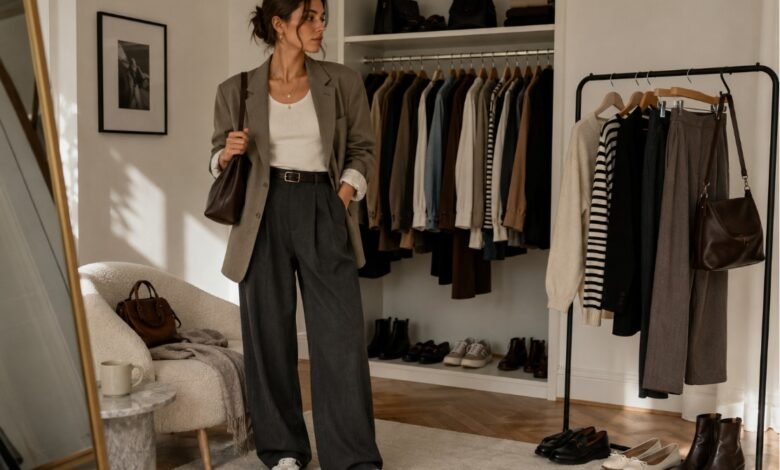
A fitted or compact top with full-length relaxed trousers.
A midi skirt with a slightly oversized knit and low-profile shoes.
Straight denim, an open shirt, a fitted base layer and a structured bag.
A dress with practical outerwear and shoes that make it wearable for an ordinary day.
In each case, the individual pieces can change.
The top may be white, grey, striped or burgundy. The trousers may be charcoal, brown, denim or olive. The jacket may be linen in summer and wool in winter.
The silhouette remains familiar enough that you understand it.
This is important because the body does not experience clothes as a list of trends.
It experiences pressure, movement, exposure, temperature, fabric and proportion.
You may admire several aesthetics and still feel best in one or two physical clothing structures.
Maybe you enjoy volume below the waist but dislike large sleeves. Perhaps you feel comfortable in long skirts but never in mini lengths. You may like oversized clothing only when one fitted layer remains visible. You may love tailored jackets and dislike tailored trousers.
A style uniform respects those preferences.
It says: this is the territory where I already know how to move.
That knowledge creates confidence.
It also creates room for experimentation because one part of the outfit remains stable while another changes.
A uniform should reduce panic, not reduce personality.
Repetition is one of the fastest ways to become recognizable
Fashion content often treats repetition as failure.
The same jeans again.
The same coat in another photograph.
The same shoe appearing through an entire month.
But personal style is built through repeated decisions.
If every outfit has a completely different silhouette, palette and mood, the wardrobe may be creative without becoming coherent.
Coherence does not require sameness.
It requires memory.
A person sees you several times and begins to understand the visual choices you return to.
Perhaps you always include one structured piece. Maybe your colors stay soft while your shoes remain practical. You may repeat long hemlines, silver jewelry, dark bags or crisp shirts.
Those patterns become more memorable than any isolated trend.
Repetition also improves judgment.
The first time you wear wide trousers with a compact jacket, you are testing the idea.
By the tenth time, you understand the correct jacket length, shoe shape, bag height and neckline.
The formula becomes more precise.
This is why people with strong personal style often appear effortless.
The effort did not disappear.
It happened earlier.
They already learned which details matter and which ones create unnecessary difficulty.
A uniform also protects attention.
There are mornings when clothing can be a creative project.
There are mornings when breakfast, traffic, weather and one missing earring have already used enough of your emotional budget.
A reliable formula gives you something good before the day asks for something brilliant.
Your closet already contains evidence of the uniform you need
Do not begin by inventing a completely new version of yourself.
Begin with what you already wear.
Not what you admire.
Not what you saved.
Not what you bought because it seemed like the beginning of a new era.
What do you actually reach for?
Pull out ten outfits or individual pieces that have worked during the last few months.
They do not need to be exciting.
They need to be honest.
Look at the bottoms first.
Are they mostly straight, wide, narrow, long, cropped, high-rise or soft?
Then look at the tops.
Do you prefer fitted, tucked, open, cropped, loose or layered?
Notice the distance between top and bottom.
Do you show the waistband? Cover the hip? Create one long vertical line? Repeat a short-over-long proportion?
Look at the shoes.
Are they slim or substantial? Flat or lifted? Soft or structured? Do you keep returning to sneakers, loafers, boots, sandals or ballet flats?
Finally, notice what you do not wear.
The untouched pieces are not simply bad purchases.
They may reveal the conditions your wardrobe resists.
A jacket may be beautiful but too short for your preferred trousers.
A top may be attractive but require a bra or layer you dislike.
A skirt may fail because none of your normal shoes work with its length.
A dress may be too complete, making repetition feel obvious.
Your closet is a collection of decisions and evidence.
Read it before adding another theory.
The final category is often the foundation of a true uniform.
Personal style is not only built from the garments people notice.
It is also built from the garments that allow the noticeable ones to work.
A useful uniform has three levels, not one rigid formula
I like to think of a style uniform in three levels.
The base uniform
This is the easiest outfit structure.
It works for errands, casual work, class, travel days, appointments and ordinary life.
It may be straight jeans, a fitted top, an open shirt and sneakers.
Or wide trousers, a compact knit and loafers.
Or a midi skirt, T-shirt, cardigan and flat shoe.
The base needs to be comfortable enough that you do not spend the day negotiating with it.
The polished uniform
This uses the same proportion with better finish.
The denim becomes trousers. The T-shirt becomes a fine knit. The casual jacket becomes a blazer or cleaner coat. The soft bag becomes more structured.
The person remains recognizable.
The level of formality changes.
The expressive uniform
This is where print, color, unusual shape or a dramatic accessory enters.
The base structure remains familiar enough to hold it.
Maybe the plain trousers become checked. The simple coat becomes quilted or bright. The fitted top becomes sheer, ruched or sculptural.
This prevents a common wardrobe problem: having practical clothes and expressive clothes that seem to belong to two different people.
The three levels connect them.
You do not need equal numbers of outfits at each level.
Most wardrobes need more base uniforms than expressive ones.
The goal is simply to ensure that special pieces have a known structure to enter.
Choose the silhouette before choosing the aesthetic
Aesthetics are seductive because they come with a complete visual answer.
Acubi, coquette, preppy, old money, grunge, quiet luxury, soft sporty, bohemian, minimalist.
Each offers colors, references, accessories and a mood.
But the body still needs a silhouette.
You may love a romantic aesthetic and feel uncomfortable in fitted dresses.
You may admire minimal tailoring and dislike narrow trousers.
You may enjoy Acubi styling but prefer longer tops and more secure necklines.
A personal uniform becomes durable when it begins with shape.
Ask where you like volume.
Upper body, lower body, both, or neither?
Ask where you like definition.
Waist, shoulder, neckline, ankle, wrist?
Ask which length relationships feel natural.
Short jacket with long trousers? Long shirt with straight jeans? Midi skirt with compact top? Oversized jacket over a narrow base?
Once the shape feels right, aesthetics become easier to borrow.
The same wide-trouser formula can look minimal in cream and grey, Acubi in washed black and olive, preppy with a striped shirt, romantic with a fitted lace top or polished with a sleeveless knit.
The silhouette is the grammar.
The aesthetic is the accent.
Your first formula should solve the most ordinary day
Do not begin with the outfit for a gallery opening, birthday dinner or photograph.
Begin with Tuesday.
Tuesday has errands, work, class, weather, sitting, walking and no interest in becoming a major fashion event.
Your first formula should make Tuesday look considered.
Write it as a relationship rather than a shopping list.
For example:
Formula A: compact top + full-length relaxed bottom + open or short structured layer + practical shoe + medium bag.
This could become:
A white tank, charcoal trousers, blue shirt and sneakers.
A fitted knit, dark jeans, cropped jacket and loafers.
A striped tee, olive trousers, denim jacket and flats.
The pieces change. The visual logic remains.
A useful first formula should pass several tests.
You can sit comfortably.
You can wear the correct underwear without redesigning your life.
The shoes suit the amount of walking.
The layer works with indoor and outdoor temperatures.
The bag holds the things you genuinely carry.
The outfit does not require constant tucking, pulling or checking.
This may sound unromantic.
It is actually how romance survives a schedule.
Clothes become part of personal style when they can accompany life rather than only decorate it.
The second formula should solve a different proportion
If every uniform formula uses the same trouser shape, same jacket length and same shoe, boredom will eventually arrive.
The second formula should create contrast while keeping your identity visible.
If the first formula is trouser-based, the second might use a skirt or dress.
If the first is oversized, the second might be cleaner and more vertical.
If the first emphasizes the waist, the second might emphasize length and movement.
Formula B: midi skirt or column skirt + simple top + longer soft layer + low shoe + smaller structured bag.
Or:
Formula B: straight denim + loose shirt + fitted base layer + substantial shoe + compact shoulder bag.
The formulas should not look like two unrelated wardrobes.
Connect them through color, accessories or repeated details.
Perhaps both use silver jewelry.
Maybe both rely on brown or black bags.
The same striped shirt can move between them.
The same shoe may work with trousers and a skirt.
This connection prevents the wardrobe from splitting into “the clothes I normally wear” and “the clothes I wear when I want to look different.”
Difference should remain accessible.
The third formula gives dresses and occasions a place to live
Dresses often fail to become part of personal style because they are purchased as complete events.
The dress is beautiful, but it does not connect to the normal wardrobe.
The shoes are different. The bag is different. The outerwear is an emergency. The person wearing it feels briefly transformed and slightly disconnected.
A dress formula solves this.
Formula C: simple or expressive dress + practical outer layer + familiar shoe family + one everyday accessory.
The practical outer layer may be a denim jacket, blazer, cardigan, leather jacket, trench or utility coat.
The familiar shoe family matters.
If you never wear delicate heels, a dress does not require them merely because it is a dress.
Loafers, boots, sneakers, sandals or flats can keep the outfit connected to your existing style.
The everyday accessory is equally important.
A bag you normally carry. A watch. A familiar earring. A jacket with visible wear.
These elements prevent the dress from feeling like costume.
This formula also improves shopping decisions.
Before buying a dress, you can ask whether it fits the existing equation.
Does it work with the jacket?
Does it tolerate the shoe?
Can the normal bag join it without looking accidental?
If not, the dress may require an entire second wardrobe.
A color system is more useful than a tiny neutral palette
Personal style advice often becomes beige very quickly.
Choose black, white, navy, cream and camel. Add one accent color. Live quietly ever after.
That works for some people.
It is not the only path to coherence.
A color system does not need to be small.
It needs relationships.
Choose two or three foundation colors that appear in trousers, jackets, shoes and bags.
Then choose several emotional colors that work with them.
For example:
This palette can create minimal, romantic, casual and polished outfits.
The foundation colors provide repetition.
The emotional colors prevent uniformity.
You may also discover that your wardrobe prefers temperature rather than specific shades.
Warm browns, cream, rust, olive and muted red.
Or cool grey, blue, black, lilac and silver.
Mixing warm and cool tones can be beautiful, but knowing your natural pattern makes shopping easier.
Color repetition is especially useful for accessories.
If your shoes, belts and bags share several compatible tones, the uniform becomes flexible.
If every accessory belongs to a completely different palette, simple outfits become strangely difficult.
Texture keeps familiar silhouettes from feeling copied
If you repeat the same silhouette, texture becomes one of the easiest ways to create variation.
A fitted white top can be cotton jersey, ribbed knit, linen, lace, silk, poplin or sheer mesh over a base layer.
Wide trousers can be wool, denim, linen, twill, corduroy or fluid crepe.
The formula remains recognizable.
The mood changes.
Texture also creates seasonal movement.
Summer uses washed cotton, linen, fine knits, canvas and woven accessories.
Autumn introduces suede, corduroy, denim, wool and deeper leather.
Winter adds heavier knitwear, quilting, smooth coats and dense trousers.
Spring returns to lighter layers, crisp shirting and softer surfaces.
This is more useful than replacing the entire wardrobe every season.
A uniform should have material versions.
Not only color versions.
Texture also helps monochrome outfits.
An all-black outfit can look flat when every piece has the same surface.
Black denim, a fine knit, leather bag and suede shoe create separation without adding color.
Cream linen, ribbed cotton and smooth leather can do the same.
When an outfit feels boring, the missing element may be texture rather than another accessory.
The shoe is where an outfit formula either becomes wearable or remains theoretical
Many outfit ideas work from the ankle upward.
Then real life begins.
The shoe must handle weather, walking, standing, driving, public transport and the exact hem of the clothes above it.
A useful style uniform usually has two or three shoe families.
Not twenty unrelated pairs.
Perhaps:
Each family should work with more than one formula.
The sneaker should work with trousers, denim and at least one skirt or dress.
The loafer or flat should work with workwear and casual outfits.
The boot should relate to both trousers and longer hems.
Shoe proportion matters more than many people realize.
A very chunky sneaker changes the apparent weight of wide trousers.
A delicate flat under a long heavy coat may disappear.
A high boot can interrupt a midi skirt at an awkward point.
A very round toe can make a narrow trouser feel more playful; a pointed or almond toe makes it sharper.
The most useful shoe is not always the most neutral one.
It is the one that consistently completes the proportions you wear.
This is why my article on how sneakers make basic outfits feel intentional focuses on shape and contrast rather than simply recommending a white pair.
Layers are the quickest way to change the personality without changing the uniform
A base outfit can feel minimal, preppy, romantic, relaxed or sharp depending on the layer placed over it.
Fitted top and straight jeans:
Add a linen shirt and the outfit becomes easy and summery.
Add a cropped jacket and it becomes more structured.
Add a long cardigan and it becomes softer.
Add an oversized blazer and it becomes polished.
Add a utility jacket and it becomes practical.
The base remains.
This is why a style uniform benefits from a small but distinct layer wardrobe.
The layers should not all perform the same role.
One should create structure.
One should create softness.
One should handle weather.
One may carry the strongest personality.
The best layers work open and closed.
They accommodate the sleeves beneath them.
They relate to the hem lengths you repeat.
A jacket that works with one outfit is a special item.
A jacket that changes four formulas is wardrobe infrastructure.
Accessories should edit the outfit, not rescue it
When a base outfit feels unfinished, the immediate response is often to add more.
Necklace. Belt. Scarf. Sunglasses. Bag charm. Earrings. Another necklace.
Sometimes the outfit improves.
Sometimes the accessories are trying to solve a proportion problem they did not create.
A personal uniform should work before accessories.
Then the finishing pieces can change emphasis.
A structured bag sharpens relaxed clothes.
A soft bag makes tailoring feel easier.
A belt reveals the waistband and separates volume.
Silver jewelry cools warm romantic details.
Gold can soften dark minimal outfits.
A scarf adds color near the face.
Sunglasses create structure without adding fabric.
Choose repeated accessory languages.
Maybe your bags are mostly brown and black with simple hardware.
Maybe your jewelry is silver and slightly sculptural.
Perhaps your belts remain narrow and your sunglasses are always dark and clean.
These repetitions create recognition.
The outfit does not need an entirely new accessory identity every day.
Tiny details can create polish, which is why small accessories that make outfits look more expensive can be useful once the main silhouette already works.
A uniform that ignores weather is a mood board, not a wardrobe
Climate changes style more than many aesthetic guides admit.
Humidity decides whether layering is realistic.
Rain changes the shoe.
Cold wind changes the neckline.
Air-conditioning creates an entirely separate season inside buildings.
Your uniform needs weather versions.
Hot weather
Keep the silhouette and change the materials.
Wide wool trousers become linen or light cotton.
A fitted knit becomes a ribbed tank.
The blazer becomes an open shirt or unlined jacket.
Leather loafers may become canvas sneakers, sandals or breathable flats.
The article on dressing elegantly in serious heat goes deeper into fabric, airflow and proportion.
Cold weather
Do not simply place a giant coat over everything and hope the identity survives.
Repeat the neckline, trouser shape, bag and shoe language beneath it.
Use knitwear that relates to the normal top proportion.
If your uniform depends on visible waist definition, choose shorter knits, belts or coats that open cleanly.
Rain
Build one rain version before the weather arrives.
Know which trousers can tolerate wet streets, which shoes have grip and which bag closes securely.
Style becomes easier when practical decisions are not treated as emergencies.
Your schedule should change the finish, not erase the identity
Many people feel as though they have several wardrobes.
Work clothes.
Weekend clothes.
School clothes.
Going-out clothes.
The categories may be necessary, but the person should remain visible across them.
Use the same underlying proportion and change the finish.
Work
Relaxed jeans become tailored trousers.
A cotton tee becomes a fine knit or clean blouse.
Sneakers become loafers or refined flats.
The bag gains structure.
School or class
The same trouser shape stays, but the fabrics become washable and the shoes more practical.
Use an open shirt, sweatshirt, cardigan or light jacket for temperature changes.
Weekend
Allow more texture, color and relaxed proportion.
The structure can soften without disappearing.
Dinner or event
Keep one familiar element.
The trousers you trust with a more expressive top.
The dress formula with a sharper bag.
The usual skirt with a richer texture.
This continuity makes dressier outfits feel like you rather than borrowed versions of elegance.
A personal uniform should adapt when comfort changes
Bodies change.
Weight changes. Hormones change. Health changes. Age changes. Sensory tolerance changes. The relationship to exposure changes.
A useful uniform is not a contract signed with a previous version of the body.
Keep the logic and adjust the placement.
If fitted waistbands become uncomfortable, the uniform may shift toward softer trousers while preserving the long lower line.
If sleeveless tops no longer feel right, a fitted short sleeve can maintain the compact upper proportion.
If heels leave the wardrobe, the trouser hem and dress lengths can be adjusted around flats.
If the waist changes, structure can move toward the shoulder, neckline, wrist or ankle.
Definition does not live in one location.
This is also why body-type rules often feel too permanent.
They tell a person which silhouette she is supposedly allowed to wear rather than helping her understand which proportion currently feels good.
A uniform is personal because it can evolve with the person.
The uniform becomes a filter for trends instead of a wall against them
A personal uniform does not require ignoring trends.
It gives trends a test.
Ask whether the trend can enter one of your existing formulas.
Brown shoes?
Can they replace the black shoe in your trouser and skirt uniforms?
Eyelet?
Can an eyelet top fit the compact-top formula you already use?
Capri pants?
Do they work with the shoe and jacket proportions you prefer?
A statement collar?
Can it appear under the knitwear you already own?
If the trend requires a completely new silhouette, shoe, bag, bra, coat and personality, it may be inspiration rather than a useful purchase.
This filter prevents the wardrobe from becoming a museum of isolated moments.
It also allows trends to feel personal.
The same item looks different when placed inside an established style language.
A romantic blouse with your usual dark trousers and practical shoes.
A sporty jacket over your familiar skirt formula.
A trending color inside the coat shape you already repeat.
You do not need to choose between timelessness and fashion curiosity.
You need a structure capable of editing both.
Once the formula is clear, shopping becomes less dramatic and more accurate
Shopping without a uniform often begins with attraction.
The item is beautiful.
The price seems acceptable.
The product page creates a life around it.
Then the wardrobe is asked to solve the consequences.
Shopping with a uniform begins with a role.
I need a warm-weather version of the compact top.
I need a structured layer that works with both trouser formulas.
I need a flat shoe that does not disappear beneath wide hems.
I need one dress that works with my existing jacket and bag.
This does not make shopping joyless.
It makes the joy more likely to continue after delivery.
This method also reveals when a duplicate is useful.
If one pair of trousers supports half the wardrobe, a second version in another season or color may be more valuable than an entirely new silhouette.
Repeating a successful role is not boring.
It is wardrobe maintenance.
When the uniform feels boring, change one layer of the system
Do not destroy the entire wardrobe because one week feels repetitive.
Identify the layer that has become tired.
If the silhouette feels boring
Use the contrasting second formula more often.
Change trouser width, hem length or jacket proportion while keeping the palette familiar.
If the colors feel boring
Add one emotional color that works with the foundation.
Burgundy, cobalt, butter yellow, olive, pink, red or silver can enter through a top, bag, shoe or knit.
If the surfaces feel boring
Change texture.
Denim instead of twill. Lace instead of jersey. Suede instead of smooth leather. A woven bag instead of a structured one.
If the outfit feels too practical
Add one expressive object.
A printed coat, unusual collar, sculptural earring or interesting shoe.
If the outfit feels too polished
Interrupt it with canvas, washed denim, a practical bag or relaxed layer.
If everything feels wrong
Return to the easiest base uniform for several days.
Sometimes the wardrobe is not boring.
The person is tired.
The seven-day test reveals whether the formula belongs to your life
Choose one base formula and wear a version of it for seven days.
Not the exact same clothes.
The same structure.
Day one: the easiest version with your most familiar pieces.
Day two: change the color while preserving the silhouette.
Day three: change the layer and notice how the mood shifts.
Day four: use a different shoe family.
Day five: make the formula polished enough for work or dinner.
Day six: add one expressive piece or trend.
Day seven: repeat the strongest version without trying to improve it.
Take quick photographs.
Notice where the outfit succeeds and where it requires too much management.
Does the top stay in place?
Does the trouser length work with the shoes?
Does the bag interrupt the silhouette?
Which layer creates the best proportion?
At the end of the week, the formula should feel easier rather than restrictive.
If every day required major correction, the structure may not be yours.
The seven-day outfit rewear challenge can help test repetition more broadly without buying anything new.
Seven personal uniforms that feel different without becoming complicated
The relaxed editor
Full-length trousers or dark denim, compact top, oversized shirt or blazer, low-profile sneakers or loafers, structured shoulder bag.
Colors: white, charcoal, blue, brown, burgundy.
The personality comes from proportion, clean layers and one good bag.
The practical romantic
Midi or full skirt, simple knit or fitted top, utility jacket or cardigan, flat shoe, soft leather bag.
Colors: cream, olive, faded blue, chocolate, soft pink.
Romantic shapes are grounded by practical outerwear.
The quiet maximalist
Simple trouser or skirt base, one print, one texture and accessories kept calm.
The uniform is not minimal, but the hierarchy is clear.
The long-line minimalist
Column skirt or straight trouser, fitted or fine-knit top, long coat, slim shoe, minimal bag.
Variation comes through fabric and monochrome color stories.
The soft sporty dresser
Relaxed trousers, tank or fitted tee, zip layer or lightweight jacket, sneakers, nylon or structured casual bag.
One polished detail prevents the outfit from looking like gym clothing.
The denim loyalist
One preferred jean shape, rotating tops, strong jacket wardrobe and two reliable shoe families.
The denim remains stable while the upper half creates mood.
The dress-and-jacket person
Easy dresses in several fabrics, repeated jacket shapes, familiar flat shoes and one everyday bag family.
The dresses vary widely, but the finishing language remains recognizable.
None of these uniforms requires a tiny wardrobe.
They require a clear relationship among the clothes.
A uniform fails when convenience becomes self-erasure
Making every item identical
You do not need five copies of the same black top unless you genuinely enjoy that level of repetition.
Repeat the role, not necessarily the exact object.
Choosing the uniform from someone else’s life
A fashion editor’s blazer-and-loafer formula may not suit a hot climate, active job or school schedule.
The uniform must survive your day.
Building around fantasy footwear
If the outfit only works with shoes you cannot wear for the required hours, the formula is incomplete.
Removing every expressive piece
Ease is not the same as neutrality.
Keep color, print, jewelry, texture or unusual outerwear if those details create pleasure.
Ignoring occasion gaps
A wardrobe may solve casual days perfectly and collapse before dinner, work events or celebrations.
Create polished and dress versions before the invitation arrives.
Using the uniform to avoid body changes
A silhouette that worked three years ago may no longer feel secure or comfortable.
Adjust the formula instead of blaming the body.
Shopping only for excitement
The exciting item must still join a role.
Otherwise the wardrobe becomes full of punctuation without sentences.
A uniform should evolve slowly enough to remain recognizable
Personal style changes because life changes.
A new job may require more polish.
A move changes climate.
Travel changes shoe priorities.
A health change makes certain fabrics or waistbands less comfortable.
A new aesthetic becomes interesting.
The uniform should absorb those changes rather than resist them.
Change one dimension at a time.
Keep the trouser formula and change the tops.
Keep the palette and change the silhouette.
Keep the shape and introduce a stronger shoe.
Keep the dress formula and replace the jacket.
This slower evolution allows style to remain connected.
It also makes purchases more intelligent because the new item has something to relate to.
A uniform is not finished when you write it down.
It becomes visible through use.
You may begin believing your signature is wide trousers and discover that the real signature is an open neckline.
You may think you love black and realize the consistent element is actually contrast.
You may believe the coat is the important piece when the true repetition is the relationship between long hems and compact bags.
Personal style is often more specific and more subtle than the aesthetic labels used to describe it.
Your uniform is not the outfit people can copy. It is the logic they can recognize but cannot reproduce without becoming you.
The goal is not to become predictable. It is to become easier to understand.
A personal style uniform gives the wardrobe a memory.
It remembers which trousers work with which shoes.
Which jacket length makes the lower line feel balanced.
Which colors connect without effort.
Which dress becomes wearable when interrupted by the right coat.
Which bag looks polished but still holds the actual day.
That memory reduces waste, shopping confusion and morning panic.
It also makes experimentation safer.
You can add an unusual print because the silhouette already works.
You can try a trend because the shoe and bag remain familiar.
You can wear a memorable coat because the clothes underneath know how to stay quiet.
The uniform creates stability.
Personality creates movement.
Good style needs both.
I do not want a wardrobe that surprises me every morning.
I want one that recognizes me—and still leaves enough room for a better idea.
Questions and answers
What is a personal style uniform?
A personal style uniform is a repeatable combination of silhouettes, colors and finishing details that consistently works for your body, comfort and schedule. It is usually a flexible outfit structure rather than one identical outfit worn every day.
How many outfit formulas should a personal uniform include?
Two or three main formulas are enough for most wardrobes. One can cover ordinary casual days, another can create a different proportion, and a third can handle dresses, work or more polished occasions.
Does a style uniform have to be neutral?
No. A coherent uniform can include bright color, checks, florals, metallics or unusual accessories. Repetition comes from relationships among colors and shapes, not from limiting the wardrobe to beige, black and white.
How do I find my personal outfit formula?
Look at the clothes you wear most often and identify repeated proportions. Notice your preferred trouser or skirt shape, top fit, jacket length, shoe weight and bag size. The strongest formula usually already appears several times in your real outfits.
Will wearing a uniform make my style boring?
It becomes boring only when every layer remains identical. Keep the silhouette and vary texture, color, outerwear, shoes or one expressive piece. A familiar structure often makes stronger items easier to wear.
Can I follow fashion trends with a personal uniform?
Use the uniform as a filter. A trend is useful when it can enter one of your existing silhouettes or color relationships without requiring an entirely new wardrobe. This makes the trend look more personal and usually increases the number of times it will be worn.
What if my work clothes and weekend clothes are different?
Keep one or two elements consistent across both wardrobes. The same trouser proportion, neckline, jewelry, shoe shape or color system can connect casual and professional outfits even when the fabrics and level of formality change.
How often should I update my style uniform?
Update it when your body, climate, schedule or comfort needs change. There is no required season. Adjust one part at a time so the wardrobe evolves without losing every familiar relationship at once.
Can dresses be part of a personal style uniform?
Absolutely. Repeat the way you finish dresses: the same jacket family, practical shoes, bag proportions or jewelry. The dresses themselves can vary while the finishing language keeps the outfits recognizable.
How does a personal style uniform help with shopping?
It gives every purchase a possible role. Before buying, you can ask which formula the item joins, whether it works with existing shoes and layers, and whether it duplicates a role already filled well. This reduces isolated purchases that look beautiful but never become outfits.