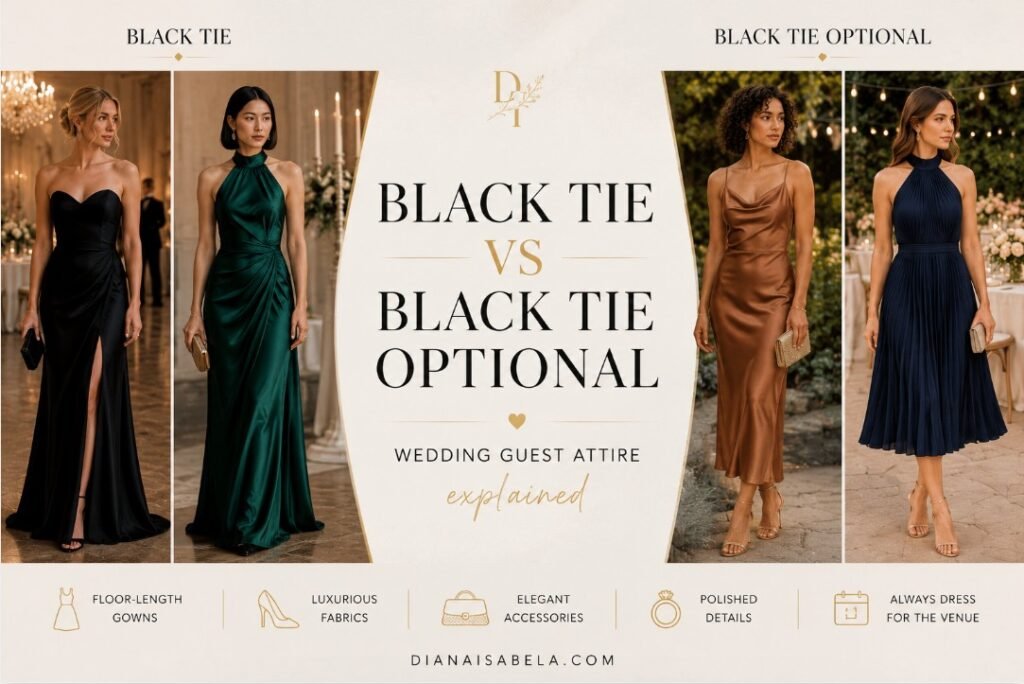
Black Tie vs Black Tie Optional Wedding Guest Attire: When a Gown Is Required and When It Is Just Very Welcome

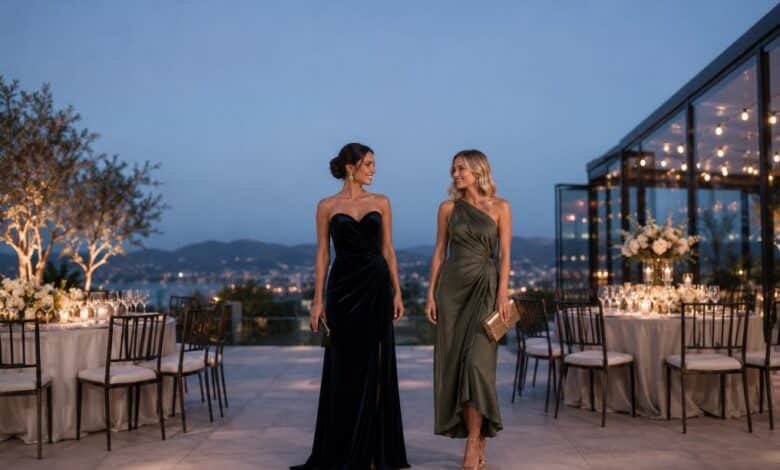
Black tie vs black tie optional wedding guest attire is the difference between a dress code that says “please wear the gown” and a dress code that says “a gown would be excellent, but I will not call the fashion police if you choose an extremely elegant alternative.” Both are formal. Both deserve evening fabrics, polished accessories, and real effort. But black tie is stricter, while black tie optional gives you a little breathing room — not sweatpants-level breathing room, obviously, more like “dressy midi with excellent judgment” breathing room.
The one-line answer Diana would text you from the fitting room
For black tie, wear a floor-length gown unless you have a truly exceptional formal alternative. For black tie optional, a gown is still the safest and most elegant choice, but a formal midi, ankle-length dress, or refined evening jumpsuit can work if the whole outfit looks expensive, intentional, and evening-ready.
What black tie means when it is written on the invitation
Black tie is one of the most formal wedding dress codes. It usually means tuxedos for men and floor-length gowns or very formal eveningwear for women. The couple is not asking guests to “look nice.” They are building a full evening atmosphere — often with a grand venue, formal dinner, candlelight, a serious photographer, and a room where casual fabric will feel like it wandered in from another tab.
The safest black tie wedding guest outfit is a floor-length gown in a formal fabric: satin, crepe, chiffon, velvet, silk-like blends, or structured jacquard. It can be minimal or dramatic, black or jewel-toned, sleek or romantic. The important part is that it reads unmistakably formal from across the room.
For the full dress-specific breakdown, use the black tie wedding guest dresses guide as the deeper reference.
What black tie optional actually gives you permission to do
Black tie optional is formal, but it is not as rigid as black tie. It means the couple would be happy if guests wear tuxedos and gowns, but they are allowing polished alternatives. For women, that means a floor-length gown is still very safe, but a dressy midi, ankle-length evening dress, formal cocktail dress, or elegant jumpsuit can also work when the styling is strong enough.
The mistake is hearing only the word “optional.” The black tie part still sets the tone. Optional does not mean casual. It does not mean daytime florals, office dresses, thin cotton, flip-flops, or a dress you would wear to a nice lunch with a better lipstick. It means you can interpret the formal standard with a little flexibility.
For a full guide to the softer side of this dress code, see black tie optional wedding guest dresses.
Black tie
The dress code is strict, traditional, and evening-formal. A gown is the default answer. If you skip the gown, your alternative has to be very, very convincing.
Black tie optional
The dress code is still formal, but slightly more forgiving. A gown is welcome, yet a formal midi or ankle-length dress can be perfectly appropriate.
The gown meter: how much dress do you really need?
This is not about being dramatic for sport. It is about matching the room. Some invitations want a gown because the whole wedding is designed around that level of formality. Others give you permission to be elegant without full red-carpet energy.
Can you wear a midi dress?
To black tie optional, yes — if the dress is formal enough. A navy satin midi, black crepe midi, emerald jacquard tea-length dress, burgundy velvet midi, or sculptural one-shoulder dress can work beautifully with the right shoes, bag, earrings, and hair. The midi should look like eveningwear, not like a pretty dress you upgraded with emergency jewelry.
To black tie, a midi dress is much harder. It is not automatically forbidden in every modern setting, but it has to be exceptional. The fabric must be luxurious, the silhouette sophisticated, the color evening-appropriate, and the accessories very polished. If you have to ask whether the midi is formal enough for black tie, I say this lovingly: wear the gown.
Midi for black tie optional
Possible and often chic. Choose satin, crepe, velvet, jacquard, formal chiffon, or a dress with a refined architectural shape.
Midi for black tie
Only if it looks clearly evening-formal. It should not feel like cocktail attire trying to sneak past security.
Midi that fails both
Office sheath, casual floral, beachy wrap dress, thin jersey, cotton sundress, or anything that wrinkles before the toast.
The Diana test: would it survive standing next to tuxedos?
Imagine the room. Men in tuxedos. Women in gowns. A formal table setting. Candlelight. A photographer who will absolutely capture your outfit from an angle you did not approve. If your look still feels like it belongs there, you are in the right zone.
Fabric: the fastest way to tell the difference
Black tie and black tie optional both need elevated fabrics, but black tie is less forgiving. A simple silhouette can be black tie if the fabric is rich, the length is right, and the styling is formal. A fancy-looking dress can still fail if the fabric is flimsy, clingy, too casual, or too daytime.
Color: both like depth, but black tie likes certainty
Black tie looks especially strong in black, navy, emerald, burgundy, deep teal, plum, chocolate, espresso, wine, and metallic accents that do not look bridal. These colors understand evening light. They do not need to beg for attention.
Black tie optional can handle the same deep palette, but it also gives slightly more room for softer shades if the fabric and cut are formal enough. Dusty blue satin, rose crepe, mauve chiffon, sage jacquard, or soft gold can work — as long as the outfit does not drift into bridesmaid, daytime, or almost-white territory. White, ivory, cream, and bridal champagne remain dangerous little traps with excellent lighting.
The venue tells you how strict to be
When the invitation feels unclear, look at the setting. Venue is the part of the dress code nobody prints in bold but everyone feels immediately when they arrive.
Shoes, bags, and jewelry: the outfit’s final signature
For black tie, the accessories should feel evening-specific: metallic heels, satin heels, refined sandals, a small clutch, drop earrings, pearls, diamonds, sculptural cuffs, or one strong piece of jewelry. The bag should be small. The shoes should be elegant. The overall effect should be polished enough for a formal photograph beside tuxedos.
For black tie optional, accessories can still be formal, but they can be slightly less ceremonial. A sleek clutch, heeled sandals, slingbacks, delicate jewelry, polished waves, or a low bun can make a formal midi look appropriate. This is where the optional outfit either becomes elegant or gets exposed as “nice but not enough.”
Outfit formulas that make the difference clear
When your brain starts comparing gowns at midnight, use formulas. They are less emotional than a shopping cart and more reliable than asking three friends who all have different weddings in mind.
Black satin column gown + metallic clutch + drop earrings
Classic, safe, elegant, and completely appropriate beside tuxedos without becoming bridal or theatrical.
Emerald crepe midi + slingbacks + sculptural earrings
Formal enough for the invitation, flexible enough if you do not want a floor-length dress.
Navy chiffon gown + pearl drops + satin sandals
Soft, refined, and gown-level without looking like prom, pageant, or someone else’s bridal party.
Chocolate ankle-length satin dress + gold cuff + small clutch
Rich, modern, and polished. This is the kind of alternative that understands the dress code.
If you do not want to wear a gown
For black tie optional, you have options. Choose a dressy midi, ankle-length dress, or elegant jumpsuit in a formal fabric. Keep the color rich or refined, the shoes polished, the bag small, and the beauty look intentional. You can skip the gown, but you cannot skip the effort.
For black tie, skipping the gown is much harder. If you really do not want a traditional gown, look for a sleek floor-length dress that feels minimal rather than dramatic. A black column gown, one-shoulder crepe dress, satin slip gown, or long halter dress can feel easy while still being correct. The trick is not to fight the dress code. It is to find the version of it that does not make you feel like you are wearing someone else’s personality.
What not to wear to either one
The wrong outfit for these dress codes usually falls into one of two tragedies: too casual or too attention-hungry. We do not need either. We are guests, not plot twists.
Where this comparison fits in the dress-code map
This comparison sits between two full guides: black tie wedding guest dresses for the strictest gown-forward version, and black tie optional wedding guest dresses for the formal-but-flexible version. For the full ladder of wedding formality, start with the main wedding guest dresses guide.
The mirror check before you leave
Ask yourself this: if half the room arrives in gowns, do I still look right? If the invitation says black tie and the answer is no, change. If the invitation says black tie optional and the answer is yes, you are probably safe. Then ask a second question: does this outfit look like a guest, not a bride, bridesmaid, prom queen, or nightclub headline?
The best outfit is not necessarily the most dramatic one. It is the one that understands the invitation without needing a legal argument.
The elegant difference is permission, not informality
Black tie asks for the gown. Black tie optional invites the gown but allows a polished alternative. That is the whole distinction. If the wedding is black tie, choose floor-length eveningwear and let your personal style live in the color, fabric, neckline, and accessories. If it is black tie optional, you can wear a gown or a very formal midi, ankle-length dress, or jumpsuit. Either way, the outfit should feel intentional, evening-ready, and respectful of the room. Optional does not mean casual. It means choose beautifully.
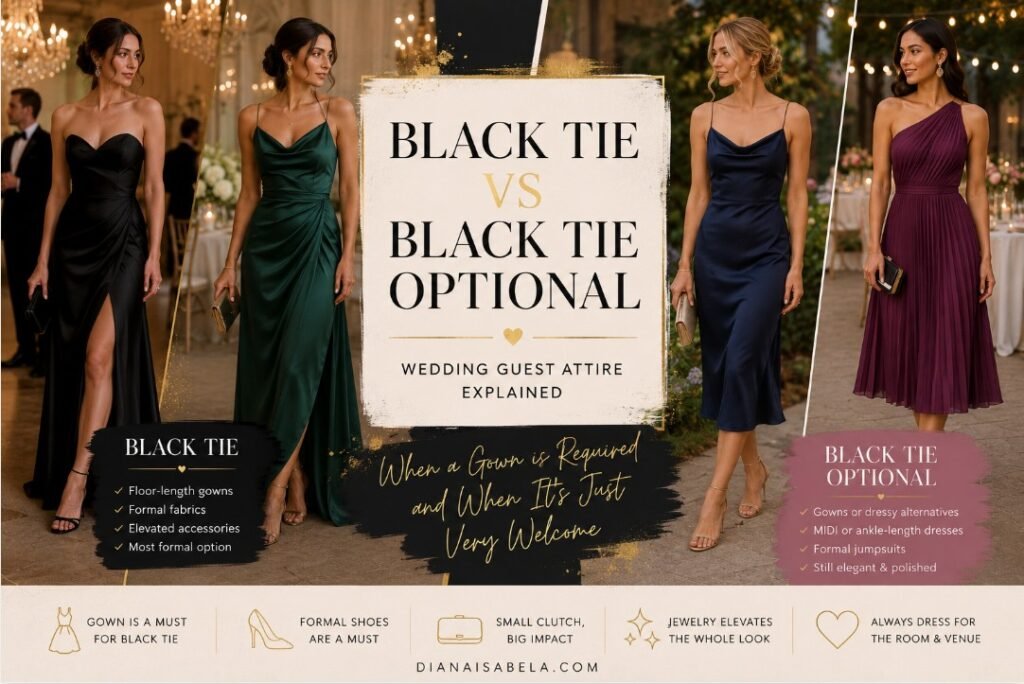
FAQ
What is the difference between black tie and black tie optional wedding guest attire?
Black tie is stricter and usually calls for a floor-length gown or very formal eveningwear. Black tie optional is still formal, but it allows more flexibility, such as a formal midi dress, ankle-length evening dress, or elegant jumpsuit.
Do I have to wear a gown to a black tie wedding?
A floor-length gown is the safest and most traditional choice for a black tie wedding. Some very formal alternatives may work in modern settings, but a gown is usually the correct answer.
Do I have to wear a gown to a black tie optional wedding?
No, you do not have to wear a gown to a black tie optional wedding. A gown is welcome and safe, but a dressy midi, ankle-length dress, formal cocktail dress, or elegant jumpsuit can work if the outfit looks polished and evening-appropriate.
Can I wear a midi dress to a black tie wedding?
A midi dress is risky for black tie unless it looks extremely formal in fabric, cut, color, and styling. If you are unsure, choose a floor-length gown.
Can I wear a midi dress to a black tie optional wedding?
Yes, a midi dress can work for black tie optional if it is made from formal fabric like satin, crepe, velvet, jacquard, or chiffon and styled with elegant shoes, a clutch, and polished jewelry.
Is black tie optional less formal than black tie?
Yes, black tie optional is slightly less strict than black tie, but it is still a formal dress code. Guests should still avoid casual fabrics, daytime dresses, and underdressed outfits.
What colors work for black tie and black tie optional weddings?
Good colors include black, navy, emerald, burgundy, plum, chocolate, espresso, deep teal, wine, and refined metallic accents. Softer shades can work for black tie optional if the dress is formal enough.
What should you not wear to black tie or black tie optional weddings?
Avoid casual sundresses, cotton florals, office dresses, denim, flip-flops, casual shoes, white or ivory dresses, bridal lace, and anything that looks too daytime or too informal.
Can I wear a jumpsuit to a black tie optional wedding?
Yes, an elegant jumpsuit can work for black tie optional if it is tailored, made from formal fabric, and styled with evening accessories. For black tie, a gown is usually safer.
How do I know if my outfit is formal enough?
Imagine standing next to guests in tuxedos and gowns. If your outfit still looks polished, formal, and appropriate in that setting, it is probably formal enough. If it looks like cocktail, office, or daytime attire, choose something dressier.