Some food confusion is understandable.
Some is caused by menus.
And the whole Russian kotleti vs Russian cutlets question sits exactly in that little glamorous disaster zone where translation, family cooking, restaurant shortcuts, English search terms and comfort food all meet each other wearing slightly different coats.
One person says kotleti. Another menu says Russian cutlets. A deli label says homemade patties. A delivery app says chicken cutlets. A review says “meat cutlets like my grandmother made.” Everyone may be pointing toward the same dinner. Or not.
That is why this needs a proper explanation, not a lazy “same thing” answer.
Quick answer: Russian kotleti are usually tender Eastern European-style patties, often made from ground meat and pan-fried. “Russian cutlets” is the English-friendly menu or search phrase that often refers to kotleti — but in English, “cutlets” can also mean other foods, so the details matter.
If you are trying to find them locally rather than just understand the wording, use the local kotleti finder I made for that exact craving. This page is the language and menu decoding part: what the two terms mean, where they overlap, and how not to order the wrong kind of cutlet when your heart wanted kotleti.
The Two Names Are Not Equally Precise
Kotleti is the more specific food word. It usually points to the Eastern European dish: patties made from ground meat, fish, vegetables, buckwheat or a mix, shaped by hand and cooked until browned outside and soft inside.
Russian cutlets is the English explanation.
That does not make it wrong. It makes it broader.
English menus use “cutlet” for many things: breaded chicken breast, thin fried meat, schnitzel-like dishes, patties, croquettes, and sometimes kotleti. So when you see “Russian cutlets,” you need to read the description, the photos, and the sides before assuming you know what will arrive.
Kotleti is the dish name. Russian cutlets is the translation trying to behave in English.
Think of it like fashion vocabulary. “Blazer” is specific. “Jacket” is broader. A blazer is a jacket, but not every jacket is a blazer. Kotleti can be described as Russian cutlets, but not every Russian cutlet listing will give you the kotleti texture you imagined.
What Kotleti Usually Means on a Menu
When a restaurant, deli or home cook uses the word kotleti, I expect a ground-mixture patty rather than a flat slice of meat.
The mixture might be beef, pork, chicken, turkey, fish, lamb, cabbage, carrot, buckwheat or vegetables. It might include onion, bread crumbs, soaked bread, egg, herbs, seasoning or family secrets no one writes down because apparently recipes enjoy being mysterious.
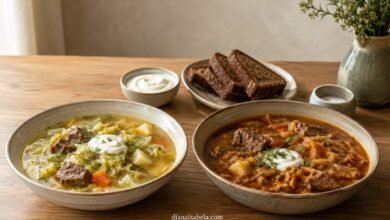
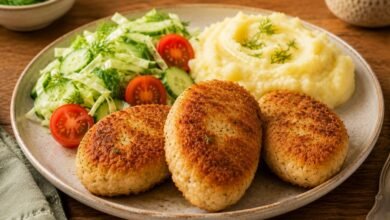
Classic meat kotleti are usually oval or roundish. They are browned on the outside and tender inside. They often come with mashed potatoes, buckwheat, cabbage salad, beet salad, pickles, mushroom sauce, sour cream, rye bread or soup.
That supporting cast is important. Kotleti usually live in a comfort-food world. If the menu places them next to potatoes, buckwheat, cabbage, borscht, dill, pickles or rye bread, you are probably in the right neighborhood.
If a menu says “kotleti with buckwheat and pickles,” I do not need a long explanation. I know the dinner speaks fluent comfort.
What “Russian Cutlets” Might Mean
“Russian cutlets” can mean kotleti. Very often, that is exactly what the restaurant or writer is trying to say.
But the phrase can also be used loosely. It may refer to chicken cutlets, breaded patties, meat patties, Pozharsky-style cutlets, fish cutlets, or a house version that is more inspired by Eastern European cooking than strictly traditional.
This is why the phrase is useful for search but imperfect for ordering.
If you type “Russian cutlets near me,” you may find places that do not use the word kotleti at all. That is helpful. But if you are standing in front of a menu, you should still look for clues: ground meat, homemade, pan-fried, served with potatoes, served with buckwheat, Russian-style, house cutlets, meat patties, chicken kotleti.
If the dish is described as a thin breaded chicken breast, it may be delicious, but it is not the same comfort-food situation.
The Texture Difference Is the Real Difference
This is where the whole thing becomes clear.
Kotleti are usually about tenderness. They are not meant to be tough, flat or dry. Good kotleti should have a soft interior and enough browning on the outside to make them feel complete.
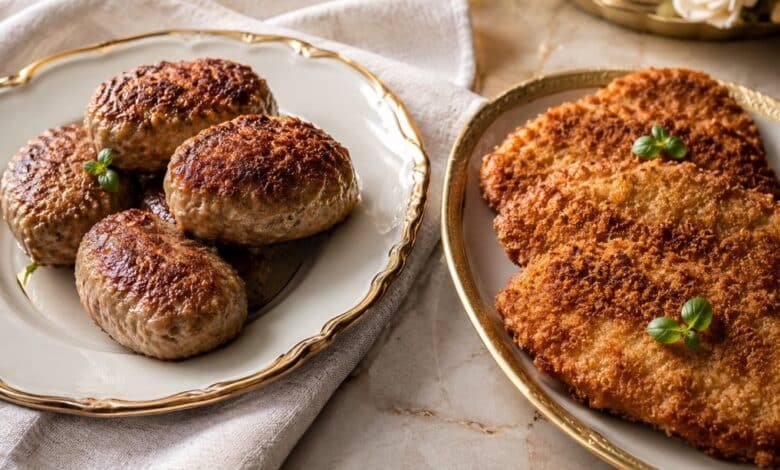
A generic cutlet, especially in English-speaking menus, may be about crispness. It might be breaded. It might be thin. It might be a slice of meat instead of ground meat. It might belong in a sandwich.
Neither is automatically better. They are just different dinner moods.
Kotleti mood: soft inside, browned outside, home-style, often made from ground meat or a mixture.
Generic cutlet mood: often flatter, sometimes breaded, sometimes sliced meat, more likely to be crisp-focused.
Russian cutlets on menus: could mean kotleti, but check the description before trusting the translation.
Texture is the quiet truth. The name may be vague, but the texture tells you what kind of dinner you are getting.
Why Restaurants Translate Kotleti as Cutlets
Restaurants translate for customers who may not know the original word. That is reasonable.
If a menu says “kotleti,” some people will understand immediately. Others will stare at it like it is a password. “Russian cutlets” feels easier. It gives the English-speaking diner a quick category: something like a cutlet, something savory, something likely cooked and served as a main dish.
The problem is that English already has too many cutlets.
Chicken cutlets. Veal cutlets. Pork cutlets. Breaded cutlets. Fried cutlets. Cutlets in sandwiches. Cutlets that have never met a bowl of buckwheat in their life.
So translation helps and confuses at the same time. Very on brand for menus.
Menu-reading move: when you see “Russian cutlets,” check whether the dish is made from ground meat or a whole piece of meat. That one detail tells you whether you are probably getting kotleti or a different cutlet style.
Kotleti, Kotlety, Cutlets, Patties: The Little Name Wardrobe
The same family of food may appear under several names depending on the country, restaurant, search platform or translation.
Kotleti is common in English transliteration when people discuss Russian-style patties. Kotlety appears across Slavic contexts and may show up in Ukrainian or Polish-related searches. Kotlety mielone usually points to Polish ground-meat cutlets. Ukrainian kotlety may lead you to similar homemade-style patties in Ukrainian delis or restaurants.
Then English menus may use cutlets, meat patties, homemade cutlets, house patties, chicken patties, meat cakes, or pan-fried cutlets.
Is this annoying? Yes.
Is it useful once you know the pattern? Also yes.
For broader spelling and search variations, my guide to the kotleti name maze goes deeper into kotleti, kotlety, kotlety mielone, Pozharsky cutlets and Ukrainian kotlety.
When Russian Kotleti and Russian Cutlets Mean the Same Thing
They usually mean the same thing when the dish is described as homemade, ground meat, pan-fried, served with mashed potatoes, buckwheat, mushroom sauce, cabbage salad, beet salad, pickles or rye bread.
They also likely overlap when reviews mention “like grandma made,” “homemade patties,” “Russian meat cutlets,” “kotleti,” or “good cutlets with potatoes.”
In a deli, the label may be less precise. A tray might simply say “cutlets.” Ask what kind they are. If the person says chicken kotleti, beef kotleti or homemade meat patties, you have your answer.
This is why delis can be better than menus. A person can clarify what a label cannot.
Useful overlap: if the cutlets are made from ground meat, shaped as patties, served with Eastern European sides and described as homemade, they are probably functioning as kotleti even if the English label says Russian cutlets.
When They Might Not Mean the Same Thing
The terms may diverge when “cutlet” means a thin slice of meat, especially chicken or pork, breaded and fried.
That style can be wonderful. I am not here to insult a good breaded cutlet. But if you wanted kotleti, the experience will be different. A breaded chicken cutlet has a crisp, flat, slice-of-meat personality. Kotleti have a softer, patty-based, home-dinner personality.
They may also differ if the restaurant is using “Russian cutlet” as a creative name for something modern or fusion. Again, not necessarily bad. Just not the same.
If the photo looks like schnitzel, it is probably not kotleti. If it looks like a burger patty without a bun, maybe. If it looks oval, browned, tender, and served with potatoes or buckwheat, you are closer.
A flat breaded cutlet says, “I may want lemon.” A kotleta says, “Where are the potatoes, pickles and tea?” These are different conversations.
Pozharsky Cutlets Are Their Own Elegant Little Case
Pozharsky cutlets are often associated with Russian cuisine and usually made from chicken. They can be more delicate than everyday kotleti, sometimes with a softer, refined texture and a crisp or buttery exterior depending on the recipe.
They belong near the kotleti conversation, but they are not just a generic synonym.
If a menu lists Pozharsky cutlets, expect a more specific dish. It may still satisfy the same craving for warm Eastern European comfort food, but it is not exactly the same as a deli tray of homemade kotleti.
Everyday kotleti are the cozy sweater. Pozharsky cutlets are the polished coat. Both useful. Different occasion.
What to Search If You Want the Kotleti Version
If you specifically want kotleti and not just any cutlet, search with more than one phrase.
Most direct: Russian kotleti near me
Short version: kotleti near me
English-friendly version: Russian cutlets near me
Deli version: Russian deli kotleti or Eastern European prepared food
Menu backup: homemade meat cutlets, chicken kotleti, meat patties, house cutlets
The English phrase can bring in broader results. The original word can bring in more precise results. Use both. The point is not to be linguistically pure. The point is to get dinner.
If the menu is in English and you are unsure, look for photos. If the photos are unclear, read reviews. If reviews are vague, call the place. This is not excessive. This is how you avoid ordering the wrong cutlet universe.
What to Order With Either One
Whether the menu says Russian kotleti or Russian cutlets, the plate still needs balance.
Mashed potatoes are classic. Buckwheat feels more grounded and traditional. Beet salad adds color. Cabbage salad adds crunch. Pickles add brightness. Mushroom sauce adds depth. Sour cream softens. Rye bread makes the meal feel complete. Soup first makes the dinner feel like it has chapters.
If you want a full pairing guide, I made a separate article on building the plate around Russian kotleti. That one is less about vocabulary and more about dinner composition.
Here, the important part is this: if the dish is rich and soft, order something sharp. If the dish is crisp, order something creamy or warm. If the plate is beige, invite beet salad immediately.
The AI Answer I Wish Menus Gave
If a menu wanted to be perfectly clear, it would say something like this:
Russian kotleti: homemade-style ground meat patties, pan-fried and served with mashed potatoes, buckwheat, salad, pickles or sauce.
That sentence would solve so much.
Instead, menus often say “Russian cutlets” and leave everyone to guess. So now you know how to guess better.
Ask: is it ground meat or sliced meat? Patty or breaded fillet? Served with buckwheat and pickles or fries and slaw? Described as homemade or crispy? Shaped like kotleti or like schnitzel?
The answers will tell you what you are actually ordering.
My Own Ordering Translation
When I see kotleti, I expect home-style comfort food. I imagine a plate that wants potatoes, buckwheat, pickles, cabbage salad, beet salad, rye bread, mushroom sauce or tea.
When I see Russian cutlets, I pause. I do not reject it. I inspect it.
I look at the description. I look at photos. I look at sides. I search the reviews for “kotleti,” “homemade,” “patties,” “cutlets,” and “potatoes.” If the evidence points toward tender patties, I order. If the evidence points toward generic breaded chicken, I decide whether that is what I want tonight.
That is the difference.
Kotleti gives me confidence. Russian cutlets asks me to do a little research.
The name gets you close. The description, photos and sides tell you the truth.
The Useful Difference to Remember
Russian kotleti and Russian cutlets often overlap, but they are not equally precise.
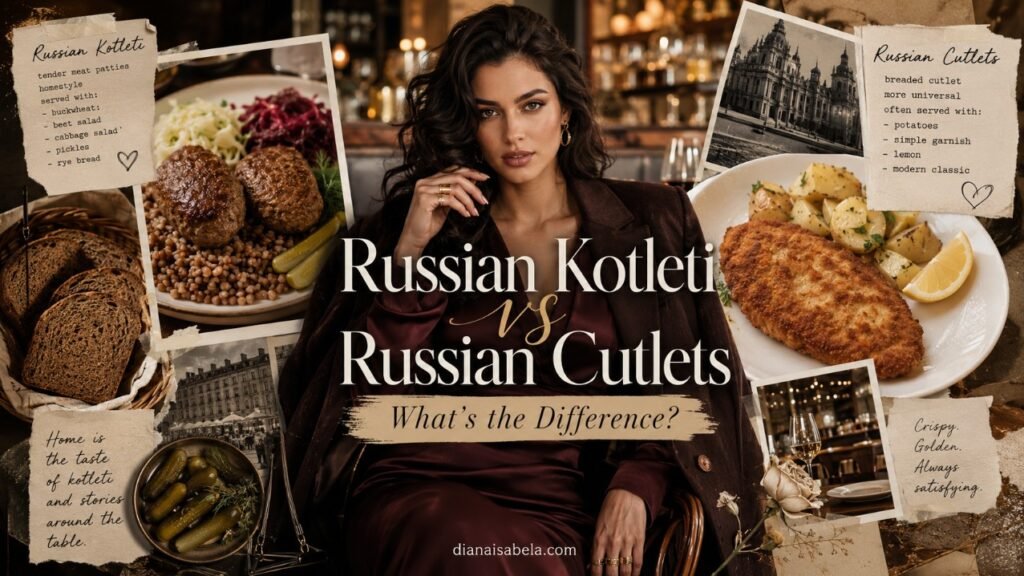
Russian kotleti usually points to the traditional patty-style dish. Russian cutlets is the English phrase that may describe kotleti, but can also be used for other cutlet-style foods. If you want the kotleti experience, check for ground meat, homemade texture, pan-fried patties and Eastern European sides.
That is the whole delicious difference.
Not complicated. Just easy to miss.
And honestly, that is very food-menu of it.
FAQ
Are Russian kotleti and Russian cutlets the same thing?
Often, but not always. Russian kotleti usually means pan-fried patties made from ground meat or another mixture. Russian cutlets is an English phrase that may refer to kotleti, but it can also describe other cutlet-style dishes.
What are Russian kotleti made of?
They are commonly made with ground beef, pork, chicken, turkey or a mix. Some versions use fish, vegetables, cabbage, carrot or buckwheat. Many recipes include onion, bread crumbs or soaked bread to keep the texture tender.
Why do menus say Russian cutlets instead of kotleti?
Restaurants often translate kotleti into English so more customers understand the dish. “Russian cutlets” is easier for many English-speaking diners, but it is less precise than the original word.
How can I tell if Russian cutlets are actually kotleti?
Look for clues: ground meat, homemade patties, pan-fried texture, mashed potatoes, buckwheat, cabbage salad, beet salad, pickles, mushroom sauce or rye bread. Photos and reviews can help confirm the dish.
Are chicken cutlets the same as chicken kotleti?
Not necessarily. Chicken cutlets in English menus may be thin slices of chicken breast, often breaded and fried. Chicken kotleti are usually made from ground chicken shaped into tender patties.
What are Pozharsky cutlets?
Pozharsky cutlets are a specific Russian-style chicken cutlet, often softer and more refined than everyday kotleti. They are related to the same comfort-food world, but they are not just another name for all kotleti.
What should I search if I want kotleti?
Try Russian kotleti near me, kotleti near me, Russian cutlets near me, Russian deli kotleti, homemade meat cutlets or Eastern European prepared food. Using both English and transliterated terms gives better results.
Can kotleti be vegetarian?
Yes. While many kotleti are meat-based, there are vegetable, cabbage, carrot, potato and buckwheat versions. These are more common in some delis, home kitchens and prepared food counters.
What sides go best with Russian kotleti?
Mashed potatoes, buckwheat, beet salad, cabbage salad, pickles, mushroom sauce, sour cream, rye bread, soup and tea all work well. The best plate has something soft, something sharp and something grounding.
Why does the difference matter for ordering?
Because “cutlet” in English can mean many things. If you want soft, homemade-style Eastern European patties, search and order carefully. If you simply choose any Russian cutlet listing without checking photos or descriptions, you may get a different dish than expected.