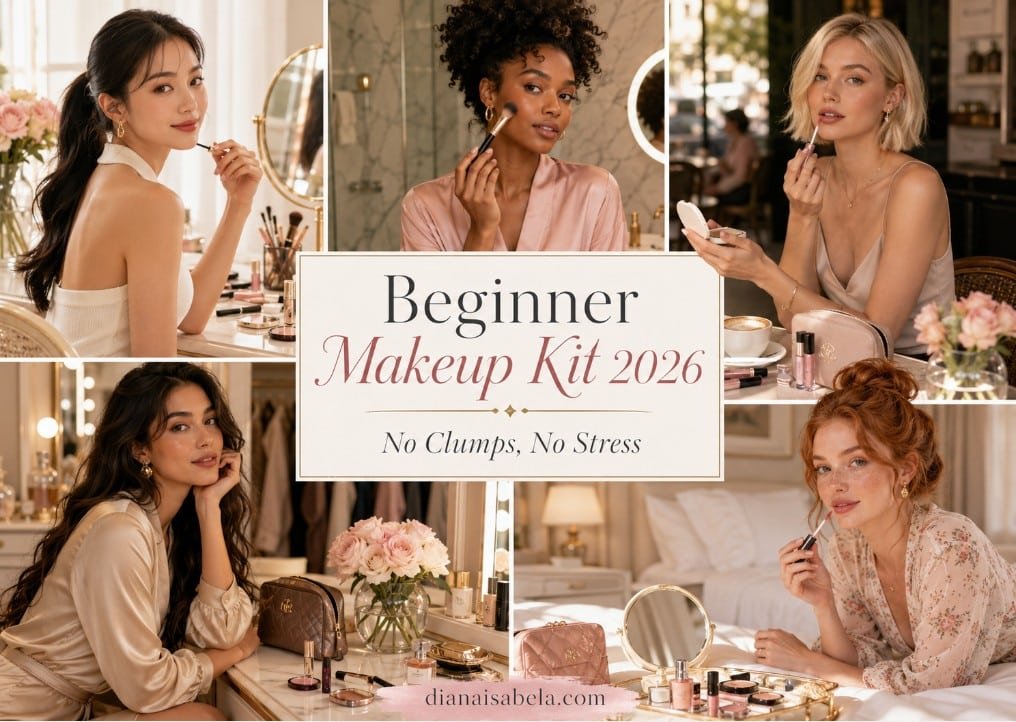
A beginner makeup kit in 2026 should not feel like you are packing for a beauty pageant, a chemistry exam, and a small emotional breakdown at the same time. You do not need twenty brushes, three foundations, a contour palette that looks like an architectural project, or a mascara that turns your lashes into five dramatic spider legs before first period.
The best beginner makeup kit is calmer. It helps you look more awake, more polished, more like yourself on a good-lighting day. It does not clog your skin, punish your lashes, dry your lips, or make you afraid of mirrors in natural daylight. No clumps. No stress. No “why did this tutorial look easy and now I look haunted?”
I want this kit to feel like a pretty little vanity drawer with actual common sense inside: comfortable skin prep, light coverage, a blush that makes you look alive, mascara that separates instead of clumps, brows that behave, lips that survive talking, and a few tools that make everything easier. Beginner makeup should be cute, forgiving and realistic. You should be able to do it before school, before work, before coffee, before a birthday photo, or before seeing someone who makes you suddenly care about your eyelashes.
The 2026 beginner makeup rule: less product, better behavior
The old beginner mistake was trying to buy a full face before learning what each product actually does. Foundation, primer, concealer, contour, powder, blush, bronzer, highlighter, brow pencil, brow gel, eyeshadow palette, eyeliner, mascara, lip liner, lipstick, gloss, setting spray, six brushes, one sponge, and a little panic.
That is not a kit. That is a drawer with commitment issues.
In 2026, beginner makeup is more about product behavior than product quantity. Does the mascara comb through the lashes? Does the concealer blend before it dries? Does the blush melt into the skin or sit there like a sticker? Does the brow product make you look groomed or surprised? Does the lip product feel comfortable after an hour? Can you fix a mistake without washing your whole face?
Diana’s starter rule: buy fewer products first, but make sure every product has a clear job. A beginner kit should solve real-life problems: tired eyes, uneven redness, pale lips, messy brows, flat cheeks, clumpy lashes and makeup that looks too obvious in daylight.
The goal is not to cover your face. The goal is to create a soft, clean version of your face that still moves, laughs, sweats a little, eats snacks, and survives a normal day.
What belongs in the beginner kit, and what can wait
Every beginner makeup kit has two categories: the things that help immediately, and the things that become useful later. The mistake is buying “later” products first because they look glamorous online.
Buy first
Moisturizer or skin prep, gentle sunscreen for daytime, concealer or skin tint, cream or powder blush, non-clumping mascara, brow gel, lip balm or gloss, one small brush or sponge, and cotton swabs for fixing tiny disasters.
Wait until you know your face better
Heavy foundation, contour palettes, complicated eyeshadow palettes, liquid liner, bold lipstick, baking powder, false lashes, glitter, strong bronzer and anything that requires a 12-minute explanation from a creator with studio lighting.
A good kit lets you practice. A bad kit makes you feel like makeup is a test you already failed. I do not want that for you. We are not suffering for mascara.
The beginner kit checklist that actually makes sense
1. Skin prep that makes makeup behave
Before you buy makeup, your skin needs a comfortable base. I do not mean a luxury skincare shelf with ten bottles that all promise to make you look like a glazed pearl by Thursday. I mean clean skin, moisturizer, and daytime sunscreen if you are leaving the house. Makeup sits better on skin that is not dry, angry, greasy from panic, or covered in random products fighting each other.
If your skin is oily, choose a light gel or lotion moisturizer. If your skin is dry, choose something creamier but not heavy. If your skin is sensitive, keep it boring in the best way: fragrance-free, gentle, simple. A beginner makeup kit should not turn skincare into drama.
Beginner move: wait a few minutes after moisturizer before applying concealer or skin tint. Makeup slides less when the skin prep has settled.
Skip for now: sticky primers, strong acids, heavy oils and anything that makes your face feel like a glazed donut under foundation.
If your skin is changing a lot, that does not mean your skin is “bad.” It means it is skin. For a calmer routine before makeup, use this guide to understand moody skin without treating your face like a problem.
2. Concealer or skin tint, not a mask
Most beginners do not need full foundation right away. They need something that makes redness, dark circles, little spots or uneven patches look softer. That can be a concealer, a tinted moisturizer, a skin tint, or nothing on some days. The kit should give you options without making your face feel hidden.
A good beginner concealer should blend easily, not dry instantly into a chalky stamp. Put it only where you want help: around the nose, under the eyes, on blemishes, around redness. Then tap and blend the edges. The face looks fresher when you do not cover every inch just because a bottle exists.
If you want almost no makeup: use concealer only where needed, then blush and lip balm. Done. Very civilized.
If you want more polish: use a thin skin tint first, then spot conceal. Thin layers look better than one thick layer asking for attention.
Shade matters. Test concealer in real light if you can. If it looks orange, gray, pink, chalky or ghostly, it is not “brightening.” It is betrayal.
3. Blush, because beginner makeup needs life
Blush is one of the most useful beginner products because it changes the whole face quickly. A little color on the cheeks can make you look awake, softer, healthier and more styled. The trick is choosing a shade and texture that you can control.
Cream blush is beautiful if you like a fresh, skin-like finish. It blends with fingers and looks less powdery. Powder blush is easier if your skin gets oily or you want something that lasts without feeling sticky. Liquid blush can be gorgeous, but beginners need to be careful because some formulas are extremely pigmented. One dot can become a full weather event.
Easy shade family: soft pink, peach, rose, berry, muted coral or warm terracotta depending on your skin tone.
Placement tip: start higher on the cheeks and blend outward. Low blush can drag the face down if you are not careful.
Beginner blush should look like your face got invited somewhere nice. Not like your cheeks are making an announcement.
4. Mascara that separates, not mascara that starts a fight
Mascara is the emotional center of a beginner makeup kit because when it works, you feel instantly prettier. When it clumps, flakes or smudges, the whole face starts looking tired and annoyed. A beginner mascara should separate, lift and define. It does not need to create a false-lash effect on the first try.
Look for words like lengthening, defining, tubing, separating, natural volume, washable or smudge-resistant depending on your needs. If your lashes are straight, a lash curler helps more than adding five coats. If your eyes water, tubing mascara may be easier because it tends to remove in little tubes with warm water. If your lashes are already thick, choose a cleaner brush instead of a super-wet volume formula.
No-clump method: wipe the extra mascara off the wand, start at the roots, wiggle lightly, then pull through the tips. Stop before the lashes start gathering into groups.
Beginner truth: the second coat is where many good lashes go to die. Add it only while the first layer is still flexible.
Brown mascara can be beautiful for school, soft makeup, blond or light lashes, and anyone who wants definition without drama. Black mascara gives more contrast. Clear mascara is useful for very natural days or brows, but it will not create much lash impact.
And please, if your mascara smells strange, feels dry, flakes badly or has been living in your bag since the last century, let her go. Mascara is not a family heirloom.
5. Brow gel before brow panic
Brows can make beginner makeup look clean even when you barely did anything. But brows can also become the place where a sweet face suddenly looks like it is supervising a meeting. Start with brow gel, not a dramatic pencil unless you truly need filling.
Clear brow gel is perfect if your brows have enough color but need shape. Tinted brow gel is useful if your brows are light or sparse. A pencil can help fill gaps, but use tiny hair-like strokes, not one long block of color. The front of the brow should stay soft.
Beginner brow routine: brush up, set lightly, fill only the empty spots, then brush again to soften.
Do not do this: draw the same eyebrow you saw on someone with completely different face structure, brow hair and lighting.
Good brows frame the face. They do not need to arrive before you do.
6. Lip balm, gloss or lip oil that you will actually use
A beginner lip product should be easy to apply without a mirror panic moment. Tinted balm, clear gloss, lip oil, soft pink, peach, rose, berry tint or a sheer brownish nude can all work. The best beginner lip is one you can reapply during the day without needing a legal strategy.
Matte liquid lipstick can wait. Sharp dark lip liner can wait. Very pale nude lipstick can wait unless it truly suits your coloring. Beginners usually look fresher with lips that have moisture and a little color.
School or daytime: tinted balm, lip oil or a soft gloss. Comfortable, pretty, low stress.
Photo day: lip liner close to your lip color, blended edge, gloss in the center.
If the lips feel dry, fix that before adding color. Lipstick over cracked lips is not a glow-up. It is texture with a publicist.
7. One soft eye product, not a giant palette you fear
A beginner does not need a 42-shade eyeshadow palette with names like Moon Drama, Cinnamon Secret and Emotional Espresso. You need one easy eye product you can use without creating a smoky eye by accident.
A champagne shimmer, soft beige, taupe, rosy brown, bronze stick, cream shadow or one small neutral quad is enough. You can tap shimmer on the lid, add a soft brown shade near the lash line, or brighten the inner corner. The point is to make the eyes look awake, not like you are attending a red carpet in algebra.
Beginner eye look: curl lashes, add mascara, tap a soft shimmer on the lid, brush brows. Finished.
Save for later: liquid liner, cut creases, dark smoky shadows and glitter fallout that follows you into lunch.
Eye makeup is easier when you build slowly. Start with light. Add definition later.
8. Powder only where the face asks for it
Powder is useful, but it is not wallpaper. Beginners often powder the whole face because they think makeup must be “set.” Then the skin looks flat, dry and older, and the blush sits on top instead of blending into the face.
Use powder only where makeup creases or shine bothers you: under the eyes, around the nose, chin, maybe forehead. Keep the cheeks fresher if you like glow. A small fluffy brush is better than pressing a heavy layer everywhere.
Good powder behavior: it softens shine without making the skin look dusty.
Bad powder behavior: it makes concealer crack, blush disappear, and your face look like it lost Wi-Fi.
If your makeup looks cakey, do not automatically add more setting spray or more powder. Usually the answer is less product and better blending.
9. Tools that help instead of confusing you
Tools do not need to be expensive, but they do need to be clean and useful. A beginner kit can start with one small brush for blush or powder, one sponge if you like skin tint, a spoolie for brows, cotton swabs for fixing mascara, and maybe a lash curler if your lashes point straight down like they have given up.
You do not need a brush set with 19 nearly identical fluffy things. You need tools you can recognize at 7:20 a.m.
Most useful: blush brush, damp sponge, spoolie, cotton swabs, lash curler, pencil sharpener if you use pencils.
Most forgotten: cleaning your tools. Dirty brushes can make makeup apply badly and irritate skin.
Also keep a tiny makeup bag for your essentials. Not your whole vanity. Just lip balm, blotting paper or tissue, mini powder if needed, and maybe a clean spoolie. Your backpack does not need to become Sephora with homework.
The five-minute beginner makeup routine
This is the routine I would give someone who wants to look fresh without learning seventeen techniques first. It works for school, casual plans, errands, coffee, video calls and low-stress everyday days.
Step 1: moisturize and let it settle. Daytime needs sunscreen if you are going outside.
Step 2: conceal only where needed: under eyes, redness, little spots, around the nose.
Step 3: add blush high on the cheeks and blend until it looks like skin.
Step 4: curl lashes if you want, then apply one clean layer of mascara.
Step 5: brush brows with clear or tinted gel. Fill gaps only if needed.
Step 6: finish with lip balm, lip oil or gloss. Check in natural light if possible.
This is enough. Truly. You can add eyeshadow, powder, highlighter or liner later, but the beginner face works because it is clean and believable. The prettiest everyday makeup usually looks like you slept well, drank water, and did not argue with a mascara wand before leaving the house.
The no-clump mascara lesson everyone needs first
Since this article is called No Clumps, No Stress, we need to speak directly to mascara. Mascara clumps for several reasons: the formula is too wet or too dry, the wand carries too much product, you add coats after the first layer has already dried, your lashes have leftover product on them, or you are trying to make one mascara do the job of false lashes, a lash lift and divine intervention.
Start with clean lashes. Curl first if you curl. Wipe extra product off the wand. Apply from root to tip. Comb through while the mascara is still flexible. Use a clean spoolie if lashes start sticking together. Stop sooner than you want to. That is the hard part.
Best for school, daytime, soft makeup, natural lashes and anyone who wants definition without drama.
Good for photos or stronger eye makeup, but only if the first coat is still slightly flexible.
Proceed only if your mascara, lashes and patience are all unusually cooperative.
Use almost nothing. Touch the tips lightly or skip them if mascara smudges under your eyes.
If your mascara always clumps, change the wand style before blaming your face. Rubber comb wands often separate well. Curved wands can help lift. Big fluffy wands can add volume but may overwhelm short or fine lashes. Tiny wands are underrated because they give control.
Beginner makeup mistakes I would fix first
Too much base. Thick foundation rarely makes beginner makeup look better. It usually makes every other product harder to blend. Start thinner.
Wrong concealer shade. Under-eye concealer that is too light can look gray or chalky. A little brightening is pretty. A white triangle under the eye is not a personality.
Clumpy mascara. Wipe the wand. Use one coat. Comb through. Replace old mascara. Stop using the tube that has been through three emotional eras.
Blush with no blending. Blush should melt into the face. If you can see where it starts and ends, keep blending.
Brows that are too heavy. Strong brows can be gorgeous, but beginner brows often look better brushed and softly filled instead of sharply drawn.
Copying a tutorial exactly. Your face, skin tone, eye shape, school lighting, time limit and comfort level are not the same as the creator’s. Use tutorials as ideas, not laws.
Three beginner kits depending on your real life
What not to buy first, even if it looks fun
I am not against dramatic makeup. I love drama when it knows where it is going. But beginner kits become stressful when you start with products that punish small mistakes.
Liquid eyeliner can wait unless you are already patient and steady. Heavy contour can wait because face shape is easier to learn after you understand base and blush. A giant eyeshadow palette can wait because beginners usually use three shades and feel guilty about the other thirty-nine. Bold lipstick can wait if you are still figuring out lip shape and comfort. Glitter can wait because glitter never truly leaves. It simply relocates.
Diana’s shopping edit: when you are tempted by a product, ask: will I use this on a normal Tuesday? If the answer is “only if I become a different person,” do not buy it first.
Your first kit should be made of products you can actually use, not products that look pretty in a drawer and accuse you every time you open it.
How to choose shades without spiraling
Shade choosing is where beginners often panic, because beauty aisles can feel like a wall of beige, pink, brown and marketing poetry. Start with undertone, depth and comfort. You do not have to become a professional artist. You just need products that do not fight your face.
For concealer, choose something close to your skin tone for blemishes and redness. For under eyes, a tiny bit brighter can work, but not several shades lighter. For blush, choose what your face naturally looks like when you flush: pink, peach, rose, coral, berry, terracotta. For lips, start with a shade close to your natural lip color but prettier. That is usually the easiest “my face but better” product.
If makeup looks orange: the shade may be too warm or too dark.
If makeup looks gray: the shade may be too cool, too light, or the coverage may be sitting strangely over your skin tone.
If blush disappears: the shade may be too light or too close to your skin tone.
If blush looks clownish: use less product, blend more, or choose a softer tone.
Natural light helps. Store lighting lies. Bathroom lighting lies with confidence. Your phone camera sometimes lies creatively. Check your makeup near a window if you can.
A beginner kit should be easy to remove
Removal matters. A makeup kit is not beginner-friendly if taking it off requires scrubbing your eyes like you are trying to erase a secret. Mascara and long-wear products should come off gently. If you use tubing mascara, warm water and light pressure often remove it in little tubes. If you use waterproof mascara, you need a proper remover or cleansing balm.
Do not sleep in makeup. I know. Boring rule. Still true. Sleeping in mascara can make lashes feel brittle and eyes irritated. Sleeping in base makeup can make skin feel congested. Sleeping in lip gloss is mostly just a pillowcase tragedy, but still, remove it.
Night routine: remove makeup gently, cleanse, moisturize. That is enough for most beginners. You do not need to punish your face for wearing blush.
The final vanity edit
A beginner makeup kit in 2026 should feel like relief, not pressure. It should help you build skill slowly. It should make your lashes look separated, your skin look like skin, your cheeks look alive, your lips feel soft, and your brows look like they understand the plan.
Start with skin prep, concealer or skin tint, blush, mascara, brow gel, lip balm or gloss, one easy eye product, light powder if needed, and a few tools that actually help. Learn your face. Notice what you like. Notice what annoys you. Use less than the tutorial. Add more only when the mirror asks nicely.
Makeup is not a requirement for being pretty. It is a little ritual, a little mood, a little play, a little polish. Some days you will want only lip balm. Some days you will want soft doll blush and fluttery lashes. Some days you will want no makeup and a hoodie. All valid.
The best beginner kit does not change your face into someone else’s. It gives you a softer, fresher, less-stressed version of your own. No clumps. No stress. No beauty panic. Just a small, useful bag of products that make getting ready feel easier.
FAQ: Beginner Makeup Kit 2026
What should be in a beginner makeup kit in 2026?
A beginner makeup kit should include moisturizer or skin prep, daytime sunscreen, concealer or skin tint, blush, non-clumping mascara, brow gel, lip balm or gloss, one easy eye product, light powder if needed, and a few simple tools like a sponge, blush brush, spoolie and cotton swabs.
What makeup product should a beginner buy first?
Start with products that make the biggest difference with the least stress: concealer, blush, mascara and lip balm or gloss. These are easier to use than contour, eyeliner or heavy foundation, and they help the face look fresh quickly.
Do beginners need foundation?
Not always. Many beginners look better with concealer only where needed or a light skin tint instead of full foundation. Foundation can be useful, but it is not required for a pretty everyday routine.
How do I stop mascara from clumping?
Wipe extra mascara off the wand before applying, use one light coat first, comb through while the mascara is still flexible, and avoid adding layers after the first coat has dried. If the formula is old, dry or too wet for your lashes, it may clump no matter how carefully you apply it.
Is brown mascara better for beginners?
Brown mascara can be easier for beginners because it gives softer definition and looks less harsh in daylight. Black mascara gives more contrast and drama. The best choice depends on your lash color, eye shape, outfit mood and how natural you want the makeup to look.
What is the easiest beginner makeup routine for school?
Use moisturizer, sunscreen, a little concealer, cream blush, one clean layer of mascara, brow gel and tinted balm. That routine looks fresh without feeling too heavy or complicated.
Should beginners use cream blush or powder blush?
Cream blush is great if you want a fresh, skin-like finish and easy finger blending. Powder blush is helpful if your skin gets oily or you want a softer, longer-lasting finish. Both can work; the best beginner blush is the one you can control.
What makeup should beginners avoid at first?
Beginners may want to wait on liquid eyeliner, heavy contour, large eyeshadow palettes, very matte liquid lipstick, false lashes and glitter. These products can be fun later, but they often make the first makeup routine more stressful than it needs to be.
How do I choose makeup shades as a beginner?
Choose concealer close to your skin tone, blush that looks like your natural flush, and lip color close to your natural lips but slightly prettier. Check shades in natural light when possible because store and bathroom lighting can be misleading.
How many makeup products does a beginner really need?
A beginner can start with six to eight useful products. You do not need a full professional kit. A small routine you can actually use is better than a drawer full of products that feel confusing.