Russian Kotleti in California: Where to Eat, Buy & Take Them Home
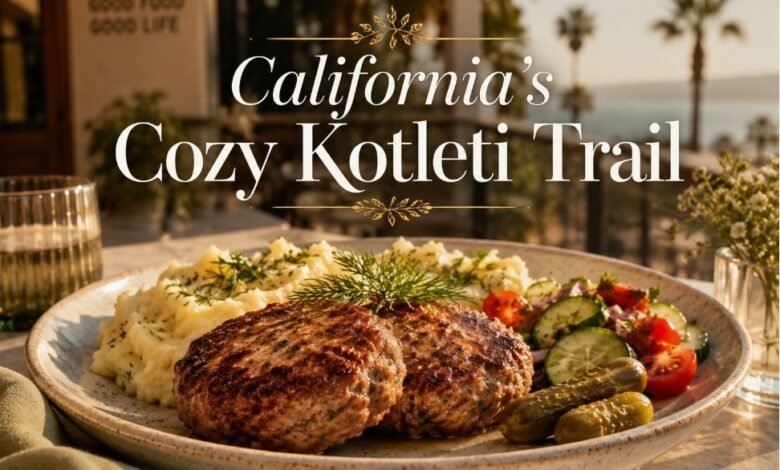
California has a slightly ridiculous definition of “near me.” A place can be excellent, technically in the same state, and still require enough freeway time to make you reconsider how badly you wanted a meat patty.
So finding Russian kotleti here is less about declaring one restaurant “the best in California” and more about figuring out which California you are actually standing in.
San Diego gives us the easiest restaurant answer: kotleti appear by name on a current menu as pan-fried ground chicken patties. Around Sacramento, Rancho Cordova gives us something I find almost more appealing—a European deli selling meat-and-bread cutlets by the pound, surrounded by the salads, soups and prepared foods that make kotleti feel like what they really are: dinner rather than an event.
Los Angeles is its own universe. Glendale matters more than a statewide ranking because Russian, Armenian and broader post-Soviet food traditions overlap there in ways that make both restaurants and specialty markets worth checking. The Bay Area changes the strategy again: Walnut Creek, San Francisco and San Jose are separate food zones, and a good market can be far more useful than a dining room if what you really want is several portions to bring home.
This is exactly the kind of dish that deserves that distinction. Kotleti are home food. They do not require white tablecloths, architectural plating or a waiter explaining the emotional journey of the onion. They require good meat, proper moisture, enough browning, and somebody who understands that minced meat becomes less tender the more aggressively you handle it.
My father taught me that part years before I knew the food science behind it. His version was simply: stop touching the meat. Mine, as a child, was apparently to interpret mixing as a competitive sport.
He was right.
One more thing before we eat our way through the state: I do not treat every dish called a “cutlet” as Russian kotleti. Sometimes the word refers to a ground-meat patty. Sometimes it means an intact chicken breast, pounded and fried. Both have a right to be delicious; they are just different foods.
San Diego is the easiest choice when you want kotleti served as a restaurant entrée. Rancho Cordova is exceptionally good for the take-home deli version. Glendale is the most interesting Los Angeles-area starting point. Walnut Creek and the wider Bay Area reward a market-first approach.
The thirty-second version
California does not have one kotleti scene
If I were planning this meal from a hotel room, car, apartment or mysteriously empty refrigerator, this is how I would divide the state.
Pomegranate currently uses the word Kotleti on its menu and describes the dish as pan-fried ground chicken patties. This is the least complicated place to start.
Kalinka Russian Cuisine remains one of the most relevant Glendale stops, and the surrounding area gives you plenty of grocery and deli alternatives if one dish is unavailable.
Privoz sells prepared cutlets by the pound, with meat, bread, onion and spices listed in the preparation. That is the sort of ingredient list that gets my attention immediately.
Babushka Market combines Eastern European groceries, prepared foods, deli service and café food in one place, with kotleti documented among its specialties.
The South Bay makes more sense when you think Russian and Eastern European market first, exact restaurant entrée second.
Notice what is missing: a statewide “winner.” California is too large for that to be useful. The most relevant kotleti are the ones you can actually reach before you become hungry enough to buy tortilla chips at a gas station and declare the evening over.
Southern California
San Diego: when the menu finally says exactly what you wanted it to say
Sometimes local-food research is wonderfully uneventful.
You want kotleti. The menu says Kotleti. The description says ground chicken patties.
Everyone can go home early.
Pomegranate — San Diego
A Russian and Georgian-rooted restaurant where kotleti currently appear by name rather than being hidden behind the broader English word “cutlet.”
How I would order: the chicken kotleti first, then something acidic or fresh. Beet salad, cabbage or another bright vegetable side makes more sense to me than stacking every creamy comfort food on the table at once.
Details checked August 2026.
Chicken kotleti are not the lesser sibling
Chicken has an unfair reputation in the ground-meat world. People call it lighter, healthier or more practical before anyone bothers to ask whether it is actually delicious.
It can be.
Chicken kotleti simply expose bad technique more quickly. Beef and pork bring more fat and therefore more forgiveness. Lean chicken makes you pay attention to moisture, onion, whatever bread or panade the cook uses, how firmly the mixture is handled and how long it stays in the pan.
That is why the texture tells me more than the ingredient list alone.
A good chicken kotleta should yield easily when you cut it. It should have real browning on the outside but not feel dry through the center. It should be cohesive without bouncing back at your fork like exercise equipment.
The last one is a particularly sad outcome.
The rest of the Pomegranate table
The restaurant also gives you a useful mix of Russian and Georgian foods, which makes it a good place for a group where not everyone arrived with the same obsession.
Pelmeni are the obvious sharing addition if somebody wants dumplings. Golubtsi move dinner toward cabbage rolls and another style of minced-meat comfort. Borscht makes the meal feel larger without repeating the kotleti texture. Olivier is wonderfully nostalgic but considerably richer.
And then Georgian food enters the room with khachapuri, khinkali and sharper sauces and suddenly your tidy little kotleti dinner has acquired ambitions.
I would choose rather than collect.
Restaurants with unfamiliar or nostalgic menus create the same psychological problem as a good vintage store: everything feels like it may disappear if you do not take it home immediately.
Dinner is not a rescue mission.
The side I would prioritize in Southern California
Freshness.
Not because traditional sides need to be “fixed,” and certainly not because comfort food requires an apology. I just think climate matters.
On a warm San Diego evening, chicken kotleti beside tomatoes, cucumbers, herbs and something pickled can be a much more appealing plate than chicken kotleti buried under three soft starches.
The browned meat gives you savory depth. Vegetables give you water and crunch. Pickles give you salt and acid. Dill ties the whole thing together without requiring a culinary TED Talk.
Los Angeles County
Glendale: where the Russian food search becomes much more interesting than one restaurant
Trying to discuss “Los Angeles” as if it were one neighborhood is one of those ideas that sounds normal only until you have actually driven there.
For kotleti, Glendale is a far more useful starting point.
The city has a deeply established Armenian community, including families whose histories pass through the former Soviet Union, and that creates a food landscape where Armenian, Russian, Georgian and neighboring traditions regularly sit close together without actually becoming the same cuisine.
That distinction is worth keeping.
Shared ingredients and shared grocery stores do not erase cultural specificity. They simply make dinner more interesting.
Kalinka Russian Cuisine — Glendale
A long-running Russian restaurant on Victory Boulevard and one of the strongest Los Angeles-area places to check when chicken kotleti are what you want.
Los Angeles has taught generations of people that “only fourteen miles away” is not useful information. Check the food first. Then check your willingness to participate in traffic.
What makes Glendale useful even if one dish disappears
A local-food destination is much more useful when it gives you a second answer.
If kotleti are unavailable, you do not want the entire evening to collapse into a parking-lot debate.
Glendale and the surrounding parts of Los Angeles have enough Russian, Armenian, Georgian and international food businesses that you can change direction without abandoning the entire cuisine family.
Pelmeni or vareniki can solve the same desire for something hot and home-style, though obviously with a very different texture. Buckwheat, prepared salads, pickled vegetables and deli foods can turn a grocery stop into dinner. A nearby Armenian market may not have the exact Russian dish you came for, but it may have several ingredients and prepared foods that feel completely at home beside it.
This is why immigrant grocery stores are often more informative than restaurant categories.
The category says “Armenian.”
The refrigerator tells you the family also buys sour cream, smoked fish, dill, mineral water, pickles and several products printed in Cyrillic.
Real life is rarely as tidy as a navigation menu.
The one phone question worth using
If the menu says “chicken cutlet,” do not ask whether they have chicken cutlets. You already know that.
Ask:
“Is it made from ground chicken, or is it a whole piece of chicken?”
That sentence has saved more confusion than any amount of scrolling through photographs.
If your LA plan is primarily deli food rather than a restaurant meal, my guide to finding Russian delis is the more useful companion because Los Angeles is exactly the sort of place where dinner may be sitting behind a grocery counter instead of on a printed entrée list.
Sacramento region
Rancho Cordova: sometimes “by the pound” is the most beautiful phrase in food writing
Restaurant plating is lovely.
I appreciate handmade ceramics, herbs placed with tweezers and a sauce swoosh as much as the next woman who has ever photographed lunch before touching it.
But there is something extremely seductive about a food counter that says:
Cutlets — $9.99/lb.
That language understands Tuesday.
Privoz Grocery & Deli — Rancho Cordova
A European grocery and prepared-food deli where the listed cutlets use meat, bread, onion and spices—the kind of composition that points strongly toward classic minced kotleti rather than a whole breaded piece of meat.
My weakness: a prepared-food counter where dinner can quietly become tomorrow’s lunch, breakfast-adjacent syrniki and “perhaps we also need one salad” in under eight minutes.
Menu, price and contact details checked August 2026.
That ingredient list is doing important detective work
English menu translations can be frustratingly vague around kotleti.
Cutlet might describe a whole chicken breast, a pork chop, a breaded slice, a minced-meat patty or something in between.
But Privoz gives us more than the noun.
Meat.
Bread.
Onion.
Spices.
That is much closer to the domestic logic of kotleti.
The meat is not simply portioned. It is being turned into a mixture.
Why bread belongs in good kotleti
Bread has terrible public relations.
People hear that it is mixed into ground meat and immediately assume someone is trying to cheat them out of protein.
Historically, stretching meat certainly mattered. Most classic home cooking evolved in households where ingredients had a cost and nobody had invented the phrase “food content creator.”
But bread can also improve texture.
When softened with liquid and mixed appropriately into minced meat, it helps hold moisture and keeps the finished patty from becoming compact and tough.
The important part is balance.
Too much and you lose the meat character. Too little moisture and you gain nothing. Overmix everything and you undo some of the tenderness anyway.
This is why very simple foods are often technically revealing. There is nowhere for bad handling to hide.
The dinner I would bring home from Rancho Cordova
First: cutlets.
Second: vinegret.
That would probably be my favorite pairing because beets and pickles bring sweetness and acidity against browned meat.
If I wanted the fully comforting version, then potatoes or another warm starch.
Olivier is always tempting, though pairing a rich meat patty with potatoes and a mayonnaise-heavy salad is the culinary equivalent of putting on a cashmere sweater, wool coat and scarf because each is individually beautiful.
Eventually you become warm.
Add something sharp.
Pickles are cheap therapy for a heavy plate.
Why this format may suit kotleti better than a restaurant
Kotleti are almost designed for leftovers.
They reheat well if you do not abuse them.
They work beside a completely different side the next day.
They can become a sandwich with dark bread, mustard or something pickled.
They can sit in a lunch container without requiring an elaborate sauce architecture.
And they do not become existentially sad at room temperature within seven minutes the way some crisp fried foods do.
So if I lived anywhere near Rancho Cordova, I would buy enough for more than one meal.
Future me deserves occasional evidence that past me cared.
Northern California
Walnut Creek and the Bay Area: the market is part of the answer
The Bay Area refuses to give this guide one neat restaurant street.
Russian and Eastern European food is scattered across different cities, so a useful plan depends heavily on whether you are already in San Francisco, the East Bay, Walnut Creek or San Jose.
For this particular dish, Walnut Creek gives us the most interesting market-style lead.
Babushka Market, Deli & Cafe — Walnut Creek
A family-run Eastern European food market with an in-house deli and café, where kotleti have been featured among the prepared foods the business is known for.
A rotating deli does not bother me. In some ways it makes more sense for home-style food. Somebody cooked a batch. People bought it. The tray emptied. That is not a failed menu strategy; that is lunch.
Business and location details checked August 2026.
This is why I love immigrant markets
Restaurants show food prepared to be ordered individually.
Markets show how people actually organize a kitchen.
Look around a good Eastern European store and the story becomes much wider than the hot counter.
Buckwheat.
Pickled vegetables.
Frozen dumplings.
Smoked fish.
Rye bread.
Sour cream.
Cakes.
Jars whose labels assume you already know what they are for.
Prepared salads sold by weight because nobody at home needs precisely one restaurant-sized scoop of Olivier.
This is the part of food culture I find endlessly interesting. A restaurant tells you what a cuisine is proud to serve to guests. A market tells you what people want waiting in the refrigerator on Wednesday.
Kotleti belong very naturally to Wednesday.
And if kotleti are gone?
Do not make the entire trip emotionally dependent on one tray.
If Babushka has pelmeni, golubtsy, piroshki, soup or another freshly prepared dish you like, dinner can change shape without becoming a disappointment.
That is part of why a market is safer than a one-dish mission.
There is usually another answer within ten feet.
San Jose: treat the Russian grocery as a resource, not a consolation prize
The South Bay has Russian and Eastern European grocery inventory even when an exact permanent kotleti entrée is less obvious.
That means I would search the prepared-food and frozen sections before driving north solely because another city has a more photogenic restaurant result.
Frozen food gets underrated in local-food guides because it is not glamorous enough.
But if your Russian grocery is twenty or thirty minutes away, frozen dumplings, prepared patties and a few pantry basics may be the smartest possible purchase.
Convenience is part of good food.
Especially in California.
What kind of evening are we solving?
One dish, three completely different plans
I want to sit down and eat kotleti
San Diego: Pomegranate gives you the cleanest current answer because Kotleti are explicitly listed as ground chicken patties.
Glendale: Kalinka is the Los Angeles-area restaurant I would check first, with a quick call before a cross-city trip.
In this scenario, certainty beats abundance. You want dinner now, not an interesting freezer section.
I want several portions to take home
Rancho Cordova: Privoz is the standout because the cutlets are sold by weight and the deli has a broad prepared-food selection around them.
Walnut Creek: Babushka makes sense when you want prepared food plus groceries, bread, pickles and whatever else dinner becomes once you are actually standing inside the store.
This is the format I personally prefer for kotleti. They are too good at leftovers to buy exactly enough.
I am feeding a group
Forget the single entrée price for a moment.
Ask whether the kitchen can produce the quantity you need, how the food is priced, whether the kotleti arrive hot or chilled, what sides can be ordered in matching quantities and how much notice is required.
A restaurant serving two beautiful kotleti on a plate does not automatically mean the kitchen wants to make sixty of them on Saturday afternoon.
Restaurants have limits. So do hosts.
The linguistic trap
How to tell whether a California “cutlet” is actually the kotleta you mean
The safest method is almost offensively simple.
Ask what happens to the meat first.
You are probably in kotleti territory
The cook grinds or minces the meat, combines it with ingredients such as onion, bread, seasoning or moisture, then shapes individual patties.
You are looking at another kind of cutlet
The cook begins with an intact chicken breast, pork piece or other whole cut, then pounds, breads, batters or fries it.
That distinction sounds technical until you eat both.
The textures are nowhere near each other.
A kotleta should not fight the fork
There are many family styles, but tenderness is one of the characteristics I care about most.
The inside should feel cohesive, not loose, but it should not resemble compressed meat.
Ground meat changes as it is mixed. The proteins start binding more firmly. Work the mixture heavily enough and you can create a springier, tighter texture.
That can be excellent when you are making something that needs that structure.
I do not want it here.
Shape confidently, not aggressively.
Onion is part flavor, part moisture management
Raw grated onion nearly disappears into the mixture and brings liquid with it.
Finely chopped onion is more visible.
Cooked onion turns sweeter.
Every family has a preference and every family somehow becomes convinced that preference is jurisprudence.
This is how you know you are dealing with real home food.
Bread is not an admission of defeat
Bread or a bread-based panade appears in many kotleti styles because it can help with moisture and tenderness.
It also reflects the practical history of home cooking, where meat needed to feed families rather than perform as a luxury object.
I like foods that contain that history.
A good recipe often tells you more about ordinary life than a ceremonial dish ever could.
Build a better plate
What tastes good with kotleti in California
I am not interested in changing traditional food into something “California-friendly,” whatever that would mean.
I am interested in appetite.
A cold evening and a 95-degree inland afternoon do not ask the same thing from dinner.
Mashed potatoes
The classic soft companion. Potatoes absorb the savory juices beautifully and make particular sense with beef or mixed-meat kotleti.
Buckwheat
Nutty, earthy and brilliant for take-home meals. It reheats well and gives you a firmer texture than mashed potatoes.
Vinegret
Beets, pickles and acidity make this one of my favorite sides for richer kotleti. It gives the plate contrast instead of more weight.
Cucumber-tomato salad
Especially good in warm weather. Juicy vegetables and dill make chicken kotleti feel brighter without making them less comforting.
Cabbage
Raw, lightly dressed or pickled cabbage gives crunch, which is exactly what a plate of tender meat and soft potatoes sometimes lacks.
Pickles
Possibly the highest-performing square inch of the entire plate. Acid, salt and crunch all at once.
And yes, Olivier is wonderful
I simply would not automatically combine kotleti, mashed potatoes and a large portion of Olivier unless maximum comfort is the entire objective.
All three are soft and rich.
Add something sharp beside them.
One pickle can save a plate from taking itself too seriously.
What about borscht and pelmeni?
Borscht before kotleti makes beautiful sense when you want a slower, larger dinner.
Pelmeni are useful when people are sharing and somebody wants dumplings too—which somebody almost always does.
But I would not order every familiar dish simply because it appears on the same menu.
Good dinner has rhythm.
Soup, meat, vegetables, something acidic, perhaps bread.
Not eight greatest hits fighting for table space.
The part of local food I love most
Why a deli counter can tell you more about a community than a restaurant menu
A restaurant has to communicate quickly.
Names get translated. Dishes are selected for individual ordering. Certain foods stay because customers recognize them. Others disappear because they are difficult to explain, difficult to plate or simply more natural at home.
A market answers a different question:
What do people actually buy?
This is where you see the foods that do not need an introduction.
Containers of prepared salad.
Frozen dumplings.
Smoked fish.
Pickles.
Bags of buckwheat.
Dark bread.
Sour cream.
Sweets purchased entirely because one bite can transport an adult back to being eight years old.
And, if you are lucky, a tray of kotleti.
This is the ordinary side of cuisine, and I mean ordinary as the highest compliment.
Celebration food tells us what people cook when everybody is watching.
Everyday food tells us what they actually miss.
When California is being California
If the nearest good kotleti are simply too far away
There is a distance at which “worth the drive” stops being a food recommendation and becomes a personality trait.
If none of the stronger California options are reasonably close, widen the type of business before you widen the radius.
Try a Russian deli. Kotleti are home-style food and often appear more naturally at a prepared-food counter than on a formal restaurant menu.
Try Ukrainian and broader Eastern European markets. Household food traditions overlap enough that a store may have minced cutlets even when the business does not call itself Russian.
Ask about the prepared-food counter. “Do you have ground-meat kotleti today?” is much more useful than asking whether the store sells Russian food.
Check the freezer. If specialty shopping is an occasional trip, frozen food can turn one drive into several future dinners.
Cook them. Eventually your own frying pan becomes a much better transportation system than I-5.
For places beyond California, continue with my Russian Kotleti Near Me guide.
And if nothing reasonable is close enough, the classic Russian kotleti recipe is the solution I would choose before sacrificing half a day to traffic.
Focus on tenderness before complexity: enough moisture, onion, gentle mixing and a properly heated pan. Let the first side develop real browning before turning the patties. A good kotleta does not need twenty ingredients; it needs somebody to stop interfering at the right moment.
Before you leave
Five questions that are more useful than forty old food photos
Do you have kotleti today? Prepared-food counters sell through batches.
Are they made from ground meat? This immediately separates classic kotleti from many whole-meat cutlets.
What meat do you use? Chicken, beef, pork and mixed-meat versions can taste and behave quite differently.
How are they sold? Restaurant plate, individual pieces, by weight, chilled or frozen?
Can I order more for a group? Ask about quantity and notice before assuming the regular menu scales up automatically.
Those questions are not particularly glamorous.
Neither is arriving after a 55-minute drive and discovering the last kotleta left the building at lunch.
Where I would begin
My California shortlist
San Diego: Pomegranate when you want the simplest restaurant answer and an explicitly named ground-chicken kotleti dish.
Glendale: Kalinka when Los Angeles is your territory and you want a proper Russian restaurant first.
Rancho Cordova: Privoz when take-home dinner matters more than restaurant service. The by-the-pound format is almost perfectly suited to kotleti.
Walnut Creek: Babushka Market when you want prepared Eastern European food and grocery shopping in the same stop.
South Bay: think Russian and Eastern European grocery first if the alternatives require unreasonable driving.
The important thing is not finding California’s theoretical best kotleta.
It is finding the good one that fits your actual evening.
Local information checked: August 2026. Restaurant menus, prices and deli inventory can change, especially prepared foods made in batches. If you are driving a significant distance for one specific dish, call first.
California questions
Russian Kotleti in California FAQ
Where can I find Russian kotleti in California?
San Diego currently has one of the clearest restaurant options at Pomegranate, where Kotleti are listed as pan-fried ground chicken patties. Rancho Cordova is especially useful for take-home cutlets at Privoz, while Glendale and Walnut Creek are strong Southern California and Bay Area places to check.
Where can I eat Russian kotleti in San Diego?
Pomegranate at 2312 El Cajon Blvd in San Diego lists Kotleti made as pan-fried ground chicken patties. The restaurant phone number is (619) 298-4007. Call before a long drive because menus and prices can change.
Where can I buy kotleti near Sacramento?
Privoz Grocery & Deli in Rancho Cordova sells prepared Cutlets by the pound. The listed ingredients are meat, bread, onion and spices, which closely match classic minced kotleti construction. It is at 9777 Lincoln Village Rd and the phone number is (916) 661-8824.
Where should I look for Russian kotleti in Los Angeles?
Glendale is a useful place to begin. Kalinka Russian Cuisine at 1714 Victory Blvd is a relevant Russian restaurant to check for chicken kotleti. Because Los Angeles travel times can be substantial, confirm current availability before crossing the city for one dish.
Can I find kotleti in the Bay Area?
Babushka Market, Deli & Cafe in Walnut Creek is a strong Eastern European market and deli lead. Chicken Kotleti and Russian-style meat patties have been featured among its specialties, but prepared-food availability can rotate, so call before a dedicated trip.
Are Russian kotleti the same as chicken cutlets?
Not always. Classic kotleti are generally made from ground or minced meat that is mixed, shaped and cooked as patties. A chicken cutlet on an American menu may instead be an intact piece of chicken that has been pounded, breaded or fried. Ask whether the meat is ground if you want classic kotleti texture.
Can I buy Russian cutlets by the pound in California?
Yes. Privoz Grocery & Deli in Rancho Cordova currently lists its prepared Cutlets by the pound. This format is particularly useful when you want several portions for home rather than one restaurant entrée.
What tastes good with Russian kotleti?
Mashed potatoes and buckwheat are classic warm choices. Pickles, vinegret, cabbage salad and cucumber-tomato salad add acidity and crunch, which balance browned meat particularly well. Borscht can turn the meal into a larger dinner, while pelmeni are useful for sharing.
Should I call a deli before driving there for kotleti?
Yes, especially when the trip is long. Prepared-food counters may rotate dishes or sell through a batch during the day. Ask whether kotleti are available, which meat is used, whether they are made from ground meat and whether they are sold by piece, weight, hot, chilled or frozen.
What can I do if there are no Russian kotleti near me in California?
Check Russian, Ukrainian and Eastern European delis or markets before expanding your driving radius. Prepared-food counters and freezer sections may offer better options than restaurant searches. If nothing useful is nearby, homemade kotleti are usually more practical than a long California drive.