Why Fashion Trends Look Better in Motion Than in a Screenshot

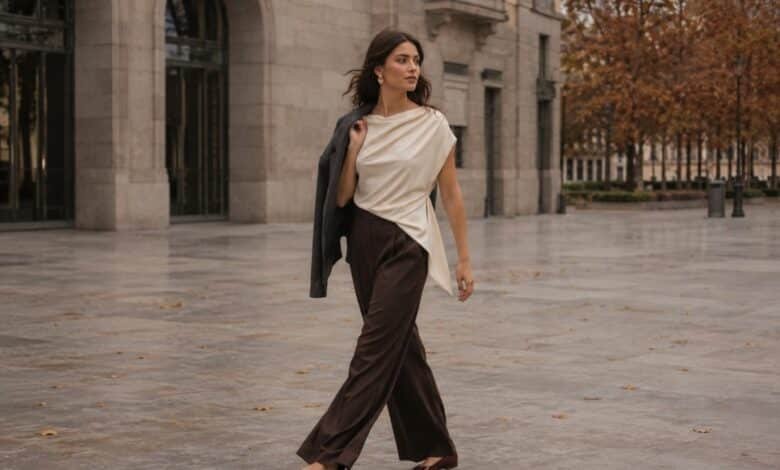
Some clothes are terrible at photographs and brilliant at being clothes. They need a step, a breeze, a bent knee, a swinging arm or simply a human body that refuses to stand perfectly straight. The internet often makes us judge them at exactly the wrong moment.
I have a very specific suspicion whenever I see a fashion trend explode through short videos: I want to see what happens when the person stops walking.
Not because I assume the outfit is fake. Quite the opposite. Movement can reveal something genuinely wonderful about clothes. A soft skirt opening with every step, a long coat swinging behind the body, trousers changing shape when a knee bends, fringe catching half a second of air — these are real qualities. Fashion is worn on moving people, so movement matters.
But movement can also be flattering in the same way good lighting is flattering. It can hide awkward hems. It can keep an oversized piece from settling into its full volume. It can make cheap fabric look fluid for three seconds. It can prevent us from noticing that a top needs adjusting every time the wearer raises an arm.
That difference interests me much more than another list of trends we are supposedly required to buy.
So I started thinking about outfits in two versions: the frame and the sequence.
The frame is what you see in a screenshot.
The sequence is what the clothes do across ten seconds of actual life.
And the two can tell surprisingly different stories.
The screenshot is a strangely unfair way to judge fashion
We pretend a still image tells us what an outfit looks like. Sometimes it does. A structured blazer, straight skirt or crisp shirt can communicate itself quite efficiently in one frame.
But a large category of clothes makes almost no sense without time.
Think about a pleated skirt. In a still photograph, you see the final shape of the pleats at one particular second. When somebody walks, the skirt opens and closes around the legs. That repeated expansion is part of the design.
A long coat is similar. Hanging from a mannequin, it is essentially a rectangle with sleeves. Walking down a street, it develops a back, a front, two moving sides and a completely different relationship with the body.
Even simple wide trousers can look disproportionately large in a frozen image taken at the wrong point in a stride. Two frames later, the fabric may fall into a beautiful vertical line.
That does not mean photographs are misleading. It means clothes are three-dimensional objects used across time, while photographs capture one very thin slice of that experience.
This is especially relevant now because so much fashion discovery happens through video. We often encounter the moving version first. The skirt twirls before we know how it hangs. The jacket swings before we know how wide it really is. The scarf trails before we notice its length.
Then the item arrives at home, we stand still in front of the mirror, and there is a small existential crisis.
“Why doesn’t it look like the video?”
Possibly because the video never stopped moving.
Movement is not decoration. It changes proportion
When a body moves, clothing constantly redistributes itself.
A trouser leg gets narrower when it swings backward and wider when it moves toward the camera. A skirt that looks enormous when fully open may collapse close to the body between steps. A cropped jacket can appear more fitted while the arms are moving because the fabric is under temporary tension.
That is why proportion can be difficult to read from a fashion clip.
The outfit you think has a perfect waist may actually have no defined waist when the model stands neutrally. The “effortless oversized shirt” might be dramatically oversized, but movement keeps breaking up its total surface area. A long scarf looks like a graceful line while trailing behind someone; standing still, it may simply be very long.
The useful distinction: ask whether movement is revealing the design or rescuing it. Those are not the same thing.
If a skirt looks good because the pleats open beautifully while walking, movement is revealing its design.
If trousers only look balanced while the wearer is taking exaggerated long steps because they pool strangely when standing, movement may be rescuing them.
If fringe creates a soft shimmer when someone turns, that is the design doing exactly what fringe is meant to do.
If a top looks wonderful while someone’s hands are permanently holding the hem away from the body, I want another video.
Test one: walk like you have somewhere normal to be
Not runway walking. Not the tiny three-step mirror walk where you already know a camera is watching. Walk down a hallway, turn around, come back, put something down, change direction.
Watch what the hem does
Does it fall back into place after each step? Does the front ride upward? Does one side twist? Does the skirt gradually rotate around your waist until the side seam begins exploring your kneecap?
This is where fluid trousers, skirts and long coats prove themselves.
A well-behaved wide trouser should create movement without requiring constant correction. The legs can swing, fold and open, but when you stop, the garment should remember what it is.
The same is true of skirts. Movement does not need to be perfectly symmetrical — in fact, some of not need to be perfectly symmetrical — in fact, some of the nicest clothes are interesting because they are not — but the garment should return to a convincing resting shape.
I also pay attention to sound.
This sounds ridiculous until you wear trousers that swish like a waterproof camping tent every time your thighs acknowledge each other.
Video cannot tell you everything.
Test two: sit down, because apparently fashion editors also use chairs
Sitting is the fastest way to expose fantasy fit.
A waistband can look perfect when standing and become unbearable the second your hips flex. A short skirt can gain an entirely different relationship with public decency. A fitted button-down may look crisp upright and begin pulling between buttons once your shoulders relax.
I do not consider these tiny inconveniences separate from style. Comfort changes how you carry an outfit.
If you spend dinner quietly pulling a skirt downward, you are not experiencing the outfit that appeared in the campaign.
If trousers dig so strongly into your waist that you unbutton them under the table, those trousers do not fit your life even if the standing photograph is exceptional.
Try this: sit normally rather than perching beautifully on the edge of the fitting-room stool. Cross one leg if you usually do. Lean forward. Reach for your bag. Then look at the outfit again.
Fabric pooling is normal. Creases are normal. Your stomach changing shape is extremely normal. Clothing that appears completely wrinkle-free around a seated human body should probably be approached as science fiction.
What I care about is whether the garment still looks like itself.
Test three: raise your arms and discover what the top was hiding
There is a whole category of shirts and tops that are fantastic as long as the wearer agrees never to interact with the upper half of the world.
Reach upward.
Reach forward.
Put your hands in your hair.
Take off an imaginary coat.
Carry an imaginary shoulder bag.
If the entire top rises six inches and does not come back down, that is information.
If an off-shoulder neckline immediately relocates itself, information.
If a beautiful draped panel migrates under your armpit, information.
If the sleeves pull so tightly across your back that hugging someone becomes advanced choreography, information.
This test matters particularly with cropped jackets, fitted shirts, sculptural tops, off-shoulder shapes and anything whose beauty depends on a very precise arrangement of fabric.
Some garments are supposed to need minor adjustment. I do not expect a scarf-like draped top to behave like a sweatshirt. But there is a difference between a piece requiring awareness and a piece requiring employment.
Test four: imagine an actual breeze, not the flattering editorial breeze
Fashion wind has impeccable taste.
It lifts hair away from the face, sends a hem in one elegant direction and apparently never blows a dress straight over someone’s head outside a pharmacy.
Real wind has other interests.
Flowy clothes deserve a practical wind question because lightness and movement often form the entire sales pitch.
Is the wrap dress secure?
Does the skirt have enough weight?
Does an open cardigan become wings?
Does the oversized collar repeatedly hit your face?
Will the scarf survive outside without strangling you or escaping into traffic?
Again, none of these problems means the trend is bad. The goal is simply to distinguish visual fantasy from wearable movement.
Test five is my favorite: stop moving completely
This is the slightly cruel one.
Stand naturally.
Do not angle one leg forward.
Do not lift your heel.
Do not turn your torso away from your hips.
Do not place one hand dramatically in a pocket.
Do not hold the bag where it hides exactly the part of the garment you dislike.
Just stand.
Now look.
This is not because a garment must look perfect while you imitate a passport photo. It is because its neutral state matters too. Life contains queues. Elevators. Conversations. Train platforms. Waiting for somebody who said “two minutes” nine minutes ago.
If you only like an outfit while performing a pose, you may actually like the pose.
The fabric usually decides whether motion looks luxurious or chaotic
Silhouette gets most of the attention, but movement starts with material.
Two skirts cut from an almost identical pattern can behave completely differently if one is heavy satin and the other is thin polyester.
The heavier fabric may fall downward before swinging outward. The lighter one may lift sooner, cling unexpectedly or react dramatically to static electricity.
A wool trouser creates broad, controlled folds. A thin synthetic trouser can reveal every change in tension across the leg.
Soft viscose may produce wonderful drape but stretch under weight. Crisp cotton holds a shape instead of melting around the body. Linen becomes increasingly expressive as it creases. Velvet changes visually whenever the pile catches light from a different direction.
This is one reason I take fashion videos seriously even while distrusting them slightly. A good unedited clip can tell you more about fabric than ten perfect product photographs.
Watch how quickly the material settles after movement.
Does it bounce?
Does it float?
Does it collapse?
Does it stick?
Does it wrinkle instantly?
Does the garment return to its intended shape?
If you shop online often, this kind of material reading pairs well with my guide to checking clothing quality online, because the fabric description and construction details matter just as much as the pretty moving clip.
Wide trousers are perhaps the perfect example of the motion illusion
Wide trousers photograph unpredictably because their silhouette changes during every step.
At one moment, both trouser legs separate and the width becomes obvious.
Half a second later, one leg overlaps the other and the silhouette looks much narrower.
Turn sideways and the volume can nearly disappear.
This creates wonderful video because the trousers are constantly drawing new lines around the body.
But before buying, I want to know what happens when those lines stop moving.
I want all three versions.
And this is why copying an outfit directly from one social clip can be frustrating. You may have copied the exact trousers while missing the thing you actually loved: how they moved during the clip.
Fringe is almost meaningless until it moves
Fringe exists to misbehave slightly.
That is its charm.
Still, it can look like threads hanging from an object. Moving, those threads separate, catch light, create rhythm and reveal the body underneath in tiny intervals.
The difference is dramatic enough that I consider movement part of the design rather than a styling bonus.
Fine fringe can make a simple skirt interesting without changing the basic silhouette. Long fringe can create a second hem that seems to continue after the garment itself has stopped. Fringe on scarves moves close to the face and can soften very sharp tailoring.
But there is a practical question: does it move beautifully at your normal speed?
Not when spinning.
Not when an assistant throws the fabric.
Not in wind strong enough to alter regional weather patterns.
Walk across a room.
If you still enjoy the movement, excellent.
Then stop and check whether you also like the underlying garment, because eventually the fringe will be stationary while you are waiting for your drink.
Draping can look accidental in a screenshot and perfect two seconds later
Asymmetric clothes are particularly vulnerable to bad screenshots.
One side hangs lower. One panel folds over another. A neckline deliberately refuses symmetry. In motion, the eye understands that irregularity as flow.
Freeze the wrong moment and the whole thing may look as though someone forgot to finish sewing it.
I find this fascinating because it exposes how strongly we expect static clothing to be balanced.
Traditional symmetry gives the eye easy landmarks: left shoulder, right shoulder, waist, hem. Asymmetric design interrupts those landmarks, so movement often helps us understand the intended relationship.
That does not automatically make every twisted blouse sophisticated.
I still want to know whether the drape survives ordinary activity. Does the neckline remain intentional after carrying a bag? Does the side panel stay roughly where it belongs? Does the garment need adhesive, strategic underwear or a personal assistant?
Drama is welcome.
Structural instability is a separate subscription.
Oversized clothes shrink visually when the wearer moves
This is one of the biggest video illusions.
A genuinely oversized jacket has a lot of fabric. Standing straight with both arms down, you see all of it.
Start walking and the shape breaks into smaller pieces.
The arm moves away from the torso.
The jacket opens.
One front panel turns sideways.
The back folds.
A shoulder bag interrupts one side.
Suddenly the item looks less enormous because you are never seeing its full front-facing surface.
This can explain the familiar experience of loving an oversized look online and feeling swallowed by the exact same proportion at home.
The creator may genuinely look wonderful in it. But you mostly watched the garment fragmented through motion.
Try your own neutral stance before sizing down automatically. Then walk.
Sometimes the volume suddenly makes sense.
If it still feels wrong, my three-point outfit check is useful for separating a genuine proportion problem from the general feeling that “something is off.”
Sheer layers also depend on what sits behind them
Transparency changes with angle, light and movement.
A sheer skirt can look almost opaque where two layers overlap and suddenly transparent when the layers separate during a step.
A mesh top may appear subtle in front lighting and far more revealing when backlit.
Video can either expose this honestly or disguise it completely depending on the room, edit and angle.
So when I look at sheer fashion, I stop asking only, “Do I like this?” and start asking, “Which version of this am I seeing?”
Front-lit?
Backlit?
Standing?
Walking?
Layered over shapewear?
Layered over another skirt?
Photographed against a dark background?
Those variables materially change the garment.
Sheer clothes are not inherently impractical. They simply demand a more complete visual inspection than opaque ones.
Then the camera joins the conspiracy
Clothes move. Cameras move too.
And once both are moving, our perception gets complicated quickly.
A low camera can lengthen almost everything
A phone positioned below waist level can make legs appear longer and an oversized silhouette more imposing. This may be perfect for the creative intention of the video, but it is not the same as seeing the garment at eye level.
A moving camera prevents your eye from measuring proportion
If the camera pans, circles or zooms while the subject walks, your visual reference points are constantly changing.
This makes the sequence exciting. It also makes careful fit assessment nearly impossible.
Wide-angle lenses change edge proportions
Objects closer to the lens can appear exaggerated relative to the rest of the body. A shoe pushed toward the camera becomes huge. A leg closer to the lens looks longer. An extended sleeve can become a major graphic shape.
Motion blur makes imperfect lines softer
This is not necessarily deliberate deception. It is simply what cameras do. A fast-moving hem becomes less sharply defined, so we register an impression of fluidity rather than inspecting each wrinkle.
The simple fix: when evaluating an outfit online, look for at least one normal full-body shot with the camera approximately level and the person standing naturally. The cinematic clip can tell you how it moves. The boring photograph tells you what you are actually buying.
Sometimes what looks like garment movement is really body choreography
There are poses so common in fashion content that our brains barely register them anymore.
One knee bends inward.
One hip shifts.
The jacket opens with one hand.
The other hand holds the bag slightly away from the body.
The chin turns.
The torso rotates just enough that we never see the garment flat from the front.
There is nothing wrong with posing. Photographs are meant to be composed.
But I like mentally removing the choreography.
If the model’s hand were not holding that jacket open, what shape would it have?
If the bag moved away from the waist, what would I see?
If both feet were flat, where would that hem actually fall?
If the person’s shoulders faced the camera, would the top still look narrow?
These questions have saved me from buying more things than I care to admit.
I trust a boring product video more than a beautiful one
For actual shopping, the least glamorous clip can be the most useful.
Give me someone walking forward.
Turning once.
Standing still.
Sitting if the garment makes that relevant.
No dramatic editing.
No handbag covering the waistband.
No hands permanently in pockets.
No coat held over the shoulders so I never discover whether the sleeves technically accommodate human arms.
A gorgeous campaign can sell me the mood. A plain fit video helps me decide whether I want the clothes.
Ideally, I want both.
If you regularly buy from fashion sites, my online clothes shopping guide goes deeper into measurements, returns and the things worth checking before trusting the product page.
Video itself is useful. The mistake is treating any video as objective evidence.
My five-minute fitting-room test is basically terrible modeling
I do not need to look chic during a fitting-room test. That would defeat the purpose.
I need to look like a person who may eventually wear the garment while being busy, distracted and unaware of her best camera angle.
Feet comfortably apart, arms down, shoulders relaxed. This gives me the garment’s resting silhouette.
I watch hems, twisting, pulling, noise and whether anything needs immediate adjustment.
No elegant perch. I want to know what the waist, hips, neckline and hem do when the body folds.
Reach forward and overhead. Pretend to put on a coat. Check whether the garment returns to position afterwards.
One walk toward the mirror, one turn, one pause. Watching yourself in motion can reveal things the mirror missed — without needing to make the clip flattering.
If an item survives this and I still like it, I become much more confident.
Not confident that every photograph will be perfect. That is not a reasonable job description for clothing.
Confident that the item actually participates in my life instead of functioning only during carefully controlled moments.
And if the real obstacle is not the clothes but the strange emotional experience of seeing yourself in them, I would separate that from fit. I wrote about that distinction more deeply in how to feel more confident in your outfit.
Sometimes movement is exactly why the piece deserves to exist
I do not want this to turn into a manifesto for sensible static clothing.
Quite the opposite.
Some of the best clothes are enjoyable precisely because they refuse to sit quietly.
A fringe skirt should dance a little.
A full trouser should change width with every step.
A silk scarf should respond to air.
A pleated dress should open when you move.
A long coat should follow behind you.
An asymmetric hem should produce different lines from different angles.
That pleasure is real. It may even be the best reason to own the thing.
But then I want to buy it knowingly.
I do not want to buy a “perfect silhouette” when what I loved was actually a ten-second performance.
I want to understand that I am buying motion.
Not being photogenic is not a fashion flaw
This may be my favorite conclusion from the whole experiment.
We have quietly begun evaluating clothing as content.
Does it photograph?
Does it create a strong thumbnail?
Does the silhouette read immediately?
Can somebody understand the outfit in half a second?
Those questions matter to fashion media because fashion media needs images.
They do not always matter to your Tuesday.
A soft black trouser may look visually unremarkable in a mirror selfie and beautiful while you walk into a room.
A coat may look enormous in a photograph but create the nicest silhouette you’ve ever had when moving through a city.
A skirt may produce strange freeze-frames and feel joyful every time you wear it.
That counts.
Your wardrobe does not need to function as an Instagram grid.
It needs to function around your body.
So before copying a moving trend, I ask four different questions
Do I like the garment?
Not the girl, the music, the café, the lighting or the general evidence that this person appears to have a very lovely Sunday.
The garment.
Do I like the resting shape?
I do not demand perfection, but I want a silhouette I can tolerate while standing still.
Do I like what happens during normal movement?
Not spinning. Not runway striding. Walking, sitting, reaching.
Is its movement a feature or a distraction?
Beautiful fringe is a feature. A neckline that requires six corrections an hour is an unpaid internship.
If all four answers are yes: the trend probably has a real chance in your wardrobe.
If only the moving version is yes: decide whether the movement itself is enough reason to own it.
If only the screenshot is yes: I would be even more cautious. Real life is unfortunately animated.
What I want fashion videos to show me now
I still want the beautiful clip.
I want the dramatic coat turn. I want the skirt catching air. I want the close-up of a sleeve, the heel hitting pavement, the perfectly timed scarf movement. Fashion is allowed to make ordinary things feel cinematic. That is part of why I enjoy it.
I just want one boring clip after it.
Walk.
Stop.
Turn.
Sit.
Lift your arms.
Show me the back.
Show me where the waistband actually sits.
Let the trousers fall completely still.
That combination — fantasy plus evidence — is much more useful than pretending only one of them matters.
And perhaps this is also why the current return to draping, fluidity, larger proportions and expressive details feels interesting. These are not clothes that always reveal themselves neatly in a product grid. They ask to be worn.
Which sounds obvious.
But fashion online has made “actually wearing the clothes” feel surprisingly revolutionary.
The screenshot never gets the last word
Next time a screenshot of a fashion video looks strangely disappointing, I would not immediately decide the outfit was fake, unflattering or overhyped.
Maybe you froze the pleated skirt at the awkward half-open moment.
Maybe the enormous coat makes visual sense only once the arms separate from the body.
Maybe the fringe was designed for time rather than photography.
Maybe the asymmetric top is supposed to keep changing.
Maybe the trousers really are beautiful when walking and slightly odd when waiting for the train.
Both things can be true.
The more useful question is whether you like enough versions of the garment to live with all of them.
Because the person in the video eventually stops walking.
So will you.
Then you will start again.
Good clothes do not have to freeze beautifully. They should come back to life when you do.
Questions and answers
Why do clothes look better in videos than in photos?
Movement constantly changes the silhouette. Fabric opens, folds, swings and catches light differently while a person walks or turns, so a video can make an outfit feel more fluid and balanced than one frozen frame. Camera movement, posing, lens choice and editing can strengthen that effect too.
Why does an outfit look good while I am moving but strange when I stand still?
Some designs depend heavily on motion. Wide trousers, fringe, pleats, draped fabric and long coats can break into more flattering moving lines while you walk, then reveal their full volume when you stop. That does not automatically mean the outfit is wrong; it means its moving and resting silhouettes are different.
How can I tell whether a TikTok fashion trend will look good in real life?
Look for both moving and static views. Check the outfit with the wearer standing naturally, then watch what happens while walking, sitting and using the arms. Pay attention to whether the garment returns to its intended position or requires repeated adjustment. A normal product video is often more useful than an aggressively styled campaign clip.
What clothes change the most when you walk?
Wide-leg trousers, full skirts, pleated pieces, fringe, long coats, fluid dresses, scarves and asymmetric draped garments can change dramatically in motion. Their fabric and construction allow the silhouette to open, collapse or shift as the body moves.
Should clothes look good when I am standing completely still?
They do not need to look perfect in every frozen position, but I like a garment to have a convincing resting silhouette as well as an enjoyable moving one. You will spend parts of real life standing, sitting and waiting, so an outfit that only works during a carefully choreographed walk may become frustrating.
Why do oversized clothes sometimes look bigger in the mirror than online?
Movement breaks a large garment into smaller visual sections. When someone walks, an oversized jacket opens, the sleeves move away from the torso and the fabric folds. Standing directly in front of a mirror reveals much more of its total width at once. Camera angle and posing can increase the difference.
How should I test clothes in a fitting room?
Stand naturally first, then walk several normal steps, sit properly, reach forward and overhead, and check whether the garment settles back into place. A quick unposed phone video can also help because it shows how the clothes behave across several seconds instead of one mirror position.
Can a fashion video hide poor fit?
It can, even without deliberate deception. Continuous movement can hide pulling, awkward hems or excess volume because the garment never settles long enough for you to inspect it. Bags, hands, camera angles and motion blur can also cover areas that would be obvious in a straightforward still image.
Is it bad if a dress or skirt only looks beautiful in motion?
Not necessarily. Movement may be a legitimate part of the design, especially with pleats, fringe, fluid fabrics and asymmetric hems. The real question is whether you also feel comfortable with the garment when it settles and whether the moving effect is important enough to you to justify owning it.
What should I look for in online clothing videos before buying?
Look at how the fabric falls after movement, whether seams twist, where the waistband sits, whether the hem rides up, how the garment behaves when the model turns and whether there is at least one neutral full-body view. Beautiful movement is useful information, but it should not be the only information you have.