Brooches Are Back: How to Wear One Without Looking Costume-y

A brooch can make a plain blazer look collected instead of basic, give a soft sweater a point of view, or rescue a white shirt from feeling suspiciously like something you wore to a school presentation. The trick is not treating the brooch as a precious object that requires a precious outfit. In 2026, it looks freshest when it interrupts something ordinary.
I understand why brooches make people nervous. They arrive with baggage. Pearls. Antique shops. Royal portraits. Your grandmother’s velvet jewelry box. Possibly a woman in a detective novel who knows exactly who poisoned the duke.
But that history is also why I find them interesting again. We have spent years making our wardrobes simpler: the good blazer, the white shirt, the straight jeans, the black coat, the knit we buy in three colors because it behaves. Eventually, very sensible clothes begin asking for a little misbehavior.
A brooch gives you that without demanding a new wardrobe.
The modern version is less about matching jewelry and more about placement, proportion and contrast. A sculptural pin on an oversized jacket feels different from a tiny floral brooch centered perfectly on a formal lapel. A pearl piece on washed denim feels different from the same piece beside a pearl necklace and pearl earrings. Context changes everything.
So this is not a list of rules for wearing jewelry “correctly.” It is a styling experiment: where a brooch works, where it becomes too polite, why some combinations accidentally read as costume, and how I would make one tiny object earn its place in a real wardrobe.
Why the brooch suddenly makes sense again
For a while, fashion’s answer to almost every styling question was subtraction. Remove the extra necklace. Keep the palette neutral. Buy the cleaner shoe. Make the bag simpler. Let the tailoring speak. If something looked expensive, there was a fair chance someone would describe it as “quiet.”
I still love restraint. But restraint works best when it is a choice, not a personality requirement.
The interesting shift now is toward clothes that still have wardrobe usefulness but carry one piece of visual tension: a strange proportion, a romantic texture, a sharper collar, a bright shoe, a scarf tied somewhere unexpected, a piece of jewelry with enough personality to change the sentence.
A brooch is almost comically good at this job.
You can keep the blazer. Keep the jeans. Keep the white T-shirt. Keep the loafers. The outfit does not need a complete trend transplant. One pin changes the eye’s route through the look.
That is also why I would not approach brooches as collectibles first. You can become a collector later if you genuinely fall in love with them. For now, think like a stylist: what shape, color or texture would give clothes you already wear a more deliberate finish?
The one rule that stops a brooch from looking old-fashioned
Give it something contemporary to argue with.
That is the entire game.
If the brooch is ornate, let the clothing be relaxed. If the brooch is romantic, give it tailoring, denim or a clean knit. If it is extremely polished, place it slightly off-center. If it is tiny and sweet, avoid surrounding it with five other tiny and sweet details.
Modern brooch formula: one expressive object + one ordinary wardrobe piece + a little visual tension.
The danger zone is not “vintage.” Vintage can look fantastic. The danger is recreating an entire era unintentionally.
Imagine a cameo brooch with a pussy-bow blouse, pearl earrings, a tweed skirt, a structured top-handle bag and sensible pumps. Every individual element may be beautiful. Together they start demanding period-appropriate transportation.
Now take exactly that cameo and pin it to a faded denim jacket over a black tank. Suddenly it feels personal rather than theatrical.
This is why styling matters more than the age of the jewelry.
Where you pin it changes the whole personality
The classic upper-lapel position still works, but treating it as the only option is what makes brooch styling feel stiff. Move the pin ten centimeters and the outfit can become less formal, more graphic or simply more interesting.
High on the blazer lapel
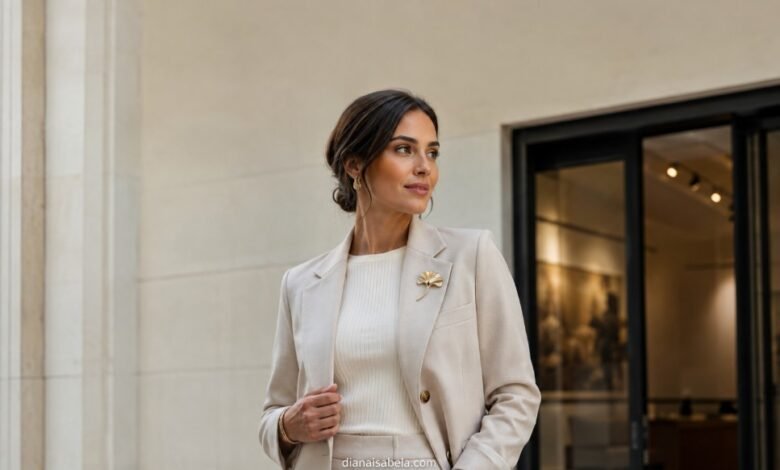
The easiest entry point. Keep it slightly higher than you first expect, especially with an oversized blazer. This lifts the eye and stops the brooch from disappearing into the chest area.
Near the collarbone on a knit
Softer and more intimate than a lapel. This works beautifully with crew-necks and fine-gauge knits when the brooch is not too heavy.
At the top button of a shirt
This can mimic jewelry without requiring a necklace. Keep the shirt itself clean so the brooch feels intentional rather than busy.
Off-center near a coat collar
Excellent with substantial pieces because coats can visually support more scale. Slight asymmetry makes an ornate brooch feel less ceremonial.
At a scarf knot
Part accessory, part engineering. A small-to-medium brooch can hold a soft scarf arrangement while making it look deliberate.
On a jacket pocket or chest pocket
More casual than a lapel and particularly good for workwear, denim or military-inspired jackets.
At the waist of a wrap or draped dress
Potentially beautiful, but check the fabric first. This works best when the pin is light and the dress already has some structure.
The blazer test: probably the easiest way to get this right
If you are brooch-curious but do not want to look like you have suddenly developed an aristocratic alter ego, start with a blazer.
Blazers already contain enough structure to make jewelry feel purposeful. They also belong firmly in modern wardrobes, which gives vintage or romantic pieces the contemporary friction they need.
My easiest combination would be an oversized charcoal blazer, white or cream T-shirt, dark straight jeans, loafers and one medium gold brooch.
Easy: oversized blazer + T-shirt + dark denim + loafers + sculptural brooch.
You can make it sharper with a black trouser and pointed shoe. You can make it softer with a silk slip skirt. You can make it younger with a washed tee and sneakers. The brooch survives all three because the blazer provides its visual home.
What I would not immediately add is a statement necklace. You already created a focal point near the face. Let it enjoy its job.
Small earrings are fine. Rings are fine. A watch is fine. This is not a jewelry prohibition zone. I simply like giving one piece the microphone.
A white shirt becomes much less obedient with a brooch
A white button-down is almost aggressively useful. Office. Weekend. Airport. Dinner. Over swimsuit. Under sweater. Half tucked. Fully tucked. Open over a tank. It does everything, which means it can occasionally feel like it has no opinion of its own.
The brooch fixes that.
Instead of pinning it exactly where you would on a blazer, try one of three placements:
At the collar: small, crisp, slightly preppy.
Beside the upper buttons: more relaxed and asymmetrical.
On a pocket: casual, graphic and almost badge-like.
I especially like an ornate brooch on an oversized shirt with sleeves pushed up and relaxed jeans. The shirt keeps it clean. The denim removes ceremony. The jewelry supplies the tension.
Try: oversized white shirt + loose blue denim + simple flats + antique-looking gold brooch.
That outfit feels collected rather than styled within an inch of its life.
On a sweater, the brooch becomes almost like punctuation
Knitwear is where I would go quieter.
A heavy jeweled piece on very fine cashmere can pull the fabric down, distort it or leave marks. A lighter brooch on a more stable crew-neck knit is much easier.
Placement matters too on very fine cashmere can pull the fabric down, distort it or leave marks. A lighter brooch on a more stable crew-neck knit is much easier.
Placement matters too. Rather than putting it dead center, move it toward one shoulder or slightly below the collarbone. It should look like it landed there because the outfit wanted it, not because you measured the geometry.
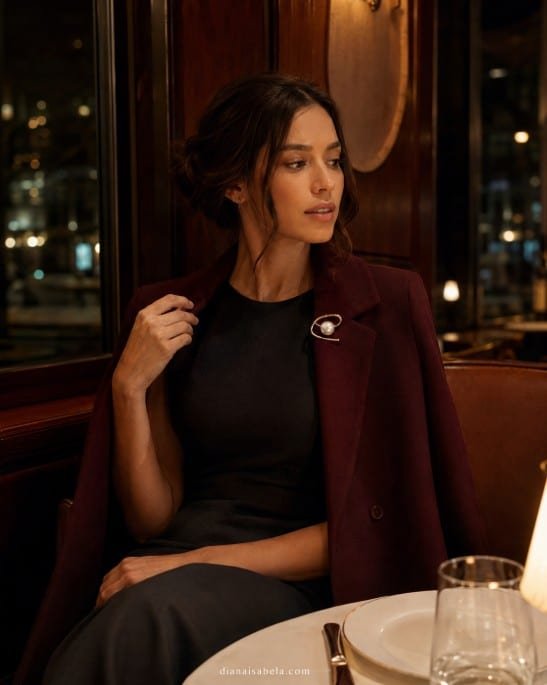
An oatmeal sweater with a silver sculptural pin is lovely because the contrast is primarily texture. A burgundy knit with a small pearl piece feels richer. A charcoal sweater with a colorful enamel brooch can make a quiet outfit suddenly look much more personal.
I would also avoid overloading delicate knitted fabric just because a very large brooch looks fabulous in your hand. Jewelry has weight. Clothes have gravity. Fashion unfortunately remains subject to physics.
A coat can handle the brooch your T-shirt cannot
Outerwear is where a larger brooch starts making sense.
A wool coat, substantial blazer, barn jacket or structured jacket has enough visual weight to support something architectural, oversized or ornate. You are no longer asking a thin layer of cotton to carry a chandelier.
This is also where I like slightly stranger pieces: abstract metal forms, oversized florals, vintage animal motifs, dark stones, chunky pearls, sculptural silver.
On a clean black coat, the brooch can become the whole mood.
On camel, gold and warm enamel feel luxurious.
On grey, silver, pearl, burgundy and deep green are especially convincing.
On navy, almost anything with enough contrast works.
And because the coat is already one large visual field, the accessory does not compete with much else.
Denim is the secret weapon if your brooch feels too “ladylike”
This is the contrast I would recommend to anyone who has inherited a brooch and thinks, “Beautiful, but absolutely not me.”
Put it on denim before giving up.
Denim removes ceremony with almost embarrassing efficiency.
A pearl brooch on a blue denim jacket.
A floral vintage pin on dark denim.
A small gold animal brooch on a denim shirt.
A rhinestone piece on washed black denim.
The material says everyday; the brooch says considered. Neither wins completely, which is exactly why the pairing works.
Pretty jewelry + unfussy fabric = one of the easiest ways to make a brooch feel current.
If the piece is inherited, denim can also make it feel emotionally yours instead of like something you are temporarily borrowing from another generation.
The dress problem: one brooch, not an entire period drama
Dresses are trickier because the silhouette often already has a strong identity.
A brooch on a minimalist black dress? Excellent.
A brooch on a clean column dress or simple knit dress? Also excellent.
A brooch on a heavily ruffled floral midi with puff sleeves, lace trim and vintage heels? Possibly still excellent, but now we need to know whether the theatrical effect is intentional.
The more romantic the dress, the more I would simplify the brooch.
The simpler the dress, the more expressive the brooch can become.
For an event outfit, the brooch can also replace a necklace when the neckline needs breathing room. Sometimes removing jewelry is what allows the interesting piece to look expensive.
The most interesting placements are not always on your clothes
This is where brooches become much more fun.
Pin one through a scarf
Use it to secure a soft scarf near the shoulder, at the side of the neck or over a coat. This feels particularly good when the scarf itself is plain and the brooch has character.
Add one to a fabric bag
Canvas, denim and substantial textile bags can take a small brooch surprisingly well. I would avoid delicate leather unless you are happy to risk a permanent puncture.
Use one on a beret or structured cap
Very styling-dependent, but genuinely chic when the rest of the outfit is restrained. One small metallic brooch on a plain dark beret needs almost nothing else.
Pin a cardigan strategically
A brooch can hold a cardigan partly closed near the neckline or waist, but only if the knit and clasp can support the tension. Do not use delicate jewelry as structural engineering unless you enjoy both wardrobe and jewelry repairs.
Cluster several — but deliberately
Three small pins can look brilliant on one blazer lapel or jacket pocket. The key is making them read as a group rather than random jewelry storage. Repeat a metal, shape family or color so the eye understands the relationship.
The size question is really a proportion question
I would not divide brooches into “small is classy, big is statement.” That is too simplistic.
The correct scale depends on the garment underneath.
A tiny brooch can disappear on a huge oversized coat.
A giant floral pin can overwhelm a fitted fine-knit tee.
A medium geometric piece may be ideal on a blazer but look strangely corporate on a delicate dress.
Instead, compare the visual weight of the accessory to the fabric and silhouette.
Fine blouse: lightweight and usually small.
Shirt: small to medium.
Fine knit: lightweight small to medium.
Blazer: medium to substantial.
Denim jacket: almost anything the fabric can physically support.
Wool coat: medium to oversized.
Then consider your other accessories. A large brooch beside dramatic earrings can make the upper half of your outfit visually congested. Sometimes that is fun. More often it just looks as though two accessories are arguing over custody of your face.
Gold, silver, pearl or color? Start with the clothes, not your “season”
You do not need to rebuild your entire jewelry identity around one brooch.
If most of your wardrobe is black, charcoal, cream, denim and navy, both gold and silver are easy. Choose the one that creates the mood you want.
Gold usually adds warmth, richness and a slightly vintage undertone.
Silver tends to feel sharper, cooler and more graphic.
Pearls are wonderful when the surrounding outfit is not too precious.
Colored enamel is one of my favorite options for neutral wardrobes because the brooch becomes a controlled little color event rather than requiring a completely colorful outfit.
And mixed metals are not a crime. If the brooch combines gold and silver, you have practically been handed permission to stop worrying about matching everything else.
Why some brooch outfits suddenly look like costume
The brooch itself is rarely the problem.
Usually too many elements are telling the same historical story.
A vintage brooch plus contemporary denim is contrast.
A vintage brooch plus modern tailoring is contrast.
A vintage brooch plus plain knitwear is contrast.
A vintage brooch plus vintage blouse plus vintage handbag plus vintage skirt plus retro pumps plus victory rolls is not contrast. It is commitment.
And commitment is completely valid if that is your style. But if your question is specifically how to make a brooch feel modern, you need one foot outside the period reference.
The Diana test: if you remove the brooch, does the rest of the outfit already look like it belongs to another decade? If yes, the pin will reinforce that impression. If no, the brooch will probably feel like personality rather than costume.
The second problem: everything is “special”
A sequined top, dramatic earrings, printed scarf, decorated bag, giant belt buckle and ornate brooch all contain interesting information. Together, they become visual spam.
Choose hierarchy.
Let the brooch lead. Let everything else support.
The third problem: perfect symmetry
Traditional placement can sometimes make a brooch feel formal simply because everything is too exact. Try moving it higher, closer to the shoulder, onto a pocket or near the neckline instead.
The fourth problem: the accessory is too small for the garment
This does not look vintage so much as timid. A tiny pin stranded on a huge wool coat does not create elegance; it creates a search-and-rescue mission.
Before you stab your favorite silk blouse, please inspect the pin
Brooches physically pierce clothing. This very obvious fact becomes surprisingly easy to ignore when the jewelry is pretty.
Check both the weight of the piece and the thickness of the pin.
Heavy brooches can pull delicate material downward. Thick pins can leave visible holes in silk, satin, fine knits and tightly woven technical fabrics. Repeated use in the same spot can also weaken material.
I would be relaxed about sturdy denim, many wool coats and substantial blazer fabrics. I would be much more cautious with silk, very fine cashmere, sheer fabrics and anything delicate or expensive enough that a pinhole would ruin your mood for several business days.
Also inspect vintage clasps. An old safety catch may be less safe than its name suggests.
If I were buying my first brooch now, I would avoid the “most versatile” one
Versatility is useful for trousers. I am not convinced it is the correct ambition for a brooch.
This object is supposed to add character. If you buy the most neutral, smallest, least noticeable option because it “goes with everything,” you may discover that it changes absolutely nothing.
I would look for one of four personalities.
The sculptural metal piece
Best if your wardrobe is minimalist, tailored, black, grey, white or denim-heavy. An abstract gold or silver shape adds interest without adding another color story.
The slightly strange vintage piece
An animal, leaf, flower, star, insect or surreal shape can be much cooler than generic “classic jewelry,” especially with everyday clothes.
The pearl brooch with an imperfect attitude
I prefer pearls when they are asymmetrical, mixed with metal or arranged in a less bridal way. They look wonderful against denim, charcoal wool and black knitwear.
The color piece
If you own mostly neutrals, a small enamel brooch in red, green, cobalt, burgundy or amber can act almost like lipstick for the outfit.
What I would check before buying is less glamorous: clasp quality, pin straightness, weight, rough edges, missing stones and whether the back construction feels strong enough for actual wear.
The back of jewelry is boring right up until it falls off.
Ten brooch outfits I would actually wear
Not runway fantasies. Not a brooch balanced on a transparent couture cape while you stand in conceptual fog. Real combinations.
1. Gallery Saturday: charcoal oversized blazer + white tee + straight dark jeans + loafers + one abstract gold brooch high on the lapel.
2. Coffee and errands: oversized white shirt + relaxed denim + ballet flats + small vintage floral brooch near the chest pocket.
3. Soft office day: oatmeal crew-neck knit + charcoal trousers + sleek flats + silver brooch slightly below the collarbone.
4. Cold-city coat: long black wool coat + dark denim + boots + oversized sculptural brooch near one collar.
5. Romantic without becoming precious: satin midi skirt + simple black knit + loafers + pearl-and-metal brooch on the knit.
6. Denim antidote: blue denim jacket + black tank + black trousers + ornate inherited brooch on one pocket.
7. Dinner: minimalist black dress + burgundy coat + sculptural brooch at the coat neckline + small earrings.
8. Soft tailoring: cream blazer + grey tee + dark brown trousers + geometric silver brooch + no necklace.
9. Scarf experiment: black knit + jeans + patterned silk scarf secured loosely with a small gold brooch.
10. Slightly chaotic in the good way: worn leather jacket + crisp striped shirt + tailored trousers + tiny rhinestone brooch where you would normally expect a badge.
Notice what these outfits do not require: a new aesthetic identity.
You can be minimalist, romantic, Acubi-adjacent, classic, preppy, vintage-loving or mostly interested in getting dressed without becoming late for work. The brooch is not the aesthetic. It is the edit.
One brooch is elegant. Three can be cooler.
Once you understand one, clusters become interesting.
I would not scatter seven unrelated pins over an entire blazer unless the maximalism is deliberate. Instead, make a tight little composition near one lapel or pocket.
Three small gold shapes.
Two pearl pieces plus one metal form.
A collection of miniature animals.
Three different brooches sharing burgundy stones.
The common element keeps the cluster from looking accidental.
Spacing matters too. Imagine the pieces as one larger accessory rather than three separate ones. Keep enough room that each shape remains readable but close enough that the eye groups them together.
This is a particularly good trick with older inherited jewelry. One tiny brooch may feel overly delicate alone; grouped with two modern pieces, it becomes part of a new composition.
The best brooch may already be sitting in somebody’s drawer
There is something especially nice about a fashion trend that gives forgotten objects another life.
Brooches are disproportionately likely to survive wardrobes because they do not depend much on body size. A dress may stop fitting. Shoes may be the wrong size. A brooch remains a brooch.
If you have one from a mother, grandmother, aunt or vintage market, I would resist the urge to style it in the period from which it came. First try it against your most normal clothes.
Your black blazer.
Your denim jacket.
Your plain winter coat.
Your grey sweater.
Your striped shirt.
That is usually where it starts feeling like yours.
Will brooches still look good when the trend cycle moves on?
Yes — if you buy or wear one because you actually like the object.
This is one reason I am much more comfortable with the return of brooches than with trends that demand a highly specific cut of trousers or one awkward shoe shape. A brooch does not make the rest of your wardrobe obsolete. It sits on top of it.
When fashion attention shifts elsewhere, you can simply wear it less often.
And unlike many accessories, an interesting brooch does not need to look “current” in isolation. Its age, oddness or specificity can be the entire appeal.
The styling around it determines whether the final look feels relevant.
The final mirror check is wonderfully simple
Before leaving, look at the whole outfit rather than the brooch.
Does your eye know where to go first?
Does the pin change the outfit or merely sit on it?
Is there another accessory competing in exactly the same area?
Does the brooch physically pull the fabric?
Does the look feel too literal?
If something bothers you, remove one thing before adding another.
Maybe the necklace goes.
Maybe the earrings get smaller.
Maybe the brooch moves five centimeters upward.
Maybe the romantic blouse becomes a T-shirt.
Maybe nothing changes because the slightly odd combination is precisely why you like it.
That last option is allowed.
The point is not to make a brooch behave. The point is to make it belong to you.
I suspect that is why this particular comeback feels more interesting than a simple nostalgia cycle. A brooch does not tell you exactly what to wear. It asks you to style.
And after years of being told that every wardrobe problem can be solved by buying the correct neutral basic, I am very happy to have a tiny piece of jewelry making things complicated again.
Questions and answers
Which side should a woman wear a brooch on?
There is no modern rule requiring a brooch to stay on one particular side. The left lapel is traditional, but placing it on the right, closer to one shoulder, near a pocket or slightly off-center can make the styling feel fresher. Choose the position that works with the garment’s neckline, your hair, other jewelry and the visual balance of the whole outfit.
How do you wear a brooch without looking old-fashioned?
Pair it with something that clearly belongs to a contemporary everyday wardrobe. An ornate brooch looks much more current on an oversized blazer, denim jacket, plain crew-neck knit or relaxed white shirt than when it is surrounded by several equally vintage-looking pieces. Contrast is usually more useful than trying to make every part of the outfit match the brooch.
Can I wear a brooch on a sweater?
Yes, provided the knit can support the pin without stretching or developing a visible hole. Lightweight brooches work best on finer sweaters, while thicker knits can usually support more substantial pieces. Try the brooch near one shoulder or just below the collarbone instead of automatically centering it.
Can you put a brooch on a coat?
A coat is one of the easiest garments for brooch styling because wool and other substantial outerwear fabrics can visually support larger jewelry. Place the brooch near the collar, high on a lapel or slightly toward one shoulder. Always check that the pin will not permanently damage the particular fabric.
Should a brooch match my earrings and necklace?
No. It can share a metal or mood with your other jewelry, but exact matching is unnecessary. In fact, a strong brooch often looks better when the necklace is removed and the earrings are kept simple. Mixed metals can also work, especially when the brooch itself already contains more than one metal tone.
How big should a brooch be on a blazer?
Most blazers can comfortably handle a medium brooch, while oversized or heavier tailoring can support something larger. Rather than following a strict measurement, compare the visual weight of the brooch with the width of the lapel and the scale of the jacket. A very tiny piece can disappear on oversized tailoring, while an enormous piece may overwhelm a fitted blazer.
Can a brooch damage clothing?
Yes. A brooch pin creates a physical hole, and heavier pieces can pull or distort delicate fabric. Be particularly careful with silk, satin, fine cashmere, sheer fabrics and tightly woven delicate materials. Sturdier denim, wool and many blazer fabrics are usually more forgiving, but a hidden test is sensible when the garment matters to you.
Can I wear more than one brooch at the same time?
Absolutely. A small cluster can look more modern than one tiny brooch sitting alone on a large jacket. Keep the pieces relatively close together and give them a common thread such as the same metal, similar colors, repeated shapes or a deliberate theme so they read as one composition.
Where else can I wear a brooch besides a blazer?
Try one on a denim jacket, shirt pocket, sweater, wool coat, scarf, beret or sturdy fabric bag. It can also be used near the neckline of a simple dress. The main considerations are whether the placement looks intentional and whether the material can safely take the pin.
Are brooches actually fashionable again in 2026?
Brooches are receiving renewed attention in Fall 2026 fashion coverage and collections, alongside a broader return to expressive accessories and more individual styling. That does not mean you need to wear one as a trend uniform. Their real advantage is that a single brooch can change clothes you already own without requiring an entirely new seasonal wardrobe.