A logo is easy. A logo can be printed, embroidered, stamped, embossed, engraved, inflated, turned into a charm, slapped on a hoodie, and sold to people who may or may not have eaten breakfast. A personality is harder. A personality has to walk into the room before the product does.
That is why some brands feel like objects and other brands feel like people you somehow know. Not literally, obviously. I do not think a tank top has a soul. I am dramatic, not medically concerning. But a strong brand can start behaving like a character: it has a tone, a world, a promise, a mood, a kind of weather.
Gen Z does not only buy “things.” We buy stories we can step into for five minutes. We buy proof that someone understands the version of ourselves we are trying to assemble. We buy a tiny myth with a shipping label.
A brand becomes a personality when people stop saying “I bought this” and start saying “this feels like me.” That sentence is where marketing ends and mythology begins.
This is not about worshipping brands. Please, no altar made of shopping bags. It is about why certain labels become emotional shorthand: confidence, softness, coolness, discipline, rebellion, comfort, main-character energy.
The logo is the signature. The myth is the whole letter.
Old-school branding often loved the visible mark. The logo was the signal: I know this, I can afford this, I belong to this taste level, please observe the tiny metal initials on my bag. There is still power in that. Fashion has never exactly been innocent; it has always flirted with status while pretending to adjust its collar.
But a logo alone feels thin now. Gen Z has seen too many ads, too many hauls, too many “must-have” lists, too many brands trying to sound like our best friend after one marketing meeting and a matcha latte. A logo can get attention, but attention is cheap. The myth keeps people around.
The myth is what the brand seems to believe about life. Are we soft? Are we rich-but-relaxed? Are we chaotic and handmade? Are we minimal and body-conscious? Are we vintage romantic? Are we sporty and clean? Are we the cool older sister? The mysterious girl in the back of the café? The person who owns three lip balms and one perfect pair of gray sweatpants?
A logo says, “Here is my name.” A brand personality says, “Here is the version of yourself you might become when you wear me.” Sneaky little wizardry.
Gen Z is allergic to being sold to, but very vulnerable to a universe
The funny thing about Gen Z is that we can detect fake marketing from three apps away. We know when a brand is trying too hard. We know when “community” means “please comment for engagement.” We know when the intern was told to add slang and accidentally made the brand sound like someone’s aunt using TikTok for the first time.
And yet, we are absolutely not immune to a good universe. Give us a brand with a consistent mood, good photography, a clear silhouette, a believable story, and a world we can imagine ourselves inside, and suddenly we are not being sold a skirt. We are being offered a role.
This is ancient, honestly. Humans have always loved symbols. Tribes, flags, uniforms, crests, perfume bottles, school jackets, signet rings, band tees. We like objects that say something without making us give a whole speech. A brand just packages that old human habit in newer lighting.
The five ingredients of a brand personality
A brand does not become a personality because it posts pretty photos. Pretty is everywhere. Pretty has become the wallpaper of the internet. A real brand personality needs a stronger spine.
SKIMS is not just shapewear. It is a discipline fantasy.
Whether someone loves it, side-eyes it, or only knows it through social feeds, SKIMS is a useful example because the brand does not feel like just a product rack. It feels like a world of smoothness, control, neutral tones, body-conscious silhouettes, soft lighting, and the dream of looking calm while your life is probably doing cartwheels behind the camera.
The magic is not only “this fits.” The magic is “this might make me look like I have my life edited.” That is a very different promise. It is not exactly glamour in the old Hollywood sense. It is not sequins descending a staircase. It is more like: clean bathroom mirror, slick bun, beige room, expensive water bottle, no visible chaos.
That is why the story of how SKIMS became a Gen Z favorite is interesting beyond celebrity. The brand understood that modern comfort is not always about disappearing into softness. Sometimes comfort is about feeling contained, shaped, and visually calm. Basically: emotional compression, but make it fashion.
Brandy-style branding is the fantasy of casual belonging
Some brands sell polish. Some sell rebellion. Some sell the feeling of having wandered into a friend group that already has a playlist, a beach house, and a weirdly specific way of wearing basics. That is the Brandy-style effect: the clothes may look simple, but the world around them is doing a lot of invisible work.
The fantasy is not just a top. It is the girl who wears the top. The room she stands in. The casual photo. The slightly messy hair. The implication that nobody tried too hard, which is often the most carefully produced illusion in fashion. Effortless is rarely effortless. It has simply hidden the receipt.
This is where brand personality gets complicated. A vibe can be inspiring, but it can also become narrow. If the brand world only seems to welcome one type of body, one type of girl, one type of life, then the myth starts feeling less like a dream and more like a velvet rope. Gen Z notices that too. We may be romantic, but we are not blind. Well, sometimes we are blind about crushes, but that is another department.
Small brands win when they feel like a secret with good lighting
Small fashion brands do something big labels sometimes forget: they can feel personal. A tiny studio, a strange top, a handmade-looking necklace, a drop that sells out too fast, a model who looks like she actually has a bedroom and opinions. The scale itself becomes part of the charm.
People love saying “I found this brand” because discovery is emotional. It gives the buyer a little authorship. You are not just consuming the trend; you are curating. You are not just wearing a piece; you are carrying evidence that your taste went wandering and came back with treasure.
That is why TikTok-famous small labels can become so sticky. They give the internet something to whisper about. The guide to small fashion brands worth following lives in that exact mood: not “everyone must buy this,” but “look at these tiny fashion universes trying to become real in someone’s closet.”
A small brand is not automatically better just because it is small. A bad seam can still have indie energy. But when the quality, story, and mood line up? Dangerous. Wishlist dangerous.
The aesthetic universe is the real product
Sometimes the product is a hoodie, but the actual product is Sunday morning. Sometimes it is a dress, but the actual product is being the girl who gets invited to the dinner. Sometimes it is a silver bag, but the actual product is looking like you always know where the good café is.
This is why brands build entire aesthetic universes. Not only product photos. A world. The chair. The lighting. The skin. The playlist you imagine. The friends. The street. The bedroom. The mirror. The latte. The tiny details that whisper, “People like this wear things like this.”
- Color becomes character. Beige can mean calm luxury. Pink can mean softness or irony. Black can mean polish, mystery, or “do not speak to me before coffee.”
- Fabric becomes mood. Ribbed cotton, glossy satin, washed denim, mesh, fleece, lace — each has a different emotional temperature.
- Photography becomes proof. A brand can look expensive, intimate, rebellious, lazy, romantic, or suspiciously perfect depending on the lens.
- Styling becomes language. A tank with cargos speaks differently than the same tank with ballet flats. Clothes are grammar with sleeves.
Brand personality can be useful — until it starts wearing you
Here is the part where Diana ruins the shopping fantasy a little. A strong brand personality is fun when it gives you ideas. It is less fun when it starts making you feel like your real life is not aesthetic enough to deserve the clothes.
A brand should not make you feel like you need a new face, a new room, a new friend group, a new body, a new breakfast, and a mysterious apartment with white curtains just to wear a basic tank top. That is not style. That is emotional real estate fraud.
The best relationship with a brand is playful, not obedient. You can borrow the mood without surrendering your whole identity. Take the silhouette, the color story, the styling idea. Leave the pressure. A brand universe is a place to visit, not a country you must become a citizen of.
When the myth works and when it gets suspicious
Brand personality is not automatically manipulative. Sometimes it is simply good storytelling. Fashion has always been storytelling. A Chanel jacket, a Vivienne Westwood corset, a Margiela tabi, a band tee from a concert you definitely want people to ask about — these are not just objects. They are references with fabric.
| Brand behavior | Good version | Suspicious version |
|---|---|---|
| Strong aesthetic | Helps you understand the mood and styling possibilities. | Makes you feel wrong if your life does not look like the campaign. |
| Community | People share ideas, outfits, and personal interpretations. | Everyone looks like they are auditioning for the same mirror selfie. |
| Scarcity | Small drops feel special because production is limited. | Urgency is used to make you panic-buy things you do not actually love. |
| Brand story | Adds meaning, memory, and personality to the pieces. | Turns ordinary products into overpriced personality rentals. |
The coolest people never look fully owned by a brand
This is the final little twist. The people with the best style rarely look like one brand swallowed them whole. They mix. They edit. They steal the best idea and leave the rest. They can wear a famous label without becoming a walking ad. They can wear a small brand without announcing they are a discovery genius. They can wear a logo and still look like themselves.
That is taste. Not rejecting brands. Not worshipping them. Using them. Aesthetic intelligence is knowing what part of a brand’s personality actually belongs with yours.
Because if a brand has a personality, you need one too. Otherwise the logo gets the whole conversation and you become the background character in your own outfit. Tragic. Stylish, maybe. But still tragic.
So why do brand stories matter?
Because people do not only dress for weather. We dress for belonging, distance, fantasy, protection, flirtation, memory, confidence, rebellion, comfort, and the tiny hope that someone will understand what we meant without us having to explain the whole thesis.
Brand stories matter because they give clothes emotional context. They turn a top into a mood, a bag into a signal, a hoodie into a tiny safe place, a dress into a character, a pair of jeans into evidence that you know who you are today — or at least who you are trying to become by Friday.
More essays in the Brand Stories section live in that same space: not just what brands sell, but what they make people feel, imagine, copy, question, and save at 1:03 a.m. while pretending they are “just browsing.”
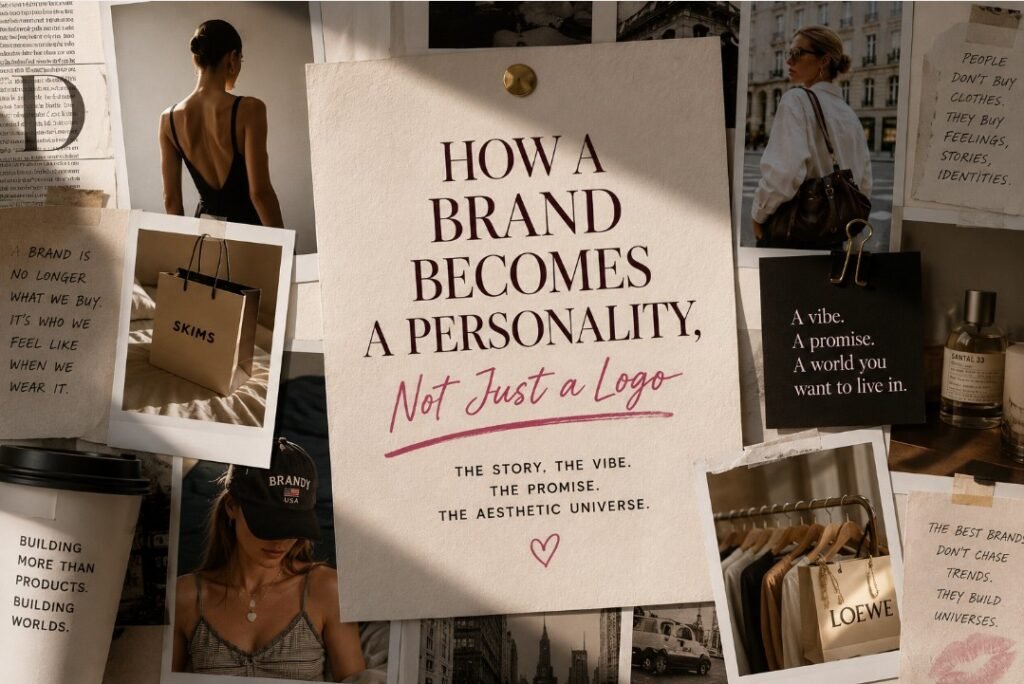
A logo can be copied. A real brand personality is harder.
Anyone can print a symbol. Anyone can make a pretty feed. Anyone can say “community,” “authentic,” “effortless,” or “iconic” until the words pass out from exhaustion.
But a brand that becomes a personality does something more interesting. It builds a world people recognize. It offers a feeling people want to borrow. It creates a story strong enough that the clothes become evidence, not the whole argument.
The smartest thing is not to fall for every myth or reject every brand. It is to ask: what is this brand promising me, and do I actually want that promise? Does it make me feel more like myself, or more like a very expensive stranger?
Because the best style is not when a brand becomes your personality. It is when your personality is strong enough to choose the brand, edit the myth, and walk away still sounding like you.
FAQ
What is brand personality in fashion?
Brand personality in fashion is the mood, story, attitude, visual world, and emotional promise behind a brand. It is what makes people associate a label with a certain lifestyle, feeling, or identity instead of only seeing a logo.
Why does Gen Z care about brand personality?
Gen Z often cares about brand personality because clothes are used to express identity, taste, mood, and belonging. A strong brand story can make an item feel like part of an aesthetic universe, not just a product.
How does a brand become more than a logo?
A brand becomes more than a logo when it creates a recognizable world through design, styling, photography, tone, values, community, and emotional meaning. People start connecting the brand with a feeling or version of themselves.
Are small fashion brands better at building personality?
Small fashion brands can be good at building personality because they often feel more personal, specific, and discovered. But size alone does not make a brand better; quality, consistency, originality, and storytelling still matter.
Can brand personality affect personal style?
Yes, brand personality can inspire personal style by giving people ideas about mood, silhouettes, colors, and styling. The healthiest approach is to borrow what fits your taste without letting a brand define your whole identity.