Dominican Longaniza vs Puerto Rican Longaniza: What’s Actually Different?
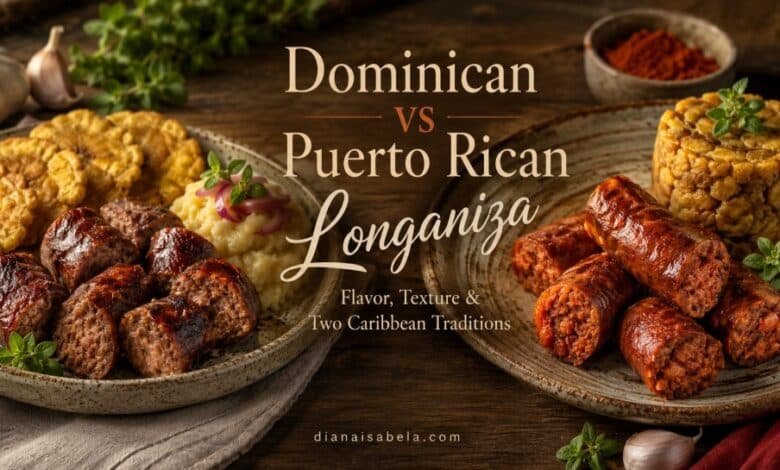
Dominican longaniza and Puerto Rican longaniza share a name, a Caribbean neighborhood and enough visual similarities to make the comparison look easy. It is not. Once you move beyond the word on the menu, the two traditions begin telling different stories about seasoning, texture, meat preparation, frying and what belongs beside the sausage on the table.
The complication is actually the interesting part. Neither island has one laboratory-standard sausage recipe issued to every butcher at birth. Producers vary. Restaurants vary. Families vary. Puerto Rico alone has longanizas made from pork, chicken and more adventurous combinations, while Dominican versions can also differ in seasoning and production method.
So this is not a contest between two rigid formulas. It is a comparison of culinary identities: what tends to define Dominican longaniza, what makes Puerto Rican longaniza — especially the famous Orocovis tradition — distinctive, where the two overlap, and why tasting one does not automatically tell you what the other will be like.
Dominican longaniza is strongly associated with seasoned pork, garlic, oregano, Dominican fritura and dishes built around plantains, yuca and rice. Puerto Rican longaniza also commonly uses oregano and garlic, but Puerto Rican versions — especially the Orocovis tradition — are notably associated with annatto, a chunkier meat texture, brief air-drying before frying, and an island food culture where longaniza has its own celebrated mountain route.
First, stop treating “longaniza” as one universal sausage
Longaniza is a sausage name used across several countries, not a single international recipe. Spain, the Dominican Republic, Puerto Rico, Mexico and other places developed their own versions, seasonings and serving traditions. Two sausages can therefore share the word longaniza while tasting and behaving very differently.
For Dominican longaniza, pork is particularly central to the traditional identity. Garlic and oregano recur in descriptions and recipes, and the sausage is deeply at home in fritura, fried plates, breakfast combinations and dishes involving plantain, cassava or rice.
Puerto Rican longaniza has its own powerful local identity. The clearest example is Orocovis in Puerto Rico’s central mountains, where longaniza is not merely one item among many. It has become enough of a local specialty to inspire an official food route.
Dominican Republic
Puerto Rico
If you need the Dominican sausage explained on its own before comparing it with anything else, read my guide to Dominican longaniza. That gives the Dominican side enough room to breathe rather than forcing its whole history into one comparison paragraph.
The seasoning overlaps more than you might expect
Garlic and oregano do not belong exclusively to either island, which immediately ruins the easy internet version of this comparison. Both can appear in Dominican and Puerto Rican longaniza. Salt and pepper are hardly surprising either.
The interesting difference is in the broader seasoning pattern rather than one magical ingredient. Dominican longaniza is often described through pork, garlic, oregano and sour or acidic seasoning elements, with individual recipes varying. Puerto Rican longaniza from Orocovis is officially described with a base of salt, pepper, oregano, garlic and annatto.
That means the correct comparison is not “Dominican uses oregano; Puerto Rican uses something else.” Both can use oregano. What matters is how those aromatics are balanced, what additional seasonings enter the mixture, how the meat is cut and how the sausage is cooked afterward.
Diana’s kitchen note: food comparisons become much more useful when we stop assigning one ingredient to one flag. Garlic travels. Oregano travels. Cooks borrow, adapt and repeat ingredients. The personality lives in the combination.
The meat itself may be one of the clearest clues
Dominican longaniza is commonly described as a pork sausage, although exact grind and fat ratio vary between recipes and producers. Some preparations use finely ground or chopped meat; others create a coarser filling. That variation is precisely why I would not identify an unknown sausage from texture alone.
Puerto Rico gives us a particularly useful documented example. Discover Puerto Rico describes traditional Orocovis longaniza as using chopped rather than finely ground meat, which contributes to a chunkier texture inside the casing.
That distinction becomes noticeable once the sausage is fried and sliced. A chunkier filling can retain more obvious pieces and a meatier chew, while a more uniformly ground filling tends to feel more cohesive.
Notice the language here: Orocovis-style Puerto Rican longaniza gives us a documented regional method. It would be careless to announce that every Puerto Rican sausage everywhere must have exactly that texture.
Annatto is a useful Puerto Rican clue — not a passport scanner
Annatto, or achiote, is particularly useful when understanding Puerto Rican longaniza because it appears in descriptions of the traditional Orocovis seasoning base. It can contribute warm color and an earthy quality while fitting naturally into Puerto Rican seasoning traditions more broadly.
But even here I would resist turning one ingredient into a universal border guard. Individual sausage recipes vary, and annatto is not exclusive to Puerto Rican cuisine. Its presence is a clue in context, not proof by itself.
If a Puerto Rican menu describes house longaniza with annatto, oregano and garlic, the combination makes cultural sense. If you see a reddish sausage without any menu description, the color alone cannot tell you whether you are looking at Dominican longaniza, Puerto Rican longaniza, chorizo or something else entirely.
For another example of why sausage names require context, see my Dominican longaniza and chorizo comparison. The lesson is similar: identify the culinary tradition before trying to identify the sausage by color.
The path to the fryer can be different too
This is one of my favorite differences because it changes something you can actually feel when eating.
Dominican longaniza has both traditional drying references and modern versions that may be handled more like fresh sausage. Producers differ, so it is safer to follow the actual product rather than forcing every Dominican sausage into one processing category.
The Orocovis tradition has a wonderfully specific restaurant rhythm. Discover Puerto Rico describes many places as air-drying their longaniza for only an hour or two, then deep-frying the sausage whole before chopping it into small pieces. The goal is a crisp exterior with a juicy interior rather than a sausage saturated with grease.
What do Dominican and Puerto Rican longaniza actually taste like?
Both can be savory, aromatic, garlicky and herbal, so the difference is often more nuanced than people expect. This is not vanilla versus chocolate. It is closer to two relatives who inherited some of the same vocabulary and then developed different accents.
Dominican longaniza often brings pork richness together with garlic, oregano and an aromatic, sometimes tangy seasoning profile. Frying intensifies the browned meat flavors and creates contrast between crisp exterior and juicy filling.
Puerto Rican longaniza can share that garlic-and-oregano foundation, while annatto becomes a particularly recognizable Orocovis clue. The chunky meat texture described in the region also affects how the seasoning is perceived because the bite can feel meatier and less uniformly emulsified.
There is enough overlap that a blind taste test would be much more interesting than a tidy infographic. Producer, meat choice and cooking technique can sometimes create larger differences than the nationality label alone.
The plates overlap — but the surrounding food tells a story
Tostones make sense beside both sausages. So does yuca in a broader Caribbean context. Rice dishes appear in both culinary traditions, and mofongo can welcome longaniza enthusiastically.
That overlap is not evidence that the cuisines are interchangeable. Plantains, rice, pork, garlic and frying all move through Caribbean cooking in different ways. The interesting question is how each cuisine assembles them.
Dominican serving context
Longaniza fits naturally into fritura, where fried sausage can share the table with other meats, tostones, yuca or fried cheese. It can also appear at breakfast, particularly in restaurant combinations involving mangú, eggs and other Dominican breakfast foods.
It is equally comfortable away from the fryer. Longaniza can season rice dishes or enter other cooked preparations, moving from crisp standalone protein to an ingredient that flavors the food around it.
Puerto Rican serving context
Discover Puerto Rico describes Orocovis longaniza served with tostones and other sides, stewed with rice and beans or stuffed into mofongo. That last option is especially useful for understanding how flexible the sausage can be: sometimes it is the thing beside the starch, and sometimes it becomes part of the starch.
The larger cultural difference is not that one island understands plantains and the other does not. Both clearly do. It is the specific food traditions that grew around the sausage.
Puerto Rico has something Dominican longaniza does not: La Ruta de la Longaniza
Orocovis has turned longaniza into a destination food. The municipality sits in Puerto Rico’s central mountain range, and its sausage tradition became formalized as La Ruta de la Longaniza, a route connecting restaurants known for the local specialty.
Why Orocovis matters
The longaniza route was officially established in 2014 as a municipal tourism initiative. Around fifteen restaurants originally participated, with businesses concentrated particularly along PR-155 and PR-156. The result is something wonderfully specific: people can drive into the mountains not merely hoping a restaurant happens to serve longaniza, but specifically to eat their way through a region known for it.
The regional tradition also shows how flexible Puerto Rican longaniza can become. Pork and chicken are traditional choices, but Orocovis restaurants have developed house variations using different meat combinations and preparations.
That diversity is a useful warning against sentences like “Puerto Rican longaniza is always pork.” Pork may be foundational, but the living restaurant tradition is more imaginative than a one-line definition.
And culturally, the route matters because food becomes geography. Longaniza is attached to mountain roads, weekend outings, restaurants and local identity. That gives Puerto Rican longaniza a particularly visible place-based story.
Breakfast is where Dominican longaniza starts feeling especially Dominican
Dominican longaniza can be eaten at breakfast, lunch or dinner, but breakfast gives it a particularly recognizable frame. Mangú, eggs, fried cheese and other breakfast foods put the sausage into a meal structure many people immediately identify with Dominican cooking.
That does not mean longaniza automatically replaces Dominican salami in traditional Los Tres Golpes. Restaurant combinations can add or substitute proteins, and larger breakfasts may use both. But mangú gives Dominican longaniza a breakfast relationship that is especially useful when explaining how the sausage lives beyond fritura.
Puerto Rican longaniza is more famously documented in the Orocovis restaurant world with tostones, rice and beans and mofongo. That does not mean Puerto Ricans never eat sausage at breakfast; it means the strongest documented cultural identity for this particular longaniza tradition points us elsewhere.
That difference in emphasis is subtle but useful: Dominican longaniza frequently enters a distinctive Dominican breakfast vocabulary, while Puerto Rican longaniza’s most celebrated regional identity is tied to Orocovis and its mountain restaurant culture.
Can Dominican and Puerto Rican longaniza substitute for each other?
Sometimes in practical cooking, yes; invisibly, no. If a recipe simply needs a flavorful sausage to brown beside rice or plantain, either may produce a delicious meal. But flavor, texture and cultural character will change.
My preferred rule with flavorful regional ingredients is simple: substitute when you need to, but do not pretend nothing changed. Sometimes the difference is the interesting part of dinner.
How to tell which longaniza a restaurant is serving
If a menu gives you only the word longaniza, look around it. Cuisine, side dishes, breakfast vocabulary and the rest of the menu usually tell you more than the sausage name itself.
If what you actually want is a Dominican fried plate in the United States rather than another sausage comparison, use my U.S. guide to finding fried Dominican longaniza. That page is built around places, dishes and ordering rather than sausage theory.
Which longaniza should you try first?
Try the one that belongs to the meal you are actually excited about.
The lovely thing about this comparison is that similarity does not make either sausage less distinctive. Garlic can appear on both islands. Oregano can appear on both islands. Tostones can sit happily beside both. The personality emerges from the way meat, seasoning, preparation, place and serving tradition come together.
Same word, different sense of place
Dominican and Puerto Rican longaniza are close enough to make comparison useful and different enough to make comparison fun. Neither needs to be reduced to a checklist of “this one has ingredient A, that one has ingredient B.”
Dominican longaniza belongs naturally to Dominican fritura, mangú, yuca, rice and a seasoning tradition strongly associated with pork, garlic and oregano. Puerto Rican longaniza has its own flavor vocabulary and, in Orocovis, something even more tangible: a mountain region where the sausage became a destination.
If I could choose the ideal research method, it would involve one Dominican plate, one Orocovis plate, excellent tostones, several friends and absolutely no obligation to declare a winner.
What is the difference between Dominican and Puerto Rican longaniza?
Dominican longaniza is strongly associated with seasoned pork, garlic, oregano and Dominican foods such as fritura, mangú, yuca and rice. Puerto Rican longaniza also commonly uses garlic and oregano, while the famous Orocovis tradition is particularly associated with annatto, chunky chopped meat, brief air-drying and whole frying before the sausage is cut into pieces.
Do Dominican and Puerto Rican longaniza taste the same?
No, although they can share savory, garlicky and herbal notes. Seasoning ratios, meat texture, annatto, production methods and cooking style can make the finished sausages taste noticeably different. Individual producers also vary on both islands.
Does Puerto Rican longaniza contain annatto?
Annatto is an important seasoning clue in the well-documented Orocovis longaniza tradition. Discover Puerto Rico describes salt, pepper, oregano, garlic and annatto as the seasoning base, but individual Puerto Rican longaniza recipes can vary.
What meat is Puerto Rican longaniza made from?
Pork and chicken are traditional in Puerto Rico, and Orocovis restaurants also offer specialty versions using other meat combinations. This is one reason it is inaccurate to describe every Puerto Rican longaniza as exactly the same sausage.
What meat is Dominican longaniza made from?
Pork is the meat most strongly associated with traditional Dominican longaniza. Recipes and commercial products can vary, so check the producer or restaurant when the exact meat matters.
How is Puerto Rican longaniza cooked?
In Orocovis, a famous regional style briefly air-dries the sausage, deep-fries it whole and then chops it into small pieces. Puerto Rican longaniza can also be served with tostones, rice and beans or inside mofongo.
Can I use Puerto Rican longaniza instead of Dominican longaniza?
You can substitute one flavorful sausage for the other in some practical situations, but the seasoning and texture of the finished dish will change. The difference is especially noticeable when longaniza is one of the central flavors of a traditional plate.
What is the Puerto Rican Longaniza Route?
La Ruta de la Longaniza is a food route in Orocovis, Puerto Rico, created around the municipality’s celebrated longaniza tradition. It was officially established in 2014 and includes restaurants concentrated around mountain roads such as PR-155 and PR-156.
Where can I find Dominican longaniza in the United States?
Dominican restaurants, cafeterias, delis and fritura counters are useful places to look, especially in communities with a strong Dominican food presence. Diana Isabela’s national guide tracks fried Dominican longaniza options across several U.S. states.
Have a Longaniza Story I Should Know About?
I’m endlessly curious about the small details that make regional food feel alive — a family longaniza recipe, an unusual seasoning, the way your favorite place serves it, a new Dominican or Puerto Rican restaurant, a story from Orocovis, or simply a combination I should taste next.
If this article reminded you of something I should know about Dominican or Puerto Rican longaniza, write to me at info@dianaisabela.com. Photos, recipes, menu finds, local stories and new places are all welcome. I’d genuinely love to hear from you — and together we can keep making this longaniza guide more useful, delicious and interesting for everyone who lands here hungry.