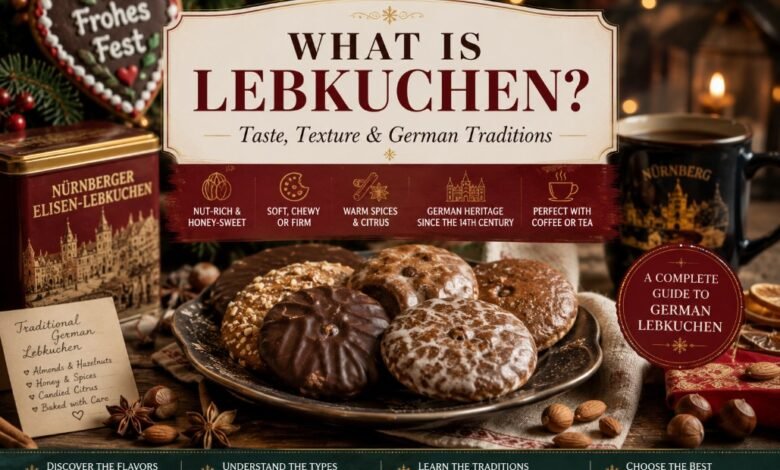
Lebkuchen is a family of German spiced baked goods made in styles ranging from soft, nut-rich rounds to firmer glazed cookies and decorated festival hearts. Although it is often translated as “German gingerbread,” that description can be misleading. Premium Lebkuchen may contain substantial amounts of almonds and hazelnuts, honey, candied citrus peel and aromatic spices, giving it a texture and flavor very different from a thin American gingerbread cookie.
The version many people hope to find when they search for authentic German Lebkuchen is a soft, round cookie baked on a thin edible wafer. It may be left plain, covered with a clear sugar glaze or coated in dark chocolate. A particularly prized variety called Elisenlebkuchen is known for its high proportion of nuts and limited use of flour.
This guide explains what Lebkuchen tastes like, why its texture varies so much, what the main German names mean and how to recognize the style you actually want. Readers ready to compare current sellers, package sizes and seasonal prices can continue to the Best Lebkuchen Near Me shopping guide.
The useful definition: Lebkuchen is not one single cookie recipe. It is a broad German baking tradition that includes soft wafer-backed rounds, chocolate-coated shapes, filled bars, regional specialties and firm decorated hearts.
Lebkuchen Is Better Understood as a Family of Baked Goods
Lebkuchen belongs to Germany’s long tradition of honeyed and heavily spiced baking. The term can describe products that differ in shape, ingredients, moisture and purpose, which is why two packages labeled “Lebkuchen” may look and taste almost unrelated.
At one end of the spectrum is soft Elisenlebkuchen: a substantial round built around ground nuts, honey, citrus and spice. At the other end is a firm decorated Lebkuchen heart sold at a festival or Christmas market. Between them are glazed wafer cookies, chocolate-coated gingerbread shapes, jam-filled bars, small stars, hearts, pretzels and regional variations.
English-language retailers frequently translate every one of these products as German gingerbread. The translation is convenient, but it hides the differences. American gingerbread often suggests a flour-based dough flavored with ginger, cinnamon and molasses, rolled thin and cut into shapes. Lebkuchen may be softer, thicker, more aromatic and considerably more nut-rich.
The name also does not identify one required shape. Round wafer-backed cookies are strongly associated with Nuremberg, but rectangular pieces, small molded shapes, bars and hearts are all found within the larger tradition. A package may contain six large rounds intended to be eaten slowly with coffee, while another may contain dozens of small chocolate-covered pieces for sharing.
That variety explains why a first-time buyer can be disappointed even after purchasing a legitimate German product. Someone expecting a soft almond-and-hazelnut round may accidentally buy a firm festival heart. Someone hoping for a simple ginger cookie may open a package filled with candied citrus, nuts and dark chocolate.
Before choosing a brand, decide whether you want a soft nut-rich cookie, a familiar chocolate-covered gingerbread or a decorative seasonal treat.
Lebkuchen is closely connected with the Christmas season, but the food itself is not merely decoration. Well-made varieties are layered baked goods in which sweetness, spice, nuts, honey, citrus and coating must remain balanced. The best examples taste complete without frosting, whipped cream or an additional filling.
Many German producers sell Lebkuchen only during a defined holiday season. Some begin taking preorders in summer or early fall and ship from October onward. Other shops receive imported packages for only a few weeks. This seasonal pattern is one reason the product can seem difficult to find in the United States even when German food is otherwise available year-round.
What Does Lebkuchen Taste Like?
Lebkuchen tastes warm, nutty, lightly citrusy and deeply spiced, with sweetness coming from honey, sugar, glaze or chocolate. The exact balance depends on the style. A plain nut-rich round may emphasize toasted almonds and fragrant spices, while a milk-chocolate-covered cookie may taste sweeter and more familiar.
The first impression is usually aromatic rather than sharply gingery. Cinnamon is common, but the spice profile can also include cloves, cardamom, coriander, anise, nutmeg, mace, allspice and ginger. The aroma should feel blended. A well-balanced cookie does not taste like a spoonful of cinnamon or a piece of candy dominated by clove.
Honey contributes more than sweetness. It gives the flavor a rounded, floral depth and helps create the association with old European honey cakes. Depending on the recipe, brown sugar, white sugar, syrup or chocolate may add additional sweetness, but the cookie should still taste of nuts and spice rather than only sugar.
Candied orange and citron are important in many traditional recipes. They bring brightness and a mild bittersweet quality that keeps the nut mixture from tasting heavy. The citrus is usually integrated into the dough rather than used as a separate fruit filling. People who dislike candied peel may notice it less in a dark-chocolate-coated version.
Almonds and hazelnuts create the flavor that most clearly separates premium Lebkuchen from ordinary gingerbread. A high-nut cookie can taste almost like a cross between a soft spice cake, a flourless nut cookie and a restrained piece of marzipan, although traditional Lebkuchen is not necessarily made with marzipan.
Plain or nut-topped Lebkuchen: the clearest expression of almonds, hazelnuts, honey and spice.
Sugar-glazed Lebkuchen: brighter and sweeter, with citrus and spice still easy to detect.
Dark-chocolate Lebkuchen: richer and slightly more bitter, with cocoa balancing the honey.
Milk-chocolate Lebkuchen: softer and sweeter, often approachable for children and new tasters.
Filled Lebkuchen: may add jam, marzipan or fruit, making the center sweeter and more dessert-like.
A good Lebkuchen should not produce a strong raw-flour taste. In Elisen-style products, nuts dominate the structure. In more economical or firm varieties, flour may play a larger role, but the cookie should still smell distinctly of spice and retain some tenderness.
There is no requirement that Lebkuchen be extremely spicy. Modern commercial products made for a broad audience can be mild, while artisan products may have a darker and more complex spice profile. “Authentic” does not necessarily mean aggressive. Balance matters more than intensity.
The flavor also changes depending on temperature. Lebkuchen eaten directly from a cold delivery box may seem firm and muted. At room temperature, the chocolate softens slightly and the spice aroma becomes clearer. Heating is usually unnecessary and may damage the coating.
Lebkuchen Can Be Soft, Chewy, Cakey or Firm
The texture of Lebkuchen depends on the proportions of nuts, flour, honey, eggs and moisture, as well as the cookie’s shape and storage. This is why texture is the most important detail to check when reading a product description.
Premium Elisenlebkuchen is generally soft, dense and slightly chewy. It should hold together when bitten but remain moist inside. Ground nuts create a fine, substantial crumb rather than the airy crumb of a sponge cake. Small pieces of candied citrus may be visible, but they should not dominate every bite.
A standard packaged Lebkuchen made with more flour may feel more cake-like. It can still be tender, but the crumb is usually smoother and lighter. Chocolate-coated shapes sold in large bags often fall into this category. They are useful for sharing and may be less expensive than premium Elisen rounds.
Firm Lebkuchen is not automatically stale. Some styles are intentionally structured so they can be shaped, decorated, hung on ribbons or kept as souvenirs. Festival hearts, houses and decorated plaques need enough strength to support icing and handling. Judging them by the standards of soft Elisenlebkuchen would be unfair because they serve a different purpose.
The edible wafer underneath many round cookies also affects the eating experience. The wafer is dry and thin, but the nut mixture above it should be moist. First-time buyers sometimes try to remove the wafer because it resembles packaging paper. It is meant to be eaten and helps support sticky dough during baking.
Do not use “soft” and “fresh” as exact synonyms. A freshly made festival heart can be intentionally firm, while a poorly sealed Elisen cookie can become dry even before its best-before date.
Coatings change the first bite. A thin dark-chocolate shell provides a clean snap before the soft center appears. A sugar glaze may crack into delicate pieces. A thick milk-chocolate coating makes the cookie feel richer and can conceal some dryness, which is why the interior should still be evaluated separately.
Package size matters after opening. Mini Lebkuchen exposes more surface area and may lose moisture faster than large rounds. Individually wrapped pieces are practical for offices, gift baskets and households that will not finish the package quickly.
Storage conditions can make an excellent product seem disappointing. Excessive heat can bloom or soften chocolate. Dry air can harden the interior. A damaged package can reduce aroma. Always inspect the seal and follow the producer’s instructions before deciding that the recipe itself is poor.
The Ingredients Explain Why Lebkuchen Tastes Unlike Ordinary Gingerbread
Lebkuchen recipes vary, but several ingredients appear repeatedly across traditional and modern versions: nuts, honey or sugar, spices, candied citrus, eggs, flour in varying amounts and an optional chocolate or sugar coating.
Almonds and hazelnuts provide richness, fat and structure. In premium products, they are not a decorative addition but one of the main ingredients. Ground nuts create a moist crumb and allow some recipes to use very little flour.
Honey connects Lebkuchen with the larger European tradition of honey cakes. It contributes aroma, sweetness and moisture. Some contemporary products also use sugar syrup, invert sugar or other sweeteners to manage texture and shelf life.
Spices vary by baker and region. Cinnamon and cloves are common, but the mixture can include coriander, cardamom, anise, ginger, nutmeg, mace or allspice. German stores sell prepared Lebkuchengewürz spice blends, but commercial bakers often guard their exact formulas.
Candied orange and citron are chopped finely and distributed through the dough. They should add fragrance and a faint bitterness. The citrus is one reason Lebkuchen can taste more complex than a cookie flavored only with cinnamon and ginger.
Eggs help bind nut-heavy dough. They also contribute richness and structure, particularly when flour is limited. This means many traditional versions are unsuitable for someone avoiding eggs.
Flour may range from a supporting ingredient to a major structural component. Elisenlebkuchen is prized partly because flour is restricted or minimized relative to nuts. Other legitimate Lebkuchen styles use more flour and therefore have a more familiar cookie or cake texture.
Oblaten wafers are the thin edible bases used under many round cookies. Similar wafers appear in confectionery and baking elsewhere in Europe. Their purpose is practical: they keep soft dough from spreading excessively and make the finished cookie easier to lift, pack and eat.
Chocolate and glaze create the final finish. Dark chocolate adds bitterness and richness. Milk chocolate makes the cookie sweeter. A translucent sugar glaze preserves more of the visible cookie and allows the spice profile to remain prominent.
A nut-forward ingredient list usually predicts a dense, moist and premium-style cookie.
Flour appearing prominently usually predicts a lighter, more cake-like or firm product.
Orangeat and Zitronat refer to candied orange and citron peel.
Oblaten means the cookie is baked on an edible wafer.
Zartbitter generally indicates dark or bittersweet chocolate.
Artificial flavors and preservatives may appear in some mass-market products, but they are not necessary to the identity of Lebkuchen. A shopper interested in a cleaner artisan-style product should compare ingredient lists rather than relying on the appearance of the box.
Elisenlebkuchen Is the Style Most People Mean by Premium Lebkuchen
Elisenlebkuchen is a particularly high-quality type of Lebkuchen distinguished by a large proportion of almonds, hazelnuts or other oil-rich seeds and a limited amount of flour. It is usually formed as a substantial round on an edible wafer and finished plain, glazed or chocolate-coated.
The center is not supposed to resemble a crisp cookie. It is soft, dense and fragrant, with enough moisture to remain tender over time when properly packaged. The nuts should be clearly perceptible in both flavor and texture.
Official producer descriptions consistently emphasize many nuts and little flour. Lebkuchen-Schmidt describes Elisen products as containing high-quality nuts, spices and dough spread onto wafers, while individual product descriptions distinguish glazed, chocolate-coated and uncoated varieties.
The exact nut percentage differs by product and manufacturer. Some makers highlight 40% almonds and hazelnuts, while others use product standards or internal recipes with different minimums. A percentage can be useful, but it is not the only quality measure. Freshness, spice balance, citrus quality and coating also affect the result.
The name “Elisen” has inspired a well-known Nuremberg legend. According to the story, a gingerbread baker created an especially nourishing cookie for his ill daughter Elisabeth, or Elise. The story is part of local folklore rather than a reliably documented recipe origin, so it is better understood as a cultural legend than a proven historical event.
What to expect from Elisenlebkuchen: a large, soft and aromatic cookie in which nuts are structural ingredients, not a few pieces scattered on top.
Elisenlebkuchen can still vary widely. One version may be almost plain and intensely nutty. Another may contain extra cocoa, marzipan, baked apple, plum and cinnamon or another seasonal flavor. Modern variations do not erase the traditional base, but buyers should read the label when they want a classic first experience.
For a first tasting, a box containing glazed, chocolate-coated and uncoated nut Elisen provides the clearest comparison. A flavored annual edition is more useful after the basic style is familiar.
Elisenlebkuchen is often more expensive than standard packaged gingerbread because almonds and hazelnuts cost more than flour, and large rounds are relatively substantial. Decorative tins and imported shipping can increase the final price further.
Why Nuremberg Became the City Most Closely Associated With Lebkuchen
Nuremberg’s connection with Lebkuchen is both historical and commercial. The city’s location on important European trade routes gave bakers access to spices, nuts and other imported ingredients that were once rare and expensive.
Official Nuremberg tourism material traces local gingerbread baking back to Franconian monks in the 14th century. Medieval monasteries had traditions of honey cakes and spiced baked goods, while the growing commercial city provided access to cinnamon, cloves, cardamom, nutmeg and almonds.
Nuremberg was also surrounded by forests that supported beekeeping. Honey was an essential sweetener before refined sugar became widely accessible. The combination of honey, imported spices and skilled bakers created favorable conditions for a distinctive regional specialty.
By the early modern period, specialized Lebküchner—professional gingerbread bakers—were producing goods under regulated craft traditions. Recipes and techniques were passed through families and businesses, reinforcing Nuremberg’s reputation.
The city’s Christmas identity later strengthened the association. The Nuremberg Christkindlesmarkt became one of Germany’s best-known Christmas markets, and Lebkuchen became one of the foods visitors expected to see, smell and carry home.
Nürnberger Lebkuchen is now protected as a geographical indication in the European Union. The PGI status concerns geographical production and protects the regional name; it does not mean that every product carrying the broader word “Lebkuchen” must be made in Nuremberg.
Nuremberg did not invent every form of German gingerbread, but it developed the most internationally recognized Lebkuchen identity.
This distinction matters when shopping in the United States. A Colorado baker can produce Nuremberg-style Lebkuchen using traditional methods and ingredients, but the protected geographical term has a specific regional meaning in European labeling. A general German product may be authentic Lebkuchen without being Nürnberger Lebkuchen.
Nuremberg remains home to major historic producers and smaller artisan bakeries. Visitors can find traditional shops, market stalls, modern flavor variations and year-round retail displays, even though Christmas remains the emotional center of the tradition.
The Main Lebkuchen Styles and Words You Will See on Packages
German package terminology often tells you more than the front photograph. Understanding a handful of terms makes it easier to predict texture, coating and filling before opening the box.
Elisenlebkuchen: premium, soft and nut-rich Lebkuchen with little flour.
Oblatenlebkuchen: Lebkuchen baked on a thin edible wafer.
Nürnberger Lebkuchen: geographically associated and protected Nuremberg Lebkuchen.
Schokoliert: coated with chocolate.
Glasiert: covered with sugar glaze.
Ungeglasiert or natur: plain or without a full coating.
Gefüllt: filled, usually with fruit preparation, jam or marzipan.
Lebkuchenherzen: heart-shaped Lebkuchen, sometimes soft but often firm and decorated.
Pfefferkuchen: a regional term for spiced gingerbread, especially common in parts of eastern Germany.
Braune Lebkuchen: a flour-based brown gingerbread category that can include molded or cut shapes.
Printen: an Aachen specialty with a firmer, often syrup-based character.
Chocolate assortments may contain milk chocolate, dark chocolate or both. “Assorted” may also refer to one dough with different finishes rather than several distinct recipes. A box labeled three-way assortment may include two glazed cookies, two chocolate-coated cookies and two nut-topped plain cookies.
Filled varieties can be more confectionery-like. Fruit filling adds acidity and softness, while marzipan increases almond sweetness. These products can be excellent, but they are less useful for learning the basic flavor of Lebkuchen.
Decorated hearts deserve separate expectations. Small soft hearts in a supermarket assortment can resemble other chocolate gingerbread pieces. Large festival hearts are often thick, firm and covered with colorful royal icing. They may carry messages such as greetings, names or romantic phrases.
Printen from Aachen is frequently grouped with German gingerbread but has its own regional identity. Traditional Printen tends to be firmer and may use sugar-beet syrup or other syrups, producing a darker and more structured bite.
Pfefferkuchen does not necessarily contain a noticeable amount of black pepper. Historically, “pepper” could function as a broad reference to spices. The flavor can overlap significantly with other regional gingerbread traditions.
Modern bakers also create annual special editions with ingredients such as marzipan, berries, baked apple, extra cocoa, roasted almonds or plum and cinnamon. These varieties are best considered extensions of the tradition rather than replacements for classic glazed and chocolate-coated styles.
Lebkuchen Compared With Gingerbread, Printen, Spekulatius and Läckerli
Lebkuchen shares ingredients and holiday associations with several European sweets, but the differences in texture and structure help shoppers understand what they are buying.
Lebkuchen versus American gingerbread: American cutout gingerbread is usually flour-based, rolled and shaped, with molasses and ginger providing much of the recognizable flavor. Premium Lebkuchen is often thicker, softer, more nut-rich and more citrus-forward. A gingerbread man snaps or bends; an Elisenlebkuchen round yields like a dense soft cake.
Lebkuchen versus gingerbread cake: Gingerbread cake is baked as a loaf, sheet or layer and has an open cake crumb. Lebkuchen is portioned as cookies, rounds, bars or shapes and generally has a denser structure.
Lebkuchen versus Aachen Printen: Printen is associated with Aachen and is commonly firmer, darker and more structured. It may be plain, nut-topped, chocolate-coated or decorated, but the bite is usually less soft than Elisenlebkuchen.
Lebkuchen versus Spekulatius: Spekulatius is a thin, crisp molded biscuit. Its spice profile may overlap with Lebkuchen, but its texture is closer to a crisp butter or spice cookie. Spekulatius works well for dunking and cookie trays, while soft Lebkuchen is more substantial.
Lebkuchen versus Basler Läckerli: Swiss Basler Läckerli is typically a flat, chewy spiced biscuit containing honey, nuts and candied peel. It is cut into rectangles and has a firmer chew than a soft Nuremberg-style round.
Lebkuchen versus Pfeffernüsse: Pfeffernüsse are small, round spice cookies often covered in powdered sugar or glaze. They tend to be bite-sized and firmer, while Lebkuchen can be much larger and softer.
The main difference is not nationality alone. Shape, nut content, flour content, thickness and intended texture determine whether a product feels like soft Lebkuchen, crisp Spekulatius or chewy Läckerli.
These distinctions are useful when building a German Christmas cookie plate. Rather than buying four similar chocolate gingerbread packages, combine one soft Lebkuchen, one crisp Spekulatius, one buttery vanilla crescent and a small piece of Stollen. The contrast makes each item easier to appreciate.
How Lebkuchen Is Traditionally Served and How to Enjoy It at Home
Lebkuchen is normally served at room temperature with coffee, tea or another winter drink. It does not require warming, frosting or a plated restaurant presentation.
A large Elisenlebkuchen can be eaten as one portion, but it is rich enough to divide. Cutting one glazed and one chocolate-covered round into wedges allows several people to compare them without becoming overwhelmed by sweetness.
Black coffee is a natural pairing because its bitterness balances honey and glaze. Espresso works especially well with chocolate-coated Lebkuchen, while an Americano gives a plain nut-rich cookie more space.
Black tea and Earl Grey are also useful. Earl Grey echoes the citrus notes, and a strong breakfast tea cuts through chocolate. Unsweetened tea is usually more effective than an elaborate holiday drink already flavored with syrup and whipped cream.
Fresh pears, tart apples and orange slices bring moisture and acidity to a dessert plate. Pears pair particularly well with dark chocolate and cloves. Orange emphasizes the candied citrus already present in many recipes.
Mulled wine is strongly associated with German Christmas markets and is a classic adult pairing, but it is not essential. The combined spices can become repetitive if both drink and cookie are very sweet. Coffee and tea often reveal the cookie more clearly.
For a cozy café-style tasting at home, use a small plate, cut the cookies neatly and serve them with plain drinks rather than surrounding them with excessive decoration. The site’s cozy European café food guide offers more ideas for creating that relaxed atmosphere.
Simple tasting for one: half a glazed Elisenlebkuchen, half a chocolate-coated one, black coffee and sliced pear.
Tasting for two: two large cookies cut into quarters, Earl Grey tea and orange slices.
Holiday plate for a group: mini Lebkuchen, Spekulatius, vanilla crescents, fruit and both coffee and tea.
Lebkuchen is also suitable for winter gatherings, host gifts and dessert tables. At an elegant event, serve smaller portions and identify common allergens. A decorative tin can become part of the table styling, while individually wrapped pieces work well as favors.
Readers planning a cold-weather celebration can pair the food inspiration with the site’s guide to winter wedding guest dresses. The connection is practical rather than decorative: Lebkuchen is most naturally served during the same season of indoor receptions, holiday dinners and winter gatherings.
How to Recognize Good Lebkuchen Before and After Opening the Package
Good Lebkuchen should smell clearly of nuts, citrus and spice, remain moist in the center and taste balanced rather than aggressively sweet. The package description can help, but the cookie itself provides the final evidence.
Begin with aroma. A freshly opened package should release a noticeable warm fragrance. If the cookie has almost no aroma, it may be old, poorly sealed or made with a very mild formula.
Look at the interior. Elisenlebkuchen should show a fine nut-based structure, sometimes with small pieces of citrus. The crumb should not resemble dry bread. A more flour-based product may be lighter, but it should still retain tenderness.
The spice profile should unfold gradually. Cinnamon may be obvious, followed by clove, cardamom or citrus. A cookie that tastes only of sugar and generic cocoa offers less complexity, even if the chocolate coating is pleasant.
The coating should complement rather than dominate. Dark chocolate should be thin enough to crack cleanly and melt with the center. A sugar glaze should add sweetness without creating an impenetrable shell.
Check the wafer. It should remain attached to the bottom and may be slightly dry by design. The wafer itself is not expected to taste rich; it functions as an edible base.
Encouraging signs: strong but balanced aroma, visible nut texture, moist center and a clean coating.
Possible signs of age: weak aroma, crumbly interior, separation from the coating and excessive hardness in a style meant to be soft.
Possible storage damage: melted or gray-bloomed chocolate, condensation, torn packaging or an unsealed inner bag.
Not automatically a flaw: fine cracks in sugar glaze or a pale edible wafer underneath.
Chocolate bloom is not always dangerous, but it indicates temperature changes and can affect appearance and texture. Follow the package guidance and contact the seller if a premium gift arrives melted or damaged.
Value should be evaluated by ingredients, weight and eating quality rather than package size. A large metal chest may be beautiful but contain less Lebkuchen than expected. A plain refill box can offer the same cookie without the collectible packaging cost.
Is Lebkuchen Gluten-Free, Vegan or Safe for Nut Allergies?
Traditional Lebkuchen is not automatically gluten-free, vegan, dairy-free, egg-free or nut-free. The exact product label must be checked because different styles use different ingredients.
Tree nuts are especially common in premium Elisenlebkuchen. Almonds and hazelnuts may make up a large proportion of the dough, and walnuts or marzipan may appear in specialty versions. A person with a tree-nut allergy should not assume that a plain glazed cookie is safer than a chocolate-coated one.
Some Elisenlebkuchen contains very little flour, but low-flour does not mean gluten-free. Wheat may appear in the dough or in the edible Oblate wafer. Shared equipment can also create cross-contact.
Gluten-free Lebkuchen is commercially available, including specialist versions that replace the standard wafer or use a different base. Anyone with celiac disease should verify both the ingredient list and production controls.
Eggs commonly bind nut-heavy dough, and honey is a traditional sweetener. For that reason, many dairy-free-looking products are still not vegan. A vegan product should be explicitly labeled and checked for honey, eggs, milk chocolate and confectionery glaze.
Milk appears most obviously in milk-chocolate coatings, but it can also occur as butterfat, whey or milk powder. Dark chocolate does not guarantee dairy-free status because formulas and manufacturing environments differ.
Soy may appear in chocolate emulsifiers, and sulfites may be associated with some processed dried or candied fruit ingredients. People with specific sensitivities should review the full label.
For a serious allergy, ask about the exact variety. “Lebkuchen” is a category, not one fixed ingredient list. A gluten-free cookie may still contain almonds, eggs and dairy, while a plain cookie may still contain wheat and hazelnuts.
Halal and kosher suitability should also be confirmed through current certification or direct manufacturer information. The absence of meat does not answer questions about alcohol-based flavorings, emulsifiers, shared equipment or certification standards.
Which Lebkuchen Should a First-Time Buyer Choose?
The best first Lebkuchen purchase is a small assortment containing glazed, dark-chocolate-coated and preferably plain nut-topped rounds. This combination shows how the same basic cookie changes under different finishes.
A glazed cookie reveals spice, honey and citrus clearly. A dark-chocolate cookie adds bitterness and richness. A plain or nut-topped cookie provides the clearest view of the dough itself. Buying only milk-chocolate shapes may be enjoyable, but it does not show the full character of premium Lebkuchen.
Look for the words Elisenlebkuchen or Oblatenlebkuchen when softness and nut content are priorities. Read the ingredient list and net weight. A high nut percentage is encouraging, but it should be considered alongside freshness and coating.
Avoid beginning with the largest chest. Large assortments can combine many products, some unrelated to the specific style you are trying to understand. Start with five or six good cookies, learn what you prefer and then choose a larger holiday gift later.
Decorative tins are useful when the package will be given as a present or reused. For personal tasting, a refill box or simple sealed bag may offer better value.
Check the shipping schedule. Seasonal specialists may allow orders months before the first baking or delivery week. A product available to preorder in July may not ship until October. This is helpful for planning but not for an immediate craving.
Choose glazed Elisenlebkuchen for the clearest spice and citrus flavor.
Choose dark-chocolate Elisenlebkuchen for a richer and less sugary finish.
Choose a mixed box when you do not yet know your preference.
Choose mini Lebkuchen for parties and dessert boards.
Choose a decorative tin for gifting rather than maximum edible value.
Choose a large budget box when feeding a group that prefers familiar chocolate gingerbread.
A Note From Diana: I would never introduce someone to Lebkuchen with only a giant festival heart or a random chocolate supermarket shape. Those can be fun, but they do not explain the tradition. A small mixed Elisen box gives the most honest first impression because you can taste the nuts, wafer, citrus and spice before deciding which coating you prefer.
Once you know the style you want, use the Best Lebkuchen Near Me guide to compare specialist bakeries, German importers, seasonal retailers, current price ranges and call-ahead options in the United States.
Lebkuchen in One Clear Explanation
Lebkuchen is a broad German tradition of spiced honey cakes and cookies rather than one fixed gingerbread recipe. It can be soft or firm, round or shaped, glazed or chocolate-covered. The most prized soft style, Elisenlebkuchen, relies heavily on almonds and hazelnuts, uses relatively little flour and is often baked on an edible wafer.
Nuremberg became the city most associated with Lebkuchen because of its medieval trading connections, access to spices and almonds, honey-producing surroundings and specialized baking tradition. The regional name Nürnberger Lebkuchen now has protected geographical status in the European Union.
For the most informative first taste, choose an assortment with glazed and dark-chocolate Elisenlebkuchen. Serve the cookies at room temperature with coffee or tea, and check the exact ingredient label for wheat, nuts, eggs, milk, honey and other allergens.
What is Lebkuchen?
Lebkuchen is a family of German spiced baked goods made with ingredients that may include nuts, honey, candied citrus, eggs, flour and warm spices. Styles range from soft wafer-backed rounds to firm decorated hearts and chocolate-coated shapes.
What does Lebkuchen taste like?
Lebkuchen typically tastes nutty, honeyed, citrusy and warmly spiced. Cinnamon, cloves, cardamom, coriander, anise and ginger may be used. Glazed versions taste brighter, while dark-chocolate versions are richer and slightly more bitter.
Is Lebkuchen soft or hard?
Lebkuchen can be soft or firm depending on the style. Elisenlebkuchen is generally soft, dense and moist. Flour-based shapes may be more cake-like, while decorated festival hearts are often intentionally firm.
What is Elisenlebkuchen?
Elisenlebkuchen is a premium type of Lebkuchen made with a high proportion of almonds, hazelnuts or other oil-rich seeds and relatively little flour. It is usually baked as a large round on an edible wafer and may be glazed or chocolate-coated.
Why does Lebkuchen have a wafer on the bottom?
The thin Oblate wafer supports soft, sticky Lebkuchen dough during baking and makes the finished cookie easier to handle. The wafer is edible and should not be removed like packaging paper.
Why is Nuremberg famous for Lebkuchen?
Nuremberg developed a major Lebkuchen tradition because medieval trade routes provided access to imported spices and almonds, while the surrounding region supplied honey. The city later became internationally associated with Lebkuchen and Christmas markets.
What is the difference between Lebkuchen and gingerbread?
Premium Lebkuchen is often thicker, softer, more nut-rich and more citrus-forward than an American gingerbread cookie. American cutout gingerbread generally contains more flour and molasses and is designed to hold a crisp shape.
Is Lebkuchen gluten-free?
Lebkuchen is not automatically gluten-free. Wheat may be present in the dough or edible wafer even when the cookie contains a large amount of nuts. Choose a specifically labeled gluten-free product and confirm cross-contact when necessary.
Does Lebkuchen contain nuts?
Many premium varieties contain substantial amounts of almonds and hazelnuts. Walnuts and marzipan may also appear. People with tree-nut allergies should check the exact ingredient list and contact the producer if needed.
How should Lebkuchen be served?
Lebkuchen is normally served at room temperature with coffee, black tea or another winter drink. Large rounds can be cut into wedges for tasting. Heating is unnecessary and may melt the coating or dry the cookie.