White Canvas Sneakers Are Back: I Styled Them for Seven Real-Life Days

Some trends arrive carrying a full personality. They want a specific bag, a particular skirt length, the correct sunglasses and possibly a reservation somewhere with tiny tables.
White canvas sneakers arrive carrying almost nothing.
That is precisely why they are interesting again.
They are flatter than the chunky sneakers that dominated entire outfits. Less sporty than technical runners. Less precious than ballet flats. Less authoritative than loafers. A plain pair of white canvas shoes does not promise to transform your life, improve your posture or make strangers assume you own a villa.
It simply waits for the outfit to decide what it means.
I wanted to know whether that quietness still feels fresh or whether white canvas sneakers are merely one of those trends that looks charming in an editorial and slightly disappointing beside an ordinary grocery cart.
So I gave them seven days.
Not seven versions of the same jeans-and-T-shirt outfit. I wore them with wide trousers, a slip skirt, shorts, a summer dress, denim, a soft office look and one outfit that nearly proved the entire experiment wrong.
The rules were simple. The shoes had to remain the same. No buying a different pair because one outfit needed a thinner sole or a creamier white. No pretending I spend every afternoon walking past photogenic cafés. And no styling them only with pieces that already look effortlessly cool without any help.
A weekly style pick should survive a real week.
The comeback makes sense because fashion became visually tired
For several years, sneakers were asked to perform.
They became sculptural, technical, nostalgic, futuristic, deliberately ugly, aggressively clean or designed with enough panels to require a diagram. A shoe could contain mesh, suede, reflective strips, a platform, a visible air unit and three shades of beige before breakfast.
Then outfits began calming down.
Relaxed trousers replaced some of the sharper tailoring. Slip skirts returned without requiring a full evening look. White jeans became less pristine. Simple dresses appeared beside practical bags. The most appealing outfits started combining one thoughtful shape with pieces that seemed almost normal.
A flat canvas sneaker fits that mood.
It does not add another layer of design to an outfit already containing volume, texture or unusual proportion. It gives the eye somewhere quiet to land.
There is also a useful nostalgia to it. White canvas sneakers carry associations with old tennis photographs, school uniforms, ’90s street style, summer holidays, French films, art students and people who somehow look good carrying groceries in paper bags.
But nostalgia alone does not make a useful shoe.
The modern version works because the styling around it has changed. Instead of wearing the sneakers only with narrow jeans and a striped top, we now see them under long wide trousers, with sheer skirts, silky shorts, fuller dresses and intentionally oversized shirts.
The shoe remains familiar. The proportions around it make it new.
The appeal is not “look at my sneakers.” It is “the outfit did not need louder sneakers.”
That difference matters.
A trend based on a loud object can disappear when people become tired of seeing the object. A trend based on styling can remain useful because the item keeps adapting.
White canvas sneakers are not trying to replace technical running shoes, leather trainers, loafers or ballet flats. They occupy the space between them: casual but not athletic, classic but not formal, youthful without being restricted to teenagers.
They also suit the current desire to make wardrobes work harder. A simple shoe that can move between jeans, skirts, dresses and trousers has a better chance of surviving beyond one season than a highly specific micro-trend.
That does not mean every pair looks current.
The wrong shape can make the shoe appear flat in an unintentional way, overly school-uniform, visually heavy around the toe or strangely flimsy beneath wide clothes. The comeback is not only about color. It is about construction.
Before the outfits, the shoe itself had to pass inspection
“White canvas sneaker” sounds specific until you place five pairs side by side.
One has a very round rubber toe. Another has a narrow almond-shaped front. One sits low below the ankle. Another rises high enough to shorten the visible leg. Some have bright blue-white fabric. Others are cream. Some have thick foxing around the sole, while others look almost like fabric slippers with laces.
Those differences decide what the shoe can do.
A low profile creates the cleanest line
For this experiment, I chose a low-top pair with a relatively narrow toe, flat white laces and a sole that had presence without looking like a platform.
The low opening matters because it shows the ankle. That small area of skin can make long trousers, midi skirts and dresses feel lighter.
A higher opening may feel more secure, but it can create a stronger horizontal line. That is not necessarily bad. It simply changes the proportion.
The toe should not look like a cartoon speech bubble
A very round, wide rubber toe can make the shoe appear playful and slightly retro. That works with denim, mini skirts and relaxed shorts.
Under tailored trousers or a fluid dress, it may feel too visually blunt.
A slightly narrower toe is more flexible. It still reads casual but does not interrupt the line of the outfit as sharply.
The sole cannot disappear completely
Ultra-thin canvas shoes may look delicate in photographs, but a sole with no visual substance can seem lost beneath wide trousers or a midi dress.
You do not need a platform. You need enough structure for the shoe to look intentional rather than temporary.
Branding changes the personality
A completely plain shoe feels minimal. A visible stripe, colored heel tab or contrast logo makes it sportier. A rubber toe cap introduces more nostalgia. Metal eyelets feel practical and slightly utilitarian.
None of these details is universally better. The question is whether the shoe can join the clothes you already own.
The pair passed.
Now it had to earn seven outfits.
Monday: wide trousers made the sneakers look more expensive
I began with the outfit most likely to flatter them.
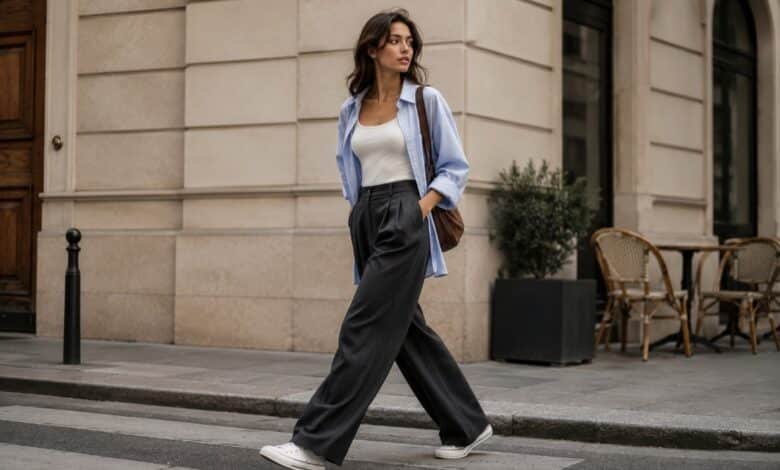
Long charcoal trousers. A white fitted tank. An oversized pale blue shirt worn open. A medium brown shoulder bag. Nothing complicated.
The trousers were fluid rather than sharply tailored, and the hem almost touched the floor. Underneath, the white canvas sneakers appeared only in flashes.
This was exactly where the shoe made sense.
A chunky trainer would have added too much visual machinery beneath the wide hem. A ballet flat might have made the outfit feel more delicate than I wanted. A loafer would have sharpened the look and moved it closer to workwear.
The canvas sneaker kept the outfit relaxed.
More importantly, its slim shape prevented the wide trousers from becoming heavy. The eye followed the long charcoal line downward, met a small clean shoe and continued rather than stopping at a large sole.
Why this outfit worked
There were three levels of structure.
The fitted tank created a narrow center. The open shirt provided movement without closing the torso. The trousers added the major volume. The shoes did not repeat that volume.
Color also helped. Because the tank and sneakers were both white, the outfit had a subtle visual connection from top to bottom. It did not look matchy. It looked resolved.
The brown bag prevented the palette from becoming too cold and office-like.
What could have ruined it
A trouser hem stopping several inches above the sneaker would have exposed too much shoe and made the feet look unexpectedly small beneath the wide leg.
A cropped wide trouser could still work, but it would need a slightly stronger sneaker shape, visible sock or more deliberate ankle line.
A very oversized shirt buttoned completely over the tank would also have removed the outfit’s narrow point. Wide shirt, wide trouser and flat sneaker can become one uninterrupted column of fabric.
The practical reality
The outfit was comfortable for walking, sitting and working. The canvas shoes felt lighter than leather trainers, though not as supportive as running shoes.
That distinction matters. “Comfortable” can mean soft, light and nonrestrictive. It does not always mean supportive enough for twelve thousand steps.
By lunchtime, I understood the limit. For a normal day, the sneakers were excellent. For a full travel day, I would choose more cushioning.
Tuesday: jeans revealed how quickly “classic” becomes forgettable
Jeans and white sneakers are supposed to be automatic.
That is both their strength and their problem.
I began with straight blue jeans, a plain white T-shirt and the sneakers. The outfit was fine. Not wrong. Not ugly. Not interesting enough to remember after turning away from the mirror.
The sneakers had disappeared into a collection of defaults.
This is where people often blame the shoe for being boring. In reality, the entire outfit has the same level of visual information. Basic top, familiar jeans, familiar sneaker. Nothing creates contrast, shape or point of view.
The first correction: change proportion, not color
I replaced the regular T-shirt with a slightly cropped boxy one. The exposed waistband gave the outfit a clear break.
Better.
Then I cuffed nothing. The straight jeans fell full length and lightly touched the shoes. The longer line looked more current than an ankle crop with bare skin between denim and sneaker.
The shoes became part of the silhouette instead of a separate white object at the bottom.
The second correction: add one polished piece
A black structured shoulder bag changed the outfit more than a necklace would have.
The bag introduced a firm shape. Its polished surface contrasted with the canvas and faded denim. Suddenly the sneakers looked casual by choice rather than casual by default.
The third correction: stop accessorizing before the outfit becomes themed
I tried sunglasses, a belt, layered chains and a cap.
Too much.
The look began to resemble a checklist called “how to style jeans.” I removed the cap and most of the jewelry. The bag and proportions were enough.
What about baggy jeans?
Baggy denim works beautifully with slim canvas shoes when the hem does not completely consume them.
The shoe should still appear as a recognizable shape. If the jeans drag, fold and cover nearly the entire sneaker, the outfit can look untidy rather than relaxed.
A slightly pooled hem is different from fabric collecting dirt from three neighborhoods.
With very wide jeans, the sneaker’s low profile becomes more noticeable. This can look modern, especially when the upper body is fitted or cropped. If the top is also oversized, the shoe may need a thicker rubber edge to avoid appearing too fragile.
What about skinny jeans?
White canvas sneakers with skinny jeans are not forbidden by international law.
They simply create a very familiar proportion. To make it feel current, I would add a longer relaxed shirt, a strong jacket, an interesting sock or a more deliberate bag.
The problem is rarely the jeans alone. It is the full collection of older styling signals: tight denim, long fitted top, tiny cuff, no-show socks and a rounded white shoe.
Change two of those signals and the outfit changes.
For a broader look at how footwear affects simple clothes, the article on using sneakers to make basic outfits feel intentional explores shape, contrast and accessories beyond this one white canvas pair.
Tuesday lesson: jeans and white canvas sneakers need one decision. A different proportion, a polished bag, a strong shirt or an intentional hem is enough. Without that decision, the outfit remains wearable but anonymous.
Wednesday: a slip skirt gave the sneakers a reason to exist
This was the outfit I expected to enjoy most.
A dark chocolate midi slip skirt, a soft grey tank, a lightweight cream cardigan carried rather than worn, and white canvas sneakers.
The contrast was obvious: fluid skirt, practical shoe.
Obvious contrasts can become cliché, but this one still works because the pieces solve each other’s problems.
The slip skirt risks looking too evening-like or delicate for an ordinary day. The canvas sneakers reduce that formality. The sneakers risk looking plain. The skirt gives them context.
The skirt length mattered
A midi skirt that ended at the narrow lower calf created enough visible leg between hem and shoe. The sneaker looked clean and small.
A skirt ending at the widest part of the calf would have created a heavier horizontal line. In that case, a slightly lower shoe opening or more exposed ankle could help.
A maxi skirt can also work, especially with a slit. Without movement or visible ankle, the shoes may disappear entirely.
The fabric could not be too formal
A high-shine satin skirt with a lace camisole and delicate bag might make canvas shoes feel accidentally underdressed.
My skirt had a muted finish. The grey tank was simple. The brown and cream palette made the white shoes feel fresh rather than stark.
Socks nearly ruined it
A visible athletic sock made the outfit too sporty. A lace-trimmed sock made it too self-conscious. A low simple sock that remained mostly hidden worked best.
This does not mean visible socks cannot work with a midi skirt. They can create a playful, preppy or slightly quirky look. But they become a real styling element rather than a practical afterthought.
The cardigan question
Wearing the cardigan buttoned turned the outfit softer and more classic. Draping it over the shoulders looked too curated for my actual day. Carrying it in the bag was the least photogenic and most realistic solution.
This is why real-life style tests matter. An outfit can look excellent for a photograph and become irritating after twenty minutes.
The sneakers passed because they allowed the skirt to move without requiring careful walking. I could sit, cross the street, shop and stand for longer than I would in a delicate flat.
Would a leather sneaker look better?
It would look more polished and perhaps more expensive. It would also remove some of the texture contrast.
The canvas had a dry, matte surface beside the fluid skirt. That difference made the outfit interesting without adding another color.
Canvas is not always the cheaper-looking choice. Sometimes it is the more thoughtful texture.
Thursday: the dress needed less romance, not more styling
The dress was a soft blue cotton midi with a fitted upper section, a fuller skirt and narrow straps. On its own, it leaned romantic. With sandals, it became a familiar summer look. With ballet flats, it felt more polished. With the white canvas sneakers, it became useful.
Useful can sound like faint praise in fashion.
It should not.
A dress that can survive an ordinary day is more valuable than one that becomes beautiful only after the correct shoes, bag and weather all arrive together.
The sneakers changed the posture of the outfit
Sandals made me aware of the dress. The canvas sneakers made me forget about it.
I walked faster. The skirt moved. The outfit felt less like “wearing a summer dress” and more like simply being dressed.
That change is psychological as much as visual.
Why the color worked
Blue and white already have a clean relationship, but the outfit could have become overly sweet. A black or brown bag prevented it from looking like a coordinated holiday set.
I chose a dark brown shoulder bag with minimal hardware. It grounded the dress without introducing the sharpness of black.
The sneaker shape had to remain narrow
A bulky athletic shoe under a full cotton midi would have added another round, substantial shape beneath the skirt.
The flat canvas pair kept the lower line light.
If the dress had been very short or straight, a thicker sneaker could have balanced it. With a fuller midi, the smaller shoe made more sense.
Printed dresses
White canvas sneakers work especially well with prints because they do not introduce another pattern or material story.
Florals become less precious. Stripes feel relaxed. A graphic print receives a neutral base.
But the shade of white matters. A soft cream printed dress may look slightly disconnected from a blue-white sneaker. In that case, an off-white canvas pair can create a more harmonious finish.
Short dresses
With a mini dress, flat white sneakers can lengthen the visible leg because they sit low around the ankle.
The effect is strongest when the shoe color does not create a harsh contrast with the skin or sock. A bright white sneaker with black socks makes a clear stop. Bare ankle or low socks create continuity.
Loose dresses
A loose dress plus flat canvas shoes can look beautifully relaxed—or like sleepwear escaped the house.
Structure must appear somewhere. A defined neckline, rolled sleeve, substantial bag, sunglasses or visible seam can give the outfit a center.
The sneakers alone cannot provide all the structure because their appeal is precisely that they are quiet.
Thursday lesson: white canvas sneakers make a romantic dress easier, but they cannot rescue a dress with no visible shape, no texture contrast and no anchoring accessory. Casual is a direction, not the absence of decisions.
Friday: office dressing exposed the difference between clean and childish
Can white canvas sneakers work in an office?
That question depends heavily on the office, but the visual answer is easier: they need clothes with enough intention to keep the shoe from looking like an afterthought.
I wore cream tailored trousers, a fine black sleeveless knit, a narrow belt, a structured brown bag and the sneakers.
The outfit looked polished from the ankle upward. The canvas shoes lowered the formality but did not collapse it.
The trousers needed proper length
Cream trousers ending awkwardly above a flat white sneaker can create a school-uniform effect. Full length looked more sophisticated.
The hem skimmed the shoe and allowed only the toe and outer edge to remain visible.
A cropped trouser could work with a sharper ankle line, a sock chosen intentionally or a slightly more substantial sneaker. Mine looked better long.
The knit gave the upper body enough finish
A regular cotton T-shirt would have made the outfit significantly more casual. The fine knit introduced a smoother texture and cleaner neckline.
This is an important lesson for mixing casual footwear into dressier settings: the top half may need to compensate slightly.
Not with sequins. With finish.
The bag could not be floppy
A large soft tote, loose trousers and canvas shoes would have made the outfit feel unfinished.
The structured bag gave the eye a firm shape and suggested that the sneakers were deliberate.
How white was too white?
For the office look, the shoes needed to appear clean. Not untouched, but maintained.
A little softness in the canvas was fine. Dark scuffs around the rubber edge were not.
There is a difference between lived-in and neglected. Casual shoes in a polished outfit receive more scrutiny because the contrast is already visible.
Would I wear them to an interview?
Usually not, unless the environment was clearly creative and informal.
Would I wear them to a normal day in a relaxed workplace? Yes.
Would I wear them to a meeting where I wanted to appear more authoritative? I would probably choose loafers, refined leather sneakers or flats.
A weekly style pick does not need to work everywhere. It needs to know where it belongs.
The “expensive” question
Canvas sneakers do not become luxurious because a fashion magazine declares them timeless. They look elevated when the outfit contains good proportion, fabric contrast and care.
The cream trousers fit well. The knit held its shape. The bag was structured. The shoes were simple and clean.
That combination mattered more than labels.
The same principle appears in my article on making relaxed clothes look polished rather than careless: expensive-looking style usually comes from relationships among pieces, not from forcing every item to look formal.
Saturday: shorts proved that a plain sneaker can still have personality
Saturday was hot enough to make every fashion principle negotiate with reality.
I chose black tailored shorts, an oversized white linen shirt worn partly open over a grey tank, the canvas sneakers and a woven brown bag.
The outfit contained four neutral colors and no dramatic accessory. It could easily have looked like a packing list.
Instead, the proportions carried it.
The shorts were not tiny
A slightly longer relaxed short gave the flat sneaker enough visual balance. Very short shorts with a low white shoe can make the feet appear longer by comparison, especially when the top is also minimal.
That can be attractive, but it creates a different mood.
The tailored shape also prevented the sneakers from making the outfit too sporty.
The shirt created movement
Worn fully buttoned, the oversized shirt looked too boxy over the shorts. Open over the tank, it created vertical lines and allowed the waist to remain partly visible.
I rolled the sleeves once. That exposed the forearms and kept the shirt from overwhelming the shorter lower half.
The woven bag introduced summer texture
Without the bag, the look felt urban and minimal. With it, the outfit gained warmth and seasonality.
The sneakers remained simple enough not to compete.
Denim shorts
Canvas sneakers and denim shorts are another automatic combination, which means they need one thoughtful element.
A sharp button-down, a fitted knit, an interesting belt or a polished bag can prevent the outfit from becoming generic.
If the denim is heavily distressed and the sneakers are visibly worn, the top should probably bring more refinement.
Athletic shorts
White canvas sneakers are not true performance shoes, but visually they can work with nylon or running-style shorts.
The result feels more lifestyle than gym. Add a crisp shirt, fitted tank or structured bag to make that distinction clear.
Bermuda shorts
This may be the best shorts pairing.
A longer tailored or denim Bermuda creates enough vertical line to make the small shoe feel deliberate. A fitted tank or shorter shirt keeps the upper half clear.
The combination feels slightly ’90s without requiring sunglasses the size of a small windshield.
Sunday: the outfit failed because everything was equally relaxed
Every styling experiment needs one honest failure.
Mine involved loose beige linen pants, a long oversized cream T-shirt, a soft canvas tote and the white sneakers.
On paper, it sounded like effortless summer dressing.
In the mirror, it looked as though I had dressed entirely from a laundry pile labeled “comfortable neutrals.”
Nothing was individually wrong.
The pants had a beautiful drape. The shirt was soft. The tote was useful. The sneakers were clean.
The problem was that every piece had the same attitude.
Loose. Pale. Matte. Unstructured. Casual.
The sneakers could not provide contrast because they belonged too comfortably inside the same visual family.
Correction one: the half-tuck
I tried a small tuck at the front.
It helped by revealing the waistband, but the T-shirt fabric bunched and created a soft knot over already soft pants.
Better, not solved.
Correction two: change the bag
I replaced the tote with a small dark brown structured bag.
The outfit improved immediately. The darker, firmer shape created an anchor.
Correction three: roll the sleeves
Rolling the shirt sleeves exposed the arms and made the upper body appear more intentional.
Now the sneakers looked like part of a relaxed outfit rather than the final item in a surrender.
Correction four: add a belt
A brown belt visible at the waistband connected visually to the bag and created enough structure.
I did not need a jacket, jewelry stack or different shoes.
What the failure taught me
White canvas sneakers are not magical neutralizers.
They do not automatically make soft clothes modern. They do not add structure. They do not create a focal point unless the surrounding colors make the white significant.
When every piece is relaxed, add one item with a firmer edge.
That can be a bag, belt, watch, sunglasses, buttoned shirt, stronger neckline or darker color.
The shoe then benefits from the structure without having to provide it.
A quiet shoe needs the outfit to make at least one audible decision.
The sock question is not small once the shoe is this simple
With a technical sneaker, the eye notices the shoe first. With white canvas sneakers, a visible sock can become almost equally important.
That is why the wrong sock can make an otherwise good outfit feel accidental.
No-show socks
No-show socks create the cleanest ankle line with dresses, skirts and cropped trousers.
The practical problem is fit. A sock that slides beneath the heel turns a simple outfit into an afternoon-long personal dispute.
Look for a silicone grip and enough coverage over the toes to prevent bunching.
White crew socks
These make the outfit sportier, younger and more preppy.
With shorts, mini skirts and cropped jeans, the effect can be intentional and charming. With long trousers, only a small glimpse may appear when sitting.
The thickness matters. A heavy ribbed athletic sock can overwhelm a very slim shoe. A lighter crew sock follows the scale more naturally.
Colored socks
A burgundy, navy, grey or brown sock can connect the sneakers to another part of the outfit.
This works especially well with cropped trousers or a skirt when the sock is clearly meant to be visible.
Choose a color already present in the bag, top or print. Random contrast can look interesting, but it requires confidence and repetition elsewhere.
Lace and decorative socks
These shift the sneaker toward a romantic, coquette or playful mood.
They can look excellent with a simple dress or denim skirt. They can also make the outfit feel overly styled if the clothing already contains bows, ruffles or a strong print.
Black socks
Black creates a sharp break against white canvas. With black trousers or a black skirt, it can connect the leg to the outfit. With pale clothes, it may look visually abrupt.
There is no universally correct sock. There is only an intentional or unintentional one.
With a midi dress: hidden or very light socks keep the ankle clean.
With shorts: a fine crew sock can add shape and personality.
With cropped trousers: use the sock to connect colors rather than leaving it random.
With long trousers: prioritize comfort because the sock is mostly invisible.
Bright white is not always the most versatile white
Online, white often appears as one category.
In a real outfit, blue-white, cream, ivory, natural canvas and aged rubber all behave differently.
Optical white
A very bright white sneaker feels crisp, sporty and graphic.
It works beautifully with black, navy, strong denim, bright color and clean white tops. Against soft cream, oatmeal or antique white, it can appear slightly harsh.
This is useful if you want contrast. Less useful if you want tonal dressing.
Natural canvas
Natural canvas has a slightly warm, unbleached quality. It pairs easily with beige, brown, olive, cream, faded denim and soft summer colors.
It may look less sharp with a pure white shirt, but the difference can feel intentionally textured rather than mismatched.
Off-white and ivory
These shades suit softer wardrobes and outfits built around warm neutrals.
They also age more gracefully because minor discoloration is less obvious than on optical white.
White upper with cream rubber
This combination often looks subtly vintage. The rubber does not create a stark line around the shoe, making the overall shape feel softer.
Matching whites perfectly is unnecessary
Your white shirt and sneakers do not need to be identical.
In fact, slightly different whites can create depth. The outfit looks problematic only when one item appears accidentally yellowed or dirty beside the other.
Texture helps explain the difference. Linen, cotton, leather and rubber reflect light differently even when dyed the same color.
The slim sole changes more than the sneaker trend
The return of white canvas shoes is part of a larger change in footwear proportion.
For years, many outfits relied on a substantial sneaker to balance oversized clothing. The shoe created weight at the bottom, making wide trousers and large jackets feel anchored.
A slim sneaker handles volume differently.
It does not balance by matching weight. It balances by creating contrast.
With wide trousers
The small shoe makes the trouser appear longer and more fluid. The effect is elegant when the hem nearly covers the sneaker.
If the trousers are cropped, the foot may look unexpectedly small beneath the wide leg. A visible sock, slightly thicker sole or more fitted top can restore balance.
With straight jeans
The proportions feel natural because neither garment dominates. Full-length jeans create the most continuous line.
With skinny jeans
The shoe and leg form one narrow line. This can elongate the body but may feel familiar rather than trend-forward. An oversized or structured upper layer adds contrast.
With midi skirts
The shoe keeps the lower half light. A narrow opening and exposed ankle prevent the skirt from ending in a heavy block.
With mini skirts and shorts
The flat shoe can lengthen the visible leg, especially with low socks. A very wide rounded toe may shorten that line slightly.
With oversized jackets
A small sneaker beneath a large blazer or bomber can look intentionally unbalanced in a fashion-forward way.
However, the outfit needs one connection between top and bottom: matching white, a narrow trouser line, a structured bag or visible fitted layer.
The shoe’s modest size makes other proportion choices more visible. That is why it feels fresh—and why it can expose an outfit that has no clear structure.
The same sneaker does not create the same line on everyone
Footwear advice often pretends that one shoe shape produces one universal result.
It does not.
Height, leg length, ankle width, foot length, trouser hem and the scale of the clothing all change how a slim white sneaker appears.
Petite frames
A low-top canvas sneaker can be useful because it exposes the ankle and does not add a heavy visual stop.
With full-length trousers, choose a hem that lightly meets the shoe rather than swallowing it. With skirts, a low opening preserves more visible leg.
Very long rounded toes may make the foot appear disproportionately large, while extremely wide rubber caps can shorten the line. A moderately narrow toe is often easiest.
Monochrome or low-contrast pairings can lengthen the body: cream pants with off-white sneakers, pale denim with white canvas, or bare ankle with a low shoe.
Tall frames
Tall women can carry longer trouser breaks, midi skirts and larger clothing volumes without the sneaker disappearing as easily.
A very small-looking shoe beneath extra-wide trousers can still feel unbalanced. A pair with a slightly stronger rubber edge or visible toe cap may suit the scale better.
High-tops can also work beautifully on longer legs, though they create a different, more graphic proportion.
Curvy frames
A slim sneaker does not need to “balance” curves by becoming chunky.
The more useful question is whether the shoe supports the clothing line. With wide trousers, let the hem connect to the sneaker. With a midi skirt, expose enough ankle to separate the skirt from the shoe. With fitted jeans, a structured top or bag can distribute visual weight through the outfit.
If the shoe feels too small, try a pair with a wider foxing strip or slightly thicker sole before jumping to a full platform.
Long feet
Bright white naturally draws attention, so a long narrow shoe may emphasize foot length.
A toe cap, warmer white, contrast piping or slightly rounded shape can break the line. Long trousers that meet the shoe also reduce the amount visible.
Wide feet
Canvas often softens with wear, but width should not depend entirely on stretching.
A narrow sole can cause the foot to spill visibly over the edge and become uncomfortable. Choose a true wide option or a naturally broader last.
The most flattering shoe is one that allows the foot to sit correctly. Pain does not improve proportion.
Strong ankles or calves
A low-cut sneaker can create a clean break below the ankle. High-tops may visually shorten the lower leg, especially with a midi hem ending nearby.
This is not a prohibition. It simply means the distance among skirt hem, sock and shoe opening should look deliberate.
The shoes should look worn, not abandoned
There is a peculiar tension around white canvas sneakers.
Brand-new pairs can look too bright, too stiff and slightly disconnected from relaxed clothes. Heavily stained pairs can make even a polished outfit look careless.
The most appealing point is somewhere between the two.
Softened canvas. Natural creasing. Clean laces. Rubber without a collection of unexplained dark marks.
Do not wash them after every small mark
Excessive cleaning can weaken canvas, loosen glue and change the texture. Spot treatment is usually enough for small stains.
Use a soft brush or cloth. Test any cleaner in an inconspicuous area. Avoid soaking the shoe unless the manufacturer specifically allows it.
Clean the rubber separately
The rubber edge often looks dirty before the canvas does.
A damp cloth and mild soap may be enough. Cleaning that edge can make the entire shoe appear maintained without fully washing it.
Laces matter more than expected
Grey, twisted laces make the shoe look older immediately.
Remove and wash them separately or replace them when necessary. Fresh laces can extend the visually useful life of the sneakers.
Dry them carefully
Strong heat can damage glue and distort the shoe. Allow them to air-dry away from direct high heat.
Stuffing the toe lightly with clean paper can help preserve shape, but avoid printed paper that may transfer ink when wet.
Accept normal aging
Canvas will crease. White will soften. Rubber may become slightly warmer in tone.
This is not always damage. A shoe can look better once it stops appearing factory-fresh.
The goal is not permanent perfection. It is enough care that the wear appears connected to a life rather than neglect.
A simple shoe leaves nowhere for bad construction to hide
When a shoe has very few details, each detail becomes more visible.
Uneven stitching. Crooked eyelets. Glue around the sole. A heel that collapses. Canvas that puckers near the toe. A rubber edge that separates after three wears.
White makes all of it easier to see.
Stitching should remain even around stress points
Inspect the toe, eyelets, heel and point where the upper meets the sole.
Loose threads are not always catastrophic, but several inconsistent seams suggest rushed construction.
The sole should flex in the correct place
A walking shoe bends near the ball of the foot. If it folds through the middle like a soft envelope, it may provide very little structure.
A completely rigid sole is not ideal either. Canvas sneakers should move.
The heel counter needs enough shape
Some canvas shoes are intentionally unstructured, but a heel that collapses inward can rub and make the shoe look tired quickly.
Press it lightly. It should have some resistance unless the design is deliberately slipper-like.
Eyelets should sit flat
Metal eyelets should not have rough edges that catch laces. Stitched eyelets should remain reinforced.
The insole decides whether “easy” becomes painful
A thin flat insole may feel acceptable for a short fitting-room walk and uncomfortable after an hour.
Removable insoles offer flexibility, especially if you need more cushioning or support.
Check both shoes
Simple advice, frequently ignored.
One shoe may have a crooked toe cap, uneven rubber, different stitching tension or slightly altered shape. White pairs make asymmetry noticeable.
Quality does not mean indestructible: canvas is a light textile, not armor. A good pair should be neatly built, comfortable and appropriate for its purpose—not expected to perform like a hiking shoe.
Who actually needs this trend—and who can skip it
A weekly style pick should not end with the conclusion that every reader needs to purchase the selected item.
You may already own a shoe that performs the same role.
Buy them if your wardrobe contains polished pieces you rarely wear casually
Slip skirts, midi dresses, wide trousers and crisp shirts become easier with a plain canvas sneaker.
The shoe lowers formality without introducing an athletic look.
Buy them if chunky sneakers overpower your clothes
If you like sneakers but feel that substantial soles dominate your outfits, canvas offers a quieter alternative.
Buy them if your style mixes classic and relaxed pieces
They suit wardrobes built around denim, cotton dresses, trousers, button-down shirts, simple knits and practical bags.
Buy them if you want a warm-weather closed shoe
Canvas is often lighter and more breathable than leather, although construction and lining matter.
Skip them if you need strong all-day support
Many canvas sneakers are flat and minimally cushioned. If you walk long distances or require specific support, a performance or supportive lifestyle sneaker may be more appropriate.
Skip them if you already own a simple low-profile leather sneaker you love
The visual role is similar. Canvas offers a different texture and lighter mood, but the wardrobe function may overlap.
Skip them if white shoes make you anxious
A trend should not create a cleaning ritual you resent.
Natural canvas, tan, navy or black may give you the same shape with less maintenance.
Skip them if your clothes are mostly athletic
Technical runners may integrate more naturally with leggings, performance shorts and sportswear.
Canvas sneakers can work, but they may feel stylistically disconnected if every other garment is designed for exercise.
Buy one pair, not a collection
This is the kind of item that gains value through repetition.
You do not need a bright white pair, cream pair, platform pair, vintage pair, high-top pair and one pair with a tiny colored stripe before deciding whether the shape suits your life.
Start with the version that fits the greatest number of your existing outfits.
After seven days, the sneakers earned a place—but not a pedestal
The best outfit was not the dress, although that was the prettiest.
It was Monday’s wide trousers.
The sneakers did exactly enough. They kept the trousers light, echoed the white tank and allowed the shirt and bag to shape the outfit.
The most useful outfit was Thursday’s dress because the shoes changed how wearable the dress felt.
The most instructive outfit was Sunday’s failure. It proved that a quiet shoe cannot create structure inside an outfit where every other piece is equally soft, pale and relaxed.
The jeans outfit required the most editing. Familiar combinations are often harder than unusual ones because they arrive loaded with old habits.
The office outfit had the narrowest acceptable range. Clean shoes, proper trouser length and a polished upper half were nonnegotiable.
The slip skirt created the most interesting texture contrast. The shorts worked because linen, tailoring and woven accessories gave the neutrals dimension.
What the shoe did well
It moved between seven outfit categories without becoming the theme of any of them.
It made dresses and skirts more practical. It lightened wide trousers. It gave tailored pieces a little youth. It allowed accessories and fabric to carry the style.
What it could not do
It could not create polish inside an unfinished outfit.
It could not provide serious walking support. It could not balance every oversized silhouette automatically. It could not make a plain jeans-and-T-shirt combination memorable without help.
Why I would keep wearing it
The shoe does not demand a new wardrobe.
That is becoming one of my favorite qualities in a trend.
It works with clothes people already own: jeans, summer dresses, midi skirts, shorts, trousers and button-down shirts. The update comes from proportion, hem length, texture and accessories rather than purchasing an entirely coordinated look.
This also makes white canvas sneakers a natural companion to a realistic summer wardrobe built for repeat wear. They do not solve every outfit, but they connect enough of them to become genuinely useful.
Would I call them revolutionary?
No.
Would I wear them next week?
Yes—and that is a more meaningful endorsement.
The best weekly style pick is not the piece that photographs once. It is the piece that quietly returns on Thursday.
The white canvas sneaker does not finish an outfit—it edits one
That is the clearest conclusion from the week.
A chunky sneaker may add weight. A loafer adds authority. A ballet flat adds delicacy. A technical runner adds movement and sport.
A white canvas sneaker subtracts.
It removes formality from a skirt. Removes preciousness from a dress. Removes heaviness from wide trousers. Removes some seriousness from tailored shorts.
Subtraction is useful when the outfit already contains something worth noticing.
When the clothes contain no shape, contrast, texture or idea, the same subtraction can leave the look empty.
So I would not style these sneakers by asking, “What matches white shoes?” Almost everything does.
I would ask, “Which part of this outfit needs to feel less formal, less heavy or less carefully arranged?”
That is where the shoe belongs.
Not because it is loud enough to rescue the outfit.
Because it is quiet enough to let the right part speak.
Questions and answers
Are white canvas sneakers in style in 2026?
White canvas sneakers have returned as a low-profile alternative to heavier and more technical trainers. Their simple shape works especially well with wide trousers, midi skirts, summer dresses and relaxed tailoring.
What can I wear with white canvas sneakers?
They work with full-length jeans, tailored shorts, slip skirts, cotton dresses, wide-leg trousers and simple office outfits. The strongest combinations usually contain one polished, fluid or structured piece that contrasts with the casual canvas shoe.
Do white canvas sneakers look cheap?
Not automatically. Neat construction, a balanced toe shape, clean laces and a well-maintained rubber edge make a significant difference. They look most polished when the surrounding clothes fit well and the outfit includes deliberate texture or structure.
Can I wear white canvas sneakers with a dress?
A cotton midi, printed summer dress, slip dress or simple mini can all work. The sneakers lower the formality and make the dress easier for daytime. With a very loose dress, add a structured bag, visible neckline or another clear shape so the outfit does not appear unfinished.
Should white canvas sneakers be bright white or off-white?
Bright white feels crisp and graphic, while off-white or natural canvas blends more easily with cream, beige, brown and muted colors. Choose the shade that relates to the clothes you wear most often rather than assuming the brightest white is always the most versatile.
What socks should I wear with white canvas sneakers?
Low socks create a clean ankle line with dresses and skirts. Fine white crew socks feel sportier or preppy, while colored socks can connect the shoes to another part of the outfit. The sock should look intentional whenever it is visible.
Can white canvas sneakers work with wide-leg pants?
They can look especially elegant under wide trousers because the slim shoe keeps the hem from feeling heavy. Full-length pants that nearly meet the sneaker are generally easier than very cropped wide trousers.
Are canvas sneakers comfortable for walking all day?
Many pairs are light and flexible but provide limited cushioning and arch support. They may be comfortable for an ordinary day without being the best choice for long-distance walking, travel days or anyone who needs more structured support.
How do I clean white canvas sneakers without ruining them?
Brush away dry dirt first, spot-clean the canvas with a mild product suitable for the material and clean the rubber separately. Remove the laces and allow the shoes to air-dry away from strong heat. Always check the manufacturer’s care instructions before soaking or machine washing them.
Do white canvas sneakers work for the office?
They can work in relaxed or creative workplaces when the shoes are clean and the rest of the outfit is polished. Full-length tailored trousers, a fine knit and a structured bag make the sneakers look intentional. More formal workplaces may still require loafers, flats or refined leather sneakers.