Why Do Bolivian Anticuchos Come with Potatoes and Peanut Sauce?

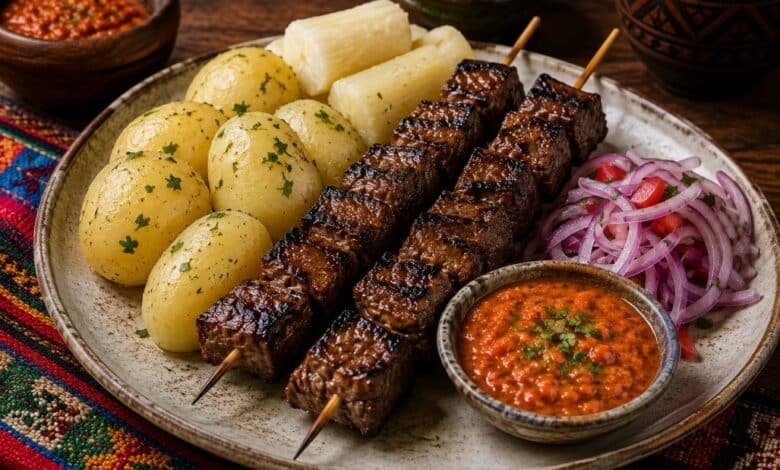
There is a moment in every good anticucho dinner when the potato stops looking like the least exciting thing on the plate. It has been sitting quietly beside the beef heart while the skewer gets all the attention — smoke, char, dramatic anatomy, chile, history. Then you drag that potato through the sauce and realize it may be the most strategically intelligent ingredient at the table.
The same is true of peanut llajua. At first glance, a nutty sauce beside grilled beef heart sounds like one of those combinations a modern chef might invent and explain to you for several exhausting minutes. In La Paz-style anticucho, however, the idea is traditional, practical and almost suspiciously logical.
Heart is intensely beefy but lean. The grill gives it smoke and dark edges but no internal marbling. Chile gives the meat brightness and heat. Peanut supplies richness. Potato supplies softness and starch. Put them together and every weakness of one ingredient is answered by another.
This is not garnish.
It is engineering you can eat.
If your next question is where to get the actual dish rather than why the plate works, I keep a separate guide to where to find Bolivian anticuchos in the United States.
Why are Bolivian anticuchos served with potatoes and peanut sauce?
In the La Paz-style tradition, potatoes and peanut llajua balance the characteristics of grilled beef heart. Heart is flavorful but very lean and naturally firm. Potato adds soft starch and absorbs sauce, while ground peanut gives the spicy llajua body and richness. Red ají brings heat and aroma, and the charcoal adds smoke and browning.
The result works because the four main elements do different jobs rather than repeating one another.
Lean, firm, deeply savory and intensely beefy.
Adds smoke, browning and roasted flavor.
Softens the experience and carries sauce.
Add richness, body, chile aroma and heat.
It is difficult to improve much on that basic equation. You can certainly make it prettier, move the sauce into an expensive ceramic bowl and position the potato at a geometrically confident angle. The palate remains unimpressed by graphic design.
Start with the problem: beef heart has almost nowhere to hide
Beef heart is an excellent ingredient precisely because it does not behave like a luxurious steak cut. It is a working muscle: dense, muscular and comparatively lean. It gives you strong beef flavor but very little of the buttery fat that makes a marbled ribeye forgiving.
That means an anticucho cook is managing several things at once. The heart needs strong heat for real browning. It needs enough seasoning to keep the lean flavor lively. It needs to come off the grill before firm becomes tough. And once it reaches the plate, something needs to supply the richness the meat itself does not contain.
Enter the sauce.
This is the part of traditional cooking I find endlessly interesting. Combinations that look quaint on paper frequently turn out to be excellent solutions to ingredient chemistry.
Beef heart does not need sauce because it lacks flavor. Quite the opposite. It has plenty of flavor. What it benefits from is moisture, fat, chile and contrast.
The potato gives your mouth somewhere quiet to go
Imagine three consecutive bites of lean charcoal-grilled beef heart coated with spicy sauce. Delicious, certainly. Also increasingly intense.
Now put a warm potato between the second and third.
Suddenly the meat tastes smokier because you have briefly stepped away from smoke. The chile becomes more exciting because the starch softened the previous hit. The sauce has somewhere else to go besides the heart. The firm texture of the meat feels more appealing because the potato created contrast.
This is what good accompaniments do. They do not merely add another flavor. They manipulate your perception of the flavor you already have.
Heart alone
Concentrated beef, char, firm muscle texture and seasoning. Excellent, but potentially relentless over a larger portion.
Heart followed by potato
Firm becomes softer by contrast, spice feels more controlled, and the next piece of meat regains some of its impact.
Potato also has the tremendous virtue of behaving like edible blotting paper for delicious things. Whatever llajua, meat juice and chile remain on the plate are no longer leftovers. They are instructions.
Why not rice?
Rice could certainly absorb sauce, and Bolivian cuisine has plenty of dishes where rice belongs perfectly. But the potato has a deeper Andean logic here and a different physical relationship with anticucho.
A piece of potato can sit directly beside or even travel on the skewer in some anticucho traditions. It is substantial enough to pick up, drag through sauce and eat between pieces of heart. Its creamy interior contrasts directly with the muscular beef.
Rice would produce a different meal: looser, spoon-oriented and less naturally suited to the hand-held street-food structure of a skewer.
That does not make rice bad. It means potato understands the assignment particularly well.
Why peanut makes so much sense with beef heart
Now for my favorite part.
If heart’s defining challenge is leanness, peanut enters the meal carrying exactly what the meat does not: fat and body.
Ground peanut makes a sauce feel substantial. It coats the tongue, rounds sharp chile and creates a richer sensation around a piece of meat whose own fat content is comparatively low. That contrast can make the heart seem almost juicier even though the sauce has not magically changed the structure of the beef.
Fat also carries aroma. So chile, garlic and other seasoning can linger differently when dispersed through a richer sauce rather than a thin liquid.
This is why “peanut sauce” is slightly misleading as a description if it makes you imagine something sweet. The role here is savory. Peanut gives texture and richness; ají keeps the sauce awake.
The cleverness is simple: lean meat + rich sauce is a more interesting combination than lean meat + another lean thing.
The chile is doing more than making dinner spicy
I dislike descriptions that reduce ají to a number on a heat scale. Chile has fragrance, fruitiness, bitterness, sweetness and sometimes smokiness long before anyone begins dramatically reaching for water.
In the La Paz anticucho preparation, red ají helps connect the heart and the peanut. Without chile, a rich peanut sauce could feel heavy beside beef. With chile, the richness gains energy.
Think of acidity in a rich salad dressing or mustard beside fatty sausage. The contrasting element keeps you wanting another bite.
The same principle applies here, only dinner is now considerably more interesting.
One important distinction: Bolivian llajua is not always peanut sauce
This is where I want to be precise, because the words are easy to flatten into something inaccurate.
Llajua is a broader Bolivian chile-sauce tradition. It appears throughout the country and varies by region, household and cook. Tomato, locoto and aromatic herbs such as quirquiña or huacataya can appear in versions of the everyday table sauce.
The peanut-based llajua discussed here is specifically important because it appears in the La Paz anticucho preparation I am using as the reference for this plate.
So I would not write:
Too broad
“Bolivian llajua is peanut sauce.”
More accurate
“La Paz-style anticucho can be served with a spicy peanut-based llajua.”
That small distinction matters. National cuisines are already complicated enough without turning one regional sauce into legislation.
Fresh llajua and peanut llajua solve different problems
A fresher tomato-and-locoto-style llajua gives brightness, raw chile energy and acidity. It can cut through grilled food beautifully.
A cooked peanut-based accompaniment does something else. It adds thickness, nutty richness and more persistent coating power around the heart.
If a restaurant gives you both, this is not a problem requiring restraint. Try the meat with each.
The same heart suddenly tells two different stories.
One bite can feel bright and chile-forward. The next becomes rounder, nuttier and more luxurious. Same skewer. Different sauce politics.
And then La Paz casually brings yuca into the conversation
The La Paz anticucho preparation also includes cooked white yuca alongside the potatoes, which gives us another useful starch to think about.
Yuca is denser and more fibrous than potato. Its flavor is gentle, but texturally it has more presence. It can absorb a rich sauce beautifully without dissolving into it.
Put heart, potato and yuca on the same plate and you suddenly have three very different types of chew: muscular beef, creamy potato and denser cassava.
That is much more interesting than simply saying “served with sides.”
And if yuca becomes the part of the plate you unexpectedly love most, Bolivia has another completely different comfort-food direction waiting for you in sonso de yuca, where cassava meets cheese rather than beef heart.
Potato and yuca are cousins at dinner, not duplicates
I would eat both if the restaurant serves both because the sauce exposes their differences beautifully.
Potato gives you a softer, almost creamy interior that absorbs sauce eagerly. Yuca is more compact and slightly fibrous, so a thick peanut sauce sits on it differently.
The contrast is particularly obvious if you alternate them:
You have not ordered five dishes. You have simply stopped treating accompaniments as scenery.
The bite that explains the entire plate
If I had to demonstrate this article using four bites instead of several thousand words, I would do this.
Heart without sauce
Taste the beef, char and seasoning. Notice the muscular texture and how little fat the meat itself contributes.
Heart with peanut llajua
The same beef now feels richer and more coated. Peanut rounds the bite while chile extends the finish.
Potato through the remaining sauce
The chile softens, the starch absorbs the richness and your palate gets a gentler texture.
Heart, sauce and potato together
Smoke, firm beef, creamy starch, chile and nutty richness finally operate as one bite rather than separate ingredients.
After this I would stop performing analysis and protect the rest of dinner from myself.
Why the potato tastes better after touching the anticucho plate
A plain boiled potato is perfectly respectable and rarely causes anyone to reconsider their life choices.
A potato that has touched beef juices, chile and peanut sauce is another matter.
Starch absorbs water-based flavors easily while its soft texture catches thicker sauces on the surface. This makes potato unusually good at collecting all the small things that would otherwise remain separated on the plate.
It becomes the place where meat, chile and sauce meet without requiring another piece of heart.
That is why the final potato is sometimes better than the first one. By the end of dinner, it has acquired friends.
What if the restaurant does not serve peanut sauce?
Do not immediately assume the anticucho is wrong.
Bolivian food is regional. Family preparations differ. Restaurants adapt. Some places may serve another style of llajua, a thinner chile sauce or a preparation influenced by neighboring culinary traditions.
The correct question is not “Where is the mandatory peanut sauce?” It is “What style of anticucho is this restaurant serving?”
If the menu identifies the dish as Bolivian but does not explain the sauce, ask. You may learn something considerably more useful than policing the plate from a photograph.
What if there are no potatoes?
Again, restaurant variation exists. But now I would become more curious about what replaced them.
Yuca can make perfect sense. Corn can shift the plate toward another Andean pattern. A contemporary restaurant may deliberately reinterpret the starch. A mixed Bolivian–Peruvian kitchen may combine elements from both traditions.
What matters is whether the rest of the plate still balances the lean heart rather than leaving the skewer stranded beside decorative parsley.
Parsley has suffered enough responsibility in restaurant history.
Why this combination survives outside Bolivia
Traditional pairings travel well when their logic survives ingredient substitution.
An American restaurant may not have exactly the same potato variety, chile or peanut preparation used by a street vendor in La Paz. Yet the relationship can remain intact: grilled lean heart, mild starch, chile and a richer sauce.
That is more important to me than a plate reproducing one recipe photographically while missing the balance entirely.
Tradition is often less about freezing ingredients in place and more about preserving the relationships that made them sensible together.
Could you serve anticucho without anything else?
Of course. A beautifully grilled piece of seasoned heart is still delicious.
But remove potato and sauce and you have changed the eating experience more than the photograph might suggest. You have removed the two elements responsible for most of the texture and richness contrast.
The heart becomes more dominant. Smoke becomes more persistent. The lean character becomes more obvious.
This may be exactly what you want if you are tasting the meat analytically. It is less representative of why the complete La Paz-style plate is so satisfying.
Why peanut sauce makes heart friendlier for first-timers
The word heart tends to arrive at the table several minutes before anyone’s palate has been consulted.
A rich chile sauce helps because it places the unfamiliar ingredient inside a very familiar culinary structure: grilled meat + delicious sauce.
Suddenly you are not evaluating an organ in isolation. You are eating beef with smoke, chile and nutty richness.
That does not mean hiding the heart is desirable. I always suggest tasting one piece with minimal sauce first. But once you understand the meat, the peanut llajua can make the next bite feel much more indulgent.
If the ingredient itself is what makes you hesitate, my guide to what Bolivian anticucho tastes like goes deeper into beef-heart flavor and texture.
Why this is excellent street food
The composition is also practical in a way restaurant plating sometimes hides.
A skewer creates portion control and fast cooking. Potato is inexpensive, filling and easy to portion. Sauce lets a vendor create a distinctive house flavor without changing the underlying protein. Charcoal cooks quickly and produces an aroma capable of advertising dinner without a marketing department.
And because anticucho remains visible in contemporary municipal food events in La Paz, this is not a reconstruction of some vanished street tradition. The dish continues to occupy public food space alongside other paceño favorites.
I appreciate any cuisine where smell still has better conversion rates than social media.
Llajua deserves its own little moment
One of the easiest mistakes when writing about Bolivian food is treating sauce as a footnote. Llajua is much too culturally useful for that.
La Paz Tourism describes llajua as a chile sauce consumed throughout Bolivia, from restaurants to street-food stalls, with regional variation. Its everyday form can include tomato, locoto and herbs such as quirquiña or huacataya.
That means the sauce alongside anticucho belongs to a much bigger Bolivian habit of bringing fresh or spicy condiments to the table. Peanut llajua is one particularly delicious expression of that relationship, not the definition of every llajua in the country.
I find this distinction much more interesting than pretending national cuisine can be summarized by a condiment glossary.
If I wanted to turn the plate into a larger Bolivian dinner
I would avoid adding another dish that simply repeats meat + potatoes + chile. The anticucho already owns that territory very successfully.
Instead I would change regions, texture or temperature.
Sonso de yuca for another starch story
Yuca is already relevant to the La Paz anticucho preparation, but sonso takes cassava somewhere completely different: toward cheese, softness and eastern Bolivian comfort food. If that sounds like your kind of detour, see my guide to finding sonso de yuca.
Salteña for juice and pastry
Against firm charcoal-grilled heart, a juicy baked salteña feels almost extravagantly different. This is probably the addition I would choose for two people discovering Bolivian food together.
A cold drink if the llajua is serious
Mocochinchi is an easy nonalcoholic direction. If cocktails are part of the evening, Chuflay can bring citrus, bubbles and Singani rather than more weight to the meal. I explain the drink itself in What Is a Chuflay Cocktail?, and there is a separate guide for finding a Chuflay in the U.S.
What I would not add
I would not drown the plate in three creamy sauces. Peanut has already introduced richness.
I would not order several more grilled beef dishes unless we are sharing with a group. Heart deserves a little space around it.
And I would definitely not discard the potato because I am “saving room.” That potato is doing more culinary work than several expensive garnishes I have met.
If saving room becomes necessary, I would rather sacrifice decorative bread than the part of the plate designed to carry the sauce.
The sauce-to-heart ratio I like
There is no official number, and I would distrust anyone claiming one.
But for a first bite, I want most of the heart still visible. Enough llajua to coat perhaps a third to half of the piece lets you taste how the sauce changes the meat without losing the char.
For the potato, I am less restrained.
Potato has fewer reputational concerns and can be thoroughly introduced to the sauce.
By the second skewer, all diplomatic rules may collapse anyway.
What the plate teaches you about Bolivian cooking
I think this small combination says something larger about why traditional foods survive.
The ingredients are not impressive because they are expensive. Heart historically belongs to the world of underused cuts. Potato is among the most familiar Andean staples imaginable. Peanut and chile are not luxury garnish.
The sophistication comes from relationships.
Lean needs rich. Firm needs soft. Smoke needs freshness. Chile needs starch. A powerful main ingredient becomes more pleasurable because quieter ingredients are allowed to support it.
There is a kind of intelligence in that which modern menus occasionally spend far too much money trying to rediscover.
The next time a potato looks boring beside your anticucho…
Try the heart alone.
Then heart with llajua.
Then potato with the same llajua.
Then put them together.
The difference is immediate. The heart becomes richer without becoming fattier. The potato becomes interesting without ceasing to taste like potato. The chile feels integrated rather than simply hot.
And suddenly the least glamorous thing on the plate reveals why it has been there all along.
I love food that rewards paying attention like this. No rare ingredient required. No smoke machine. Just a cook, a grill and several ingredients that understand one another extremely well.
Does your family serve anticuchos differently?
If your Bolivian family uses another kind of llajua, serves the potatoes differently, adds yuca or has a regional anticucho combination I should know about, I would genuinely love to hear it.
You can also send a restaurant name, city, current menu or plate photo if you know a Bolivian kitchen in the United States serving a particularly interesting version.
Email: info@dianaisabela.com
The best traditional dishes are usually much larger than one recipe.
Why are Bolivian anticuchos served with potatoes?
Potatoes provide a soft, mild starch that balances the lean, firm texture of grilled beef heart. They also absorb llajua, meat juices and chile particularly well.
Why is peanut sauce served with Bolivian anticuchos?
In La Paz-style anticucho, peanut-based llajua adds body and richness to naturally lean beef heart. Red ají brings chile flavor and heat, preventing the richer sauce from feeling heavy.
Is all Bolivian llajua made with peanuts?
No. Llajua is a broader Bolivian chile-sauce tradition with many regional variations. The peanut-based sauce discussed with anticucho is particularly associated with the La Paz-style preparation used in this guide.
What is peanut llajua?
Peanut llajua is a savory spicy sauce that can combine cooked ground peanut with red ají. In La Paz-style anticucho it adds richness, chile flavor and moisture around the grilled beef heart.
Do Bolivian anticuchos come with yuca?
Some La Paz-style preparation guidance includes cooked white yuca as well as cooked potatoes. Individual restaurant and family preparations can vary.
What does potato add to anticuchos?
Potato adds softness and starch, gives the palate relief between smoky pieces of heart and carries spicy sauce particularly well. Its mild flavor also lets the beef and chile remain dominant.
Are Bolivian anticuchos always served with peanut sauce?
No. Recipes vary by region, household and restaurant. Peanut llajua is a useful feature of La Paz-style anticucho, but other sauces and presentations exist.
Is peanut llajua sweet?
It is a savory chile sauce rather than a sweet peanut sauce. Ground peanut contributes body and richness while red ají provides chile flavor and heat.
What should I eat first on an anticucho plate?
For a first tasting, try a piece of beef heart with little sauce, then another with llajua, followed by potato through the sauce. This makes it easier to understand what each component contributes.
What else goes well with Bolivian anticuchos?
Salteñas, yuca-based foods, soup and refreshing Bolivian drinks can complement anticuchos by adding different textures and flavors. A larger meal works best when the additional dishes do not simply repeat grilled meat and potatoes.