
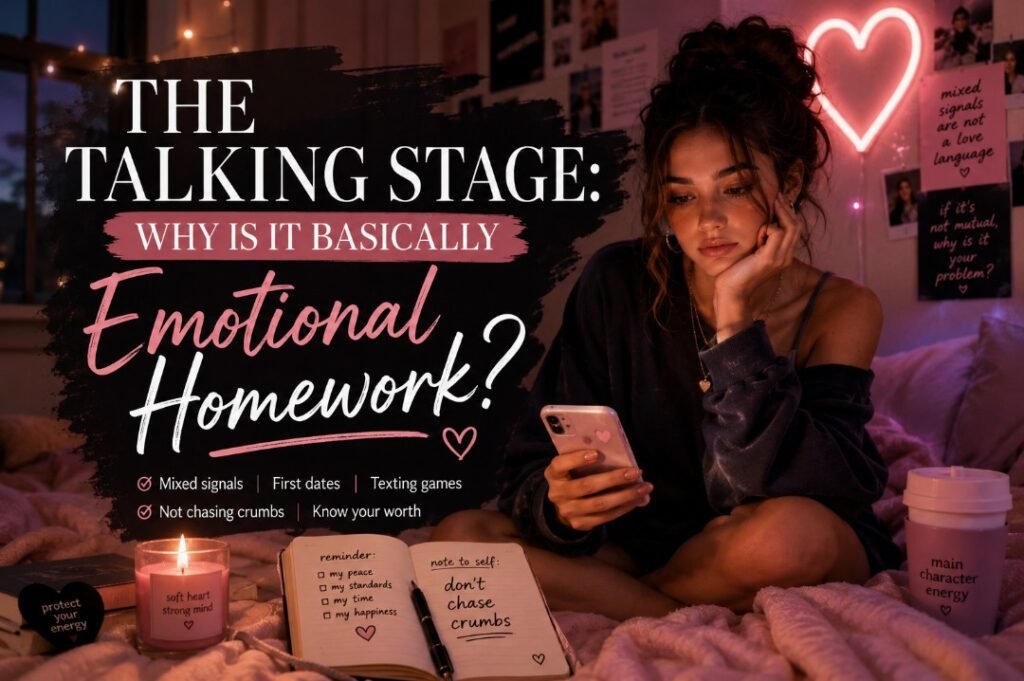
The talking stage is that strange modern hallway between “we are strangers” and “so what are we?” It is not dating, apparently. It is not friendship, apparently. It is not a relationship, definitely, because someone will remind you of that right after acting like your emotional pen pal for six weeks.
It has homework. It has notifications. It has tiny investigations that would make Sherlock Holmes remove his little hat and say, “Darling, maybe rest.” You analyze reply times. You decode punctuation. You wonder if “haha yeah” is romantic, lazy, avoidant, or just the tragic collapse of language.
And because nobody gives you a syllabus, the talking stage becomes emotional homework with no due date and too many pop quizzes. One day they text like they are auditioning to be your future. The next day they vanish like a minor character written out of a fantasy novel. Very educational. Deeply annoying.
The talking stage is not evil. The confusion is the evil part.
The talking stage can be cute. I am not here pretending romance should begin with a legal contract and two witnesses. There is something delicious about the early part: the first little jokes, the “did they just flirt?” moment, the outfit planning, the way a normal notification can suddenly turn your stomach into a tiny orchestra.
The problem starts when the talking stage becomes a fog machine. You are not sure what is happening, but you keep walking forward because every now and then they send a message sweet enough to keep you interested. It is giving emotional slot machine. Pull the lever. Maybe today they care.
That is where a girl has to become very, very honest with herself. Are you getting to know someone, or are you performing patience for a person who enjoys being wanted but does not enjoy being clear?
Uncertainty is normal at the beginning. Constant confusion is not chemistry. Sometimes it is just poor communication wearing perfume.
Mixed signals feel exciting because your brain mistakes tension for meaning
Mixed signals are powerful because they create contrast. Warm, cold. Close, distant. Flirty, vague. Interested, unavailable. Your brain starts looking for patterns because humans are pattern-making creatures, and also because having a crush apparently turns everyone into a detective with a phone addiction.
One sweet message after three dry days can feel more intense than consistent kindness. That does not mean it is deeper. It means the attention became unpredictable, and unpredictable attention can feel strangely addictive. Not romantic. Addictive.
If someone likes you in a way that is healthy, you should not feel like you are constantly trying to solve a riddle written by a moody poet with bad Wi-Fi.
The first date should not require a strategy meeting with your entire nervous system
First dates are supposed to be a little awkward. That is allowed. People are not born knowing how to sip iced tea, answer questions, flirt naturally, and not mention something unhinged from their Notes app. A first date can be imperfect and still good.
But a first date should give you information. Do they listen? Do they ask questions? Do they respect your comfort? Do they talk only about themselves like a podcast nobody subscribed to? Do you feel calmer after seeing them, or do you feel like you need three friends, two screenshots, and an emergency interpretation session?
What you wear can help you feel like yourself before you even leave the house. A cute outfit is not a personality replacement, obviously, but it can give you a tiny armor of confidence. If you need style ideas for a birthday dinner, party, or cute date-adjacent celebration, the Birthday Dress guide is useful because the best look is always the one that lets you breathe, move, and not spend the whole evening adjusting fabric like you are wrestling a curtain.
Green flags in the talking stage are usually boring in the best way
Healthy interest often does not feel like fireworks at first. Sometimes it feels like peace. They reply in a reasonable way. They make plans without acting like scheduling is a heroic sacrifice. They remember small things. They do not make you feel embarrassing for liking them.
That can feel almost too simple if you are used to chaos. But simple is not the enemy. Simple is where your nervous system stops doing unpaid internships.
Breadcrumb attention is not romance. It is a snack-sized illusion.
Breadcrumbing is when someone gives you just enough attention to keep you attached, but not enough consistency to make you feel secure. A compliment here. A late-night message there. A “miss you” with no plan. A heart reaction after three days of silence. Tiny pieces. Never a meal.
And because the crumbs are sometimes sweet, you start surviving on them. You tell yourself they are busy. You tell yourself they are shy. You tell yourself they “probably like you but are complicated.” Maybe. Or maybe they enjoy having access to you without responsibility.
The painful truth is that someone can like your attention without choosing you. Someone can enjoy flirting without intending to show up. Someone can be lonely, bored, curious, insecure, or emotionally messy — and still not be good for you.
Do not measure someone’s feelings by their best moment. Measure them by the pattern they keep repeating.
How not to chase someone who keeps giving you tiny maybes
Not chasing does not mean becoming cold, fake, or mysterious in a TikTok villain way. It means refusing to do all the emotional running for someone who is casually strolling.
You can like someone and still keep your dignity. You can be interested without being available for crumbs. You can answer warmly without becoming their unpaid therapist, backup plan, attention dispenser, or little notification pet.
The hardest part is letting the silence be silence. Not filling every gap. Not sending the extra message just to test if they care. Not creating excuses for them because the fantasy version of them is very charming and unfortunately lives rent-free in your imagination.
The “bad at texting” excuse needs a cross-examination
Some people genuinely are not amazing texters. They have lives. They forget. They hate typing. They are not glued to their phone. Fine. We support hobbies, fresh air, and not becoming a screen goblin.
But “bad at texting” cannot be a magical cloak that hides zero effort. A person who is interested can still be clear. They can say, “I am busy today, but I want to talk later.” They can make a plan. They can follow up. They can communicate like a human being with thumbs and basic respect.
So ask the real question: are they bad at texting, or are they comfortable letting you feel unsure?
- Acceptable: slow replies but consistent plans, kind tone, and no games.
- Suspicious: sudden affection only at night, then daytime invisibility.
- Exhausting: flirting hard, disappearing, returning casually, and acting like nothing happened.
- Not your job: teaching someone how to treat you with basic consideration while they enjoy the benefits of your patience.
The tiny table of “am I overthinking or is this actually weird?”
Sometimes you are overthinking. Sometimes your intuition is quietly waving a flag while your crush is playing violin music over it. This table is for the moments when your brain is dressed like a detective and refuses to sleep.
| What happens | Could be normal if… | Pay attention if… |
|---|---|---|
| They reply slowly | They are still consistent and make real plans. | They only reply when bored, lonely, or trying to restart attention. |
| They flirt a lot | The flirting comes with respect and actual interest. | They flirt but avoid clarity, dates, or public acknowledgment. |
| They cancel | They apologize and suggest another time. | They cancel vaguely and leave you to rebuild the plan alone. |
| They seem nervous | They are shy but still kind and present. | Their nerves become an excuse for inconsistency or disrespect. |
| You feel anxious | It is early, new, and you are naturally nervous. | The anxiety is caused by their repeated hot-cold behavior. |
Self-respect is not being “hard to get.” It is being hard to mistreat.
People love saying “play hard to get,” which sounds like advice invented by someone who thinks romance is a board game with perfume. I do not think you need to play hard to get. I think you need to be hard to drain.
Self-respect is not ignoring someone to look powerful. It is not posting mysterious stories so they panic. It is not pretending not to care while secretly checking if they watched your story before breakfast. That is not self-respect. That is emotional theater with Wi-Fi.
Real self-respect is quieter. It is noticing when something feels bad. It is not abandoning yourself for a reply. It is being able to say, “I like them, but I do not like how this is making me feel.” If that part feels difficult, the guide on self confidence from the inside out is the kind of glow-up that matters here, because dating confidence is mostly the ability to stay loyal to yourself when attention gets shiny.
What to do when you realize you are chasing
First, do not shame yourself. Almost everyone has chased at least once, even if they call it “being hopeful” because the word chasing hurts their aesthetic. Liking someone can make even smart people act like they left their dignity charging in another room.
Second, stop feeding the pattern. You do not need a dramatic speech. You do not need a paragraph that begins with “I just feel like…” unless you truly want to communicate. Sometimes the most powerful move is simply matching the energy, stepping back, and seeing whether they step forward with clarity.
Third, rebuild your attention around your actual life. Friends. School. Style. Sleep. Music. Your room. Your goals. Your body. Your humor. Your little routines. The more your life feels full, the less tempting it becomes to treat one inconsistent person like the final season of your emotional universe.
A first date is not a performance review
Before a first date, it is easy to start auditioning. What should I wear? What should I say? Should I be funny? Should I be chill? Should I mention my weird interests or save those until they are emotionally trapped by my charm?
But a first date is not only about whether they like you. It is also about whether you like how you feel around them. That sentence should be framed and placed above every mirror in every teenage bedroom, honestly.
You are not there to convince someone you are worthy. You are there to notice. Do you feel safe? Curious? Comfortable? Can you speak without editing your whole personality into a smaller font? Do they make room for you, or do they just enjoy having an audience?
Texts you do not have to send, even if your fingers are dramatic
Sometimes the message is not wrong. It is just not necessary. The urge to text can come from anxiety, not actual communication. Before sending, ask: am I expressing something real, or am I trying to make them give me proof?
When to walk away from the talking stage
Walk away when the talking stage makes you feel smaller. Walk away when you keep lowering your standards so their effort looks taller. Walk away when you are more attached to potential than reality. Walk away when you are embarrassed to tell your friends the full story because saying it out loud makes the situation sound exactly as bad as it feels.
Walk away when they only want you when you are leaving. That one is classic. Suddenly, when you stop replying fast, they become charming. Suddenly they miss you. Suddenly they noticed you have a soul. Interesting timing, professor.
And walk away when you realize you are not being chosen, only kept nearby. There is a difference.
You do not have to audition for consistent attention. The right person may still be nervous, imperfect, and human, but they will not make you feel like basic care is a luxury item.
The talking stage should reveal someone, not erase you
The point of the talking stage is supposed to be discovery. You learn their humor, values, habits, confidence, kindness, communication style, and whether they think “wyd” counts as a personality. You also learn how you feel in the connection.
If the talking stage turns you into a version of yourself you do not like — anxious, obsessive, insecure, constantly checking, constantly waiting — that matters. Not because you are “too much,” but because the situation may be giving you too little.
A good connection does not erase your sparkle and then call you dramatic for missing it.
You are allowed to want clarity
The talking stage does not need to become a relationship immediately. Nobody is asking for a wedding invitation after three memes and one coffee. But wanting clarity, respect, and consistency is not needy. It is normal.
You can enjoy the butterflies without letting them drive the car. You can like someone without chasing them. You can answer the message without becoming available for every crumb. You can go on the date, wear the cute outfit, laugh at the jokes, and still watch the pattern.
The talking stage may feel like emotional homework, but you are allowed to put the pencil down when the assignment becomes disrespectful. Romance should make your life brighter, not turn your phone into a tiny courtroom where you keep defending someone who barely shows up.
So flirt, yes. Get excited, yes. Wear the outfit, send the cute reply, enjoy the almost-magic. But keep yourself. Always keep yourself.
FAQ
What is the talking stage?
The talking stage is the early phase where two people are getting to know each other romantically, usually through texting, flirting, casual plans, and first dates before deciding whether they want a relationship.
Why is the talking stage so confusing?
The talking stage is confusing because feelings, expectations, and communication are often unclear. Mixed signals, slow replies, vague plans, and inconsistent attention can make it hard to know whether someone is truly interested.
What are mixed signals in the talking stage?
Mixed signals happen when someone acts interested sometimes but distant at other times. Examples include flirting heavily but avoiding plans, texting warmly then disappearing, or saying they like you while making no real effort.
How do I stop chasing someone in the talking stage?
Stop chasing by stepping back, matching their effort, avoiding extra messages sent from anxiety, focusing on your own life, and watching whether they show clear, consistent interest without you pushing for it.
When should I leave the talking stage?
Leave the talking stage when someone keeps you confused, gives only small crumbs of attention, avoids clarity, cancels without effort, makes you feel insecure, or only shows interest when you start pulling away.