Bolivian Anticuchos in New York: The Queens Food Trail
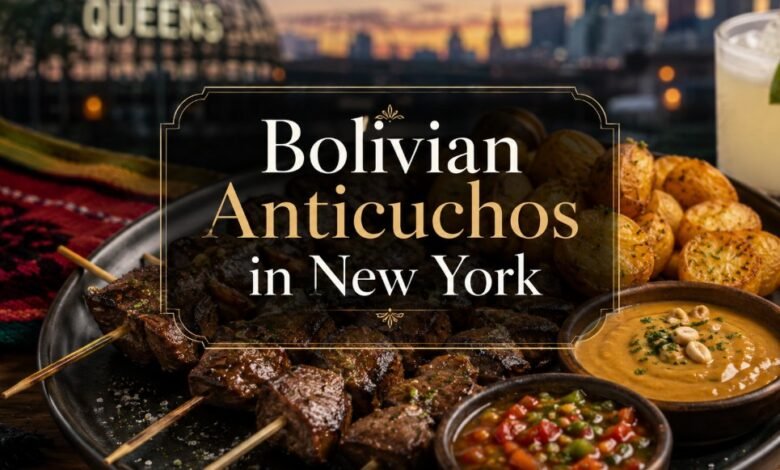
New York has a very New York way of making the search for Bolivian anticuchos complicated: the city remembers restaurants long after the restaurants themselves have stopped serving dinner.
Type the right words into a search box and Woodside suddenly fills with ghosts. Old menus still promise beef heart and potatoes. Restaurant names survive in directories. A phone number sits beside a menu as confidently as if someone answered it five minutes ago. For a second you think you have discovered a tiny Bolivian anticucho paradise in Queens — and then you realize half the evidence belongs to another version of the neighborhood.
The fascinating part is that the history is real. Woodside and the surrounding Queens neighborhoods have genuinely supported Bolivian restaurants over the years, and some of those kitchens served exactly the style of anticucho we are looking for: sliced beef heart, potato and peanut sauce. Today, however, the live Bolivian restaurant landscape is much smaller, while New York’s enormous Peruvian food scene means searching only for the word anticucho sends you somewhere else almost immediately.
So this guide is not going to pretend New York currently has six verified Bolivian anticucho restaurants because the internet has six old menu pages. Instead, I want to show you something more useful: where the Bolivian food trail still lives, where the anticuchos used to be, what is genuinely open now, and what I would eat if the beef-heart skewer I came looking for exists today only in a cached menu and my imagination.
If you are comparing New York with Virginia, Maryland and the other strongest regions, my USA guide to finding Bolivian anticuchos gives the national picture first. New York is the odd romantic chapter: historically fascinating, currently much less straightforward.
Queens is where this story makes sense
You could spend a week eating around Queens and still have the feeling that somebody hid another country around the next subway stop. Filipino bakeries, Colombian cafés, Tibetan momos, Thai curries, Ecuadorian lunch counters, Mexican tamales and Irish pubs can all exist within a remarkably small piece of the map. Bolivian food has been part of that immigrant geography too, although never with the sheer numerical presence of some neighboring cuisines.
Woodside matters because Bolivian restaurants have repeatedly appeared there over the years. Renacer, Cumbre, Puerta del Sol and other names have occupied the local food memory at different moments, while today’s Bolivian Llama Party operates nearby with a completely different, modern interpretation of the cuisine.
I like this part of New York because it shows what diaspora food actually looks like over time. A cuisine does not simply arrive, open one restaurant and remain preserved forever like a dress behind museum glass. Businesses close. Children reinterpret recipes. A traditional plate becomes a sandwich. Street-food ideas move into food halls and back into neighborhood counters. Something disappears for five years, then shows up again in a completely different form.
Anticucho happens to be one of the dishes that makes those changes especially visible.
The slightly inconvenient truth about Bolivian anticuchos in New York right now
I do not currently have a New York restaurant that I can confidently label “active Bolivian restaurant + current verified Bolivian beef-heart anticucho” with the same certainty I have for the strongest Maryland lead.
That sentence is less exciting than “The 10 Best Bolivian Anticuchos in NYC,” but it has one considerable advantage: it is useful.
There is a very real Bolivian restaurant in Woodside today. There is also excellent historical evidence of classic Bolivian anticucho in the neighborhood. What I do not have is enough current evidence to merge those two facts into one imaginary restaurant recommendation.
If that changes — and in New York, menus can change before I finish complaining about the subway — this page gets updated.
The living Bolivian anchor: Bolivian Llama Party
Bolivian Llama Party — Woodside
If you want to understand where Bolivian food in New York is alive rather than merely archived, Bolivian Llama Party is the obvious place to begin. The Oropeza brothers started the project in 2012 after selling food at street fairs, and over time their playful, very New York version of Bolivian cooking developed a following around salteñas, chola sandwiches, sopa de maní, llajua, silpancho and other dishes that move between tradition and the brothers’ own sense of what Bolivian food can become here.
In 2026 the restaurant entered the Michelin Guide, which feels like a rather satisfying plot twist for a cuisine that spent years being considerably less visible in New York than its Peruvian neighbor. Michelin highlights the salteñas, sopa de maní and chola-style sandwiches, while the restaurant itself describes its mission with much more swagger: take Bolivian street food seriously without treating it as an antique.
That final line matters. I would absolutely eat here if I wanted Bolivian food in Queens. I would not tell you they currently serve anticucho when the present menu does not support it.
And frankly, I would still go hungry. The menu is interesting enough that disappointment could be redirected quite efficiently.
What I would order if anticucho is not the point anymore
I would start with a salteña because BLP treats them as a serious piece of craft rather than an obligatory national symbol. A properly made salteña is essentially a pastry containing a small engineering problem: the filling should stay juicy enough to feel almost like stew, but the dough still has to hold everything until your first badly angled bite reminds you that gravity remains undefeated.
Sopa de maní is the quieter choice, especially in cold weather. Peanut, potato and broth create the kind of comfort food that does not need a lifestyle manifesto. Then I would look at the chola sandwiches or silpancho depending on whether I wanted street-food energy or the sort of plate that politely ends all discussion about getting dessert somewhere else.
The llajua matters too. BLP uses it throughout the menu and in several modern sauces, and this is where the restaurant becomes particularly interesting to me: the flavor vocabulary is recognizably Bolivian even when the form has been pushed into a sandwich, bowl or fried-chicken situation that somebody’s great-grandmother probably did not anticipate.
Modern Bolivian food is allowed to flirt with New York
I have no patience for the idea that immigrant food is only “authentic” when it looks exactly like the memory somebody brought through an airport thirty years ago. That expectation is oddly cruel. We let French chefs reinvent carrots, Japanese chefs deconstruct sushi and Italian chefs put foam next to pasta, but the moment a Bolivian-American cook changes a sandwich, everyone suddenly develops an anthropology degree.
Bolivian Llama Party is interesting because the restaurant makes the conversation visible. There is clearly a Bolivian base — salteñas, llajua, chicharrón, silpancho, chola, sopa de maní — but there is also brisket, fried chicken and a very Queens confidence about mixing the inherited thing with the thing outside the window.
This is not the restaurant I use to prove what anticucho tasted like in La Paz fifty years ago. It is the restaurant I use to prove Bolivian food in New York is not dead just because several older Woodside restaurants are.
Then there are the restaurants that survive mainly as menus
This is where New York becomes both useful and slightly haunted.
Old restaurant pages remain searchable for years. A menu does not know that the chairs have been stacked for the last time. It keeps showing you prices, appetizers and phone numbers with extraordinary confidence. Google finds the words. You find the menu. Everyone is happy except the person who actually tries to eat there.
Woodside has several Bolivian names that belong to this older landscape. Some are difficult to verify today; some have vanished; some have changed identities. I am not going to turn every historic restaurant into a card with an address because the purpose of a local food guide is to get you dinner, not perform a séance.
What these old menus are useful for is showing that classic Bolivian anticucho did have a real New York home — and that the combination of beef heart, potato and peanut sauce was not something I invented after staring at La Paz recipes for too long.
Renacer is the perfect example of a menu ghost
Renacer Bolivian Restaurant — Woodside
Renacer’s indexed menu is almost painfully perfect for this article. Under appetizers it lists Anticuchos as sliced beef heart with boiled potatoes covered in peanut sauce. The rest of the menu reads like somebody opened a Bolivian pantry in Queens: chairo, peanut soup, falso conejo, silpancho, plato paceño, pique a lo macho, charquekan, chuño, tunta, api and mocochinchi all appear.
If the restaurant were still open, this would be one of the strongest anticucho cards on the entire site.
It isn’t.
And this is exactly why I do not trust a restaurant simply because its menu is beautifully indexed. Old food data has an afterlife. Sometimes a very long one.
The sad little comedy of the $7.95 anticucho
Renacer’s old menu still lists its anticuchos at $7.95. For approximately half a second, that price creates a wonderful fantasy in which you have discovered cheap beef-heart skewers in New York and somehow every other person in the city failed to notice.
Then reality returns.
The price belongs to the same archive as the restaurant. It tells us something about another moment in Queens dining; it tells us absolutely nothing useful about what beef-heart anticuchos should cost tonight.
This sounds obvious, yet old menu prices are repeated online constantly as if inflation were merely a rumor. A food guide should know the difference between historical texture and shopping information.
So I love that $7.95 price for one reason only: it makes the ghost visible.
Puerta del Sol gives us another piece of the old Woodside map
There was another Bolivian restaurant in Woodside called Puerta del Sol, documented in 2019 as serving heart in a preparation modeled on the food of La Paz. Contemporary reporting described the heart cut into pieces, grilled on metal skewers and served with potato and a peanut sauce built with yellow chile.
The owner had grown up in La Paz, and the menu extended well beyond anticucho into plato paceño, charquekan, salteñas, huminta, api and mocochinchi. In other words, this was not an isolated skewer borrowed from somewhere else on the continent; it existed inside a recognizably Bolivian menu.
I am treating Puerta del Sol as part of the **historical Queens food trail**, not as a current place card. I do not have strong enough present-day evidence to tell you to take the 7 train there for dinner.
But together with Renacer, it tells us something valuable: classic Bolivian anticucho was not merely present in New York — Woodside repeatedly gave it a home.
Why do these places disappear while their menus remain?
Restaurants are fragile little ecosystems disguised as places to order lunch. Rent changes. Families change. Owners retire. Neighborhoods become more expensive. A cook who carried half the menu moves away. Children decide they would prefer a career with fewer burns and better weekends. Then the restaurant closes while the internet, which has no rent and no knees, simply continues.
Immigrant restaurants can be especially vulnerable because so much knowledge lives in people rather than formal systems. A grandmother knows the dough by feel. An uncle knows which butcher has the right cut. Somebody’s sister handles the books. Somebody’s cousin appears on Saturdays when the dining room fills. Remove one or two people and the operation can change dramatically.
This is one reason I find old restaurant menus genuinely moving. They are accidental archives of what a community was eating and selling at one particular moment. But an archive becomes dangerous when we confuse memory with inventory.
How I would search Queens without being seduced by a dead restaurant
New York requires a slightly more suspicious search style than Virginia or Maryland. The abundance of restaurant data creates the illusion that everything is current, and the enormous Peruvian food scene creates the second illusion that every anticucho result answers a Bolivian query.
If a current Bolivian restaurant tells me they make anticuchos on Fridays but never bothered adding them to the website, I care far more about that answer than a beautifully indexed page from a restaurant that closed years ago.
And yes, New York has plenty of anticuchos — just mostly not the ones this page promised
If you remove the word Bolivian, the New York search becomes dramatically easier. Peruvian restaurants across Queens, Brooklyn, Manhattan and Westchester serve beef-heart anticuchos, sometimes in deeply traditional preparations with ají panca and rocoto, sometimes in very modern restaurant forms.
There are excellent reasons to eat them. The issue is not quality. The issue is taxonomy, which is not a very glamorous word but becomes important when somebody has asked for a specific culinary tradition.
One of New York’s best-known contemporary examples is explicitly presented as a Peruvian beef-heart anticucho, with ají panca and rocoto salsa. That may be exactly what you want tonight. It simply should not become a Bolivian recommendation because the search page needed another card.
If you keep finding yourself curious about that distinction, I wrote the deeper comparison in Bolivian Anticucho vs Peruvian Anticucho.
So what would I actually eat in Queens tonight?
If my plan began with Bolivian anticuchos and the current evidence refused to cooperate, I would not declare the evening a failure and order something anonymous from a delivery app. I would go eat living Bolivian food.
Start with salteñas
At Bolivian Llama Party, this is the obvious first move. The filling should be juicy enough that eating one requires at least a little attention — a food characteristic I personally respect. Anything capable of ruining a white shirt has confidence.
Move toward sopa de maní if New York is behaving like New York
Cold, rain, gray sidewalks, somebody playing a video loudly on the train — peanut soup is a much kinder response to the city than rage. Potato, broth and peanut give you the soft, warming side of Bolivian cooking that anticucho’s grill cannot.
Order silpancho if the original snack plan has collapsed completely
Once a full plate involving breaded beef, rice, potato, egg and salsa enters the discussion, nobody can honestly maintain that dinner was supposed to be “just a little something.” Accept the situation with dignity.
Try a chola sandwich if you want Bolivia translated into Queens
This is where the current New York food story becomes more interesting than reenacting an old menu. Bolivian Llama Party treats the chola as something alive enough to reinterpret with brisket, pork and modern sauces while retaining familiar chile, bread and llajua cues.
The chola sandwich tells me more about New York than a “traditional food” sign ever could
A traditional sandwich changing inside an immigrant city is not evidence that culture has been diluted. Sometimes it is evidence that culture is comfortable enough to play.
At BLP, brisket can enter a chola sandwich. Fried chicken can acquire Bolivian chile and llajua logic. Salteñas can take on fillings that would make a strict traditionalist reach for smelling salts. Yet the underlying vocabulary — the chiles, sauces, bread, street-food sensibility and Bolivian references — remains visible.
I think this is how diaspora food becomes interesting rather than merely preserved. Preservation matters, especially for dishes in danger of disappearing from the local restaurant landscape. But a cuisine that is only permitted to repeat itself has been turned into costume.
New York does not generally allow food to remain in costume for very long.
If anticuchos came back to a current Bolivian menu tomorrow, what would I look for?
Historical Queens menus give us a very clear baseline. Renacer explicitly paired sliced beef heart with boiled potatoes and peanut sauce. Puerta del Sol was documented preparing heart on skewers with potato and a peanut-and-chile sauce in a style connected to La Paz.
That does not mean every future New York Bolivian anticucho needs to reproduce those plates exactly. Restaurants evolve and families differ. What I would want is enough context to understand what the cook is doing: beef heart rather than a generic steak skewer, strong grill character, potato or another coherent accompaniment, chile, sauce and a wider menu that places the dish within Bolivian food rather than simply borrowing an attractive name.
If a modern Queens cook decides to reinterpret the sauce or presentation, fine. I am much more offended by dry heart than creative plating.
Beef heart is particularly unforgiving after a subway ride
One practical New York problem deserves attention: takeout time.
Heart is lean. Once it leaves the grill, it does not have the internal fat of a ribeye quietly protecting it while you miss one train, transfer twice and spend seven minutes wondering why the station exit has deposited you on the wrong side of Queens Boulevard.
If you ever find current anticuchos for pickup, eat them relatively quickly. Keep sauce separate when possible. If reheating is necessary, a short spell in a genuinely hot pan makes more sense than slowly microwaving them until the meat begins developing opinions about you.
Potatoes can forgive a longer commute. Heart is less sentimental.
What the old Queens menus teach about peanut sauce
One detail repeats beautifully in the historical Bolivian anticucho evidence here: peanut sauce. Renacer’s menu says it plainly, while reporting on Puerta del Sol describes roasted peanut worked into a sauce with yellow chile.
That combination makes sense both culturally and technically. Heart brings concentrated beef flavor but little fat; peanut provides body and richness. Chile keeps the sauce from becoming too round and sleepy. Potato catches both. You move from charred meat to creamy sauce to soft starch, and the entire plate has more variation than the phrase “meat skewer” has any right to suggest.
This is the sort of thing my father always notices first in a dish: not merely what ingredients are traditional, but what jobs they are doing. Traditional combinations often survive because they solved a culinary problem long before anybody needed to explain the chemistry.
Woodside is a good place to remember that food neighborhoods belong to several worlds at once
Woodside is famous for much more than Bolivian food. Filipino restaurants and businesses have made the neighborhood one of New York’s most visible Filipino spaces, while other immigrant communities overlap around the same streets and train lines. That mixture is exactly why a small cuisine can leave a larger culinary footprint than its demographic size would suggest.
You walk a few blocks and the food language changes. Not metaphorically — literally. Signs change, ingredients change, bakeries change, the thing wrapped in dough changes. New York can be exhausting in almost every imaginable way, but it remains very good at making lunch feel like travel.
Bolivian food has been one of those quieter layers of Queens. Not enormous, not always easy to locate, occasionally disappearing from the map — but persistent enough that a restaurant started by three Bolivian-American brothers can now end up in the Michelin Guide.
That is a food story I find more interesting than pretending nothing ever closed.
Would I create a separate Woodside anticucho page yet?
Not today.
Woodside has enough historical importance to deserve this much attention, but a useful city or neighborhood anticucho page needs current inventory, not merely beautiful evidence from closed restaurants. At the moment, the living Bolivian food anchor does not give me a current anticucho listing, while the clearest classic anticucho menu belongs to a restaurant that is gone.
If another Bolivian kitchen opens, Bolivian Llama Party adds anticucho, or a reliable current weekend pop-up emerges, the answer changes quickly.
Until then, splitting Woodside into another page would not create more food. It would only create another URL.
The New York route I would save instead
If you specifically need Bolivian anticuchos today, start by calling the current Bolivian businesses rather than following old menu pages. Bolivian Llama Party is the most obvious live Queens anchor, and I would simply ask whether anticuchos are available as a special or planned item. If the answer is no, I would decide whether the nationality or the dish matters more tonight.
If Bolivian food matters more, stay with the Bolivian menu and eat salteñas, sopa de maní, silpancho, chicharrón or a chola sandwich.
If beef-heart anticucho matters more, New York gives you multiple Peruvian possibilities — just recognize that you have changed the question.
There is nothing tragic about either decision. The tragedy would be spending an hour traveling to an address because a $7.95 menu from a closed restaurant looked persuasive.
New York’s anticucho story is partly about absence, and I like it better for being honest
Food guides have a bad habit of treating absence like failure. If there are not twelve current places, somebody feels obliged to manufacture twelve vaguely relevant ones.
But absence tells you something.
It tells you how small Bolivian restaurant representation still is compared with New York’s other Latin American cuisines. It tells you how fragile independent immigrant restaurants can be. It shows which dishes survive easily and which depend on a particular cook, community or menu format. And it tells you why a restaurant like Bolivian Llama Party matters even when it does not currently serve the exact dish that started our search.
The anticucho may be missing from today’s live Bolivian menu, but the cuisine is not missing.
That feels like a much better place to end up.
Do you know where New York’s Bolivian anticuchos are hiding now?
This is the state page where a reader tip could change the map overnight. If you know a current Bolivian restaurant, family kitchen, food truck, weekend event, caterer or pop-up in New York serving anticuchos de corazón, send me the place name, neighborhood and whatever current information you have.
A menu photo is particularly valuable here. So is a recent price, phone number or note about whether anticuchos appear only on weekends.
Email: info@dianaisabela.com
And yes, if the restaurant closed in 2012 but its menu still appears on page one of search results, I probably already know it. Queens has introduced me to enough ghosts.
Where can I find Bolivian anticuchos in New York?
Queens, especially Woodside, has the strongest historical Bolivian anticucho trail. However, the clearest classic anticucho menus currently found online belong to restaurants that have closed, while today’s main Bolivian restaurant, Bolivian Llama Party, does not currently show anticucho on the menu reviewed.
Does Bolivian Llama Party serve anticuchos?
Anticucho was not found on the current Bolivian Llama Party menu reviewed for this guide. The restaurant is a strong current destination for Bolivian food in Woodside, with salteñas, sopa de maní, silpancho, chicharrón, chola sandwiches and llajua among its current specialties.
Is Renacer Bolivian Restaurant still open in Woodside?
No. Renacer is currently reported permanently closed. Its old menu remains useful historical evidence because it clearly listed beef-heart anticuchos with boiled potatoes and peanut sauce, but the old address should not be treated as a current dining recommendation.
Did Bolivian restaurants in Queens really serve anticuchos?
Yes. Historical menus and reporting document classic Bolivian anticuchos in Woodside. Renacer listed sliced beef heart with boiled potatoes and peanut sauce, while Puerta del Sol was documented serving grilled heart with potato and a peanut-and-chile sauce.
Why do New York searches show so many Peruvian anticuchos?
New York has a much larger and more visible Peruvian restaurant scene, and anticucho is deeply established in Peruvian cuisine. A generic search for anticuchos therefore produces many Peruvian options even when the original search specifically asked for Bolivian anticuchos.
Where can I eat current Bolivian food in Queens?
Bolivian Llama Party currently operates at 44-14 48th Ave in Woodside and serves a modern Bolivian menu built around dishes such as salteñas, sopa de maní, silpancho, chicharrón and chola sandwiches.
What should I order if I cannot find Bolivian anticuchos in New York?
If you want to stay with Bolivian cuisine, look for salteñas, sopa de maní, silpancho, chicharrón, chola sandwiches or other current Bolivian specialties. If beef-heart anticucho matters more than the national style, New York also has numerous Peruvian options.
What did traditional Bolivian anticuchos in Woodside come with?
Historical Woodside evidence describes beef-heart anticuchos with boiled potatoes and peanut sauce. Another documented Bolivian restaurant served grilled heart with potato and a peanut sauce prepared with chile.
Should I trust old New York restaurant menus online?
Use them cautiously. Old menus can remain indexed after restaurants close or dishes disappear. Verify that the business is currently operating and confirm anticucho availability before making a special trip.
Is Woodside worth visiting for Bolivian food even without anticuchos?
Yes. Woodside remains the strongest current New York destination for Bolivian food because Bolivian Llama Party operates there with salteñas, sopa de maní, silpancho, chicharrón, chola sandwiches and other Bolivian flavors.