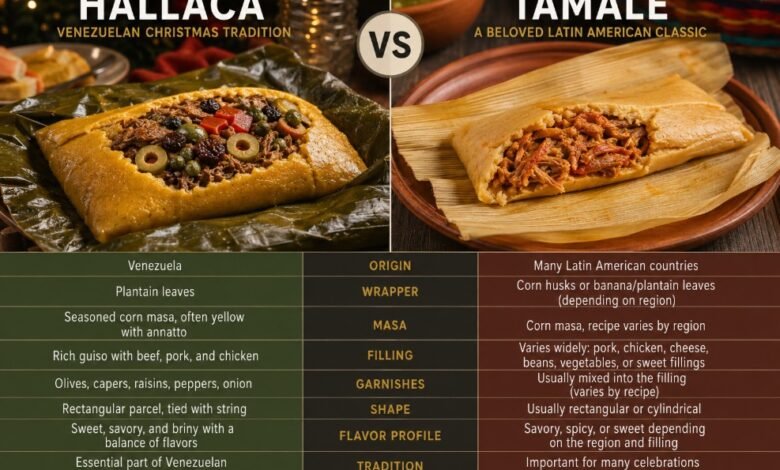
Hallaca and tamale are related foods, but they are not the same dish. Both belong to the enormous Latin American tradition of enclosing seasoned corn dough and filling inside a natural wrapper before cooking, yet that shared idea is only the beginning of the comparison.
A Venezuelan hallaca has its own very recognizable architecture: golden seasoned corn masa, a rich guiso that may combine several meats, olives, capers, raisins and other garnishes, all folded inside plantain leaves and tied into a neat parcel. Tamales, meanwhile, are not one single recipe at all. They form an enormous family of regional foods stretching across Mexico, Central America, Colombia and beyond.
So asking whether a hallaca is “basically a tamale” is a little like asking whether lasagna is basically pasta. Technically, the relationship helps you orient yourself. Practically, it leaves out almost everything that makes the food interesting.
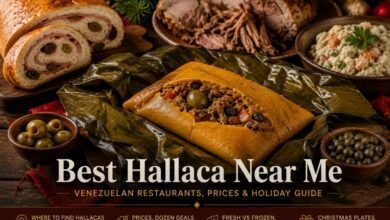
Trying to find one rather than study one? My Best Hallaca Near Me guide covers restaurants, current price examples, single and dozen orders, fresh and frozen hallacas, holiday preorders and Christmas plates.
Hallaca vs Tamale: The Simplest Difference
Hallaca is a specific Venezuelan dish and holiday tradition. Tamale is a much broader family of corn-based wrapped foods with countless regional forms.
That distinction solves most of the confusion immediately.
A hallaca has a fairly recognizable Venezuelan identity even though family recipes differ. A tamale cannot be described accurately without another question: which tamale?
A Mexican tamal from Oaxaca can be dramatically different from a corn-husk tamal from central Mexico. A Colombian tamal can look and eat very differently again. Guatemalan, Salvadoran and other Central American tamales bring their own doughs, fillings, wrappers and textures.
Hallaca is one specific culinary tradition. Tamale is an entire category of traditions.
Why people still call hallaca a Venezuelan tamale
Because it is useful for approximately five seconds.
If somebody has never seen a hallaca, saying “it is a Venezuelan corn-masa parcel somewhat related to tamales” gives them a mental picture.
The problem begins when that shortcut becomes the full explanation.
Once you open the plantain leaf and find a three-meat guiso, olives, capers, raisins, peppers and golden masa, the hallaca starts telling a much more specific story.
What Makes a Hallaca a Hallaca?
A traditional Venezuelan hallaca is built rather than simply filled.
The process usually begins with a prepared plantain leaf. Seasoned corn masa is spread over the leaf. A rich savory guiso goes over the masa, followed by carefully chosen garnishes. The leaf is then folded into a parcel, wrapped again when needed, tied with string and cooked.
The core hallaca structure
Masa: seasoned corn dough, commonly golden from annatto or achiote.
Guiso: savory filling that may combine beef, pork and chicken.
Adornos: olives, capers, raisins, peppers, onion and sometimes other family-specific additions.
Wrapper: plantain leaves.
Cooking: the tied parcel is cooked until the masa sets and the flavors come together.
The exact recipe changes between Venezuelan regions and families, which is why arguments about the “correct” amount of masa or the presence of raisins can become unexpectedly emotional.
If you want the deeper ingredient and cultural explanation, I have a separate guide to what a hallaca is and how it is made.
What Does “Tamale” Actually Mean?
The English word tamale is commonly used for a large group of dishes descended from ancient Indigenous corn-cooking traditions across Mesoamerica and other parts of Latin America.
There is no universal tamale formula.
Tamales can differ in:
corn preparation;
masa consistency;
amount and type of fat;
meat;
sauces;
cheese;
vegetables;
sweet fillings;
wrapper;
size;
shape;
cooking method;
seasonal role.
A Mexican tamale is not one thing either
Even within Mexico, saying “Mexican tamale” is wildly broad.
A narrow corn-husk tamal filled with pork and red chile sauce and a broad Oaxacan tamal cooked in banana leaf share a culinary family, but they are not interchangeable eating experiences.
And then Colombia changes the comparison again
Colombian tamales may be large leaf-wrapped parcels containing masa, meat, vegetables and sometimes rice or other ingredients depending on the region.
That is why any comparison that claims “tamales use corn husks, hallacas use leaves” fails almost immediately.
Hallaca Masa and Tamale Masa Are Related but Not Identical
Corn is central to both, but the dough can behave very differently.
Hallaca masa
Hallaca masa is generally made with precooked corn flour and seasoned with flavorful liquid and fat. Annatto-colored oil or fat commonly gives it the recognizable warm yellow-orange tone.
The dough is spread across the plantain leaf rather than shaped into a thick standalone block.
A good hallaca should have enough masa to contain the filling without making the meal feel like a search expedition for the meat.
Mexican tamale masa
Many Mexican tamales use masa derived from nixtamalized corn, often combined with lard or another fat, broth and seasonings.
The final texture can be noticeably lighter and fluffier than hallaca masa, especially when the fat is beaten into the dough.
Other tamale traditions
Some leaf-wrapped tamales are denser, wetter or smoother. Some incorporate ingredients directly into the masa. Others use rice or different corn preparations alongside the dough.
The practical difference in the bite
In a well-balanced hallaca, I expect the masa to function almost like a soft golden frame around the guiso.
In many tamales, masa takes a more dominant role in the overall texture.
Diana’s masa test: if I finish half a hallaca and still feel as though I am mostly eating corn dough, I want more filling. Hallaca should reward you for opening the leaf.
Hallaca Filling Is Built for Complexity
One of the biggest differences appears when you cut directly through the middle.
Many tamales use one clearly defined filling:
pork in red chile sauce;
chicken in green sauce;
cheese and peppers;
beans;
vegetables;
sweet fruit or dessert fillings.
Hallaca often takes the opposite approach.
Several meats can share one guiso
A classic festive hallaca may use beef, pork and chicken together.
The goal is not to make the diner identify every meat separately. The different proteins create depth in the cooked filling.
The filling is stew-like
Rather than simply placing a piece of meat inside corn dough, hallaca guiso is cooked with aromatics and seasoning before assembly.
It should taste like a coherent stew.
Then the hallaca adds another layer
After the guiso, olives, capers, raisins and peppers may be placed deliberately into the parcel.
That creates one of the hallaca’s most interesting characteristics: the flavor changes as you move through it.
Olives, Capers and Raisins Make Hallaca Immediately Recognizable
If someone gives you an unfamiliar leaf-wrapped corn parcel and you find meat guiso, a green olive, capers and raisins inside, Venezuelan hallaca should move very high on your list of possibilities.
Olives
Olives give hallaca salty, briny acidity.
Against mild corn and rich meat, a bite containing olive suddenly feels brighter.
Capers
Capers are smaller but sharper. Their concentrated briny flavor keeps the filling from becoming monotonously heavy.
Raisins
Raisins are responsible for some of the most predictable hallaca arguments.
They bring little bursts of sweetness rather than turning the whole dish sweet.
Why this is different from many tamales
Tamale fillings can be extraordinarily complex, but the combination of savory guiso plus separately noticeable olives, capers and raisins is especially characteristic of Venezuelan hallaca.
The hallaca does not want every bite to taste exactly the same.
Plantain Leaf vs Corn Husk Is Useful — but Not a Universal Rule
Hallacas are strongly identified with plantain leaves.
The leaf provides the broad surface needed for spreading the masa, arranging the filling and folding the characteristic parcel.
What the plantain leaf contributes
a subtle vegetal aroma;
moisture protection;
a broad folding surface;
structure during cooking;
the theatrical pleasure of opening dinner like a present.
Many Mexican tamales use corn husks
This is the visual comparison most American diners know.
Corn husks naturally produce a narrower, elongated form.
But tamales can also use leaves
Oaxacan tamales, Central American tamales and many South American tamales may use banana or plantain leaves.
Therefore:
Plantain leaf is a defining part of hallaca, but plantain leaf is not exclusive to hallaca.
Hallaca and Tamale Usually Have Different Silhouettes
Hallaca
A hallaca is typically broad, relatively flat and rectangular.
Once tied, it looks like a green parcel.
Corn-husk tamale
Many corn-husk tamales are narrower, thicker and more elongated.
Leaf-wrapped tamales
These can become broad squares or rectangles, which may look much closer to a hallaca from the outside.
Which one is larger?
There is no useful universal answer.
A hallaca can make a substantial individual meal. A small Mexican tamal may be much lighter. A large Colombian or Central American tamal can easily exceed both.
Size tells you far less than the ingredients and regional identity.
Both Require Work, but Hallaca Has a Very Particular Assembly Ritual
It would be unfair to claim that tamales are simple and hallacas are complicated. Some tamale preparations involve days of ingredient work, chile sauces, nixtamalized corn and large family assembly sessions.
The difference is the shape of the labor.
A hallaca assembly line can include:
preparing the guiso;
cleaning plantain leaves;
cutting leaves to size;
preparing seasoned masa;
portioning masa;
spreading it over leaves;
adding guiso;
placing olives;
placing capers;
placing raisins;
adding peppers or other adornments;
folding;
wrapping;
tying;
cooking batches.
Why families divide the work
Because producing dozens of hallacas alone would make a person reconsider every decision that led them to that kitchen.
One person can handle leaves, another masa, another filling and another tying.
The inefficiency becomes the social event.
Tamale-making can work the same way
Tamale holidays and tamaladas create their own family production lines.
That similarity is important. Both foods demonstrate how a labor-intensive dish can survive precisely because people turn the labor into gathering.
Hallaca vs Tamale: What Do They Taste Like?
Hallaca commonly has a more explicit sweet-briny-savory contrast than the tamale styles most U.S. diners encounter.
Hallaca flavor profile
seasoned corn;
rich cooked meat;
onion and pepper aromatics;
olive brininess;
caper acidity;
raisin sweetness;
subtle leaf aroma.
Mexican pork tamale
A typical pork tamal with red chile sauce may emphasize corn, pork, dried chile, garlic and fat.
Chicken tamale
Chicken versions can be lighter, with salsa verde, mole or another sauce defining much of the character.
Cheese tamale
These can emphasize mild corn, cheese, chile and dairy richness.
Sweet tamales
Some tamales move fully into sweet territory with fruit, sugar, cinnamon or colored masa.
A traditional hallaca remains fundamentally savory even when raisins contribute sweetness.
Which tastes more complex?
That depends entirely on the recipe.
A hallaca with several meats and individually placed garnishes can taste extremely layered. A tamal with sophisticated mole or regional chile sauce can be equally complex in a completely different way.
Complexity is not a competition.
The Texture Difference Is Just as Important as Flavor
Hallaca masa
Usually soft, moist and relatively smooth.
It should hold around the filling while remaining tender enough to cut easily with a fork.
Hallaca guiso
Moist, stew-like and rich.
The filling should not feel like dry shredded meat trapped inside dough.
Hallaca garnishes
An olive provides firmness. A raisin feels soft and chewy. Capers create tiny concentrated interruptions.
Corn-husk tamale
The masa may be fluffier, more crumbly or more bread-like depending on the preparation.
Banana-leaf tamale
Often moister and denser because of the wrapper and regional dough style.
Why wrapper matters
The cooking environment created by the leaf or husk affects surface moisture and aroma.
The Christmas Connection Is One of Hallaca’s Biggest Distinctions
Hallaca is deeply embedded in Venezuelan Christmas and New Year traditions.
The association is so strong that searching for hallacas in the United States often becomes a seasonal shopping problem rather than an ordinary restaurant search.
Families make batches
The preparation encourages producing dozens rather than one or two.
Families exchange them
A hallaca can function almost like an edible family signature.
You taste somebody else’s version and immediately begin comparing it with your own household.
Hallaca joins a larger holiday plate
The classic group includes:
hallaca;
pan de jamón;
pernil;
ensalada de gallina.
Are tamales holiday food too?
Absolutely.
Tamales are important Christmas and celebration foods in Mexico and many other Latin American cultures.
The distinction is not that one food is festive and the other is not.
The distinction is the specific cultural role hallaca plays in the Venezuelan Christmas table.
Regional Variation Makes Simple Comparisons Dangerous
The easiest way to write a bad Hallaca vs Tamale article is to invent one “official” example of each dish and pretend every family follows it.
Hallaca varies within Venezuela
Families can differ over:
which meats belong in the guiso;
how thick the masa should be;
whether raisins belong;
whether almonds belong;
how many olives are enough;
how sweet the filling should feel;
whether the guiso is cooked fully before assembly;
how strongly the masa is seasoned.
Tamales vary across entire countries
The range is even larger.
There is no meaningful single spectrum from “hallaca” on one end to “tamale” on the other.
Think of it as a family tree rather than two competing recipes.
Hallaca vs Mexican Tamale
This is the comparison most readers are usually asking about.
Hallaca wrapper: plantain leaf.
Many Mexican tamales: corn husk, though banana-leaf styles also exist.
Hallaca filling: commonly complex guiso with multiple meats.
Mexican tamale filling: often one primary filling such as pork, chicken, cheese, beans or chile.
Hallaca garnishes: olives, capers and raisins are highly characteristic.
Mexican tamale garnishes: usually incorporated differently into filling or sauce rather than arranged in the same hallaca style.
Hallaca shape: broad rectangular parcel.
Many Mexican corn-husk tamales: narrower elongated parcel.
Hallaca season: intensely associated with Venezuelan Christmas.
Mexican tamales: commonly eaten throughout the year while also playing important roles at Christmas and other celebrations.
Which is richer?
A multi-meat hallaca can feel richer than a simple chicken tamal.
A tamal filled with mole or fatty pork can easily reverse that comparison.
Which has more masa?
Recipe matters more than nationality.
Still, many hallaca lovers expect a relatively balanced masa-to-guiso ratio rather than a thick wall of dough.
Hallaca vs Colombian Tamal
This comparison becomes more visually confusing because many Colombian tamales are also wrapped in leaves.
Colombian tamales can be large
Some regional Colombian tamales are substantial parcels containing meat, vegetables, masa and other starches.
The ingredient architecture differs
Rice, potato, carrot, peas or other ingredients may appear depending on regional style.
That gives many Colombian tamales a whole-meal-inside-the-leaf structure.
Hallaca remains more focused on guiso and adornments
The Venezuelan hallaca’s olives, capers and raisins create a different flavor pattern from the vegetable-and-starch combinations found in many Colombian tamales.
The leaf does not solve the mystery
If both are sitting wrapped in glossy green leaves, you may need to open them before the difference becomes obvious.
Which One Should You Try First?
If you have already eaten several Mexican tamales, I would choose hallaca next simply because the familiar format makes the differences easier to notice.
Choose hallaca if you like:
savory-sweet combinations;
olives;
capers;
slow-cooked meat;
plantain-leaf aromas;
holiday foods with strong cultural rituals;
complex fillings.
Choose a Mexican-style tamal if you like:
chile sauces;
masa-forward textures;
pork or chicken fillings;
cheese;
salsa;
a huge variety of regional choices.
If you dislike raisins
Do not automatically reject hallaca forever.
Ask whether the seller’s recipe uses raisins. Family recipes vary.
If you dislike olives
This matters more.
Olive flavor is strongly associated with many traditional hallacas, and removing an olive after opening the parcel does not necessarily remove its briny influence.
If you can order both
That is the most interesting choice.
Taste them side by side and compare:
masa thickness;
moisture;
wrapper aroma;
filling ratio;
sweetness;
saltiness;
how quickly the food becomes heavy;
whether you want another one.
How to Judge a Hallaca and a Tamale Fairly
Judge hallaca by balance
I want enough guiso that the filling matters.
I want the masa soft but structurally sound.
I want the olive, caper and raisin to add contrast rather than hijack the entire parcel.
Judge tamale by regional style
Do not complain that an Oaxacan banana-leaf tamal is not fluffy like your favorite corn-husk tamal.
That may not be what it is trying to be.
Both need properly cooked masa
Undercooked masa can feel gummy or pasty.
Overcooked or badly reheated masa can become dry and tough.
Both need sensible filling distribution
No one wants twelve bites of dough followed by one final spoonful of meat.
Both should smell good when unwrapped
The natural wrapper is part of the experience.
Are Hallacas and Tamales Gluten-Free?
Many hallacas and tamales are built from corn rather than wheat, but neither category should automatically be labeled gluten-free for someone with celiac disease.
Potential hidden gluten sources
broth;
commercial seasoning;
sauces;
prepared meat mixtures;
shared prep surfaces;
cross-contact.
Dairy in hallaca
Traditional hallaca does not inherently require cheese or milk, but recipes and fats differ.
Dairy in tamales
Some tamales contain cheese or dairy-rich fillings, while others do not.
Vegetarian hallacas
Vegetarian and vegan-style hallacas exist, especially through specialty producers.
Ask what replaces the meat guiso and whether the broth and fat used in masa are plant-based.
Vegetarian tamales
Vegetarian tamales are common in many cuisines and can feature cheese, beans, peppers, squash, mushrooms or other fillings.
Allergy questions
For a serious allergy, ask the seller rather than relying on the traditional recipe you found online.
Which One Reheats Better?
Both hallacas and tamales can reheat very well because their wrappers help protect the masa.
Hallaca
A properly stored hallaca can remain moist when reheated carefully inside its plantain-leaf wrapping.
Tamale
Tamales also respond well to moist reheating methods.
The biggest enemy is aggressive dry heat, which turns corn dough firm and crumbly.
Frozen products
Follow the seller’s instructions.
Do not assume every frozen hallaca or tamale needs the same thawing and reheating method.
For takeout
Both travel well compared with fried foods because neither depends on crispness.
That makes them particularly practical holiday preorder foods.
A Note From Diana
I understand why people call hallaca a Venezuelan tamale.
I even think it is a perfectly good description if you are standing at a restaurant counter and have six seconds to decide whether you want one.
“Corn dough, filling, leaf, Venezuelan.” Fine. We have prevented total confusion.
But then I want to retire the comparison.
Because hallaca gets much more interesting the moment you stop asking whether it qualifies as a tamale and start noticing how strange and specific it is.
Olives inside corn dough.
Capers.
Raisins next to meat.
A plantain leaf wrapped like somebody expects you to put the package under a Christmas tree.
A string tied around dinner.
A family spending half a day producing dozens of parcels when everyone involved could theoretically have eaten the guiso out of a pot three hours earlier.
That inefficiency is beautiful.
And tamales have their own beautiful inefficiencies: soaking husks, making sauces, beating masa, filling, folding, steaming, arguing about whose mother makes them properly.
I do not need one dish to be the winner.
I want hallaca to taste like Venezuela.
I want a tamal to tell me which region it comes from.
And if someone serves me both, I will happily conduct extremely serious comparative research until the plate is empty.
Hallaca and tamale share an idea. What makes them worth eating is everything their cultures did differently with it.
Hallaca vs Tamale in One Clear Comparison
Hallaca: a specifically Venezuelan dish.
Tamale: a broad family of wrapped corn-based foods found across many Latin American cuisines.
Hallaca masa: seasoned corn dough often colored golden with annatto.
Tamale masa: varies enormously by country and region.
Hallaca wrapper: plantain leaves.
Tamale wrapper: commonly corn husk or banana/plantain leaf depending on regional style.
Hallaca filling: rich guiso, often with multiple meats.
Hallaca garnishes: olives, capers and raisins are especially characteristic.
Hallaca shape: typically a broad rectangular parcel tied with string.
Hallaca season: deeply connected to Venezuelan Christmas and New Year.
Tamale season: varies, although tamales are also major Christmas and celebration foods in many cultures.
Main difference: hallaca is one distinct Venezuelan tradition; tamale is a much larger culinary category.
If you want to taste the Venezuelan side of this comparison, the hallaca restaurant and holiday ordering guide can help you find current options, prices and preorder information.
Is a hallaca the same as a tamale?
No. Hallaca and tamale are related corn-based wrapped foods, but hallaca is a specifically Venezuelan dish with plantain-leaf wrapping, a complex guiso and characteristic garnishes such as olives, capers and raisins. Tamale is a much broader family of foods with many regional styles.
What is the main difference between hallaca and tamale?
Hallaca refers to one distinct Venezuelan culinary and Christmas tradition, while tamale describes a broad category of corn-based wrapped foods made in many countries and regions. Their masa, fillings, wrappers, shapes and flavors can differ substantially.
Why do hallacas have olives, capers and raisins?
Olives, capers and raisins create deliberate contrast inside hallaca. Olives add briny saltiness, capers contribute sharper acidity and raisins provide small sweet notes against the savory meat guiso and seasoned corn masa.
Do hallacas and tamales use the same masa?
Both use corn-based dough, but the recipes are not necessarily the same. Hallaca masa commonly uses precooked corn flour, seasoned liquid, fat and annatto for color. Tamale masa varies widely by region and can use different corn preparations, fats and seasonings.
Why are hallacas wrapped in plantain leaves?
Plantain leaves hold the hallaca together during cooking, protect the masa and contribute a subtle vegetal aroma. The leaf also provides the broad surface needed to build and fold the hallaca parcel.
Do all tamales use corn husks?
No. Corn husks are common in many Mexican tamales, but banana and plantain leaves are also used in Mexico, Central America, Colombia and other regional tamale traditions.
Are hallacas only eaten at Christmas?
Hallacas can be sold or eaten at other times, especially through Venezuelan restaurants and specialty food businesses outside Venezuela, but they are strongly associated with the Venezuelan Christmas and New Year season.
Which is bigger, a hallaca or a tamale?
There is no universal answer. Hallacas are usually broad rectangular parcels, while many corn-husk tamales are narrower. However, tamales vary enormously by region and some Colombian or Central American versions can be much larger than a typical hallaca.
Are hallacas and tamales gluten-free?
Many are made primarily from corn, but corn-based does not automatically mean medically gluten-free. Broth, commercial seasonings, sauces and cross-contact can introduce gluten, so diners with celiac disease should confirm the exact preparation.
Where can I buy Venezuelan hallacas?
Look for Venezuelan restaurants, bakeries, holiday caterers and specialty food businesses. Hallacas are often seasonal or made in limited batches, so confirm current availability, pricing and holiday preorder deadlines before traveling.