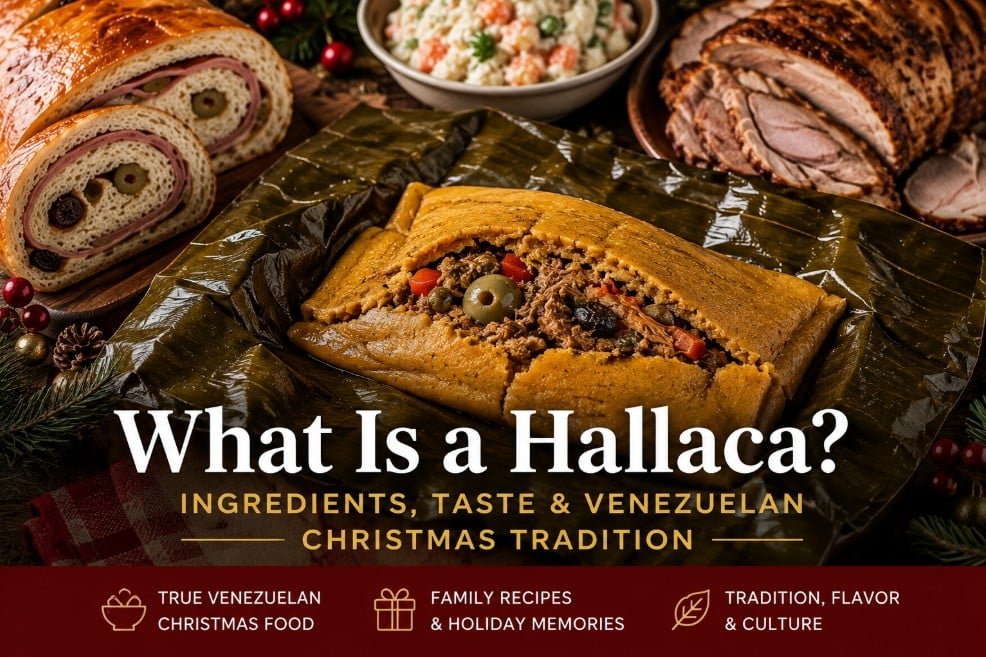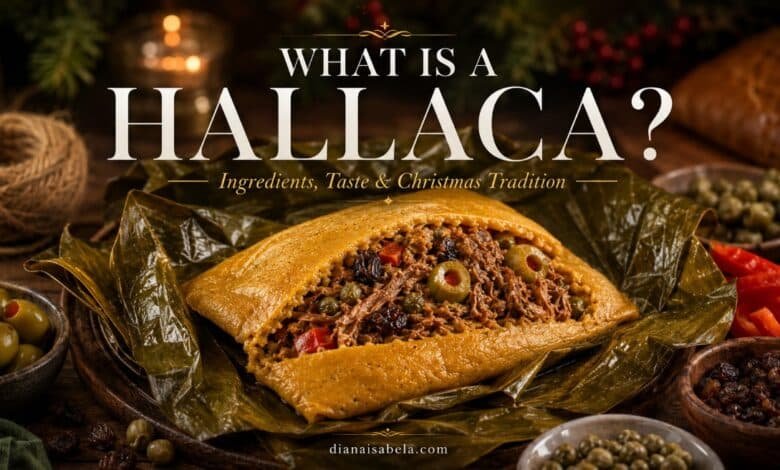
A hallaca is a Venezuelan holiday dish made by spreading seasoned corn masa onto a plantain leaf, adding a rich savory guiso and carefully chosen garnishes, then wrapping, tying and cooking the entire parcel. That sounds simple until you watch a family make fifty or a hundred of them.
The filling may contain beef, pork, chicken or a combination. Olives, capers, raisins, peppers and onions create the characteristic sweet, salty, briny and savory contrasts. The yellow-orange masa surrounds everything, while the plantain leaf keeps the package together and adds its own aroma during cooking.
Hallaca is often compared with a tamale because both belong to the broad world of filled corn dough cooked inside leaves. But if you stop at “Venezuelan tamale,” you miss the most interesting parts: the layered assembly, the complex guiso, the garnishes placed almost like jewelry, the Christmas calendar and the fact that making hallacas is often as much a family event as a recipe.
Looking for somewhere to buy one? My Best Hallaca Near Me guide covers restaurant options, current price examples, fresh and frozen hallacas, dozen deals and holiday-ordering advice.
What Exactly Is a Hallaca?
A hallaca is one of Venezuela’s defining holiday foods. At its simplest, it consists of seasoned corn dough wrapped around a savory filling, enclosed in plantain leaves and cooked as a tightly secured package.
But the word “simple” does not belong comfortably anywhere near hallaca-making.
One hallaca can involve:
corn masa;
achiote- or annatto-colored fat or oil;
a slow-cooked meat guiso;
beef;
pork;
chicken;
onion;
sweet pepper;
olives;
capers;
raisins;
plantain leaves;
string for tying the finished package.
Not every family uses every ingredient. That is important.
Hallaca is a tradition with recognizable architecture, not an industrial specification requiring every Venezuelan household to produce the same rectangular package.
Is hallaca a main dish?
It can absolutely be eaten as the main part of a meal, but at Christmas it often appears as one member of a larger plate rather than standing alone.
A typical Venezuelan holiday spread can combine hallaca with pan de jamón, pernil and ensalada de gallina.
Is hallaca eaten all year?
Some restaurants, bakeries and frozen-food sellers offer hallacas beyond December, especially outside Venezuela where Venezuelan communities want access to traditional foods year-round.
Culturally, however, hallaca remains strongly linked with Christmas and New Year.
One Hallaca, Five Very Different Jobs
The easiest way to understand hallaca is not through a giant ingredient list. Think about the five elements that have to work together.
1. Masa creates the body
The corn dough forms the soft outer layer. It needs enough structure to hold the guiso without becoming rubbery, while remaining moist enough to feel rich rather than chalky.
2. Guiso creates depth
The stew provides most of the savory complexity. Depending on the recipe, it may combine several meats rather than using one simple filling.
3. Adornos create contrast
Olives, raisins, capers and pepper are not random decorative debris. They are strategically different tastes packed into one parcel.
4. The plantain leaf creates the cooking environment
It contains the package, protects the masa and contributes aroma while the hallaca cooks.
5. The string makes the engineering work
A beautifully filled hallaca that opens during cooking is not particularly useful. The folding and tying need to survive the pot.
Hallaca works because mild corn, rich stew, briny garnish, sweetness and leaf aroma all arrive in the same bite without becoming the same flavor.
The Masa Should Taste Like More Than Plain Corn Dough
The masa is often made from precooked corn flour, but the dough is not simply mixed with water and spread onto a leaf.
Recipes may season it with broth and fat, and annatto or achiote commonly gives hallaca its warm yellow-orange color.
The exact formula changes by household.
What good hallaca masa should do
hold its shape around the filling;
stay moist after cooking;
cut without collapsing;
taste seasoned rather than blank;
remain tender after reheating;
support the guiso rather than overwhelm it.
Too much masa changes the entire experience
A disappointing hallaca can have a perfectly good stew hidden inside far too much dough.
You cut through a thick slab of masa, eventually discover a narrow strip of meat in the center and spend the rest of the meal wondering where everybody put the guiso.
Generosity in hallaca is about balance, not simply making the parcel heavier.
What color should the masa be?
Many hallacas have a warm yellow, gold or orange tone created with annatto-colored fat or oil.
The color may vary. A hallaca does not become automatically better because its masa is aggressively orange.
Guiso Is the Savory Heart of the Hallaca
Guiso is the cooked savory filling placed inside the masa.
A common festive approach combines meats such as:
beef;
pork;
chicken;
or two or three of these together.
The meat cooks with aromatics and seasoning until the flavors integrate into something closer to a stew than a pile of separate meat pieces.
Why use more than one meat?
Different meats contribute different things.
Beef brings deep savory flavor. Pork adds richness and fat. Chicken can provide a softer, lighter meat note.
Together they create a filling that tastes more layered than one neutral protein surrounded by masa.
Does every hallaca contain three meats?
No.
Two-meat hallacas, single-protein hallacas, vegetarian adaptations and regional family variations all exist.
The presence of exactly three meats is not the test of whether somebody has permission to call the dish hallaca.
Should the guiso be wet?
It should be moist and richly seasoned but not so liquid that it destroys the masa structure.
A dry filling makes the hallaca feel heavy. An excessively loose stew can make assembly and cooking difficult.
The Little Ingredients Are the Ones People Argue About
Ask a group of people about hallacas and eventually somebody will start discussing raisins.
This is inevitable.
Olives
Green olives provide saltiness, acidity and a meaty-briny bite that cuts through the rich filling.
Capers
Capers are sharper and more concentrated than olives. A few can wake up an otherwise heavy mouthful of meat and corn.
Raisins
Raisins create pockets of sweetness.
You are not supposed to forget that you are eating a savory dish. The sweetness works precisely because it appears against meat, olives and capers.
Peppers and onions
Sweet peppers and onion can contribute aroma, sweetness, moisture and color.
Almonds and other additions
Some family recipes include almonds or other garnishes. Regional and household differences are part of the tradition.
Are the garnishes mixed into the guiso?
Sometimes ingredients are incorporated into the stew; in other preparations, garnishes are deliberately arranged on top of the masa and filling before wrapping.
That assembly style creates more deliberate contrasts within each hallaca.
The Plantain Leaf Is More Than Packaging
A hallaca would be much less interesting if its leaf existed only to keep boiling water away from the dough.
The leaf contributes visually, structurally and aromatically.
It creates the parcel
The masa and filling are spread and arranged on the prepared leaf before the package is folded.
It protects the masa
The wrapper keeps the hallaca together during cooking and helps prevent the dough from directly dispersing into the water.
It contributes aroma
Warm plantain leaf can give the hallaca a subtle vegetal, grassy aroma.
It makes opening the food part of eating it
Hallaca arrives concealed.
You untie the string, unfold the leaf and reveal a golden rectangle underneath.
There are foods that look better because a chef spent four minutes decorating the plate. Hallaca looks better because you had to unwrap it.
Do you eat the leaf?
No.
The plantain leaf is removed before eating.
Why Hallaca-Making Turns a Kitchen Into an Assembly Line
This may be the most important part of hallaca that an ingredient list cannot explain.
Hallacas are famously labor-intensive, but that difficulty creates a social structure around making them.
Families can divide the work:
one person prepares the guiso;
someone cleans and cuts leaves;
someone mixes and portions masa;
someone spreads the dough;
another person adds filling;
someone places olives, capers and raisins;
another person folds;
someone ties the parcels;
then batches go into the pot.
It becomes cooking as collective production.
Why make so many at once?
If the preparation requires this much work, making four hallacas is almost insulting to the process.
Families may produce dozens at a time because the food is intended for Christmas meals, visiting relatives, gifts and later meals.
Hallacas also lend themselves well to refrigeration or freezing when handled properly.
The recipe becomes family memory
The phrase “my family makes it differently” is not a side note with hallacas.
It is almost the main story.
Who uses raisins? How much masa? Which meat? Raw guiso or precooked guiso? Almonds or no almonds? Thicker leaf? More capers?
These small decisions become family identity through repetition.
Why Hallaca Is So Closely Tied to Venezuelan Christmas
Hallaca is one of the foods most strongly associated with Christmas in Venezuela.
The connection is practical as well as emotional.
Making a large batch requires time and people. Christmas creates exactly the kind of occasion where families gather, divide tasks and cook food intended to be shared over several days.
The dish feels festive before you taste it
Look at the ingredients.
Multiple meats. Olives. Capers. Raisins. Colored masa. Prepared leaves. String. Individual packages.
This is not weekday food designed around getting dinner on the table in twenty minutes.
Hallaca also works as a gift
A wrapped hallaca can travel from one household to another, allowing families and friends to exchange versions of the same tradition.
That creates one of my favorite hallaca situations: people politely discussing somebody else’s family recipe while privately deciding that their own family still makes the best one.
The tradition traveled with Venezuelans
As Venezuelan communities grew outside the country, hallaca-making traveled too.
Restaurants, home-style sellers and specialty businesses in the United States now build Christmas menus around hallacas because the seasonal demand exists wherever Venezuelan families gather.
There Is No One Hallaca That Represents Every Venezuelan Family
Hallaca recipes change with geography and family habit.
Different regions may vary the meats, proportions, seasonings, garnishes and construction.
Some differences are obvious
more or less masa;
different combinations of meat;
raisins included or omitted;
almonds added;
different pepper or onion combinations;
changes in sweetness;
different guiso consistency.
Other differences are invisible until you taste
The broth used in the masa, the seasoning of the guiso, the fat and the cooking technique can completely change two hallacas that look almost identical on the plate.
Which hallaca is authentic?
The better question is whether the hallaca makes sense within the recipe tradition it claims to represent.
Family variation does not automatically make something less Venezuelan.
What Does Hallaca Taste Like?
Hallaca tastes savory, corn-rich, meaty, briny, aromatic and slightly sweet.
That last word is important: slightly.
A traditional hallaca is not a sweet corn cake, but raisins and some vegetables can add distinct sweet moments.
The masa
Mild, seasoned, corn-forward and rich enough to support the filling.
The guiso
Deep, savory and stew-like.
The olive
Salty, acidic and briny.
The caper
Sharp, concentrated and slightly floral.
The raisin
Soft and sweet.
The leaf
Subtle vegetal aroma rather than a strong separate flavor.
The pleasure of hallaca is not that every bite tastes identical. It is that the same soft corn-and-meat foundation keeps being interrupted by little salty, sweet and aromatic surprises.
What Texture Should a Good Hallaca Have?
The masa should be soft
Not wet, not gummy and definitely not dry enough to crumble like stale cornbread.
The guiso should remain moist
Dry shredded meat inside dense masa creates an exhausting meal.
The filling should have some definition
Hallaca is not supposed to become a completely homogeneous paste.
The garnishes should still be noticeable
An olive should feel like an olive. A raisin should provide a little change in texture.
The entire hallaca should cut without falling apart
A fork should be able to divide a portion without the parcel collapsing into unrelated corn and meat fragments.
How I Judge Whether a Hallaca Is Good
I would not begin with size.
A hallaca can be enormous and still be mostly masa.
First: masa-to-filling ratio
Cut through the center.
You should see enough guiso to understand why somebody spent all day making it.
Second: moisture
The filling and dough should feel moist without becoming soggy.
Third: seasoning
The guiso needs enough character that the hallaca does not depend entirely on one olive for flavor.
Fourth: contrast
Sweet, salty and savory elements should appear without turning the hallaca into a confused snack mix.
Fifth: leaf aroma
There should be a subtle cooked-leaf presence when you open the package.
Sixth: reheating resilience
A well-made hallaca should remain enjoyable after careful reheating rather than immediately turning dry and rubbery.
Seventh: do you want the second half?
This is the least scientific test and perhaps the most useful.
Hallaca is substantial. If halfway through you are already tired of masa and searching desperately for the last olive, the proportions were probably not ideal.
Is Hallaca Just a Venezuelan Tamale?
Hallaca and tamale are related concepts, but they are not interchangeable dishes.
Both can involve corn dough, filling and leaf wrapping. That makes “Venezuelan tamale” a reasonable two-second explanation for someone who has never seen a hallaca.
It becomes misleading when treated as the full definition.
Hallaca has a particularly complex garnish structure
Olives, capers and raisins are central to many traditional hallaca constructions.
Hallaca has a powerful Christmas identity
The seasonal association in Venezuelan culture is unusually strong.
The plantain leaf is part of the identity
Many tamales across Latin America use corn husks or various leaves depending on region. Hallaca is strongly identified with the plantain-leaf parcel.
The guiso is often complex
Multiple meats and carefully prepared stew separate many hallacas from simpler fillings.
I am keeping the full comparison out of this page because it deserves its own article. Next in this cluster: Hallaca vs Tamale.
Hallaca Is Only One Quarter of My Favorite Venezuelan Christmas Plate
Eating hallaca alone explains the food.
Eating it with the traditional holiday companions explains the occasion.
Pan de jamón
Soft rolled bread filled with ham and commonly olives and raisins.
Pernil
Roasted pork provides a direct, deeply savory meat element beside the more complex hallaca.
Ensalada de gallina
Cool creamy chicken salad brings temperature and texture contrast.
Hallaca
Soft corn masa, rich guiso, leaf aroma and sweet-briny garnishes.
If you are tasting Venezuelan Christmas food for the first time: I would rather order one complete Christmas plate than three hallacas. The contrast explains why each dish is there.
How to Eat Your First Hallaca
You do not need special etiquette.
Open the leaf completely
Remove the string and unfold the plantain leaf rather than trying to cut through the wrapping.
Look at the masa
Notice the color, thickness and whether it stayed intact.
Cut through the center
This shows the masa-to-filling ratio better than nibbling from one corner.
Taste one bite before adding sauce
The cook already spent considerable effort seasoning the guiso. Give it ten seconds before introducing hot sauce.
Notice the garnishes separately
The olive, caper and raisin are part of the design.
Then stop analyzing it
Food becomes considerably less fun if every bite turns into an examination.
Are Frozen Hallacas Good?
They can be excellent.
Hallaca is particularly well suited to batch cooking and later reheating because the food is protected inside its wrapper.
A good frozen hallaca needs good handling
What matters is:
how fresh it was when frozen;
whether it was cooled and stored safely;
how long it remained frozen;
whether the packaging protected it;
how it is reheated.
Why families freeze hallacas
Making hallacas requires enough work that producing extras makes sense.
Freezing allows a December assembly day to feed people across several later meals.
Restaurant fresh versus specialty-store frozen
Neither label automatically guarantees quality.
A carefully made frozen hallaca can be much better than a mediocre “fresh” one that sat in a refrigerator too long.
How Should Hallacas Be Reheated?
Use the seller’s directions whenever you buy prepared hallacas.
Fresh refrigerated and frozen hallacas may require different treatment.
Protect the moisture
The plantain leaf is useful during reheating because it shields the masa from direct dry heat.
Heat through the center
The outside can become hot before the dense filling in the middle reaches serving temperature.
Do not unwrap too early
Exposing the masa to aggressive dry heat can make the outside tough.
Frozen hallacas need specific instructions
Ask whether the seller recommends reheating directly from frozen or thawing under refrigeration first.
Do not leave a meat-filled hallaca sitting on the counter for hours because somebody on social media said that is how their aunt does it.
Are Hallacas Gluten-Free, Dairy-Free or Vegetarian?
Gluten
The corn masa itself does not inherently require wheat flour, but that does not automatically make every restaurant hallaca safe for someone with celiac disease.
Broths, seasoning products, sauces and cross-contact vary.
Dairy
Traditional hallaca does not inherently depend on milk or cheese, but fats, broth and restaurant recipes differ.
Vegetarian hallacas
Vegetarian versions exist and can replace the traditional meat guiso with vegetables, legumes, mushrooms or other fillings.
They should still aim for the layered seasoning and texture that make hallaca interesting rather than merely filling masa with vegetables.
Vegan hallacas
Ask specifically about broth and the fat used in both guiso and masa.
“No meat in the center” does not automatically answer whether the entire hallaca is vegan.
Olive sensitivity and sodium
Olives and capers can contribute a substantial salty taste, especially in recipes that use several pieces per hallaca.
Raisins
Not an allergy issue for most diners, but definitely a preference issue worth checking before ordering twelve.
Serious allergies
Hallacas contain enough components that the seller is the only sensible source for exact allergen information.
A Note From Diana
I love food that reveals how unreasonable people are willing to become for tradition.
Hallaca is a perfect example.
No efficient person invents this dish.
An efficient person would cook the stew, put cornmeal next to it and tell everybody dinner is ready.
Instead, somebody decided the corn needed to become dough, the stew needed several meats, the garnishes needed to be placed individually, a leaf needed to be cleaned, everything needed to be wrapped like a present, string needed to be tied around it and the finished parcels needed another round of cooking.
Then families agreed to repeat this every December.
That is why I do not think hallaca should be understood only by comparing its ingredients with a tamale.
The extra work is part of the meaning.
If I am buying hallacas rather than making them, the thing I care about most is not whether the cook reproduced somebody else’s family recipe exactly.
I want the hallaca to feel intentional.
The masa should be moist. The guiso should be worth finding. The olive should wake up a bite. The raisin should briefly make me reconsider my position on raisins. The leaf should smell like it belonged around the food.
And I want enough filling that I never have to ask why I am eating three inches of corn dough to reach one tiny piece of pork.
A good hallaca does not taste complicated because it has many ingredients. It tastes complete because somebody decided exactly where all those ingredients belong.
Hallaca in One Clear Explanation
What it is: a Venezuelan corn-masa parcel filled with savory guiso and wrapped in plantain leaves.
Traditional filling: commonly beef, pork, chicken or a combination.
Characteristic additions: olives, capers, raisins, peppers and onions.
Masa: seasoned corn dough, often colored with annatto.
Wrapper: plantain leaves tied around the parcel before cooking.
Taste: savory, meaty, corn-rich, briny, aromatic and gently sweet.
Texture: soft moist masa around a rich stew-like filling.
Season: especially associated with Christmas and New Year.
Common companions: pan de jamón, pernil and ensalada de gallina.
Most important cultural detail: making hallacas is frequently a shared family activity rather than a one-person quick recipe.
To find current restaurants, holiday prices, dozen deals and fresh or frozen options, use the Best Hallaca Near Me guide.
What is a hallaca?
A hallaca is a Venezuelan dish made from seasoned corn masa filled with a savory guiso, commonly containing beef, pork, chicken or a combination, plus garnishes such as olives, capers and raisins. The parcel is wrapped in plantain leaves and cooked.
What does hallaca taste like?
Hallaca tastes savory, corn-rich and meaty with contrasting briny and slightly sweet notes. Olives and capers add salt and acidity, while raisins can create occasional sweetness against the rich guiso.
Why are hallacas eaten at Christmas?
Hallacas are deeply associated with the Venezuelan Christmas and New Year season. Their labor-intensive assembly naturally lends itself to family gatherings, where different people can prepare the guiso, leaves, masa, garnishes, wrapping and tying.
What meat is used in hallacas?
Many traditional hallacas use beef, pork and chicken together, but recipes vary. Some families or restaurants use two meats, one main protein or vegetarian fillings.
Why do hallacas contain olives, capers and raisins?
These ingredients create deliberate flavor contrast. Olives and capers provide salty, briny and acidic notes, while raisins add small pockets of sweetness against the savory meat filling and corn masa.
Do you eat the plantain leaf around a hallaca?
No. The plantain leaf is used to wrap and cook the hallaca. Untie and unfold the leaf before eating the corn-masa parcel inside.
Is a hallaca the same as a tamale?
Hallacas and tamales are related wrapped corn-based foods, but they are not identical. Hallaca has a distinct Venezuelan Christmas tradition, plantain-leaf wrapping, complex guiso and characteristic garnishes such as olives, capers and raisins.
Can hallacas be frozen?
Yes. Hallacas are commonly suitable for freezing when prepared, cooled and stored correctly. Follow the maker’s instructions for storage and reheating because fresh, refrigerated and frozen products can require different handling.
Are hallacas gluten-free?
The basic corn masa may not contain wheat, but broths, seasoning products and kitchen cross-contact vary. Anyone avoiding gluten for medical reasons should confirm the exact ingredients and preparation with the cook or restaurant.
What is traditionally served with hallacas?
Hallacas are commonly served as part of a Venezuelan Christmas meal with pan de jamón, roasted pork called pernil and ensalada de gallina, a creamy chicken salad.