
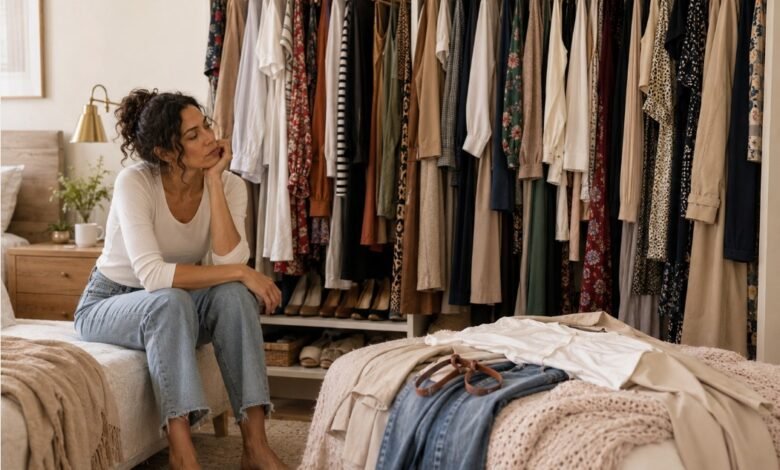
Your closet is full.
The rail is packed closely enough that removing one hanger requires negotiation. The drawers contain several versions of the same top. A chair has quietly become an unofficial clothing department. There are shoes under the bed, bags inside other bags and one drawer you open carefully because the contents have developed pressure.
And yet, when you need to get dressed, the conclusion arrives immediately:
I have nothing to wear.
This feeling is often treated like a shopping problem. You assume the missing answer is another pair of jeans, a better top, one more jacket or the exact shoe that will finally make everything cooperate.
Sometimes one piece really is missing.
More often, the closet is not empty. It is disconnected.
You own individual garments, but they do not form enough complete outfits. You have statement pieces without supporting pieces, tops without compatible bottoms, shoes that work with one very specific hem length and clothes purchased for a version of your life that rarely appears.
The problem is not always that you bought badly. It may be that your wardrobe changed in layers.
A few school outfits. A few work pieces. Several trend purchases. One romantic phase. One oversized phase. Clothes for imagined trips. Clothes for weather that lasts approximately nine days. Clothes that fit but never feel right. Clothes that feel right but no longer fit.
Nothing is completely wrong. Nothing works together easily.
The goal of a closet reset is not to throw away half your wardrobe and replace it with twelve beige garments described as essentials.
The real goal is to discover why your existing clothes stop becoming outfits.
A full closet can still feel impossible to wear when the garments do not connect into complete outfits. Common reasons include too many isolated statement pieces, duplicate items serving the same role, missing basics, unsuitable shoes, poor visibility, uncomfortable fit and clothing bought for an imagined lifestyle. The solution begins with identifying outfit gaps—not automatically buying more clothes.
A full closet measures quantity, not usefulness
A wardrobe can contain one hundred items and still produce fewer outfits than a wardrobe containing thirty.
The difference is connection.
A useful garment does not need to work with everything. But it should have at least one clear role and several realistic outfit partners.
A dramatic skirt may only work with two tops. That can be enough if you love both combinations and actually wear them.
A basic black top may theoretically work with twelve bottoms, but if the neckline annoys you and the fabric clings strangely, it contributes nothing.
Closet usefulness is not calculated by asking how many things you own.
It is calculated by asking how many complete, comfortable and appropriate outfits your clothes can create.
High quantity, low connection
Many individual pieces, but repeated problems with shoes, layers, proportions or occasions.
Lower quantity, high connection
Fewer garments, but each one belongs to several complete outfit combinations.
This is why buying another beautiful top can make the closet feel even more difficult.
The top may be good. But if the closet already contains twelve tops and only two reliable bottoms, the new purchase increases variety without improving function.
The ten-minute diagnosis tells you more than a dramatic closet purge
Before removing everything from the closet, stand in front of it and answer a few practical questions.
These questions identify patterns before emotion takes over.
A giant purge can feel productive because the closet becomes visually calmer. But if you remove clothes without understanding why outfits fail, you may rebuild the same problem with newer hangers.
Beautiful isolated pieces create the illusion of a strong wardrobe
Some garments are easy to admire and hard to wear.
They look wonderful on the hanger. They may photograph well. They may even fit correctly. But every time you try to build an outfit around them, something fails.
The color requires a very specific neutral. The neckline needs a bra you do not own. The shape only works with one waist height. The hem fights with all your shoes. The fabric looks wrong beside casual pieces but too casual beside formal ones.
These garments are isolated.
One isolated piece is not a problem. A wardrobe can contain special garments with limited use.
The problem begins when too much of the closet consists of pieces that each require their own support system.
Everything is interesting, but nothing creates a calm base
The closet contains ruffles, unusual necklines, cropped shapes, dramatic sleeves and several prints.
Each top is memorable. But the available bottoms also contain strong shapes, washes or details, so the outfits compete rather than connect.
The closet is visually full but daily life remains unsupported
Several dresses work for dinners, birthdays or events, but there are few reliable weekday outfits.
The wardrobe looks exciting until Monday morning.
The solution is not to remove every interesting garment.
It is to build enough quiet support around the garments you genuinely want to wear.
Duplicates can create less choice when they repeat the same weakness
Owning several versions of a favorite category can be practical.
If you wear straight-leg jeans four days a week, having multiple pairs makes sense.
But duplicates become clutter when they perform the same limited role.
Five cropped black tops are not five outfit solutions if all five expose the same amount of stomach, require the same high-rise bottom and feel unsuitable for the same situations.
Six oversized hoodies may offer different graphics, but if they all create the same bulky proportion with every coat, they do not increase outfit flexibility.
Duplicate buying often happens because the category feels safe.
You know how to shop for it. You know what size to choose. It produces immediate satisfaction because it resembles something you already like.
Meanwhile, the wardrobe gap remains untouched.
Useful duplicate: a repeated item that supports your routine. Unhelpful duplicate: another version of the same piece that keeps creating the same outfit problem.
The most valuable pieces are often the least exciting ones to shop for
A bridge piece connects clothing you already own.
It may be a plain fitted top that works under jackets. A simple belt that fixes several waistlines. A neutral shoe that works with both jeans and dresses. A lightweight cardigan that makes sleeveless clothing usable in air-conditioned spaces.
Bridge pieces rarely create the same immediate excitement as a statement garment.
But they can unlock five outfits at once.
| Closet problem | Likely missing bridge | What it unlocks |
|---|---|---|
| Several skirts, few wearable outfits | A fitted knit, simple tank or clean button-front shirt | Creates proportion balance without adding another strong detail |
| Dresses only work for events | A casual jacket, flat shoe or simple knit layer | Makes dressy pieces usable during ordinary days |
| Wide-leg trousers feel difficult | A shorter top, tucked knit or defined-waist jacket | Restores shape and prevents excess volume |
| Outfits look unfinished | A belt, structured bag, jewelry or deliberate shoe | Adds polish without requiring another garment |
| Nothing works across weather changes | A light cardigan, overshirt or breathable jacket | Extends warm-weather pieces into transitional days |
The smartest shopping list is often not a list of trends.
It is a list of missing connections.
Some closets are built for an imaginary schedule
Clothing can represent hope.
You buy for the person who attends gallery openings, takes weekend trips, wears linen in perfectly dry weather and never needs to carry anything larger than a tiny shoulder bag.
Meanwhile, your actual week involves school, work, commuting, errands, unpredictable air conditioning and shoes that must survive several hours.
A little aspirational clothing is joyful.
An entire aspirational wardrobe creates daily frustration.
Count the occasions you really have
How many days each month require casual clothes, polished clothes, event clothes, exercise clothes or weather-specific pieces?
Notice what remains unworn
If you repeatedly admire a garment but never find a realistic moment to wear it, the problem may not be styling.
Separate fantasy from function
You can keep a beautiful piece because it makes you happy. But do not mistake it for wardrobe infrastructure.
Your closet should support your real life first and your imagined life second.
A garment can technically fit and still make getting dressed harder
Fit is not only about whether a zipper closes.
A garment may be the correct size but require constant adjustment. The waistband rolls. The shoulder falls incorrectly. The neckline shifts. The trouser length only works with one shoe. The fabric pulls when you sit.
These pieces remain in the closet because they are not obviously unwearable.
But your body remembers the discomfort.
When getting dressed, you avoid them without consciously explaining why.
The fitting-room test is incomplete
Standing still in front of a mirror does not reveal what happens during a real day.
Movement matters
Sit, reach, walk, bend and put on the layer you expect to wear.
Undergarments matter
A top that only works with one bra may be less versatile than it appears.
Alteration may solve the problem
A hem, waist adjustment, button move or strap shortening can turn a frustrating garment into a useful one.
Before buying a replacement, ask whether the current piece needs removal or repair.
Shoes can block an entire section of the closet
Many outfits fail at the final step.
The dress looks right until you add the available shoes. The trouser length feels awkward with sneakers. The skirt becomes too formal with heels and too heavy with boots.
Shoes control proportion, mood and practicality.
This is why one well-chosen pair may improve the wardrobe more than several new tops.
Before buying another shoe, look at your difficult garments.
Do they need a low-profile sneaker? A sleek flat? A simple ankle boot? A sandal with enough structure to balance longer hems?
The right pair should connect multiple clothing categories.
For practical examples, see sneakers that make basic outfits look intentionally styled.
Sometimes the closet does not need another personality. It needs one shoe that can peacefully coexist with the personalities already living there.
Clothes you cannot see eventually stop existing in your outfit decisions
A wardrobe can feel limited because the useful pieces are hidden.
Tops are folded beneath other tops. Accessories are scattered. Seasonal clothing occupies the easiest space. Shoes remain in boxes you never open.
Your brain chooses from what is visible and easy to reach.
This creates a strange situation: you keep wearing the same eight items while feeling overwhelmed by everything else.
Group by use, not only by category
You may prefer grouping work clothes together, everyday tops together or complete outfit sections together.
Keep active-season clothing accessible
Heavy sweaters do not need prime space during hot weather.
Make accessories visible
Small items can finish outfits, but only when you remember they exist. The guide to tiny accessories that make outfits look more polished can help identify which details actually earn their space.
Photograph successful outfits
A simple album on your phone can preserve combinations you otherwise forget.
One closet may be trying to serve several different climates
Seasonal clothing creates volume quickly.
Summer dresses, rain layers, sweaters, jackets and event clothes may all occupy the same visual space even though only part of the wardrobe is currently useful.
This makes the closet look abundant while the weather-appropriate section remains small.
Instead of counting all clothes together, evaluate the active season.
Do you have enough breathable tops? Enough layers for sudden temperature changes? Shoes that work in rain? A jacket that fits over the sleeves you actually wear?
A seasonal shift does not always require a completely new wardrobe.
Sometimes it requires moving inactive clothing away and identifying two or three real gaps. For transitional dressing, late-summer closet essentials before fall begins provides a more focused approach than buying an entire new season at once.
Outfit families are more useful than isolated outfit ideas
An outfit family is a repeatable structure that works with several similar pieces.
For example:
Relaxed trouser + fitted top + short layer + low-profile shoe.
Once the structure works, you can change the color, fabric or accessory without rebuilding the entire outfit.
Another family might be:
Simple dress + casual jacket + flat shoe + structured bag.
Or:
Straight jeans + soft blouse + belt + clean sneaker.
Outfit families reduce decision fatigue because the proportions are already solved.
They also reveal gaps.
If one family depends on a fitted neutral top and you own none, the missing piece becomes obvious.
Useful wardrobe question: “What outfit structures work for me?” is more powerful than “What individual items are trending?”
A useful closet reset does not begin with throwing everything away
The goal is to sort by function before making permanent decisions.
This process is slower than filling donation bags in one afternoon.
It is also more likely to prevent the same problem from returning.
A real shopping list describes a job, not just an item
“Need a black top” is not specific enough.
What job must the top perform?
Does it need to tuck smoothly into trousers? Fit beneath a jacket? Cover a bra strap? Work in hot weather? Survive frequent washing?
The more clearly you define the job, the less likely you are to buy another almost-right version.
Weak shopping note
Black top.
Useful shopping note
Black fitted knit with a higher neckline, enough length to tuck into medium-rise trousers, short sleeves that fit beneath jackets and fabric that is not transparent.
Weak shopping note
Everyday shoes.
Useful shopping note
Low-profile neutral shoes that work with straight jeans, ankle-length trousers and casual dresses, with enough comfort for several hours of walking.
A specific list protects you from attractive substitutes that do not solve the original problem.
Temporarily stop buying the category you already understand too well
Most people have one category they buy easily.
Maybe it is graphic tees, sneakers, dresses, cardigans, bags or black tops.
You know what attracts you, so shopping requires little thought.
That ease can hide imbalance.
A temporary pause creates space to notice other needs.
This is not a permanent ban. It is a useful experiment.
For one or two months, do not add another item from the crowded category. Each time you feel tempted, ask what existing garment it would connect.
If the answer is unclear, the purchase is probably feeding the collection rather than improving the wardrobe.
Outfit repeating teaches you what your wardrobe actually needs
Repeating an outfit is often treated as a failure of creativity.
In reality, repetition creates information.
You learn whether the fabric stays comfortable. Whether the shoe works after three hours. Whether the layer feels bulky. Whether the outfit still feels like you after the first compliment disappears.
Repeated outfits reveal dependable pieces.
They also reveal where small changes would create variety.
One outfit might work with three different bags, two shoes and several layers. That is not boring. It is efficient.
A functional wardrobe contains enough repetition to feel easy and enough variation to feel personal.
A smaller closet works harder when every category has a clear role
Small wardrobes do not need perfect capsule rules.
They need enough balance.
If you own only a few bottoms, they must work across several tops. If you own only two jackets, they should support different weather or formality levels. If you own one event shoe, it should coordinate with more than one dress.
Accessories become especially valuable because they change mood without requiring much space.
Fit and laundry frequency also matter more.
A garment worn often must be comfortable to clean and strong enough to repeat.
The goal is not maximum minimalism.
The goal is a closet where the percentage of usable clothing is high.
Not every garment is staying because of style
Some clothes remain because they represent money spent, a previous body, a past relationship, a gift, a special memory or a hoped-for future.
These garments are emotionally different from ordinary clutter.
Forcing an immediate decision may create regret.
Memory does not require daily closet space
A sentimental garment can be stored carefully outside the active wardrobe.
Guilt is not usefulness
Keeping an expensive mistake does not recover the money.
Past-size clothing can affect the present
Garments that no longer fit may create pressure every time you get dressed.
A gift can be appreciated without being worn forever
The relationship and the object are not the same thing.
The active closet should contain clothes that support your current life and body.
Deciding what stays becomes easier when you ask better questions
“Do I like this?” is not enough.
You can like a garment and still never wear it.
Ask instead:
Can I create one complete outfit with it today?
Would I choose it if I saw it in a store now?
Is the problem fixable through styling, repair or alteration?
Does it support my real schedule?
Do I avoid it because it is difficult, or because I simply do not want to wear it?
Would I notice if it disappeared for one month?
These questions separate potential from habit.
Some garments deserve another styling attempt. Some need repair. Some belong in storage. Some can leave.
The decision does not need to be dramatic.
A functional closet feels quieter, not necessarily smaller
A good wardrobe does not eliminate every difficult morning.
Weather changes. Bodies change. Plans change. Sometimes nothing feels right because the problem is not the clothing.
But a functional closet reduces avoidable confusion.
You can see your options. You know which proportions work. Your shoes connect to your hems. Your layers fit over your sleeves. Your everyday life receives more space than rare fantasy occasions.
The closet may still contain color, trends, sentimental pieces and outfits with absolutely no interest in being practical.
Function does not require removing personality.
It requires enough structure that personality has something to stand on.
You probably do not need an entirely new wardrobe
The phrase “nothing to wear” often means something more specific.
Nothing feels comfortable. Nothing suits today’s weather. Nothing works with these shoes. Nothing fits the occasion. Nothing looks like the version of me I expected to be this morning.
Those are different problems.
Once you identify the real one, the closet becomes easier to repair.
You may need one bridge piece, one alteration, a better storage system or permission to stop trying to wear a garment you never liked outside the fitting room.
You may need fewer duplicate tops and one reliable bottom. Fewer event shoes and one pair that works during ordinary life. Fewer imaginary outfits and more support for the days you actually have.
A full closet is not proof that you own too much.
It is only proof that you own many things.
The useful question is whether those things know how to work together.
Questions and answers
Why does my closet feel full but I still have nothing to wear?
A closet can feel unusable when garments do not connect into complete outfits. Common causes include too many isolated statement pieces, duplicate categories, missing basics, unsuitable shoes, uncomfortable fit and clothes purchased for occasions or lifestyles that rarely occur.
Does having nothing to wear mean I need more clothes?
Not always. The problem may be poor outfit connection rather than low quantity. Before shopping, identify where outfits usually fail, such as the shoes, layer, bottom, fit or weather suitability.
What is a bridge piece in a wardrobe?
A bridge piece is a garment or accessory that connects several items you already own. Examples include a fitted neutral top, versatile shoe, light jacket, belt or simple cardigan that completes multiple outfits.
How can I organize my closet so I wear more of my clothes?
Keep active-season clothing visible, group items according to how you use them and store successful outfit photographs on your phone. Clothes that are hidden or difficult to reach are less likely to enter daily outfit decisions.
Should I remove everything from my closet during a reset?
A complete emptying is not necessary. Begin with your most reliable pieces, build outfits around them and identify repeated gaps. Move uncertain items into a temporary trial section before making permanent decisions.
How do I know whether I own too many duplicates?
Duplicates are useful when they support frequent wear. They become unhelpful when several items serve the same limited role and repeat the same weakness, such as requiring the same specific bottom or creating the same fit problem.
Why do shoes make so many outfits feel wrong?
Shoes affect proportion, formality and practicality. A trouser length, skirt shape or dress may need a specific shoe profile. One versatile pair can sometimes unlock more outfits than several new tops.
How do I create a useful clothing shopping list?
Describe the job each item must perform. Include fit, length, fabric, weather, layering and outfit requirements instead of writing only a general category such as black top or everyday shoes.
Is repeating outfits a sign that my wardrobe is boring?
No. Repeating outfits helps identify reliable pieces, test comfort and reveal useful variations. A strong outfit formula can be repeated with different shoes, layers, bags or colors.
What should I do with sentimental clothes I never wear?
Sentimental clothing can be stored separately from the active wardrobe. Keeping a memory does not require giving the garment daily closet space, especially when it no longer fits or supports your current life.
