Russian Kotleti in Maryland: Fish Kotletas, Baltimore Delis & a Chesapeake Twist
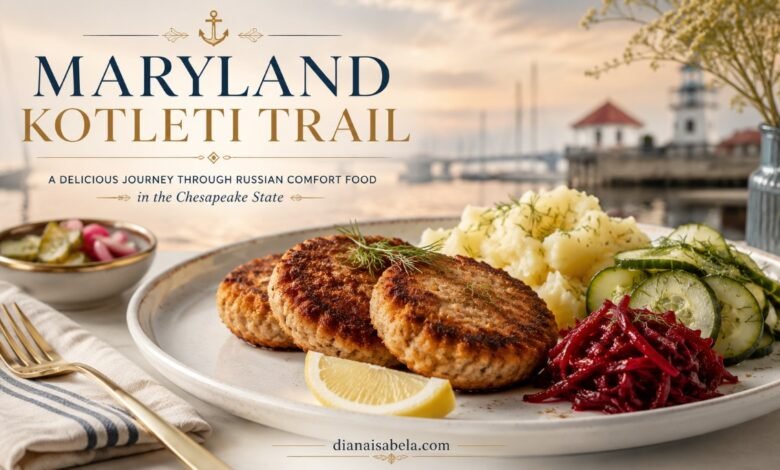
Maryland is the state where my kotleti notes unexpectedly acquired seafood.
That should probably have been predictable. This is Maryland. Eventually, the Chesapeake enters the conversation.
In Gaithersburg, Taste of Europe is currently described as carrying Ukrainian and Eastern European prepared foods including fish kotletas. In northwest Baltimore, International Food Market has a ready-made food counter where chicken cutlets appear among stuffed cabbage, Olivier, blintzes and other Russian, Ukrainian, Central Asian and broader post-Soviet foods. Bethesda gives us something different again: RUTA, Maryland’s first Ukrainian restaurant, where the current menu includes crabcake varenyky beside borscht, deruny, holubtsi and Chicken Kyiv.
None of this fits neatly into the usual “find one Russian restaurant and order beef kotleti” formula.
Good.
Maryland is more interesting because the local food culture keeps interfering. Fish is normal here. Crab is practically civic vocabulary. Baltimore has long-established Eastern European grocery corridors. Montgomery County has Russian, Ukrainian, Polish and broader international markets. Fell’s Point still has a Polish deli that has been feeding Baltimore since the 1980s.
The result is a kotleti search that feels less like locating one exact historical recipe and more like watching a familiar cooking technique travel through a new landscape.
My father is a chef, and technique is exactly where I would begin. A kotleta does not stop being an interesting formed cutlet simply because the cook uses fish instead of beef or chicken. The questions remain remarkably similar: how finely was the protein chopped or ground, how was moisture protected, what binds the mixture, how much was it handled, and did the outside brown before the center dried out?
Maryland simply adds one more question:
What happens when Eastern European comfort food reaches Chesapeake country?
The Maryland route: Gaithersburg for the most unusual kotleta lead, northwest Baltimore for Russian/Eastern European prepared food, Bethesda for contemporary Ukrainian cooking, and Fell’s Point when you want Baltimore’s Polish deli history with the harbor practically outside the door.
Gaithersburg
The most Maryland answer to the kotleti question may be made from fish
Taste of Europe is exactly the sort of store I expect to find when a regional food search becomes interesting. It is an Eastern European grocery rather than a destination restaurant, and recent business information describes its prepared-food selection as including fish kotletas, along with plov, beef tongue and a broader assortment of Ukrainian and Eastern European foods.
I am intentionally calling this a strong current lead rather than pretending I have a pristine first-party online menu with a permanent fish-kotleta SKU. Prepared-food counters rotate. The useful move is to call when fish kotletas are the reason for the drive.
GAITHERSBURG · EASTERN EUROPEAN MARKET
Taste of Europe
The Maryland stop that changes the entire state story by introducing fish kotletas into a search usually dominated by beef, pork or chicken.
My instinct: if the fish kotletas are available, I would build the plate much more brightly than I would around pork. Potatoes are still welcome, but cucumber, dill, cabbage, pickled vegetables and beet salad suddenly become even more useful.
I love this result because it makes culinary sense without feeling predictable.
Fish cutlets are not some Maryland invention. Minced or chopped fish patties exist across Eastern European, Jewish, Baltic and post-Soviet cooking traditions. But encountering them in Maryland gives the idea a wonderfully local resonance.
This is a state that already understands fish cakes.
It just usually puts crab in them.
The kitchen question
A fish kotleta has less room for bad technique than its meatier cousins
Fish changes the texture equation.
Ground pork can forgive some handling because fat provides richness and moisture. Beef mixtures vary depending on the cut. Chicken can dry quickly but still has a familiar minced-meat structure.
Fish is more delicate.
Overwork it and the mixture can become rubbery or oddly dense. Use fish that is too wet without controlling moisture and the patty becomes fragile. Cook it too long and the entire reason to use fish disappears.
Do not pulverize it into paste
A good fish cutlet benefits from enough structure that you still feel the protein rather than eating something with the texture of industrial mousse.
Fish needs balance, not panic
Bread, onion, egg or another binder may help depending on the recipe, but the mixture should remain tender rather than becoming increasingly fortified because the cook is afraid it will fall apart.
The crust has to happen quickly
A properly heated pan can brown the exterior before the center loses its moisture. This is exactly where timid heat causes trouble.
Give seafood something bright
Cucumber, dill, cabbage, pickled vegetables, lemon or beet-based salads make more sense to me than building an entirely heavy plate around a delicate fish patty.
There is a useful resemblance here to crab cakes, even though I would never call the dishes interchangeable. Both depend on respecting delicate protein. Both can be destroyed by excessive filler. Both need enough binder to behave but not so much that the binder becomes the personality.
Maryland already understands that the best seafood cake should taste like seafood. The fish kotleta simply speaks that lesson with a different accent.
This is the sort of culinary overlap I enjoy because it does not require inventing a fusion dish. The traditions already know some of the same techniques.
Northwest Baltimore
Reisterstown Road is where the kotleti search starts feeling like a post-Soviet grocery run
Baltimore’s most useful Russian and Eastern European food geography is not centered on the Inner Harbor.
It runs through grocery and deli businesses in the northwest part of the city, especially around Reisterstown Road. This is where the article stops being about restaurant reservations and becomes about prepared-food trays, freezer cases, smoked fish, sausages, stuffed cabbage, pelmeni and whatever somebody cooked that morning.
International Food Market is one of the clearest examples. Current business information describes Russian and Ukrainian groceries, Central Asian foods and a prepared-food counter where chicken cutlets appear alongside baked fish, Olivier, stuffed cabbage and filled pancakes.
The available information does not tell me cleanly enough whether every chicken cutlet is a ground kotleta rather than a whole-meat cutlet, so I am not awarding it an imaginary certificate of authenticity.
I would ask one question at the counter.
BALTIMORE · EASTERN EUROPEAN / CENTRAL ASIAN MARKET
International Food Market
A strong prepared-food route where current listings mention chicken cutlets and recent shoppers continue to report a substantial deli counter.
If the answer is yes, you have found exactly the texture family we want.
If the answer is no, I would still stay.
This is a very important quality in a deli.
A disappointing restaurant menu can leave you hungry. A disappointing Eastern European prepared-food counter usually leaves you with stuffed cabbage, pelmeni, smoked fish and cake.
I know which failure I prefer.
A few blocks away
Stolichny is the more explicitly Russian stop — and I would use it as a pantry, not a promise
Stolichny European Deli remains another Russian/post-Soviet grocery stop on Baltimore’s Reisterstown Road corridor. Current listings place it at 6852 Reisterstown Road and describe the foods shoppers expect from this kind of market: golubtsi, pelmeni, smoked fish, Russian-style sausages, sweets and other familiar products.
I do not have enough clean current first-party evidence to tell you that Stolichny has kotleti in the prepared case today.
So I am not going to.
STOLICHNY EUROPEAN DELI
6852 Reisterstown Rd, Baltimore
410-358-1981
Why it still earns a place here
Because the search for everyday Russian food often works better through the grocery store than through a restaurant menu. Pelmeni, golubtsi, smoked fish, sausages, rye bread, sweets and freezer foods can still make this a useful stop even when the exact prepared patty needs to be confirmed in person.
This is also why I would combine International Food Market and Stolichny into one Baltimore errand rather than drive across the state separately for each.
Check one prepared counter. If the cutlets are not what you want, look at the second. Buy the rest of dinner wherever it looks better.
This is shopping, not loyalty to a spreadsheet.
Bethesda
RUTA does not currently give us kotleti — it gives us something more useful for understanding Maryland
RUTA opened in Bethesda in 2024 as Maryland’s first Ukrainian restaurant. Its current menu is one of the most interesting examples in this state of a cuisine keeping its identity while acknowledging where it now lives.
The classics are there: Ukrainian borscht, green borscht, deruny, varenyky, holubtsi, banosh, Chicken Kyiv, buckwheat, honey cake and Kyiv cake.
But then Maryland walks through the door.
The menu has crabcake varenyky.
I almost laughed the first time I saw that because it is so geographically inevitable.
BETHESDA · CONTEMPORARY UKRAINIAN
RUTA
Maryland’s first Ukrainian restaurant and the place where Chesapeake ingredients enter the Eastern European conversation most visibly.
No, crabcake varenyky are not kotleti.
They belong in this guide because they explain the cultural environment around Maryland kotleti better than another generic deli listing would.
Food migration is not one-directional. Ukrainian cooking arrives in Maryland, and Maryland starts talking back.
Crab enters the dumpling.
Fish enters the kotleta.
Neither requires the original cuisine to disappear.
This is the part of food culture I find far more interesting than endless arguments about whether adaptation automatically means inauthenticity. The better question is whether the adaptation understands the original dish well enough to change it intelligently.
RUTA’s menu clearly knows what Ukrainian cooking is. That gives it room to have fun.
Fell’s Point
Baltimore’s Polish deli has been around long enough to ignore whatever food trend is happening this week
Sophia’s Place European Deli has served Baltimore since 1985 from Broadway Market in Fell’s Point. Its specialty is Polish food: pierogi, kiełbasa, gołąbki, pączki, chruściki, cheesecakes and other old-school deli and bakery staples.
I do not have a confirmed current minced kotlet on Sophia’s public menu, so this is not an exact kotleti stop.
It is something else: a Baltimore institution that gives the Maryland food trail historical weight.
BROADWAY MARKET · SINCE 1985
Sophia’s Place European Deli
A Polish deli inside one of Baltimore’s historic public-market settings, with homemade Polish classics rather than a fashionable reinterpretation of them.
I would come here when I wanted the wider Polish comfort-food experience, not because I was determined to force the word kotleti onto every stop in the state.
There is also something very Baltimore about buying pierogi in Fell’s Point and then walking toward the water.
Food geography should occasionally be enjoyable enough that you forget you were researching anything.
Rockville
The Polish counter here is for stocking the refrigerator, not proving a Russian point
Kielbasa Factory in Rockville gives Montgomery County a strong Polish specialty-grocery route. Its current public information emphasizes kielbasa, Polish meats, cheeses, pierogi, cabbage rolls, sweets and groceries.
I would not call it a kotleti destination without evidence of a current minced cutlet.
I would absolutely use it to build dinner.
ROCKVILLE · POLISH SPECIALTY STORE
Kielbasa Factory
1073 Rockville Pike, Rockville, MD 20852
The refrigerator strategy
Pick one prepared main or kielbasa, pierogi for another meal, sauerkraut or pickles, cheese, bread and perhaps sweets. This is the Montgomery County stop for a Polish pantry rather than an invented exact-kotleti promise.
I also like that Rockville and Gaithersburg can become the same regional food day without unreasonable driving. Taste of Europe gives you the Russian/Ukrainian/Eastern European route; Kielbasa Factory gives you the Polish route.
One afternoon can therefore produce fish kotletas, smoked fish, pierogi, kielbasa, pickles and probably far too much chocolate.
I have survived worse problems.
The plate is where Maryland really changes
A Chesapeake kotleta should not be dressed like a February pork cutlet
One reason I did not want to reuse the same side-dish section from Michigan, Pennsylvania or Massachusetts is that Maryland’s strongest oddity is fish.
Fish kotletas want a slightly different table.
FISH KOTLETA
Cucumber, dill and potatoes
This is the first plate I would build. Warm potato, tender fish, cool cucumber, dill and enough acidity to keep everything clean.
CHICKEN KOTLETA
Beets and buckwheat
Chicken has enough mildness to take earthy buckwheat and a vivid beet salad without disappearing.
BALTIMORE DELI
Pickles, rye and Olivier
If the meal comes from a prepared-food counter, I would happily make it more snack-table than composed entrée. Just keep something acidic near the creamy salad.
MARYLAND SUMMER
Tomato, cucumber and herbs
Eastern European minced patties do not need to spend July pretending it is January. Fresh vegetables and herbs make the meal lighter without changing the main dish.
I would also be careful with fish kotletas and heavy creamy salads. One creamy component can be lovely. Three make the fish work much harder than necessary.
Seafood wants room.
Maryland should know that better than almost anyone.
The inevitable comparison
No, a Russian fish kotleta is not a Maryland crab cake — but they have things to discuss
I would never collapse the two dishes into one category. A Maryland crab cake is culturally specific, usually centered on crabmeat and judged largely by how little unnecessary filler stands between you and that crab.
A fish kotleta may use finely chopped or ground fish, onion, bread, egg and seasonings to create a formed patty whose texture is intentionally more integrated.
They eat differently.
But the technical conversation overlaps.
Protect the identity and texture of the crab. Binding should support rather than dominate.
Create a cohesive, tender patty from fish without processing or cooking it into dryness.
Need intelligent moisture control, careful handling and enough heat to develop an exterior before the center becomes overcooked.
That is the Maryland culinary connection I actually trust.
Not “these dishes are secretly the same.”
They are not.
They simply ask cooks some of the same questions.
Pick your Maryland
I would plan two completely different food days here
Bethesda → Gaithersburg
Start with lunch at RUTA. Have Ukrainian food as an actual restaurant experience rather than trying to make every stop serve kotleti. Borscht, varenyky, deruny, holubtsi or the very Maryland crabcake varenyky can set the tone.
Then drive north toward Taste of Europe in Gaithersburg. Check the prepared-food counter for fish kotletas and build tomorrow’s dinner while you are there.
This is the prettier, more contemporary Maryland story: Ukrainian restaurant cooking followed by an Eastern European grocery run.
Northwest Baltimore → Fell’s Point
Begin around Reisterstown Road. Check International Food Market for chicken cutlets and prepared foods, then Stolichny if you want a second Russian/Eastern European grocery stop.
Later, head toward Fell’s Point and Sophia’s Place. The point is not to collect delis like passport stamps. The point is to see two versions of Baltimore immigrant food culture in one day: the post-Soviet grocery corridor and the old Polish market tradition by the waterfront.
I would not attempt Bethesda, Gaithersburg, northwest Baltimore and Fell’s Point in one heroic day.
Maryland traffic has enough personality already.
Dinner should not become a logistics dissertation.
And because Maryland has water
This may be the first kotleti food day where I want a trench coat more than a snow boot
For Bethesda, I would go polished and relaxed: trousers or dark denim, fitted knit or shirt, loafers or boots, a structured jacket. RUTA feels like an actual restaurant outing, so I would let the outfit acknowledge that without turning lunch into diplomacy.
Gaithersburg grocery shopping requires the usual Diana rule: beautiful shoes are allowed only if they understand parking lots.
Fell’s Point is different. I want denim, a knit, trench or leather jacket, flat boots and a crossbody bag — something that can move from Broadway Market to cobblestones and waterfront without requiring an emergency shoe negotiation.
Baltimore has enough texture visually that the outfit does not need to perform.
Good coat. Good food. Hands free for pierogi.
Perfect.
How I would actually search Maryland
Do not search only for Russian restaurants — you will miss half the useful food
Search Eastern European grocery stores. Maryland’s strongest kotleti leads currently live in prepared-food environments more than formal Russian restaurant menus.
Try “fish kotleta” and “fish cutlet.” Gaithersburg proves that restricting the protein to beef or chicken can hide an unusually interesting result.
Check Russian and Ukrainian markets around Montgomery County and Baltimore. Prepared-food counters rotate, so the online menu may never tell the complete story.
Include Polish delis. Baltimore and Rockville both have Polish-market infrastructure useful for the wider minced-cutlet and comfort-food search.
Ask about construction. “Is it made from ground chicken or a whole breast?” remains one of the most useful questions in this entire series.
For the national picture, continue with my Russian kotleti near me guide.
If prepared-food counters are giving you better answers than restaurant searches, use the Russian deli guide next.
And if you are nowhere near Maryland’s strongest food pockets, the Russian kotleti recipe eventually becomes more sensible than another hour on I-95.
Why Maryland earns its own page
The Chesapeake does not replace the kotleta. It gives it another place to live.
I expected Maryland to be a relatively difficult state in this search.
Instead, it became one of the more conceptually interesting ones.
Gaithersburg gives us fish kotletas — a completely logical Eastern European dish that suddenly feels almost regionally inevitable in a seafood state. Northwest Baltimore gives us prepared-food counters where chicken cutlets, stuffed cabbage, Olivier and other post-Soviet foods still function as everyday groceries. Bethesda gives us a Ukrainian restaurant confident enough to put crab cake inside varenyky. Fell’s Point preserves a Polish deli tradition that predates most current food trends by decades.
None of these places needs to pretend to be exactly the same.
That is the point.
Food migration does not photocopy a cuisine and paste it into a new ZIP code. Ingredients change. Customers change. Markets combine traditions. Restaurants become more ambitious. Family foods remain stubbornly practical.
The interesting question is what survives.
With kotleti, I think the answer is tenderness, browning, economy, flexibility and the idea that an ordinary piece of protein can become something much more comforting once somebody chops it, seasons it and treats it carefully.
Maryland adds fish.
Of course it does.
Information reviewed: August 2026. Prepared-food selections at grocery stores can rotate and sell out. RUTA’s restaurant menu is current at the time of review. Call before a dedicated trip when one exact cutlet is the only reason you are going.
Maryland questions
Russian Kotleti in Maryland FAQ
Where can I find Russian-style kotleti in Maryland?
Gaithersburg and Baltimore are the strongest current places to begin. Taste of Europe in Gaithersburg has been recently associated with fish kotletas, while International Food Market in Baltimore has current prepared-food listings that include chicken cutlets. Because deli selections rotate, call before making one exact item the purpose of a long trip.
Where can I find fish kotletas in Maryland?
Taste of Europe at 630 Quince Orchard Road in Gaithersburg is a strong current lead for fish kotletas. The store specializes in Ukrainian, Russian and broader Eastern European groceries and prepared foods. Confirm availability directly because prepared selections can change.
Where can I find Russian or Eastern European prepared food in Baltimore?
International Food Market on Reisterstown Road has a substantial Eastern European and Central Asian grocery and prepared-food selection, while Stolichny European Deli nearby is another Russian and post-Soviet grocery route. Current daily prepared foods should be confirmed at the counter.
Does International Food Market in Baltimore have chicken cutlets?
Current business information includes chicken cutlets among its ready-made foods. The available description does not clearly establish whether every version is a ground-meat kotleta or a whole chicken cutlet, so ask how the chicken is prepared if the distinction matters to you.
Where can I find Ukrainian food in Bethesda?
RUTA at 4862 Cordell Avenue is Maryland’s first Ukrainian restaurant. Its current menu includes Ukrainian borscht, deruny, varenyky, holubtsi, banosh, Chicken Kyiv and a Maryland-inspired crabcake varenyky dish.
Does RUTA in Bethesda currently serve kotleti?
Kotleti are not on the current menu checked. RUTA belongs in this guide because it is an important current Ukrainian restaurant in Maryland and illustrates how Ukrainian food is adapting locally, including crabcake varenyky.
Where can I find Polish food in Baltimore?
Sophia’s Place European Deli has served Baltimore from Broadway Market in Fell’s Point since 1985. It specializes in Polish classics including pierogi, kiełbasa, gołąbki, pączki and other deli and bakery foods.
Are fish kotletas the same as Maryland crab cakes?
No. Fish kotletas are typically formed from chopped or ground fish with seasonings and binding ingredients, while Maryland crab cakes center on crabmeat and have their own regional preparation. They do share technical concerns such as gentle handling, moisture control and avoiding excessive filler.
What should I eat with a fish kotleta?
Potatoes, cucumber and dill salad, cabbage, beets and pickled vegetables all work well. Fish is more delicate than pork or beef, so fresh and acidic sides are especially useful.
What should I search if there are no Russian kotleti near me in Maryland?
Try fish kotleta, chicken cutlet, Russian deli, Ukrainian grocery, Eastern European market, Polish deli and prepared Eastern European food. Maryland’s strongest options are often grocery and deli counters rather than permanent restaurant entrées.
Maryland Locals, I Want Your Best Finds
Know a kotleti spot, new deli or hidden Eastern European kitchen I should add?
If you live in Maryland and know a wonderful new place serving kotleti, fish cutlets, Ukrainian, Russian or Eastern European comfort food, send it my way. I’m especially interested in small delis, family kitchens and prepared-food counters that may never appear on the usual restaurant lists.
If something in this guide has changed, please tell me that too. Maybe a restaurant moved, a phone number changed, the menu now has kotleti, or one of the places above deserves a correction or a better description.
And photos are very welcome. If you have your own pictures of the kotleti, the plate you ordered, the deli counter or the location itself, send them along with the name of the place and what you tried.
The details I love most: what you ordered, approximately what it cost, what came with it, what surprised you, and the most important question — would you actually go back?
Location tips, corrections and your own food photos are all welcome.
Together we can make this Maryland guide more useful, more local and much more delicious for the next person searching for a really good kotleta.
— Diana Isabela