Russian Kotleti in Ohio: Cleveland’s Slavic Kitchens, Modern Kotleti & Cincinnati’s Russian Market
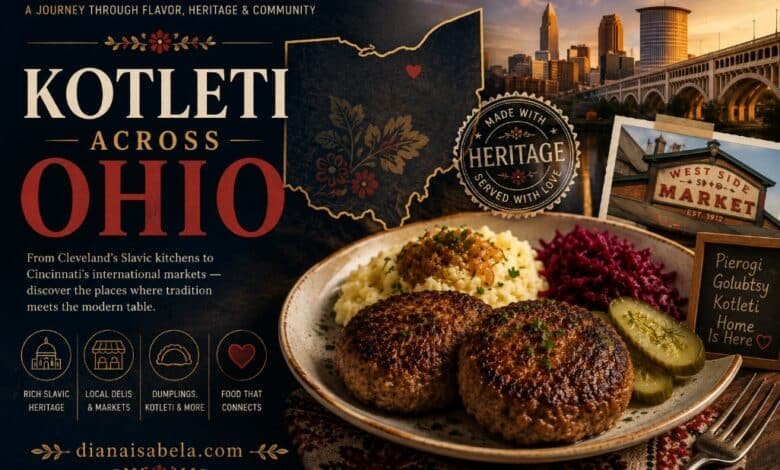
Ohio may be the first state in this series where I would tell you to look for kotleti in two completely opposite directions. One route leads backward into Cleveland’s Slavic kitchens, neighborhood markets and old butcher counters. The other leads forward into a modern Eastern European deli where beef kotleti have appeared beside sweet potato gnocchi and wild-green salsa verde.
That sounds like two different foods. It is not. It is two different ways a food tradition stays alive.
Then Cincinnati enters the story with Marina’s International Deli, where Russian, Ukrainian, Belarusian, Polish, Georgian and other Eastern European grocery traditions share shelves, freezer cases and deli space. Suddenly this is not merely a page about finding one minced patty. It is a page about what happens to familiar food after families move, neighborhoods change, chefs reinterpret things and grocery stores become cultural meeting places.
I like Ohio for exactly this reason. The state does not give us one neat line from “Russian restaurant” to “Russian kotleti.” It gives us layers.
In Cleveland, a kotleta can belong to memory. It can also become a chef’s seasonal plate. In Lyndhurst, the search shifts toward a Russian-European deli. In Cincinnati, it becomes a grocery expedition through foods from several countries that once shared kitchens, borders, empires and extremely strong opinions about dumplings.
My father is a chef, so I am always more interested in what survives beneath the styling. You can put a kotleta beside mashed potatoes or sweet potato gnocchi. You can plate it under restaurant lighting or sell it from a deli case. If the meat has been handled properly, seasoned intelligently and kept tender, the essential pleasure is still there.
The Ohio idea: Cleveland is where old-world food history meets modern interpretation. Cincinnati is where the search becomes a post-Soviet grocery story. Boardman gives us the Polish corridor between Cleveland and Pittsburgh. This is less a directory and more a map of how comfort food travels.
Cleveland, but not the nostalgic version yet
A Cleveland chef already did the thing purists usually complain about — and I kind of love it
Let us begin with the least traditional-looking plate in the entire Ohio story.
Larder Delicatessen & Bakery in Cleveland’s Hingetown neighborhood defines itself as a Jewish Eastern European delicatessen and bakery. Its food is rooted in old-world preservation, deli traditions, fermentation, baking and local ingredients, but it is very clearly not interested in preserving those traditions under glass like museum exhibits.
A recent ordering menu included beef kotleti served with sweet potato gnocchi, ramp and garlic-mustard salsa verde and sour cream.
I know. Somewhere a grandmother has already raised one eyebrow.
But this is exactly why the dish is worth discussing.
Ground meat and sour cream are completely at home in the broader Eastern European universe. Gnocchi is not the expected kotleti starch, but soft dumpling-like carbohydrates beside browned meat are hardly a philosophical betrayal. The salsa verde does something traditional pickles, cabbage and herb salads have always done: it cuts richness with acidity, freshness and herbs.
Different vocabulary. Same plate intelligence.
A good reinterpretation changes the wardrobe without changing the reason the dish was loved in the first place.
The important caveat is timing. Larder changes its menu frequently, and the current menu I checked no longer shows that beef-kotleti plate. That means this is evidence of how kotleti appear in Cleveland’s contemporary food culture, not a promise that you can walk in tonight and order the exact same seasonal dish.
I actually prefer saying that clearly. Seasonal restaurants should be allowed to have seasons.
Hingetown / Ohio City
Larder is the place I would watch, not the place I would pretend has a permanent kotleti contract
JEWISH EASTERN EUROPEAN DELICATESSEN & BAKERY
Larder Delicatessen & Bakery
A Cleveland deli where old preservation traditions and contemporary cooking live together without apologizing to each other.
How I would use Larder: check the current menu before going specifically for kotleti. If they are back, excellent. If not, I would still stay for pickles, rye, latke, pastrami or whatever seasonal dish currently has the kitchen’s attention.
This is also a useful lesson for local-food research. A dish does not need to live permanently on a menu to matter culturally. Sometimes its appearance tells you something more interesting: the kitchen considers it part of its vocabulary.
That matters in Cleveland because Eastern European food here is not some recently discovered aesthetic. It belongs to the city’s immigrant history.
Larder is simply speaking that history in a newer accent.
Now go several generations backward
Slavic Village is where Cleveland stops styling Eastern European food and simply remembers it
If Larder is the modern editorial version of Eastern European Cleveland, Slavic Village is the family archive.
The neighborhood’s Polish and Central/Eastern European food history lives through markets, sausage makers, bakeries and businesses that survived because people needed them for everyday life. This was not food created to satisfy curious diners driving across town. It was food people bought because that was what dinner, holidays and Sunday family tables required.
Krusinski’s Market is a perfect example. Its pierogi tradition dates to 1951, and the current business still makes Janka Pierogis in Slavic Village. The market describes them not simply as products, but as part of Cleveland family memory — the kind of food tied to holidays and Sunday dinners.
That is exactly the social world kotleti belong to as well.
They are batch food. Practical food. Food made when several people need dinner. Food that tastes completely normal until you move somewhere where nobody makes it, and then suddenly it becomes emotionally important.
This is why I would not approach Slavic Village asking only, “Which restaurant sells Russian kotleti?”
I would look at the whole food ecosystem.
Fresh and frozen foods intended to go home with you rather than pose for dinner photographs.
Ground meat, sausages and techniques that make minced-meat cooking part of ordinary household life.
Another example of simple dough-and-filling food becoming a carrier for family history.
Where Polish and Slavic food traditions remain part of local identity rather than merely restaurant branding.
Slavic Village
Krusinski’s is not a kotleti destination — it is the reason the kotleti search makes sense here
I am deliberately including Krusinski’s without pretending it currently lists kotleti.
The market belongs because it explains the neighborhood around the dish.
CLEVELAND TRADITION SINCE 1951
Krusinski’s Market / Janka Pierogis
6300 Heisley Ave, Cleveland, OH 44105
(216) 441-0100
What I would actually buy
Handmade pierogi first. Then I would look around for sausages and whatever prepared foods make sense that day rather than inventing a mythical kotleti tray for the sake of this page.
There is something very Diana about the fact that the humble pierogi has survived seventy-plus years of changing food fashion without requiring a rebrand.
Fashion rotates silhouettes every few seasons. Grandmother food waits patiently for everyone to rediscover butter.
Krusinski’s current ownership has changed, but the market and Janka Pierogi tradition continue. That continuity matters more to this story than forcing another exact cutlet listing into the article.
If I were spending the day exploring Cleveland’s Slavic food heritage, this would absolutely be one of my stops.
Lyndhurst
When you want the Russian grocery version of Cleveland, go east
The Cleveland-area Russian search becomes more literal in Lyndhurst, where Yeleseyevsky Deli operates as a Russian and European grocery-and-deli destination with prepared foods and specialty products.
This is a different world from Slavic Village’s Polish lineage and completely different again from Larder’s chef-driven Hingetown interpretation.
And that is exactly why Ohio works.
RUSSIAN / EUROPEAN DELI ROUTE
Yeleseyevsky Deli
A Russian-European grocery and prepared-food stop in Cleveland’s eastern suburbs.
This is the place where I would ask directly for kotleti, chicken patties, meat cutlets or whatever wording the counter uses that day.
I would also resist the temptation to leave immediately if they are not there. Russian and post-Soviet delis are unusually good at redirecting a dinner plan. Pelmeni, vareniki, cabbage dishes, salads, smoked fish, meats, bread, cakes and freezer foods can all turn “no kotleti today” into a fairly luxurious grocery bag.
Sometimes a successful food search means finding the exact dish.
Sometimes it means knowing when to let the deli improvise.
Cincinnati
Marina’s is where Ohio’s Russian-food story becomes a grocery store with several passports
Cincinnati does not have Cleveland’s dense Slavic neighborhood history. Its strongest Eastern European route is different.
Marina’s International Deli has served the region for decades as a market for customers connected to Eastern Europe, Central Asia and the former Soviet world. Its current business describes itself as a family-style international market with groceries, deli meats, cheeses, baked goods and specialty items.
An Ohio tourism feature about the store described shelves filled with foods tied to Polish, Russian, Ukrainian, Armenian, Belarusian, Georgian, Lithuanian, Romanian and other traditions, along with pelmeni, vareniki, khinkali and manty.
That list explains why I would never reduce Marina’s to “Russian grocery store.”
The fascinating thing is the overlap.
CINCINNATI · INTERNATIONAL EASTERN EUROPEAN MARKET
Marina’s International Deli
The southern Ohio stop where the kotleti search belongs inside a much broader post-Soviet and Eastern European grocery experience.
This is exactly the kind of grocery store where food geography becomes more interesting than national labels.
You may find Russian pelmeni beside Ukrainian products, Georgian dumplings beside Lithuanian ice cream, Armenian preserves beside Polish sweets.
That is not culinary carelessness. It reflects how immigrant shopping actually works in American cities with smaller diaspora populations. One market becomes the shared pantry.
I find that much more interesting than a supermarket aisle divided into little flags.
Boardman / Youngstown area
Between Cleveland and Pittsburgh, Krakus keeps the Polish road trip alive
Ohio’s eastern edge gives us another useful food corridor.
Krakus Polish Deli & Bakery in Boardman describes itself as a Polish immigrant family kitchen serving traditional food, homemade pierogi, kielbasa, baked goods and imported products. The business even positions itself as a Polish-import stop between Cleveland and Pittsburgh.
Its current hot menu centers more on pierogi, stuffed cabbage, kielbasa and Polish platters than on any confirmed minced cutlet.
So again: no fictional kotleti badge.
BOARDMAN
Krakus Polish Deli & Bakery
7050 Market St, Suite 108
Boardman, OH 44512
Why I would stop
Homemade Polish pierogi, stuffed cabbage, kielbasa, haluski, bakery goods and a strong old-world deli identity make this a useful Eastern Ohio food stop even without pretending one exact ground cutlet is currently guaranteed.
The geography is useful too. Boardman sits in a part of the state where Pittsburgh’s Polish and Eastern European influence is never very far away culturally, but it still belongs distinctly to Ohio’s own industrial immigrant history.
A road trip through this part of the Midwest can start feeling like one enormous argument over whose grandmother made the best cabbage roll.
There are worse regional identities.
This state needs more than one plate
I would not serve Cleveland’s modern kotleti and Cincinnati’s deli kotleti the same way
Ohio’s different food environments deserve different dinner logic.
HINGETOWN
Let the chef reinterpret it
If Larder brings kotleti back in another seasonal form, I would order the plate as designed before asking for substitutions. The entire point is seeing what a modern Eastern European kitchen does with the idea.
SLAVIC VILLAGE
Keep the table old-school
Ground-meat comfort food wants potatoes or pierogi, cabbage, beets or pickles, good bread and very little culinary anxiety.
LYNDHURST
Let the Russian deli build dinner
Choose whatever ground-meat dish is freshest, then one salad with acidity, one starch and perhaps something from the bakery.
CINCINNATI
Shop beyond the plate
At Marina’s, I would treat kotleti as one possible piece of a wider grocery trip: dumplings, preserves, bread, smoked fish and freezer foods can all come home.
The consistent rule is contrast.
A tender ground-meat patty beside soft potatoes wants something sharper nearby. Pickles, cabbage, beets, herbs, a vinaigrette or a fresh cucumber salad all do the job.
This is why the recent Larder plate with salsa verde made more sense to me than it might sound on paper. Garlic mustard and ramps perform the same basic balancing role that dill, pickles or sour cabbage have performed forever: they stop browned meat and starch from becoming monotonous.
The cultural styling changed.
The palate logic did not.
If I had one Cleveland food day
I would make it a conversation between old Cleveland and new Cleveland
I would not attempt six markets in one afternoon. That is not a food day. That is inventory management.
I would choose one of two versions.
The old-neighborhood day
Start in Slavic Village. Go to Krusinski’s for pierogi and the neighborhood history around them. Look at the surrounding Polish food businesses rather than treating the market like a single-purpose stop.
Later, head east toward Yeleseyevsky Deli and build a Russian/Eastern European take-home dinner. If kotleti are in the prepared case, excellent. If not, let the counter redirect you.
The modern Cleveland day
Check Larder’s current menu first. If a kotleti-inspired seasonal dish has returned, that is dinner. If it has not, go anyway only if the rest of the current menu excites you.
Pair the meal with an Ohio City / Hingetown afternoon rather than turning the entire day into Eastern European food research. Bookstore, walk, coffee, vintage shopping — then dinner.
The first day teaches you more about how immigrant food becomes neighborhood memory.
The second shows what happens when a younger kitchen inherits that memory and decides not to frame it exactly the same way.
I want both.
And because this is Diana
Cleveland gives me an excuse for two completely different food outfits
For Slavic Village, I would wear good denim, knitwear, boots and a proper coat — something attractive enough for the day but capable of surviving a market bag full of frozen pierogi.
For Larder, I would lean more editorial: tailored trousers, fitted knit, vintage leather or a structured coat, interesting earrings, perhaps the bag that is slightly too pretty for grocery shopping because this time we are actually sitting down.
Cincinnati Marina’s is firmly practical-shoe territory.
Any international food market containing glass jars, freezer cases and the possibility of impulse-buying three kilograms of dumplings deserves both hands.
I believe in glamour.
I also believe in not dropping the pickles.
If Cleveland and Cincinnati are both inconvenient
Ohio is the state where I would search by food culture before searching by dish name
Outside the strongest Eastern European pockets, exact kotleti results thin out quickly.
Do not immediately compensate by deciding a two-hour drive is normal.
Search Russian and Eastern European groceries. Prepared-food counters may never optimize a webpage for “kotleti near me,” which is honestly one of the healthier things about them.
Search Polish markets too. Mielony and other minced cutlets may be much closer to the texture you want than a generic American chicken cutlet.
Look for Jewish Eastern European delis. Cleveland’s food history overlaps across immigrant traditions in ways that make rigid labels less useful.
Ask about ground-meat patties. Describe the construction when the exact transliteration produces nothing.
Know when the frying pan wins. At some point the Ohio Turnpike stops being part of dinner and becomes a personality test.
For the broader search, continue with my Russian kotleti near me guide.
If your Ohio results keep leading to grocery stores instead of restaurants, the Russian deli guide is the more useful next step.
And when the nearest credible prepared-food counter is still too far away, the Russian kotleti recipe is where geographic research becomes dinner.
What makes Ohio different
This is not a kotleti trail. It is a before-and-after photograph of immigrant food
Cleveland lets us see the same broad food tradition at several ages.
Slavic Village shows the neighborhood version: pierogi kitchens, butcher counters, old Polish businesses and foods whose purpose was always to feed families rather than attract destination diners.
Yeleseyevsky gives us the Russian-European grocery route — the kind of place where imported foods and prepared dishes keep tastes of home accessible without needing restaurant ceremony.
Larder gives us another generation entirely. The kitchen takes Eastern European and Jewish deli vocabulary seriously enough to play with it. Beef kotleti can meet sweet potato gnocchi and foraged greens without the dish losing its recognizable emotional center.
Cincinnati adds one more transformation: the shared immigrant market, where several national food traditions occupy one commercial space because diaspora life is rarely organized as neatly as a cookbook chapter.
That makes Ohio one of my favorite states in this series so far.
Not because it has the longest list of verified kotleti.
Because it shows what happens to a simple food after eighty years, several neighborhoods, one migration story, a chef with ideas and a freezer full of dumplings.
Some dishes survive by refusing to change.
Others survive because they know exactly which parts are allowed to.
Information reviewed: August 2026. Prepared-food and restaurant menus change, particularly at Larder, where the menu is seasonal and frequently updated. Call before traveling for one exact dish.
Ohio questions
Russian Kotleti in Ohio FAQ
Where can I find Russian-style kotleti in Ohio?
Cleveland is the strongest place to begin. Larder Delicatessen & Bakery has featured beef kotleti on a recent seasonal menu, while Yeleseyevsky Deli in Lyndhurst is a Russian-European grocery and prepared-food route where daily kotleti availability is worth checking directly.
Does Larder in Cleveland serve kotleti?
Larder has featured beef kotleti on a recent menu, including a seasonal plate with sweet potato gnocchi, ramp and garlic-mustard salsa verde and sour cream. Its menu changes frequently, so that exact dish should not be assumed to be available every day.
Where can I find a Russian deli near Cleveland?
Yeleseyevsky Deli operates at 5378 Mayfield Road in Lyndhurst. It is a Russian and European grocery and deli with prepared foods, pastries and specialty products. Call or check the counter if kotleti are the specific reason for your visit.
Why is Cleveland’s Slavic Village useful for this search?
Slavic Village has a long Polish and Eastern European food history built around markets, sausage makers, bakeries and prepared foods. Krusinski’s Market, for example, has a pierogi tradition dating to 1951 and remains a useful stop for understanding Cleveland’s old neighborhood food culture.
Where can I buy Eastern European food in Cincinnati?
Marina’s International Deli at 11426 Montgomery Road is a long-running international grocery and deli serving the Cincinnati region with foods connected to Russian, Ukrainian, Polish, Belarusian, Georgian and other Eastern European and former Soviet traditions.
Does Marina’s International Deli always have kotleti?
A permanent daily kotleti listing is not confirmed, so ask the deli or prepared-food counter before making a special trip for the dish. The store is still useful for dumplings, deli products, smoked fish, preserves, cheeses, sweets and frozen Eastern European foods.
Where can I find Polish food near Youngstown, Ohio?
Krakus Polish Deli & Bakery in Boardman serves traditional Polish foods including homemade pierogi, stuffed cabbage, kielbasa, haluski and bakery items. Its current hot menu does not need to be treated as an exact kotleti destination to make it a useful Eastern Ohio food stop.
What should I eat with Russian kotleti in Ohio?
Mashed potatoes, pierogi or another soft starch pair well with kotleti, but add something acidic or fresh such as pickles, cabbage, beets or cucumber salad. Modern versions may use herbs and acidic sauces to create the same kind of contrast.
Should I call an Ohio deli before going specifically for kotleti?
Yes. Prepared-food selections can rotate, and seasonal restaurants may change menus frequently. Call when one specific cutlet is the entire reason for a long drive.
What should I search if there are no Russian kotleti near me in Ohio?
Try Russian deli, Eastern European grocery, Polish market, ground-meat cutlet, kotlet mielony and prepared Eastern European food. In Ohio, searching by food culture and store type can be more productive than relying on one exact transliteration.