Shchi Soup in Florida: Where to Look in Miami, Sunny Isles & Beyond
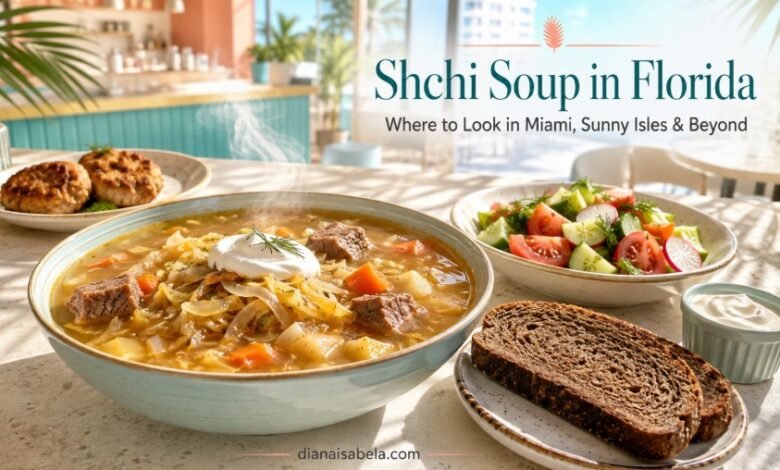
Florida may be the only place in this shchi search where you can leave Atlantic sunshine, walk into a Russian deli and seriously consider steaming cabbage soup while the temperature outside is making a persuasive case for iced coffee. South Florida somehow makes this feel completely normal.
If I were specifically looking for shchi in Florida, I would begin around Sunny Isles Beach and then work north through Hollywood and Boca Raton. Not because every Russian or Eastern European market there promises shchi every day — they do not — but because this part of Florida has the density of prepared-food kitchens, soup counters, Russian and Ukrainian cooking, delis and specialty markets that gives a rotating home-style soup a realistic place to exist.
That distinction is the entire point of this guide. I do not currently have enough evidence to tell you that Kalinka, Matryoshka or European Delights will definitely hand you shchi when you walk through the door. I do have enough evidence to treat them as useful active kitchens and markets to call. In Florida, where soup demand competes with heat, cold soups and seasonal appetites, that call-first approach is much more useful than pretending every Eastern European deli maintains an eternal pot of cabbage soup for the internet.
Start in South Florida, Where the Right Kind of Kitchen Is Already There
If I wanted shchi in Florida today, I would not begin with a statewide search for restaurants containing the word “Russian.” I would begin with southeast Florida and look specifically for businesses that actually cook: Russian and Ukrainian delis, European markets with prepared-food counters, grocery stores with homemade lunches and kitchens where borscht, solyanka, chicken soup, dumplings, cutlets, buckwheat and stuffed cabbage already share the same food ecosystem.
The logic is simple. Shchi needs a pot, not a restaurant category. A serious deli kitchen that cooks multiple soups has a plausible reason to rotate cabbage shchi even if it never earns a permanent menu page. A restaurant with no soup program but a Russian flag in its business description is a much weaker lead.
South Florida gives us several active prepared-food businesses close enough to make that search practical. The useful plan is therefore geographic: start where the kitchens are concentrated, call before driving if shchi is the whole reason for the trip, and treat today’s soup selection as something to verify rather than something a cuisine label can guarantee.
Sunny Isles Beach
The strongest first stop. Several Russian, Ukrainian and broader European prepared-food businesses sit along a relatively compact stretch of Collins Avenue.
Hollywood
Useful for larger European and Eastern European grocery culture, especially when your search is broader than one restaurant and you are willing to investigate active hot-food counters.
Boca Raton
A practical northern alternative for Palm Beach County. Driving south for soup makes much less sense if a strong local European market can answer the question first.
This geography matters more than it appears on a map. “South Florida” sounds like one convenient dining district until traffic joins the conversation. If you are already around Miami-Dade, Sunny Isles makes a logical first move. If you live around Boca or Delray Beach, a Palm Beach County lead deserves the first phone call simply because lunch should not require an interstate pilgrimage unless the bowl has genuinely earned it.
For the broader national picture, use my United States shchi guide. Florida has its own search logic, but it belongs inside a much larger American map of Russian, Ukrainian, Eastern European and Central Asian food communities.
And if you want the central guide that ties countries, menu language, soup styles and the full search method together, start with Shchi Soup Near Me. This Florida page is intentionally local: fewer theoretical restaurants, more attention to which corridors and kitchens are actually worth checking.
Sunny Isles Beach Is the First Place I Would Look
Sunny Isles is a wonderfully improbable setting for this search. The visual language is palms, high-rise balconies, bright Atlantic light and people who look as though they should be holding cold drinks. Inside several food businesses along Collins Avenue, the language changes to borscht, pelmeni, cutlets, buckwheat, sour cream, smoked fish and prepared salads.
I like the contrast because it demonstrates something useful about immigrant food: cuisine travels more easily than climate.
You do not need snow outside for a neighborhood to support serious Eastern European cooking. You need customers who want the food, cooks who know how to make it and businesses where prepared dishes are part of everyday shopping rather than a once-a-year cultural event.
Sunny Isles has that infrastructure.
This does not mean shchi is automatically waiting in every soup kettle. It means you have several worthwhile places to ask within a small area. That difference matters. One isolated restaurant with no current shchi creates a dead end. Three nearby businesses with real cooked-food programs create a search route.
You can call before leaving home, choose the most promising soup counter, and still have another nearby option if the first kitchen made borscht or solyanka instead. Even when shchi loses the daily-menu lottery, you are surrounded by enough dumplings, cutlets, prepared salads and baked goods to keep the outing from becoming a tragedy.
That density is why I rank Sunny Isles above a theoretically larger Florida city with only scattered Russian-food businesses. Local-food hunting is not a population contest. Proximity between relevant kitchens changes how useful a neighborhood actually is.
There is also a practical linguistic advantage. In a neighborhood accustomed to Russian and Eastern European food, asking for shchi, щи or Russian cabbage soup is less likely to produce confusion than it would in a generic supermarket deli. If the person behind the counter knows exactly what you mean but says, “Not today,” that is still useful information.
The next question is the valuable one: “When do you make it?”
Kalinka Euro Deli Is the Strongest First Phone Call
Kalinka Euro Deli — Sunny Isles Beach
Kalinka is the first Sunny Isles business I would call because we do not have to guess whether it cooks. Its current food selection includes borscht, chicken meatball soup, solyanka and Georgian kharcho, along with cutlets, buckwheat, mashed potatoes, pelmeni, vareniki, salads, fish and other prepared dishes.
That is exactly the kitchen profile I want when looking for a soup that may rotate.
Notice what I am not doing: I am not taking the presence of four other soups and magically converting that into “Kalinka serves shchi.” The evidence supports an active Russian/Ukrainian prepared-food kitchen and a genuine soup program. It supports a phone call. Until shchi itself is confirmed, that is the honest label.
This distinction between a confirmed dish and a good lead is important because shchi is exactly the kind of food that can disappear and reappear without the business changing anything else about its identity. A deli may make borscht consistently because everyone recognizes it, while rotating cabbage soup through a broader homemade-soup schedule.
Kalinka also gives you an excellent fallback strategy. If the answer is “no shchi today,” ask which soups are ready. Solyanka takes sourness in a stronger pickle-driven direction. Kharcho moves toward Georgian beef soup with an entirely different aromatic profile. Borscht gives you beet-led sweetness and acidity. Chicken soup is there for the day when your appetite wants diplomacy rather than adventure.
The point is not to call every other soup a substitute for shchi. They are not. The point is that a failed search can still become a very good lunch.
Then look at the rest of the counter. If you find cutlets, buckwheat, mashed potatoes, vinaigrette and bread, you can also turn one container of soup into dinner without opening another app or supermarket tab.
This is why a real deli kitchen is more useful to me than a restaurant result that appears relevant only because somebody checked “Russian cuisine” in a business directory.
Matryoshka Makes Sunny Isles a Route Instead of a One-Stop Gamble
Matryoshka Deli Food — Sunny Isles Beach
Matryoshka strengthens Sunny Isles for a different reason: it gives you another genuine prepared-food operation almost immediately after the first.
The business describes its kitchen around ready-made meals, salads, appetizers and home-style foods associated with the former Soviet region. That is useful evidence of cooking. It is not evidence of today’s shchi, so again I would keep the claim precise: good kitchen to investigate, soup not guaranteed.
This is where the neighborhood approach becomes much more useful than collecting restaurant names from across an entire state. If Kalinka does not have the soup, you are not starting your Florida search again from zero. Matryoshka gives you another relevant food counter in essentially the same culinary corridor.
That matters because rotating food creates uncertainty, and density reduces the cost of uncertainty.
If Matryoshka has shchi, excellent. Ask whether it is made with fresh cabbage or sauerkraut, whether meat is included and whether the soup appears regularly.
If it does not, ask what soup is available rather than ending the conversation. A serious prepared-food operation may have another home-style bowl worth trying, and the answer can also teach you something about rotation. “We make cabbage soup in winter” is useful. “We sometimes make it on weekends” is useful. “No, we never make it” is useful too because it prevents you from repeating the same pointless drive later.
I would not turn the counter interaction into a seminar. One or two direct questions are enough. The person serving lunch does not need to hear your thoughts on culinary nomenclature while six people behind you wait for potato salad.
Precision can coexist with manners.
European Delights Adds the Most Interesting Florida Variable: a Rotating Lunch Menu
European Delights Market & Deli — Sunny Isles Beach
European Delights gives the Florida search a particularly useful clue because its current Sunny Isles operation includes Café Dacha and a rotating monthly lunch menu with traditional European dishes, homemade soups and daily specials.
For a shchi hunter, the word rotating is almost as interesting as the word soup.
Again, it does not prove that shchi is on this month’s menu. It proves that the business currently operates the exact kind of changing lunch program where a traditional soup can appear without requiring permanent menu status.
I would call and ask one very specific question: “Does your rotating lunch menu ever include shchi or Russian cabbage soup?”
If the answer is yes, ask when.
That is much more useful than repeatedly checking a static grocery page and hoping a temporary soup will eventually reveal itself.
European Delights is also where the Florida climate becomes part of the story. A South Florida European market does not serve customers in the same physical environment as a Moscow kitchen in January. Hot soup still works — especially indoors, especially for regular customers who grew up with it, especially when air-conditioning has converted the dining room into a small climate experiment — but the kitchen can reasonably rotate toward lighter lunches and seasonal choices too.
This is not a reason to claim shchi disappears in summer unless the business says so. It is a reason to ask whether availability changes through the year.
The question is especially useful for green shchi because sorrel-led soups can carry a fresher, brighter profile than deep sauerkraut-and-beef versions. If sorrel soup appears under another name, you also need enough culinary context not to automatically rename every green soup you see.
My guide to green shchi is the right place to understand the sorrel side of the family before interpreting a menu label too confidently.
Florida Changes the Mood of the Soup Search, Even When the Recipe Stays the Same
One of the most interesting things about looking for shchi in Florida is that climate changes the emotional context of the dish without changing its identity.
Sour cabbage remains sour cabbage. Beef broth does not become less Russian because a palm tree is visible from the parking lot. But appetite is not purely intellectual. A heavy hot soup can feel wonderfully comforting on a cool evening and slightly ambitious after twenty minutes outside in humid heat.
When Florida cools down
This is when sour-cabbage shchi, borscht, solyanka, kharcho and other substantial soups become especially convincing as the center of lunch. If a kitchen rotates traditional hot soups, cooler periods are a sensible time to ask what has returned.
When Florida feels aggressively Florida
Cold and lighter preparations may become more tempting, but do not assume the hot-soup pot disappears. Russian-speaking communities do not suspend their food culture because the weather app has become rude.
What I would not do is invent a universal Florida soup calendar. One deli may make shchi year-round because customers buy it year-round. Another may bring it in more often when the weather cools. A third may almost never make it. Those are business-specific facts, so the correct tool is the phone, not climatological fan fiction.
Still, seasonality belongs in the conversation because it gives you a better question. Instead of “Why don’t you have shchi?” ask “Do you make it at another time of year?” That small change can turn a dead-end conversation into an actual schedule.
I also like what Florida does aesthetically to the meal. Dark rye bread under tropical daylight looks almost rebellious. A steaming bowl next to someone wearing sandals feels culturally specific in a way a generic restaurant photograph never could.
Food travels. Weather does not get veto power.
Hollywood Is Better Treated as a Prepared-Food Hunt Than a Promise of One Famous Bowl
Hollywood matters because Broward County has a substantial Eastern European and Russian-speaking food presence, including markets and delis where prepared food is part of the shopping experience. But this is precisely where I want the guide to become more disciplined rather than less.
I do not currently have a Hollywood business I am comfortable labeling as a confirmed shchi stop.
That does not make Hollywood irrelevant. It changes what you do there.
Look for genuine hot-food counters. Check whether recent food displays show homemade soups. Ask whether soups rotate. Look for cabbage rolls, cutlets, buckwheat, dumplings and other signs that the business is not merely a specialty grocery with packaged imports.
The most useful dedicated method for this kind of search is my guide to finding shchi at Russian and Ukrainian delis. Florida is exactly the sort of state where that strategy matters because the best answer may come from a prepared-food counter rather than a formal soup menu.
I would especially use recent customer photographs as clues, not proof. If you can see multiple homemade soups and changing prepared dishes across recent dates, the business becomes worth calling. If every image is five years old and the official business presence says nothing about prepared food, confidence should drop accordingly.
The goal is not to collect more names. The goal is to increase the chance that your next drive ends with food.
The Best South Florida Question Is Still “What Did You Cook Today?”
Prepared-food kitchens have personalities.
One keeps borscht around because customers expect it. Another rotates soup constantly. One cook loves solyanka. Another makes cabbage soup when the ingredient supply and customer demand line up. Someone else considers August a perfectly reasonable month for hot broth because the air-conditioning inside is set to a climate normally associated with penguins.
This is why I would not search South Florida with a rigid restaurant checklist.
Ask about today.
Then ask about the week.
Then, if shchi matters enough to you, ask whether it has a season.
If the answer is, “We usually make it on Fridays,” you have found something much more useful than another generic recommendation.
You have found Friday.
Boca Raton Gives Palm Beach County a Real Local Starting Point
If you live around Boca Raton, Delray Beach or another part of Palm Beach County, there is no culinary medal for driving all the way to Sunny Isles before checking a relevant business closer to home.
European Delights Market — Boca Raton
The Boca location gives this guide a reason not to behave as though all Russian and Eastern European food in South Florida belongs to Miami-Dade.
The official store information confirms a European and Russian deli selection, fresh bakery and catering/prepared-food services. What it does not currently give me is a permanent shchi listing. That puts Boca in the same honest category as several other Florida leads: active relevant business, direct soup confirmation still needed.
Call locally first.
A distant business is not automatically a better recommendation because its neighborhood has a stronger Russian-food reputation. The nearest active kitchen capable of giving you a direct answer is often the smartest starting point.
I would also ask whether the prepared-food selection differs from Sunny Isles. Two locations under one name do not have to offer identical food every day. Different customer patterns, production schedules and local demand can shape what is available at each counter.
That variability is not a problem. It is exactly why a state guide needs individual place notes instead of treating a business name as one giant interchangeable kitchen.
Six Florida Questions That Are More Useful Than Refreshing a Menu Page
Florida shchi hunting gets dramatically easier when you ask questions designed for rotating food rather than permanent restaurant dishes.
If the person tells you a day, save it in your phone. “They make shchi sometimes” is vague knowledge that will be useless in three weeks. “Call Friday morning” is a plan.
And if you are still uncertain about how to phrase the order once the soup appears, remember that you do not need perfect pronunciation. The original spelling щи, the word shchi and the description “Russian cabbage soup” give you several routes to the same conversation.
Florida Is a Good Place to Learn That “Sour Soup” Is Not One Category
A serious Eastern European deli counter can contain several soups that share acidity, meat, herbs or sour cream while still being completely different dishes. If you walk in knowing only that you want “the sour Russian soup,” the counter may reasonably offer several answers.
Shchi
In its familiar forms, cabbage is central. Fresh cabbage gives one character; fermented cabbage can make the bowl deeper and more tangy. Green shchi moves toward sorrel and other greens.
Borscht
The familiar red version is driven by beetroot, bringing earthy sweetness, acidity and its unmistakable color. Cabbage may appear, but the soup’s flavor identity is different.
Solyanka
Usually a much more assertive salty-sour experience, often associated with pickled elements and a richer mix of savory ingredients. It is not sour-cabbage shchi wearing a more dramatic outfit.
Cold soups create another Florida-specific detour. Okroshka can make immediate sense in hot weather but belongs to an entirely different style of eating. A chilled beet soup may satisfy the climate while doing nothing for a fermented-cabbage craving.
This is why I like identifying the soup before ranking it.
If a deli has excellent borscht but no shchi, say it has excellent borscht. Do not quietly rename the dish to make the search look more successful. A guide becomes more useful when “not the same thing” is allowed to be a perfectly respectable answer.
For the comparison most likely to matter at the counter, use my Shchi vs Borscht guide. The purpose is not to declare a winner. It is to make sure the spoon reaches the soup you actually intended to order.
Would I Order Hot Shchi on a 90-Degree Florida Day?
Yes.
Not automatically.
If I have just walked from a hot parking lot into a deli, I may want cold water and five minutes before anybody introduces me to beef broth. If the room is heavily air-conditioned, however, suddenly hot soup becomes completely reasonable again. Human appetite is not a climate chart.
I would also happily choose a lighter fresh-cabbage version or green sorrel shchi on a warm day if that is what the kitchen has. Bright acidity and herbs can make a soup feel less heavy even when it is served hot.
On one of Florida’s genuinely cool evenings, though, the calculation changes. Sour cabbage, rich broth, dark bread and sour cream stop sounding eccentric under palm trees and start sounding like an excellent plan.
The important thing is not to suffer for the phrase you originally searched. If the kitchen has no shchi and an excellent cold soup looks perfect for the weather, you are allowed to change lunch.
The internet will recover.
If You Find Shchi, the Rest of Dinner Is Probably Already Behind the Glass
One of the best reasons to find shchi through a deli rather than a formal restaurant is that the rest of the meal can be standing beside it ready to go.
The dedicated guide to what to eat with shchi goes deeper into the pairing logic. For Florida, the useful lesson is simpler: a strong prepared-food market can turn the soup search into a complete meal without forcing you to assemble dinner across three different stores.
And because Florida means a warm car for much of the year, buy the prepared food when you are actually heading home rather than before a leisurely afternoon of errands. Soup may be culturally resilient. It is not a decorative object for the back seat.
Shchi May Make More Sense as Florida Takeout Than as a Restaurant Mission
Shchi travels unusually well compared with foods whose entire charm depends on crispness. There is no fried crust to steam itself into disappointment. The cabbage is already cooked. The broth is supposed to be liquid. Meat, vegetables and potatoes are comfortable inside the container they arrived in.
That makes deli takeout a particularly sensible Florida format.
You can pick up soup, bring it home, reheat it properly and add sour cream or fresh herbs at the end. Bread stays separate. Salad stays separate. Suddenly the entire restaurant-versus-grocery distinction becomes much less important than whether the kitchen cooked well.
Sour-cabbage shchi is especially suited to this style of eating because its appeal does not depend on delicate last-minute textures. A deeply integrated soup can remain satisfying after the ride home and reheating.
Green shchi deserves a little more gentleness. If the attraction is fresh sorrel character and herbs, there is no advantage in repeatedly boiling it into submission.
The broader practical rule is easy: treat prepared soup as perishable cooked food, get it refrigerated rather than leaving it in a hot Florida car, and reheat the portion you intend to eat.
The parking lot may feel tropical. The soup does not receive an exemption from basic food handling because it has cabbage in it.
The Best Sunny Isles Strategy Is Not a Three-Deli Eating Contest
If I were spending one afternoon specifically looking for shchi, I would call first.
That one sentence eliminates most of the unnecessary drama.
If Kalinka confirms it, I would start there. If another Sunny Isles business confirms a rotating soup that day, I would choose based on what sounds most appealing and save the second counter for another visit. The point is to learn the neighborhood, not eat three lunches because the restaurants are geographically convenient.
If nobody confirms shchi, I would still choose one prepared-food kitchen and eat whatever looks genuinely good. Borscht, solyanka, kharcho, dumplings, cutlets or salads can turn the outing into discovery rather than failure.
Then I would buy one or two things to bring home.
One or two.
I know exactly what happens in a well-stocked Eastern European deli when you arrived planning to buy soup. Suddenly there is smoked fish. Then dumplings. Then a cake that apparently needs emotional support in your refrigerator. Restraint is theoretical until the Napoleon appears.
After that, leave the deli.
There is still an ocean outside.
Even cabbage research needs boundaries.
If Today’s Answer Is Borscht, Let Borscht Be Borscht
This is one of my favorite rules for local food guides because it protects both the reader and the food.
If the kitchen says no shchi but has borscht, do not mentally promote the borscht into cabbage soup because both can contain cabbage.
If it has solyanka, do not describe it as another kind of shchi because both may be sour.
If it has okroshka, do not pretend the cold soup fulfills the same craving simply because Florida made it appealing.
Eat each dish for what it is.
Then ask when shchi comes back.
The result is a better guide and, conveniently, a much more interesting food life. You can discover something new without pretending you found something else.
What About Orlando, Tampa Bay, Naples and the Rest of Florida?
This is where I would rather leave space than manufacture certainty.
Florida obviously does not stop north of Boca Raton. Russian, Ukrainian and Eastern European food exists elsewhere in the state, including major metro areas such as Orlando and Tampa Bay. But a large city plus one Russian restaurant is not enough reason for me to claim there is a meaningful shchi trail.
A useful local lead needs more than cultural adjacency.
I want evidence of a current kitchen, prepared food or soup program. I want a reason to believe shchi is either available or realistic enough to justify a call. If all I can establish is that a restaurant serves pelmeni and stroganoff, that may be a lovely restaurant and still not belong in a shchi recommendation.
This is also why I do not want to create separate Orlando, Tampa or Naples pages merely because those names look useful in a list. A city deserves a page when the page can genuinely help someone decide where to go, not when it gives us another location word to put after “shchi soup.”
If better evidence develops, Florida should expand. Until then, southeast Florida remains the strongest practical corridor in this guide.
What a Good Florida Shchi Lead Should Tell You Before You Start Driving
There is a difference between knowing that a business exists and knowing enough to make a food decision.
Ideally, a useful shchi lead tells you the business name, location and phone number; whether shchi is actually confirmed or merely worth asking about; whether the soup is fresh-cabbage, sour-cabbage or green; whether meat is involved; whether availability is permanent or rotating; and whether the business sells it as a restaurant portion or take-home container.
Price is useful when it can be confirmed. Soup day is useful. Pack size can be useful. Even the phrase “usually sells out by lunch” can be enormously useful when it comes from current direct information.
What is not useful is confidence without detail.
A list of ten Russian restaurants with no evidence of shchi looks impressive until you actually try to eat the dish.
A list of three active kitchens with transparent labels — current, rotating, call first — is much more likely to get you lunch.
That is the standard I want this Florida page to follow as it grows.
Why the Florida Version of This Search Is Actually Interesting
I could write a much simpler article: Sunny Isles has Russian food, call a deli, good luck.
But Florida makes the question more interesting because it shows how traditional food adapts without needing to lose its identity.
The same kitchen can sell borscht, dumplings and dark bread under bright South Florida light. Customers can buy fermented cabbage and smoked fish before going back to an apartment overlooking palms. Cold soups can coexist with foods associated in our imagination with snow. A hot-food counter can serve dishes built for long winters to people dressed for August.
None of this makes the food less authentic.
Authenticity is not weather cosplay.
A dish does not require the climate of its place of origin to remain meaningful. It requires knowledge, ingredients, technique and people who still want to eat it.
That is also why I find the deli more interesting than the tourist restaurant in this particular search. The deli tells you what people actually keep buying. It has to survive repeat customers. It has to cook food that works on a weekday, in a container, for lunch, for dinner, for someone buying enough for tomorrow.
Shchi belongs beautifully in that world.
Know a Florida Kitchen With a Real Shchi Day?
This is the Florida information I genuinely want: not another broad recommendation for “a Russian restaurant,” but the place where somebody actually knows when the cabbage soup is made.
If there is a deli, grocery, restaurant, catering kitchen or prepared-food counter in Sunny Isles, Hollywood, Boca Raton, Fort Lauderdale, Miami, Tampa, Orlando, Naples or somewhere I have not looked closely enough yet, send me the details.
Tell me the business name and city. Tell me whether the menu actually says shchi, щи, Russian cabbage soup or something else. Tell me whether it is fresh cabbage, sauerkraut or sorrel. If the soup appears only on Fridays, that may be more useful than a permanent menu description. If it sells out before lunch, I want to know that too.
I am interested in current prices, portion sizes, photos, how the soup is served and what people usually buy beside it. I also love the family details that menus never capture: the person who insists sour shchi tastes better after resting, the grandmother who would never put potato in her version, the deli where everyone knows to ask for the soup in Russian because the English label changes.
Florida adds another layer I find fascinating: how does a traditional hot-soup culture behave in a subtropical state? Does one kitchen make sauerkraut shchi throughout summer? Does another bring it back when evenings cool down? Does sorrel soup have a loyal audience regardless of weather? Those details are much more interesting than pretending every kitchen follows one universal seasonal rule.
Send the tiny places too. The grocery counter with no elegant website may turn out to be far more useful than the restaurant everybody already knows.
That is how this guide gets better: one real bowl, one soup day and one local tip at a time.
info@dianaisabela.comQuestions About Finding Shchi in Florida
Where should I look for shchi soup in Florida?
Start in South Florida, especially Sunny Isles Beach, then consider Hollywood and Boca Raton. These areas have active Russian, Ukrainian and broader European prepared-food businesses where traditional soups are part of the food culture. Because I have not confirmed a permanent current shchi listing at the main Florida leads, call before making a special trip.
Can I find shchi in Sunny Isles Beach?
Sunny Isles Beach is the strongest Florida area to investigate because Kalinka Euro Deli, Matryoshka Deli Food and European Delights all have relevant prepared-food operations. Their current business information supports homemade or ready-made food and soup activity, but shchi itself should be confirmed directly before you drive specifically for it.
Does Kalinka Euro Deli currently list shchi?
I did not find shchi as a permanent current listing. Kalinka does currently show an active Russian and Ukrainian prepared-food selection that includes borscht, chicken meatball soup, solyanka, kharcho, cutlets, buckwheat and other cooked dishes. That makes it a strong place to call and ask whether shchi rotates through the kitchen.
Does European Delights make homemade soup?
European Delights currently describes Café Dacha at its Sunny Isles Beach location as offering a rotating monthly lunch menu with traditional European dishes, homemade soups and daily specials. That makes it a useful place to ask whether shchi appears in the rotation, although I would confirm the specific soup before traveling for it.
Where can I look for Russian or Eastern European soup near Boca Raton?
European Delights has a current Boca Raton location at 9070 Kimberly Blvd #21 with European and Russian specialties, deli products, bakery and prepared-food services. Shchi is not currently confirmed as a permanent listing, so call the store and ask about its soup or prepared-food selection.
Is shchi seasonal in Florida?
It may be seasonal or rotating at an individual kitchen, but I would not assume one Florida-wide schedule. Ask the deli whether shchi is made year-round, on certain days or more often during particular parts of the year. Direct kitchen information is more reliable than guessing from the weather.
Is borscht the same as shchi?
No. Familiar shchi is centered on fresh or fermented cabbage, while the red borscht many diners know gets much of its identity from beetroot. They can share cabbage, potatoes, meat, herbs and sour cream, but the dominant flavor and structure are different.
What should I ask a Florida deli when looking for shchi?
Ask what soups are available today, whether the kitchen makes shchi or Russian cabbage soup, whether it uses fresh cabbage or sauerkraut, whether green sorrel shchi is ever made, when shchi usually appears and whether a portion can be held for pickup.
What should I eat with shchi?
Dark rye bread and sour cream are the simplest companions. For a larger deli meal, consider kotleti with buckwheat or mashed potatoes and add a fresh or pickled vegetable side for contrast. Dumplings can work too, especially when several people are sharing.
Is shchi good for takeout in Florida?
Yes. Shchi travels relatively well because its appeal comes from broth, cooked cabbage, vegetables and sometimes meat rather than a crisp exterior. Keep bread and sour cream separate, avoid leaving prepared soup in a hot car and refrigerate it promptly if you are not eating it right away.