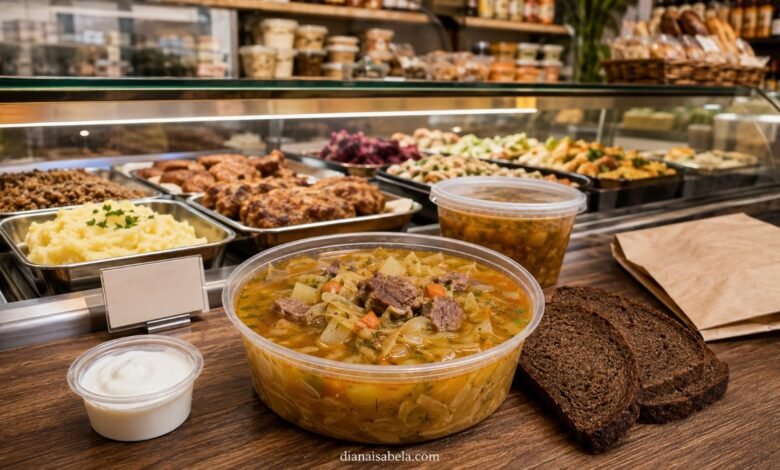
The most frustrating shchi in America may be the bowl that absolutely exists, is cooked by somebody’s aunt every Thursday, sells out by three, and has never once appeared on the internet.
That is why Russian and Ukrainian delis deserve their own method. A restaurant usually wants you to know what it serves. A neighborhood food market may assume its regular customers already know. The soup can live on a handwritten board, behind the hot counter, inside clear takeout containers, or in the extremely sophisticated information system known as “ask Marina what came out of the kitchen today.”
Finding it is less about clever searching and more about recognizing which places actually cook.
The First Mistake Is Looking Only for Restaurants
If you search for shchi as though it were ramen, you can miss half the interesting places.
Shchi is home-food territory. It fits naturally into a prepared-food kitchen because it can be cooked in a large pot, portioned easily, carried home without tragedy and reheated without turning into a completely different food.
That makes a Russian grocery with a serious kitchen potentially more useful than a beautifully photographed restaurant that has never served shchi in its life.
The useful distinction is not really restaurant versus grocery.
It is kitchen versus shelves.
A store can have magnificent imported chocolate, smoked fish, sunflower seeds, frozen pelmeni and fourteen varieties of buckwheat while doing absolutely nothing for your soup problem.
Another store may look less glamorous online but cook borscht, solyanka, chicken soup, kotleti, stuffed cabbage, blini, salads and rotating hot meals every morning.
That second place has my attention.
If you are starting with a broader location search, use the Shchi Soup Near Me in the United States page first, then narrow the hunt to local kitchens.
How I Would Find the Kitchen Before Looking for the Soup
You do not need detective training. You need a few useful signals.
Look for prepared food, not just groceries
Words such as prepared foods, homemade meals, hot bar, daily specials, catering or fresh soups matter much more than a large imported-grocery inventory.
Check whether the place sells complete meals
Kotleti, mashed potatoes, buckwheat, stuffed cabbage, cooked chicken, salads and soups tell you there is an active kitchen behind the counter. Once you see that pattern, shchi becomes a reasonable question rather than a random wish.
Look at recent food photos, not ancient evidence
A current photograph of soup containers in the prepared-food case is useful even when the labels are difficult to read. A lonely bowl photographed in 2017 is history until somebody confirms otherwise.
Notice whether the soup selection changes
A rotating list is not bad news. It is often exactly how deli soup works. Borscht Monday, mushroom soup Tuesday, chicken Wednesday, shchi another day — the useful question becomes when, not simply whether.
Then call
Not after putting on a coat, crossing a bridge and becoming emotionally invested. Before.
Why Shchi Can Be Invisible Online and Still Be Completely Real
A deli kitchen does not always behave like a restaurant kitchen.
Restaurants generally build menus around dishes they expect to serve repeatedly. Prepared-food counters can cook according to day, season, ingredient availability, demand and whoever is running the kitchen.
One large pot may become twenty or thirty containers.
Regular customers see it.
They buy it.
It disappears.
Nobody creates a polished page for it because tomorrow there may be rassolnik instead.
This is especially normal for foods that already belong to household cooking. Soup does not need ceremonial permanence to be important.
In fact, the least glamorous sentence imaginable — “we usually make it Fridays” — can be much more valuable than an old menu photograph floating around online.
Seven Signs a Deli Is Worth Calling About Shchi
Borscht, solyanka, chicken soup, kharcho, mushroom soup or rassolnik show that soup is part of the kitchen’s normal rhythm.
If cooked mains and sides are being portioned for takeaway, you are dealing with much more than an imported-food shop.
This is excellent territory for dishes that never become permanent menu items.
That setup is naturally compatible with soup made in batches.
The point is not whether one photograph proves shchi. It proves somebody is cooking.
That cultural context makes household dishes more plausible, but it is still a clue rather than proof of one particular soup.
Even “not today” can be useful if the next sentence is “try Friday.”
The Phone Call Should Take About Thirty Seconds
You do not need to perform an interview.
Start simple.
If yes, wonderful. You are already ahead.
Ask this if the style matters. The difference changes the bowl much more than the innocent word “cabbage” suggests.
Useful if you want the leafy tart version rather than cabbage-based shchi.
This is the question that turns a failed lunch attempt into useful information.
Ask if the drive is long or the soup tends to sell out.
For pronunciation, menu wording and restaurant-specific questions, I have a separate How to Order Shchi article.
“We Don’t Have It Today” Is Not the Same as “We Don’t Make It”
This distinction is probably the most useful thing to remember.
If a restaurant with a permanent menu says shchi is not on the menu, that tells you something fairly clear.
If a deli says it does not have shchi today, you have learned almost nothing about Thursday.
Ask the next question.
“Do you ever make it?”
Then:
“What day should I call?”
You may hear:
- “Usually Friday.”
- “Only in winter.”
- “Sometimes with sauerkraut.”
- “We make green one in spring.”
- “Call in the morning.”
- “It sells out by lunch.”
Every one of those answers is useful.
A rotating soup is not less real than a permanent soup. It is merely less cooperative with your calendar.
Fresh, Sour and Green: Do Not Ask for the Wrong Bowl
Once a deli says yes, there is one more useful question.
What kind?
Fresh-cabbage shchi can be mild, brothy and gently sweet from the vegetables.
Sour-cabbage shchi brings fermented tang and usually a deeper flavor.
Green shchi commonly moves toward sorrel and other greens rather than white cabbage.
If you care which one you are buying, ask rather than relying on the word shchi alone.
The difference between fresh and fermented cabbage is explained more fully in Fresh Cabbage Shchi vs Sour Cabbage Shchi, while the leafy version gets its own explanation in What Is Green Shchi?.
And if the staff says only “cabbage soup,” do not automatically rename it for them.
There are several cabbage-soup traditions.
Ask what is actually in it.
Some Clues Are Much Better Than Others
Food searching gets dangerous when enthusiasm begins upgrading weak evidence into certainty.
An old customer photograph
Useful as history. Not enough to plan today’s lunch unless the business or another recent source confirms the soup is still made.
A Russian grocery with no prepared-food kitchen
Excellent place to buy cabbage, sour cream and frozen dumplings. Not automatically a place selling hot shchi.
A review saying “great cabbage soup”
Interesting, but cabbage soup is not a precise enough name. It may be shchi. It may be something else. Keep checking.
A menu copied by an unknown third party years ago
Treat it as a lead until the current business confirms the dish.
A deli that definitely sells borscht
Promising kitchen, yes. Proof of shchi, no. Soup families do not work like package deals.
A useful rule: recent evidence tells you where to start; the kitchen tells you what exists today.
Cyrillic Can Help Even If You Do Not Speak Russian
The word щи is worth recognizing.
You do not need to read an entire handwritten board to benefit from knowing three characters.
A grocery photograph, deli label or social post may use Cyrillic even when the store’s main website is in English.
Searching both shchi and щи can reveal different results because transliteration is wonderfully inconsistent.
You may also encounter spellings such as schi or longer English descriptions such as Russian cabbage soup or sour cabbage soup.
Think in families of names rather than expecting one perfect English spelling to control the internet.
If you are still wondering what actually qualifies as the dish in the first place, What Is Shchi Soup? is the better place for that question.
At the Counter, Look Up Before You Look Down
People enter a deli and immediately stare into the refrigerated case.
Reasonable.
There are usually salads in there doing very persuasive things.
But soup may be somewhere else.
Look for a hot-food board.
Look behind the counter for large containers or soup kettles.
Look at refrigerated shelves with quart containers.
Ask whether hot soup is portioned to order.
Ask whether cold take-home soup is prepared separately.
Some places sell today’s soup hot and yesterday’s batch chilled. Some package everything cold for reheating. Some have one soup station and a completely separate prepared-food case.
Do not assume the absence of a steaming pot directly in front of you means the soup is absent.
How Much Should You Buy?
If you drove forty minutes and finally found good shchi, one tiny cup can feel emotionally irresponsible.
Fortunately, shchi is excellent take-home food.
If the deli sells it by pint or quart, think about when you will eat it.
A pint is sensible for one or two servings depending on appetite and whether the soup is a starter or the meal.
A quart makes more sense if two people want substantial bowls, if you are planning leftovers or if the entire reason you came was soup.
I would rather buy a little extra shchi than attempt to recreate a cross-town deli expedition because someone at home suddenly developed opinions about leftovers.
Once You Find the Soup, Build Dinner While You Are Already There
This is where a prepared-food deli becomes far more useful than a single restaurant order.
The obvious first addition. Good soup plus good bread is already doing most of the work.
Ask whether the soup comes with it. If not, buying a small container gives you control over how much goes into each bowl.
Especially good when the shchi is lighter and you want a substantial second course without turning dinner into an event requiring a reservation.
Both work naturally beside many prepared meats and make the entire meal feel coherent rather than assembled from unrelated deli cravings.
Enough to bring contrast without purchasing the entire salad case because everything is displayed in suspiciously attractive little mountains.
This has nothing to do with shchi and everything to do with respecting future you.
If you want more complete combinations, my What to Eat With Shchi
Take the Soup Home Without Ruining the Easy Part
Shchi is forgiving, but transportation still deserves basic competence.
Keep the container upright.
If it is hot, do not wedge it under something heavy.
If sour cream is packed separately, keep it separate until serving.
Bread belongs in its own bag unless your culinary vision involves accidental steam pudding.
Once home, refrigerate leftovers promptly rather than letting the soup conduct a long philosophical discussion on the counter.
Reheat the portion you plan to eat gently.
Fresh dill can be added after reheating if you want a brighter aroma.
Sour cream belongs in the bowl, not in the saucepan you plan to boil repeatedly.
And yes, shchi often makes very satisfying leftovers because the broth, cabbage, vegetables and meat have more time to settle into each other.
What If Nobody Within an Hour Makes It?
Then I would stop forcing the exact dish and look at the food landscape around me.
Is there a Russian or Ukrainian kitchen making borscht, solyanka, rassolnik or mushroom soup?
Is there an Uzbek restaurant with a serious soup section?
Is there a grocery with prepared food that might take a special request or tell you when cabbage soup rotates back?
Sometimes the useful discovery is not today’s shchi.
It is the place that makes the kind of food where shchi could plausibly appear next month.
That is worth remembering.
And if absolutely nobody nearby cooks it, there is always the deeply traditional culinary technique known as buying cabbage and going home.
The Deli Method Works Because It Matches the Food
Shchi is not fundamentally restaurant theater.
It is pot food.
Batch food.
Family food.
The kind of soup that can be better suited to a quart container on a refrigerated shelf than to a menu description with twelve adjectives.
That is why the deli search feels so natural once you stop expecting restaurant rules.
You look for kitchens.
You ask what was cooked.
You learn the rotation.
You remember Friday.
And eventually you become the person telling somebody else, “No, don’t go Tuesday. They make the good one later in the week.”
At that point, congratulations.
You are local.
Know a Deli With a Soup Schedule Nobody Has Written Down?
Those are exactly the places I want to hear about.
If your Russian, Ukrainian or Eastern European market makes shchi only on one particular day, tell me which day. If the sour-cabbage version disappears before lunch, tell me that too. If somebody behind the counter knows the next green-shchi batch before the internet does, that is genuinely useful information.
I am also interested in the details that make a deli worth returning to: the bread beside the soup, the homemade sour cream, the salad people always add, the prepared dish that turns one container of shchi into a full dinner, and the little local habits regular customers understand without needing a sign.
Send me the business name, city, soup style, usual day if you know it, and whatever makes the place special.
The best neighborhood food information often travels person to person long before it becomes searchable, and I would much rather hear the real story than pretend every good soup has a perfect digital footprint.
info@dianaisabela.comQuestions About Finding Shchi at a Russian or Ukrainian Deli
Can Russian or Ukrainian delis sell shchi even if it is not listed online?
Yes. Many prepared-food counters rotate homemade soups by day, so shchi may be available without appearing on a permanent online menu. Calling the deli and asking about the current soup rotation is often the most reliable method.
What should I ask when calling a deli about shchi?
Ask whether shchi is available today, whether it uses fresh cabbage, sauerkraut or sorrel, whether it contains meat, what day it is normally made and whether a container can be held for pickup.
How can I tell whether a Russian grocery actually cooks prepared food?
Look for homemade soups, hot meals, prepared salads, kotleti, stuffed cabbage, cooked sides, catering, daily specials or a hot-food counter. A large imported-grocery selection alone does not mean the store has an active kitchen.
What does it mean if a deli says it does not have shchi today?
It may simply mean the soup is part of a rotating menu. Ask whether the deli ever makes shchi and which day or season it usually appears before concluding that the soup is unavailable there.
Can shchi be sold cold for reheating at home?
Yes. Prepared-food markets may sell chilled portions, pints or quarts of soup for takeaway. Shchi reheats well, making it particularly suitable for deli and grocery prepared-food counters.
Is every cabbage soup at a Russian or Ukrainian deli shchi?
No. Cabbage appears in several Eastern European soup traditions. If a container is labeled only cabbage soup, ask how the kitchen identifies it and whether it is made as shchi rather than assuming from the ingredient alone.
What other names should I search for when looking for shchi?
Try shchi, щи, schi, Russian cabbage soup, sour cabbage soup and green shchi. Different businesses may transliterate or translate the name differently.
Is borscht on the menu a sign that a deli also makes shchi?
It is a useful sign that the kitchen prepares Eastern European soups, but it does not prove shchi is available. Ask about the soup rotation rather than assuming the two dishes always appear together.
What should I buy with shchi at a deli?
Dark rye bread, sour cream, kotleti, buckwheat, mashed potatoes and a fresh or lightly pickled salad can turn deli shchi into a complete meal. The best combination depends on how rich the soup itself is.
Should I call before making a long trip for shchi?
Yes. Calling is especially useful when the business has rotating soups, the online information is old or shchi is the main reason for the trip. A quick confirmation can also tell you whether the deli can hold a portion for pickup.