
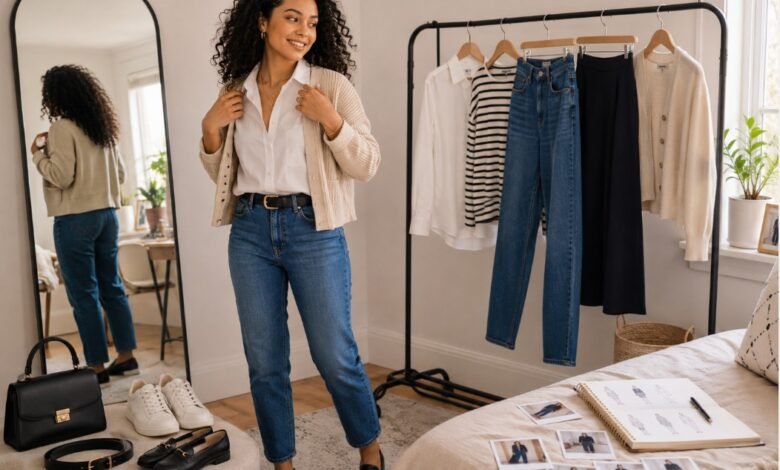
Could five ordinary pieces carry an entire week without making every outfit look the same?
That is the challenge.
For seven days, you will build your outfits around the same small clothing kit. You are allowed to repeat. You are expected to repeat. The point is not to hide the fact that the clothes are the same.
The point is to discover how much an outfit can change through proportion, layering, shoes, accessories, grooming and attitude.
This is not a capsule wardrobe makeover. You do not need to donate anything, buy matching storage boxes or order an emergency beige blazer.
You simply choose five useful pieces from your existing closet and make them work harder for one week.
Some days will feel surprisingly easy. One day may produce an outfit you want to repeat immediately. Another may make you realize that a supposedly versatile item is only versatile in theory.
By the end, you will know more about your wardrobe than another hour of scrolling through outfit inspiration could teach you.
The 7-Day Outfit Rewear Challenge: choose five clothing pieces, wear at least two of them every day for one week, and use shoes, bags, jewelry and layers to create seven distinct outfits. No shopping is allowed during the challenge.
Why repeat the same clothes on purpose?
Most fashion challenges encourage you to create more: more outfits, more aesthetics, more combinations and sometimes more shopping.
This one works in the opposite direction.
It limits the number of garments so you can see what actually changes an outfit.
When the clothes remain familiar, small styling decisions become easier to notice.
A tucked shirt creates a different waistline. A shorter jacket changes the proportion of wide-leg trousers. A sneaker makes a dress casual. A sleek flat makes the same dress look more deliberate. A belt changes where the outfit appears to begin and end.
You also learn whether the pieces you call essentials are truly useful.
A basic top may work beautifully beneath jackets but look unfinished alone. A favorite pair of trousers may only coordinate with one shoe shape. A jacket may seem versatile until you discover that its sleeves do not fit over anything.
This challenge turns vague closet frustration into specific information.
It is especially useful after realizing that your closet feels full but still gives you nothing to wear. Instead of immediately buying more, you test what the existing wardrobe can already do.
Choose five pieces that can create tension, not perfect harmony
The challenge becomes boring if every piece is almost identical.
Five black basics may be easy to combine, but they reveal less about your styling habits.
The strongest kit includes enough compatibility to function and enough contrast to require thought.
A shirt, fitted knit, tee or blouse you already wear.
Choose a different shape, texture or neckline.
Jeans, trousers, a skirt or relaxed pants.
A dress, jumpsuit or overalls that can also be layered.
A cardigan, overshirt, jacket or lightweight blazer.
You do not have to follow this exact formula.
A cold-weather version may include two bottoms and two knit layers. A hot-weather version may replace the jacket with an open shirt. Someone who rarely wears dresses can choose another bottom instead.
The five pieces should meet four conditions:
They fit now.
They suit the weather.
They can survive the planned week.
At least three of them can coordinate with more than one other piece.
Do not choose only your five favorite pieces
Your favorite top, favorite trousers, favorite dress, favorite cardigan and favorite jacket may belong to completely different wardrobes.
Choose pieces as a team.
Do not choose five pieces you already wear together constantly
The challenge should contain at least one item you want to understand better.
Do not choose clothes that require perfect weather
A challenge should test styling, not your tolerance for being cold, overheated or wet.
The rules are simple enough to follow and flexible enough to be fun
Wear the most obvious combination
Do not try to be clever yet.
Choose the pairing that immediately makes sense: the shirt with the jeans, the dress with the jacket or the fitted top with the skirt.
Day 1 creates the control outfit. It shows how you normally style these pieces before the challenge begins influencing your choices.
Photograph the full look, including shoes and bag.
At the end of the day, record what worked without trying to improve it retroactively.
Change the proportion without changing the main pieces
Use at least two garments from Day 1, but alter the silhouette.
Tuck the top fully instead of leaving it loose. Wear the shirt open as a light layer. Add a belt. Roll the sleeve. Button the cardigan differently. Layer a top over the dress so it appears to be a skirt.
The challenge is not to decorate the original outfit.
It is to change where the eye sees the waist, shoulder or hem.
Compare the Day 1 and Day 2 photographs. The clothing may be nearly identical, but the outfit should occupy the body differently.
Change the mood through shoes and accessories
Keep the clothing combination familiar and shift the emotional tone.
A clean sneaker can make a skirt feel casual. A structured bag can sharpen relaxed trousers. A soft scarf can make a simple shirt feel more thoughtful. Small earrings, a watch and a belt can turn a hurried outfit into something intentional.
Do not add every accessory you own.
Choose one direction: sporty, polished, romantic, minimal, playful or slightly rebellious.
This is a good day to use ideas from tiny accessories that make outfits look more polished.
Use a layer in a way you did not originally plan
The challenge layer does not always need to function as a traditional jacket.
Wear an open shirt beneath a cardigan. Tie a lightweight knit around the shoulders. Button the cardigan and treat it as a top. Wear the jacket over the dress but define the waist beneath it.
The goal is not to invent a complicated fashion trick.
The goal is to give the layer a second job.
Pay attention to sleeve volume. A layer is only useful if it fits over the garments you actually wear beneath it.
Build the outfit around the piece you keep avoiding
By Day 5, one challenge piece has probably become less popular than the others.
Maybe the shirt wrinkles. The dress feels too formal. The trousers need a more defined waist. The jacket is visually heavier than expected.
Do not force the same failed combination again.
Identify the exact reason for the resistance and style around it.
If the dress feels formal, use sneakers and a casual layer. If the trousers feel oversized, choose the most fitted top. If the jacket dominates the outfit, keep everything beneath it simple.
This day often provides the most useful wardrobe information of the entire week.
Move the clothes into a different dress code
Take a combination that felt casual and make it more polished—or take a polished piece and make it relaxed.
A shirt and trousers may become weekend-friendly with rolled sleeves, a soft bag and sneakers. A simple dress may feel dinner-ready with a refined shoe and structured layer.
This exercise tests whether the garments can cross occasions.
Not every item needs to work everywhere. But pieces that can shift one level up or down are especially valuable in a smaller wardrobe.
Create the best outfit of the week
Day 7 is not another random experiment.
Use everything you learned.
Choose the most reliable proportion, the shoes that made the outfit feel finished and the accessory that added personality without creating clutter.
You can repeat an earlier outfit exactly if it was genuinely the strongest.
The purpose of the challenge is not to produce seven equally original looks.
It is to discover which combinations deserve a permanent place in your real wardrobe routine.
Accessories are free, but they should still earn their place
The accessory rule prevents the challenge from becoming unnecessarily restrictive.
You can use different shoes, bags, belts, jewelry, hair accessories, scarves and sunglasses.
But “free” does not mean “add everything.”
Accessories should help the outfit perform a job.
| Accessory | What it changes | Useful challenge question |
|---|---|---|
| Shoes | Formality, proportion and practicality | Does this outfit need a sleeker or more relaxed base? |
| Belt | Waist definition and garment length | Would a clearer waist improve the silhouette? |
| Bag | Structure, scale and mood | Does the outfit need polish or softness? |
| Jewelry | Focus around the face and neckline | Is the neckline already visually busy? |
| Scarf | Color, texture and warmth | Is it solving a real styling or weather need? |
| Hair styling | How much of the collar, shoulder and earrings remain visible | Would changing the hair balance the neckline? |
The most revealing experiment is often repeating the same clothes with two different shoes.
The entire outfit may appear to belong to a different occasion.
Weather should modify the challenge, not ruin it
A seven-day wardrobe experiment cannot control rain, humidity, cold fronts or overheated indoor spaces.
Practical outerwear is always allowed.
A raincoat, winter coat or protective shoe does not need to count as one of the five pieces unless it is central to the outfit.
Hot-weather version
Choose breathable pieces and make the optional layer lightweight. An open linen shirt, thin cardigan or airy overshirt is more realistic than a structured jacket.
Cold-weather version
Include one warm knit and one layer that comfortably fits over it. Tights, thermal underlayers, scarves and weather-safe boots remain free.
Transitional-weather version
Choose pieces that can be worn alone at midday and layered in the morning or evening.
The challenge should reflect the conditions you actually dress for, not an imaginary week with perfect temperatures.
The same challenge can fit school, work or a mixed week
For school
Prioritize movement, sitting comfort and shoes suitable for walking between classes. Choose one layer that works in cold classrooms and one top that does not require constant adjustment.
For work
Select a base that fits the dress code and use accessories to vary the level of polish. A trouser, simple top, shirt, dress and structured cardigan can create several professional combinations without appearing identical.
For a mixed schedule
Use the dress or one-piece as the occasion-shifting item. Style it casually during the day and more deliberately for dinner or an event.
For a weekend challenge
Condense the idea into three days. Choose three clothing pieces and create one daytime look, one active or errand look and one evening version.
The challenge stops being useful when you try to perform perfection
Choosing only neutral basics
The outfits may coordinate easily but reveal little about the pieces that usually create difficulty.
Trying to make every look completely different
Repetition is part of the challenge. Small changes can be more useful than dramatic transformations.
Ignoring comfort for the photograph
An outfit that only works while standing still is not a successful real-life combination.
Quietly adding extra clothing
Practical underlayers are allowed, but repeatedly replacing the five pieces removes the point of the experiment.
Buying something to rescue the challenge
A missing item is valuable information. Write it down and decide after Day 7 whether the gap is real.
Judging the outfit only in the mirror
Evaluate how it performs after walking, sitting, commuting and living through the actual day.
Score the outfits by usefulness, not only by appearance
At the end of each day, rate the outfit from one to five.
A photogenic outfit may score poorly if it was uncomfortable or unsuitable for the day.
A simple outfit may become the winner because it made you feel calm, capable and properly dressed for hours.
Seven days can reveal several months of shopping mistakes
The challenge may confirm that you own excellent basics.
It may also expose a wardrobe imbalance.
You may discover a real bridge-piece gap
Several outfits may fail because the same simple top, shoe or layer is missing.
You may discover that one “essential” is not useful for you
A classic shirt means little if you dislike collars, ironing or stiff fabric.
You may discover that shoes control most of your wardrobe
One versatile pair may connect more outfits than another clothing purchase.
You may discover that your favorite silhouette repeats
Perhaps you consistently prefer a defined waist, relaxed bottom and shorter layer. That is useful style knowledge, not a lack of creativity.
You may discover that outfit boredom begins with styling habits
Wearing every shirt loose with every pair of jeans may make the closet feel repetitive even when the pieces differ.
You may discover that you already own enough
The strongest result is sometimes realizing that the wardrobe needs better combinations, not immediate expansion.
What to do after the challenge ends
Do not celebrate Day 7 by immediately shopping.
First, place the seven photographs side by side.
Identify the best outfit, the most comfortable outfit and the outfit that felt most like you. They may not be the same.
Save the combinations you would repeat.
Then review any clothing or accessory you wanted during the week.
Did the same missing item appear several times? Could something already in the closet perform that job? Would an alteration solve the problem?
A repeated gap may deserve a place on your shopping list.
A one-day impulse probably does not.
You can also repeat the challenge later with a different kit:
five colorful pieces;
five neglected pieces;
five pieces for changing weather;
five pieces built around one difficult shoe;
or five pieces chosen by a friend.
The challenge becomes more useful each time because you begin with better questions.
The winner is not the person who hides the repeats best
Fashion often encourages the illusion that every appearance should be new.
But real style is built through repetition.
You learn which sleeve length feels right, which trouser rise works with your favorite tops and which shoe makes several outfits suddenly make sense.
You stop asking whether a garment looks exciting on a hanger and start asking whether it participates in your life.
For seven days, the five pieces become familiar enough that their strengths and weaknesses are impossible to ignore.
That is the fun part.
You are not trying to prove that five garments are all anyone should own.
You are proving that creativity does not begin at the checkout.
Questions and answers
What is the 7-Day Outfit Rewear Challenge?
The challenge asks you to choose five main clothing pieces and wear at least two of them each day for one week. Shoes, bags, jewelry, belts and practical outerwear can change while the core clothing kit remains the same.
Do shoes count as one of the five pieces?
No. Shoes are free during the challenge because changing footwear is one of the easiest ways to alter an outfit’s proportion, formality and practicality.
Can I wash clothes during the challenge?
Yes. Washing, steaming and caring for the five pieces is allowed. The challenge is not intended to encourage wearing clothing that is dirty or unsuitable for another day.
Can I wear a coat that is not part of the five pieces?
Yes. Weather-protective outerwear such as a winter coat or raincoat does not need to count unless you deliberately selected it as one of the main styling pieces.
What should my five challenge pieces include?
A balanced kit can include two tops, one bottom, one dress or jumpsuit and one layer. You may adapt the formula for your climate, dress code and personal style.
Can I repeat the exact same outfit twice?
Yes. Exact outfit repetition is allowed. The goal is to discover useful combinations, not to force seven completely different looks from a limited kit.
What happens if one piece does not work?
Try to identify the specific problem, such as fit, proportion, fabric, weather or missing shoes. You may stop wearing it if it causes genuine discomfort, but record why it failed.
Is shopping allowed during the seven days?
No clothing shopping is allowed during the challenge. Save potential purchases and review them after Day 7 to see whether they solve a repeated wardrobe gap or were only a temporary impulse.
How do I make repeated clothes look different?
Change the silhouette, tuck, sleeve styling, layering, shoes, bag, belt, jewelry and hair. Small changes in proportion often create a bigger visual difference than adding another garment.
What should I do with the outfit photos after the challenge?
Compare all seven photographs and save the combinations you would willingly repeat. Use the images to identify dependable outfit formulas, difficult pieces and genuine wardrobe gaps.
