Pisto manchego and ratatouille are often introduced as Spanish and French versions of the same idea, but that shortcut hides the most interesting part of the comparison. Both dishes turn ripe summer vegetables into something softer, sweeter, and more substantial than a side salad. Both rely on olive oil, time, and careful control of moisture. Both can be served hot, warm, or at room temperature. Yet the two dishes do not organize those ingredients in the same way, and they do not create the same experience at the table.
Pisto manchego belongs to Castilla-La Mancha, where peppers, tomatoes, onions, and other garden vegetables are slowly cooked into a cohesive, spoonable dish. Ratatouille belongs to Provence and the culinary world of southern France, where eggplant, zucchini, tomato, peppers, garlic, olive oil, and herbs are expected to retain more of their individual character. Pisto often feels concentrated and unified. Ratatouille often feels layered and aromatic. That difference affects not only flavor and texture, but also what each dish is served with, how it appears on restaurant menus, how well it travels, and which one makes more sense for a particular meal.
This is not a contest designed to declare one dish better. It is a practical guide for diners, travelers, and home cooks who want to understand what a menu is promising when it says pisto manchego, pisto con huevo, Spanish ratatouille, ratatouille provençale, or simply seasonal stewed vegetables.
The essential difference is not the vegetable list
The fastest useful answer is this: pisto manchego usually cooks vegetables toward a shared, concentrated identity, while ratatouille usually preserves more contrast between the vegetables. A typical spoonful of pisto tastes primarily of the whole mixture. Tomato, pepper, onion, zucchini, and sometimes eggplant have softened into one another, often in a relatively small dice. A typical spoonful of ratatouille gives the diner more chances to identify eggplant, zucchini, pepper, tomato, garlic, and herbs separately, even though they have been cooked together.
This distinction is more reliable than saying pisto is Spanish and ratatouille is French, because geography alone does not explain what you will actually taste. It is also more reliable than saying pisto is always smooth and ratatouille is always chunky. Restaurants can plate either dish in a rustic bowl, spread it over toast, mold it into a neat cylinder, or arrange the vegetables in decorative layers. The useful question is not simply how the dish looks. The useful question is whether the cook wants the vegetables to merge or remain legible.
Pisto manchego: usually more tomato-and-pepper driven, more cohesive, more spoonable, and especially comfortable with fried egg and bread.
Ratatouille: usually more eggplant-and-zucchini forward, more herbaceous, more visibly layered, and especially natural as a side for fish, chicken, lamb, or a grain-based meal.
The overlap: both are flexible vegetable dishes whose exact form changes with season, household, chef, and restaurant style.
The phrase “Spanish ratatouille” can therefore be useful, but only as an introduction. It tells an English-speaking diner to expect Mediterranean vegetables cooked in olive oil rather than a soup, salad, or cheese-heavy casserole. It becomes inaccurate when it suggests that pisto is merely ratatouille translated into Spanish. Pisto has its own regional logic, its own common pairings, and its own relationship with egg, bread, ham, and the tapas table.
The reverse misunderstanding also happens. Diners familiar with pisto may expect ratatouille to arrive as a thick tomato-bound mixture ready to scoop onto bread. Some versions do, but many ratatouilles are looser, more aromatic, and more clearly composed of distinct vegetables. Understanding that before ordering prevents the common disappointment of receiving a good dish that simply does not match the image a diner had in mind.
Two regions use the same season in different ways
Pisto manchego is associated with Castilla-La Mancha, the broad central Spanish region known for a cuisine shaped by agriculture, pastoral traditions, preserved foods, bread, olive oil, saffron, wine, and practical dishes built from what the land provides. The official tourism authority for Castilla-La Mancha presents pisto manchego as a typical regional dish that can be eaten throughout the year and is especially connected with summer and autumn vegetable seasons. That seasonal foundation matters because pisto was never dependent on a rigid luxury ingredient list. It is a method of making garden produce taste deeper, sweeter, and more complete.
Ratatouille belongs to Provence and is also strongly associated with the food culture of Nice and the Côte d’Azur. Official French tourism sources describe it as a Provençal vegetable dish built from sun-ripened produce such as zucchini, eggplant, peppers, tomato, onion, garlic, olive oil, and basil. Ratatouille carries the aromatic signature many diners associate with southern France: olive oil, garlic, herbs, warmth, and vegetables cooked until tender but not stripped of their identity.
The regional comparison becomes more meaningful when we stop treating national cuisines as abstract flags. Castilla-La Mancha and Provence both have hot growing seasons and long traditions of using vegetables economically. The difference is not that one region discovered stewed vegetables and the other copied them. Similar agricultural conditions naturally produce related solutions. What changes is the local palate: which vegetable is allowed to dominate, how much herb aroma is expected, whether the finished mixture is treated as a tapa or side, and which additions turn it into a complete meal.
Pisto and ratatouille are culinary cousins because their landscapes rhyme, not because one dish is a translation of the other.
In Castilla-La Mancha, pisto can move easily between roles. It may be a humble bowl with bread, a tapa, a side for meat, a filling for pastry or toast, or the base beneath a fried egg. The dish welcomes enrichment. Egg yolk, cured ham, chorizo, tuna, or Manchego cheese may appear depending on the kitchen, although none of those additions is guaranteed by the word pisto itself.
Ratatouille is equally adaptable but is often framed differently. It may accompany roasted meat or fish, sit beside rice or polenta, become a vegetarian main, top toast, fill an omelet, or appear at room temperature as part of a summer spread. Herbs are more likely to act as a regional signature rather than a decorative afterthought. Basil, thyme, bay leaf, parsley, or other Provençal aromatics can change the entire impression of the dish even when the vegetables resemble those used in pisto.
This regional grounding also explains why restaurant descriptions can be misleading. A menu writer may call pisto “Spanish ratatouille” to make it recognizable, or call ratatouille “Mediterranean vegetable stew” to make it sound approachable. Those descriptions are not necessarily wrong, but they erase the details that tell you whether the dish will be dense or loose, tomato-forward or herb-forward, served alone or topped with egg, and intended as a tapa or side.
The ingredients overlap, but their importance does not
Comparing ingredient lists can make pisto and ratatouille look almost identical. Tomato, peppers, onion, zucchini, eggplant, garlic, and olive oil may appear in both. The real difference emerges when we ask which ingredients are structural and which are optional, seasonal, or secondary.
Tomato and pepper usually lead pisto
In pisto manchego, tomato often provides the body of the dish, while peppers provide sweetness, depth, and the unmistakable flavor that separates pisto from a generic zucchini-and-tomato sauté. Onion commonly supports that base. Zucchini is frequent, eggplant is common in modern and restaurant versions, and garlic may add warmth. Yet a pisto can still feel recognizably like pisto when the ingredient list is relatively simple, provided the tomato and pepper mixture has been cooked patiently and balanced well.
That balance matters because pisto can easily become either watery or overly acidic. Tomatoes must lose rawness and excess moisture. Peppers need enough time to soften and sweeten. Onion should disappear into the background rather than remain sharp. Zucchini and eggplant should contribute substance without flooding the pan. A good pisto is not defined by how many vegetables it contains. It is defined by whether those vegetables have been reduced into a savory, coherent mixture.
Eggplant and zucchini have more authority in ratatouille
Ratatouille generally expects eggplant and zucchini to make a visible and textural contribution. Eggplant absorbs olive oil and becomes silky, almost creamy at the center. Zucchini softens but can retain a cleaner, lighter bite. Peppers add sweetness, tomato supplies acidity and moisture, onion provides a base, and garlic and herbs build aroma. Remove one element and a version may still be delicious, but the familiar balance of ratatouille begins to change.
France’s official tourism recipe uses courgettes, aubergines, red peppers, tomatoes, onions, garlic, olive oil, basil, salt, pepper, and a small amount of sugar. That list illustrates a key point: ratatouille is not merely tomato sauce with vegetables added. It is a collection of vegetables whose individual qualities are meant to remain perceptible.
Eggplant is the most revealing ingredient
Eggplant is one of the fastest ways to understand the difference. In ratatouille, eggplant is usually central enough that its absence changes the dish’s personality. In pisto, eggplant is common but not universally necessary. Many diners assume it must be present because restaurant pisto often includes it, especially outside Spain, where chefs want to signal a broad Mediterranean vegetable mixture. Traditional household versions can be more focused on peppers, tomato, onion, and zucchini.
This does not mean a pisto with eggplant is less authentic or that a ratatouille without it is automatically invalid. It means that ingredient hierarchy is flexible but not meaningless. The question is whether the dish still follows the regional flavor logic. A pepper-and-tomato-centered pisto can feel complete without eggplant. A ratatouille that lacks eggplant must work harder through zucchini, peppers, tomato, herbs, and technique to achieve the expected depth.
Herbs create the clearest aromatic divide
Ratatouille often announces itself before the first bite through basil, thyme, bay leaf, rosemary, parsley, or a blend associated with Provence. Not every version uses all of them, and heavy-handed rosemary can overwhelm the dish, but aromatic herbs are commonly part of ratatouille’s identity. Pisto may contain herbs, but its central aroma is more likely to come from cooked pepper, tomato, onion, garlic, and olive oil.
This difference becomes obvious when the dishes cool slightly. Warm pisto develops a deep vegetable sweetness and a concentrated tomato-pepper fragrance. Warm or room-temperature ratatouille often releases more noticeable herbal notes. That is one reason ratatouille works so naturally as a summer side served less than piping hot: the herbs and olive oil remain expressive even after the steam fades.
The pan decides whether the dish tastes thoughtful or accidental
The common failure in both dishes is not the wrong vegetable. It is unmanaged water. Zucchini releases moisture. Eggplant absorbs oil and then softens. Tomato introduces liquid and acidity. Peppers need time to sweeten. If everything is crowded into a pan at once over insufficient heat, the vegetables steam, collapse unevenly, and create a watery mixture in which no ingredient tastes fully cooked.
Pisto is usually built toward integration
Pisto often begins with onion and peppers because they need time to soften and develop sweetness. Zucchini or eggplant may follow, and tomato is added so it can cook down around the vegetables. Some cooks use one pan, adding ingredients in sequence. Others cook certain vegetables separately and combine them later. The exact order varies, but the destination is similar: a thick, cohesive mixture that can sit on a spoon rather than run across the plate.
The smaller dice commonly used for pisto accelerates integration. Small pieces expose more surface area, release moisture faster, and absorb the tomato-and-pepper base. As the dish reduces, the edges of the vegetables soften into the sauce. The vegetables should not disappear into purée, but they should no longer behave like unrelated cubes sharing a bowl.
Oil is important but should not pool visibly. Pisto needs enough olive oil to carry flavor and prevent the vegetables from tasting boiled, yet the finished dish should feel glossy rather than greasy. Salt also requires patience. Salting early can help draw out moisture, but over-salting before reduction creates a concentrated final dish that is difficult to correct. Good cooks season in stages and taste again after the tomatoes have reduced.
Ratatouille often protects individuality
Ratatouille methods inspire more argument because there are several respected approaches. One method cooks vegetables sequentially in the same pot. Another browns or sautés eggplant, zucchini, peppers, and onions separately before combining them with tomato and herbs. A third approach roasts some or all of the vegetables, reducing moisture and deepening flavor before the final assembly.
Separate cooking is not merely a restaurant affectation. Each vegetable reaches tenderness at a different speed. Eggplant may need more oil and longer heat. Zucchini can become mushy quickly. Peppers need time to soften. Tomatoes can dissolve before the others are ready. Cooking separately gives the chef control, but it also demands more labor and oil management. A carefully sequenced one-pot ratatouille can be excellent when the cook understands those differences.
Jacques Pépin’s classic ratatouille method published by PBS demonstrates another important principle: rest and reduction. His version cooks slowly, is uncovered later to reduce excess liquid, and rests before serving. Resting is not wasted time. It allows oil, tomato juices, garlic, and vegetable flavors to settle into a more unified sauce without eliminating the vegetables’ individual textures.
A practical quality test: neither dish should leave a puddle of thin red water around the vegetables. Pisto should be thick enough to mound softly. Ratatouille may be looser, but the liquid should taste concentrated and integrated rather than like diluted tomato juice.
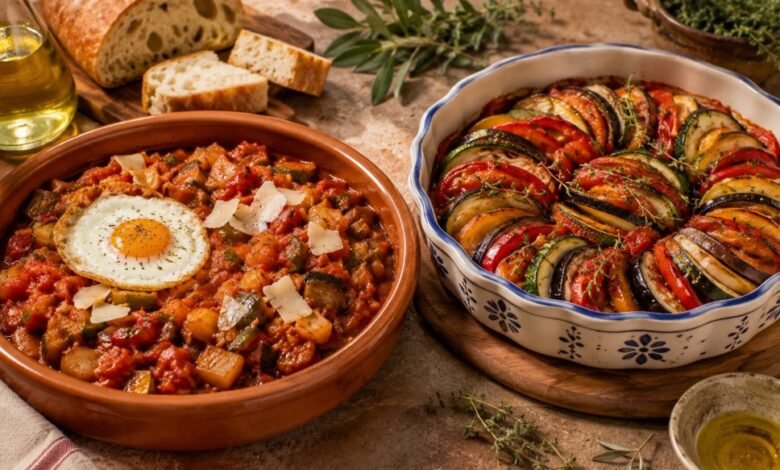
The famous layered “ratatouille” is a different visual language
Many diners picture perfect overlapping rounds of zucchini, eggplant, squash, and tomato because that image became globally recognizable through contemporary restaurant plating and popular culture. That presentation is beautiful, but it is not the only or even the most typical rustic form of ratatouille. It is closer to related layered preparations such as confit byaldi or tian-style vegetable arrangements.
Traditional ratatouille can be irregular, spoonable, and decidedly unphotogenic. The vegetables may be cut into chunks rather than thin circles. That rustic appearance does not indicate inferior technique. In fact, a loose-looking bowl can contain far more careful control of cooking times than a decorative layered bake in which every vegetable has been cooked for the same duration.
Pisto tastes integrated; ratatouille tastes conversational
The sensory difference is easier to understand through a complete bite. In pisto, tomato acidity, pepper sweetness, softened onion, zucchini, and olive oil arrive together. The flavor is rounded and concentrated. The texture is usually soft, moist, and spoonable, with enough remaining structure to avoid becoming baby food. The pleasure comes from unity.
In ratatouille, the ingredients tend to take turns. One bite may be dominated by silky eggplant and garlic. Another may emphasize sweet pepper and tomato. A piece of zucchini may feel lighter and cleaner. Basil or thyme may rise after the vegetables. The pleasure comes from contrast inside a coherent dish.
What good pisto should feel like
Good pisto should feel generous rather than watery. The vegetables should be fully tender, because this is not a dish that benefits from crunchy peppers or undercooked eggplant. At the same time, the mixture should not be completely smooth. Small pieces should remain, giving the diner a sense of cooked vegetables rather than sauce alone.
The tomato should taste cooked and mellow, not raw or metallic. The peppers should contribute sweetness without tasting burnt. Olive oil should round the acidity. If a fried egg is added, the yolk should make the pisto richer without turning it soupy. Bread should pick up the mixture cleanly. A strong pisto leaves the plate almost wipeable with bread rather than flooded with liquid.
What good ratatouille should feel like
Good ratatouille should be tender throughout but not monotonous. Eggplant can be silky, zucchini softer but still recognizable, peppers supple, and tomato reduced enough to coat rather than drown. Garlic and herbs should be present without becoming harsh. The dish should taste of vegetables first, not of dried seasoning.
Ratatouille can be rustic and soft, but it should not feel careless. Bitter eggplant, squeaky undercooked zucchini, leathery pepper skins, or large pools of oil are signs that the method did not respect the ingredients. A good version tastes even better after a short rest because the vegetables absorb one another’s juices while keeping some identity.
Temperature changes both dishes
Piping-hot pisto emphasizes tomato, pepper, and richness, especially when served with egg. Warm pisto often tastes more balanced because sweetness and acidity become easier to perceive. At room temperature, pisto can work as a spread or tapa, though a version heavy with egg or meat should be handled more carefully.
Ratatouille often excels warm or at room temperature. Cooling softens the aggressive edge of garlic and allows herbs and olive oil to become more noticeable. This makes ratatouille especially useful for a summer table, picnic-style spread, or make-ahead meal. Cold-from-the-refrigerator ratatouille can taste muted, so allowing it to lose its chill usually improves the experience.
The better choice depends on what the rest of the meal needs
Pisto and ratatouille become easier to choose when you stop asking which dish is more authentic and start asking what role the vegetables should play. One is often better at becoming the center of a simple meal. The other is often better at supporting a broader plate without disappearing.
For breakfast or brunch
Pisto is usually the more natural choice because fried egg and bread fit directly into its established serving tradition. A bowl of warm pisto topped with one or two eggs can feel complete without meat. The yolk blends with the tomato-and-pepper mixture, while toast provides contrast and makes the dish easier to eat. Manchego cheese, ham, or chorizo can be added, but the vegetable-and-egg combination already works on its own.
Ratatouille can also pair beautifully with eggs, particularly in an omelet, baked egg dish, or brunch bowl. The difference is that egg feels like an adaptation rather than the most immediately recognizable form of the dish. Ratatouille is especially good when the brunch needs brighter herbs and larger vegetable pieces rather than the comforting cohesion of pisto.
For a tapas or shared table
Pisto works exceptionally well as a shared tapa because it can be spooned onto bread, served in a small clay dish, or divided among several diners without losing its structure. It also sits comfortably beside tortilla española, croquetas, olives, anchovies, cured meats, grilled mushrooms, or a simple salad. A small order can bring vegetable richness to a table dominated by fried or salty items.
Ratatouille can join a shared table, but its serving context may feel more French bistro or summer buffet than Spanish tapas. It pairs naturally with bread, goat cheese, olives, roast chicken, grilled fish, lentils, or a bean salad. A room-temperature version can be particularly useful when several dishes need to be prepared ahead.
For a vegetarian main course
Pisto becomes a convincing main when supported by egg, beans, potatoes, rice, bread, or cheese. Without one of those additions, a restaurant portion may feel more like a vegetable side, especially if it is sold as a tapa. The diner should ask about portion size rather than assuming that a vegetable stew is automatically an entrée.
Ratatouille can become a main through polenta, couscous, rice, pasta, white beans, lentils, crusty bread, or a grain salad. Because the vegetables remain more distinct, the plate can feel larger and more varied even when the nutritional structure is similar. A spoonful of pesto or cheese may add richness, though that changes dietary suitability.
For fish, chicken, or meat
Ratatouille is often the easier side because its herbaceous character and separate vegetable textures can balance a plainly cooked protein. It works with grilled fish, roast chicken, lamb, pork, or sausage without becoming a sauce in the same way pisto might. The vegetables contribute acidity, sweetness, and moisture while remaining a distinct part of the plate.
Pisto is excellent when the cook wants the vegetables to act as both side and sauce. It can sit beneath grilled fish, accompany pork, or absorb juices from chicken. A denser pisto may feel particularly natural with rustic meats and bread. The choice depends on whether you want vegetables that support the protein quietly or vegetables that remain visually and texturally separate.
For a light summer meal
Ratatouille often wins when served warm or at room temperature with bread, a little cheese, lentils, or fish. Fresh herbs and distinct vegetables make it feel bright even though everything is cooked. Pisto can also work in summer, particularly with a softly fried egg, but its more concentrated tomato-and-pepper character may feel richer.
For comfort food
Pisto usually feels more comforting because it is cohesive and easy to spoon. Its texture resembles the satisfying middle ground between a sauté and a stew. Add egg and bread, and the dish becomes deeply familiar even to someone who did not grow up eating it. Ratatouille offers comfort too, but its identity is more connected to aromatic vegetables than to a sauce-like embrace.
Both dishes can be dietary-friendly, but the name is never enough
The vegetable base of pisto and ratatouille can be vegan, vegetarian, gluten-free, dairy-free, and nut-free. Restaurant preparation can change every one of those assumptions. Egg, cheese, butter, stock, anchovy, ham, sausage, pesto, bread, and shared kitchen equipment all create reasons to ask rather than guess.
Vegetarian and vegan questions
Plain pisto made with vegetables and olive oil can be vegan. Pisto con huevo is vegetarian but not vegan. Manchego cheese, butter, meat stock, ham, chorizo, tuna, or anchovy make a version unsuitable for some diners. Restaurants may use the word “vegetable” without classifying the dish as vegan because the garnish or cooking fat differs.
Plain ratatouille is also commonly vegan, but bistro versions may be finished with butter, Parmesan, goat cheese, pesto, or meat juices. A ratatouille served beneath fish or meat is not a separate vegan preparation merely because the vegetable mixture itself began without animal products. Confirm whether the kitchen cooks the vegetables separately and whether the garnish can be omitted.
Gluten, dairy, nuts, and cross-contact
The vegetable mixture in either dish may contain no gluten ingredients, but bread or crostini is often served alongside pisto. Flour is not normally needed to thicken either dish, yet kitchens can use packaged stock, sauces, or shared utensils. Diners with celiac disease need a cross-contact conversation rather than a simple ingredient list.
Dairy is not inherent to either vegetable base. Manchego cheese on pisto, butter in ratatouille, or creamy accompaniments change that. Nuts are also not typical base ingredients, but pesto, almond sauces, pine nuts, or shared prep areas can introduce them. Egg is particularly relevant for pisto because menus often treat it as the expected finishing touch.
Which travels better?
Plain pisto is one of the more takeout-friendly vegetable dishes because it is already cohesive. It does not depend on crispness, and its flavor often improves after a short rest. The main risks are excess oil, a container that traps too much steam, and bread packed directly against the vegetables. Bread should travel separately. A fried egg is more fragile because the white can toughen and the yolk can break or overcook.
Ratatouille also travels well, but larger vegetable pieces can release additional moisture in a closed container. A roasted version usually survives transport better than a very loose stewed version. Herbs may lose some brightness, so a small fresh garnish added after reheating can help. Layered ratatouille can shift during delivery and may not look as elegant as it did at the restaurant, even when the flavor remains good.
Reheating and leftovers
Both dishes are usually better reheated gently. High heat can split the oil from the vegetables, scorch the tomato, and turn zucchini into mush. A saucepan over low to medium-low heat gives the best control. Add only a small splash of water if the mixture is too thick; adding too much defeats the reduction that made the dish good.
A microwave works for a single portion when used in short intervals with stirring. Pisto should be reheated before adding a fresh egg rather than reheating an already fried egg repeatedly. Ratatouille benefits from a pause after warming so the temperature becomes even and the herb aroma returns.
Leftover pisto can fill an omelet, top toast, accompany rice, become a sauce for fish, or sit beneath baked eggs. Leftover ratatouille can be folded into pasta, spooned over polenta, mixed with beans, served with couscous, or used in a tart. These second-day uses are not merely ways to avoid waste. They demonstrate why both dishes have survived: each converts perishable vegetables into a flexible foundation for several meals.
Choose the dish by the experience you want, not by a rigid definition
Choose pisto manchego when you want a deep, unified vegetable dish that is especially satisfying with fried egg and bread. Choose ratatouille when you want to taste eggplant, zucchini, peppers, tomato, garlic, olive oil, and herbs as distinct voices. Choose pisto for a Spanish tapas context, a comforting brunch, or a sauce-like vegetable side. Choose ratatouille for a Provençal meal, a summer buffet, a room-temperature side, or a plate where the vegetables should remain visibly separate from the protein.
You will probably prefer pisto if: you like tomato-and-pepper sweetness, soft cohesive textures, egg-centered meals, and dishes that can be scooped onto bread.
You will probably prefer ratatouille if: you like eggplant, zucchini, fresh herbs, larger vegetable pieces, and sides that remain distinct on the plate.
You should order both if: the comparison itself interests you. The shared ingredients make the differences in technique unusually easy to taste.
Do not reject a dish because it fails one visual rule. A chunky pisto can still be excellent. A soft, integrated ratatouille can still be traditional. Household cooking is not a museum exhibit, and restaurant chefs adapt dishes to produce, service, and audience. The most meaningful signs of quality are careful moisture control, fully cooked vegetables, balanced acidity, clean olive-oil flavor, and a final texture that feels intentional.
It is also worth resisting the idea that one dish is more sophisticated. Ratatouille sometimes receives a polished reputation because French restaurant language and decorative layered presentations travel well in food media. Pisto can be dismissed as rustic because it often arrives in a clay dish beneath an egg. That difference is cultural packaging, not evidence of culinary difficulty. Producing a pisto that is concentrated but not oily, soft but not shapeless, and sweet but not flat requires judgment. Producing ratatouille in which each vegetable is tender at the same moment requires equal judgment.
The most honest final comparison is therefore simple. Pisto manchego and ratatouille begin with related Mediterranean ingredients, but they aim for different kinds of harmony. Pisto lets the vegetables become one dish. Ratatouille lets them remain a group. Once you understand that, the menu descriptions, pairings, and textures make much more sense—and the phrase “Spanish ratatouille” becomes a useful doorway rather than the end of the explanation.
What is the main difference between pisto manchego and ratatouille?
Pisto manchego usually cooks tomato, peppers, onion, zucchini, and sometimes eggplant into a more cohesive, finely diced mixture. Ratatouille usually gives eggplant, zucchini, peppers, tomato, garlic, and Provençal herbs more distinct flavor and texture.
Is pisto manchego simply Spanish ratatouille?
Pisto is often described as Spanish ratatouille because both dishes use Mediterranean summer vegetables and olive oil. The description is useful for orientation, but pisto is a separate Castilla-La Mancha dish with a stronger tomato-and-pepper identity and common pairings such as fried egg and bread.
Does pisto manchego always contain Manchego cheese?
No. The word manchego connects the dish to La Mancha; it does not mean Manchego cheese is automatically included. Some restaurants add cheese, while many traditional versions contain only vegetables and olive oil.
Do pisto and ratatouille both contain eggplant?
Ratatouille commonly treats eggplant as a central ingredient. Eggplant is frequent in modern pisto, especially on restaurant menus, but pisto can also be made primarily with tomato, peppers, onion, and zucchini.
Are pisto manchego and ratatouille served hot?
Both dishes can be served hot, warm, or at room temperature. Pisto is especially common warm with bread or fried egg. Ratatouille often tastes excellent warm or at room temperature because the herbs and olive oil remain aromatic.
Are pisto manchego and ratatouille vegan?
The plain vegetable base of either dish can be vegan. Restaurant versions may contain egg, cheese, butter, stock, ham, anchovy, pesto, or other non-vegan additions, so preparation should be confirmed directly with the kitchen.
Which dish is better for takeout?
Plain pisto is especially reliable for takeout because its texture is already cohesive and does not depend on crispness. Ratatouille also travels well, particularly when roasted, although larger vegetable pieces may release moisture in a closed container.
Which dish is more traditionally served with a fried egg?
Pisto manchego is more strongly associated with a fried egg. The runny yolk enriches the tomato-and-pepper mixture and turns a vegetable tapa into a light but complete meal.
Where can I find pisto manchego near me?
Search Spanish restaurants and tapas bars for pisto, pisto manchego, pisto con huevo, or Spanish ratatouille. Diana Isabela’s Pisto Manchego Near Me guide compares confirmed U.S. restaurant listings, published prices, addresses, and ordering details.