Shchi Soup in Illinois: Where to Find It Around Chicago
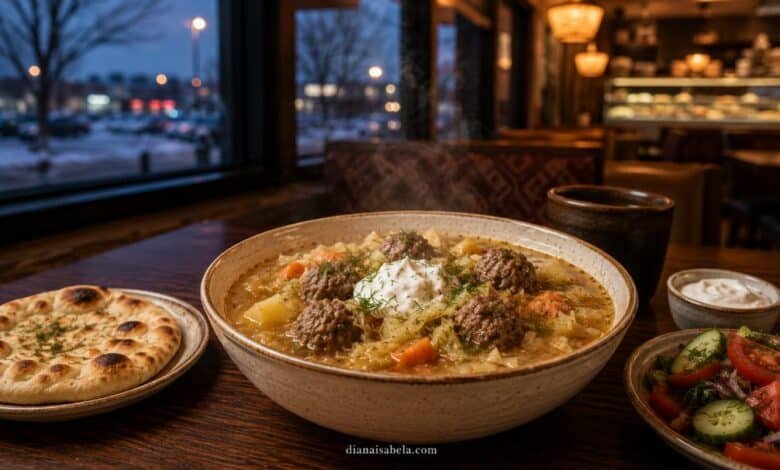
Illinois is not one of those shchi searches where I have to hand you six vaguely Eastern European restaurants and ask you to believe there might be cabbage soup hiding somewhere in the kitchen. We have something better: two current menus that actually say Shchi.
One is in Carol Stream, where Chinor lists a straightforward sour-cabbage shchi. The other is in Buffalo Grove, where Samarkand Cafe makes its version with meatballs. Both restaurants are Uzbek rather than Russian, which turns out to be one of the most useful lessons of the Illinois search: if you filter only for “Russian restaurants,” you can filter out two of the clearest current shchi bowls in the state.
Then Buffalo Grove gives the story another layer. Around that confirmed Samarkand bowl is a surprisingly dense world of European and Ukrainian prepared-food businesses — Allegro Deli, Varenychok, Ideal Deli and other kitchens where homemade soup belongs to ordinary weekly food rather than a restaurant special occasion. Illinois therefore deserves a different kind of guide: not a statewide directory, but a story about two confirmed bowls, one unusually useful suburban food ecosystem and the difference between a menu that proves shchi and a kitchen that merely gives us good reason to ask.
The Illinois Answer Fits Into Two Sentences — Until You Start Asking Better Questions
For a confirmed current shchi: start with Chinor in Carol Stream or Samarkand Cafe in Buffalo Grove.
For the more interesting food day: Buffalo Grove has the advantage because the confirmed Samarkand bowl sits inside a larger Eastern European and Ukrainian prepared-food landscape where you can continue into delis, rotating soup menus, bread, cutlets, vareniki and tomorrow’s dinner.
That is the direct answer. Everything after this is about deciding which bowl suits you, understanding why two Uzbek restaurants are such important shchi addresses, and knowing where the search should expand without turning every cabbage soup in Illinois into something it is not.
The geography matters immediately. Neither confirmed bowl is in downtown Chicago.
That is not a flaw in the guide. It is the actual food geography.
Immigrant food does not organize itself according to tourism districts. Families move, grocery stores open near customers, restaurants follow communities and suburban shopping centers quietly become better places for specific traditional foods than downtown blocks with far more famous addresses.
Carol Stream gives the western suburbs a direct shchi answer. Buffalo Grove gives the north/northwest suburban area a direct answer plus a broader prepared-food network.
If you are mapping shchi beyond Illinois, the United States shchi guide puts those suburban bowls into the larger American picture.
And the main Shchi Soup Near Me guide is where I connect Illinois back to the full international search and the larger problem of finding a traditional soup that often lives in rotating kitchens rather than fixed restaurant menus.
Carol Stream in one sentence
Choose Chinor when your priority is the cleanest current menu proof: Shchi — Sour cabbage soup — $9.99 on the restaurant’s own menu.
Buffalo Grove in one sentence
Choose Buffalo Grove when you want shchi to become a full food excursion: Samarkand gives you the confirmed bowl, and the surrounding delis give you reasons not to head home immediately afterward.
Chinor Is the Cleanest Current Illinois Shchi Listing
Chinor Restaurant — Carol Stream
The uncomplicated option when you want the menu itself to answer the question.
There is something almost luxurious about a niche-food search when the official restaurant menu simply says what you wanted it to say.
Chinor does.
The soup section lists Shchi, prices it at $9.99 and describes it as Sour cabbage soup. No detective work. No translating “traditional vegetable soup” from an unidentified stock photograph. No assumption that a restaurant serving borscht must also be making shchi somewhere behind the scenes.
For this project, that makes Chinor unusually valuable.
The description also tells us the important stylistic point: this is the sour-cabbage direction rather than a fresh-cabbage or green sorrel version.
That distinction matters if the fermented tang is precisely what brought you here.
Chinor’s surrounding menu is almost as useful as the shchi itself because it reveals the cultural environment in which the soup appears.
There is borscht.
There is lagman.
There is lamb shurpa.
Then the menu moves into shashlik, lula kebabs, samsa, Uzbek breads and other Central Asian dishes.
That combination immediately destroys the idea that a traditional Russian soup must be searched only inside a restaurant presenting itself as Russian.
Chinor is not Russian.
Its core identity is Uzbek/Central Asian.
It also serves shchi.
Both statements can be true without one erasing the other.
One useful price detail: Chinor’s direct menu currently lists shchi at $9.99, while major delivery platforms can show a higher platform price. If you are comparing costs, compare the same ordering method rather than assuming every screen reflects the restaurant’s direct menu.
This is more than a money-saving footnote. It is one of the small ways local food research gets distorted. A delivery app may be current enough to confirm that a dish is still offered while still showing a different price structure from ordering directly.
So I separate two questions:
Does the restaurant currently list the dish?
What will my ordering method cost?
Chinor gives a strong answer to the first. The second depends on how you order.
What I would eat with Chinor’s shchi
I would keep the first visit simple.
Shchi.
Bread.
Then one item from the Uzbek side of the menu.
The restaurant currently lists several bread options, including traditional layered fatir and kulcha. That is more interesting to me than forcing dark rye into every shchi meal simply because it is the pairing people expect from a Russian table.
Context matters.
You are sitting in an Uzbek restaurant.
Let the restaurant’s bread be part of the meal.
If two people are eating, a shared order of manti or samsa after soup makes more sense to me than trying to construct an imaginary Russian set menu inside a Central Asian restaurant.
The result is more respectful and probably more delicious.
Samarkand’s Meatball Shchi Is Not Just Chinor’s Bowl at Another Address
The easy version of this section would be:
“Here is another sour-cabbage shchi.”
That misses the useful detail.
Samarkand Cafe currently describes its shchi as sour cabbage soup with meatballs.
Meatballs alter the role of the bowl.
Samarkand Cafe — Buffalo Grove
A more substantial shchi and the gateway into Illinois’s strongest shchi food neighborhood.
Samarkand’s soup menu is substantial in its own right: lagman, mastava, shurpa, kuza soup, noodle soup and shchi all occupy the same section.
That tells you immediately that soup is not an afterthought on this menu.
And the meatballs make the shchi more meal-like before you have ordered anything else.
This is where I would order differently from Chinor.
At Chinor, a relatively simple sour-cabbage shchi leaves me interested in adding another savory dish.
At Samarkand, meatballs already create more protein and texture inside the soup itself.
So I would slow down.
Bread or one small hot appetizer.
Perhaps a fresh salad.
Then wait before deciding that plov, manti, kebab and fried carp are all urgently required.
They are not going anywhere.
Your appetite might.
Why the meatballs matter
Meatballs change more than fullness.
They alter the way broth and cabbage interact because each spoonful can carry meat, fermented cabbage and liquid together.
A soup with pieces of stewed beef can feel brothy first and meaty second.
A meatball makes the meat component more defined.
That is why I would hesitate to call Chinor and Samarkand interchangeable even before tasting them side by side.
The menu descriptions already tell us they are making different decisions.
That is exactly the kind of local information worth preserving instead of flattening both restaurants into a list of “places serving Russian cabbage soup.”
Two Confirmed Illinois Bowls, Four Useful Differences
I have not visited both restaurants and I am not going to invent a dramatic blind tasting I never performed.
What I can compare responsibly is what the current menus actually establish and what those menu differences mean for the meal.
Both menus explicitly call the dish Shchi and describe it through sour cabbage.
Samarkand explicitly identifies meatballs. Chinor’s direct description is simply “Sour cabbage soup.”
Samarkand reads as the more self-contained bowl because meatballs are built into the dish.
Chinor is the clean destination. Samarkand opens the door to the much larger Buffalo Grove deli orbit.
The two restaurants also share another important trait: both are Central Asian kitchens.
That is not a coincidence worth ignoring.
Many dishes travelled widely across the former Soviet space, and restaurant menus built for Uzbek, Russian-speaking and broader post-Soviet communities in the United States frequently reflect that shared culinary familiarity.
You can see the overlap directly.
Shchi and borscht can sit next to lagman and shurpa.
Olivier can sit next to plov.
Samsa and manti can share the menu with foods that English-speaking diners are more likely to label “Russian.”
The food map is more interesting when we let those histories coexist instead of forcing the restaurant into a simpler identity.
Buffalo Grove Is the Part of Illinois I Would Explore After the Bowl
Samarkand alone would make Buffalo Grove relevant.
The prepared-food businesses around it make Buffalo Grove genuinely interesting.
This is where Illinois begins to feel less like a two-address article and more like a living Eastern European food district spread across suburban shopping centers.
That combination is much more valuable than one additional restaurant card.
If Samarkand has the exact soup you wanted, you can eat it.
Then you can walk into a prepared-food business and learn how this kind of food lives outside the restaurant.
Look at the current salads.
Look at the cooked grains.
Look at the cutlets.
Look at the cabbage dishes.
Look at the refrigerated food people are clearly buying for home.
That is the ecosystem surrounding shchi.
And because Buffalo Grove has several kitchens operating at once, a missing soup does not automatically end the day.
Varenychok Explains the Rotating-Soup Problem Better Than Theory Ever Could
One reason I keep telling people not to rely exclusively on permanent menus is that Varenychok gives us an unusually clean real-world example.
Its current weekly menu changes.
Right now, the lunch soup section includes solyanka, red borscht and a sardine-and-vermicelli soup.
Not shchi.
That is useful information.
A missing shchi is not evidence that the kitchen never makes shchi
A business publishing a weekly menu is telling you exactly how its food model works: some dishes belong to the week rather than the permanent identity of the business.
If you are specifically looking for shchi, ask whether it appears on another weekly menu.
If the answer is yes, you have learned something more useful than finding an old static listing.
If the answer is no, respect the answer and enjoy the solyanka.
This also prevents us from doing something intellectually lazy.
Varenychok is Ukrainian.
It serves borscht.
It serves solyanka.
It serves fermented cabbage this week.
None of those facts automatically produces shchi.
The kitchen can be highly relevant to the search without being falsely advertised as a shchi destination.
That is exactly the distinction I want throughout this cluster.
The same principle applies to Allegro.
Its current site confirms daily homemade meals, a rotating prepared-food menu and a soup category. That is excellent evidence that it is worth asking about soup.
It is not evidence that we should write “Allegro serves shchi today.”
For the deeper method behind this part of the search, use my guide to finding shchi at Russian and Ukrainian delis.
The Chicago Problem: Famous City, Weaker Current Shchi Evidence
Illinois creates a slightly awkward headline problem.
Most people outside the state search Chicago.
The strongest current shchi evidence I can actually verify is in Carol Stream and Buffalo Grove.
I am not going to solve that mismatch by pretending suburbs are downtown neighborhoods.
Nor am I going to manufacture a “best shchi in Chicago” list from restaurants that merely serve borscht, pierogi, kapusniak or another Eastern European soup.
Chicago unquestionably has deep Polish, Ukrainian and broader Eastern European food culture.
That is not the same statement as “I have a current confirmed Chicago-proper shchi bowl.”
At the moment, I do not have one strong enough to recommend with the same confidence as Chinor or Samarkand.
That makes the honest Illinois map slightly suburban.
I am perfectly comfortable with that.
A food guide should follow the food.
There is another reason not to force a Chicago page prematurely.
The city already has many cabbage-soup traditions.
Chicago’s Polish food history means you may encounter kapuśniak or other sauerkraut soups.
Ukrainian kitchens may serve cabbage-based soups under different names and family traditions.
A restaurant may have borscht with cabbage.
A deli may offer a generic cabbage soup.
These are all relevant to a person who loves cabbage soup.
They are not automatically shchi.
That is why the distinction gets its own section instead of being hidden inside a disclaimer.
Illinois Has Enough Cabbage Soup That Naming the Dish Correctly Actually Matters
Shchi
The two confirmed Illinois menus actually use the word Shchi. Both describe sour-cabbage versions. That is the strongest kind of menu evidence for this page.
Kapuśniak and other cabbage soups
Polish and other Central/Eastern European cabbage soups may share sauerkraut, meat, potatoes or broth. Similar ingredients do not erase the identity of the original dish.
Green soups
Sorrel soup, green borscht and green shchi can overlap in ingredients and family language, but I would still ask how the kitchen itself names the bowl.
This is one of the reasons I dislike building local food pages from keyword matching alone.
If a database sees “sauerkraut + broth,” it may decide every sour cabbage soup is close enough.
A reader making a special trip deserves better than close enough.
If the business itself calls the dish shchi, excellent.
If staff confirms that its “sour cabbage soup” is shchi, useful.
If neither happens, keep the original name.
The separate Shchi vs Cabbage Soup guide goes deeper into that distinction without forcing this Illinois page to become a taxonomy lecture.
The Illinois Gap Is Green Shchi — and I Would Rather Leave the Gap Visible
Washington currently gives us a confirmed green sorrel shchi.
Illinois currently gives us two clear sour-cabbage examples.
I think that difference is useful.
Not every state page needs to pretend it represents every style of the dish.
If you specifically want green shchi in Illinois, neither Chinor nor Samarkand is the answer established by the current menu evidence I have.
So the search changes.
I would ask the rotating kitchens.
I would ask Ukrainian prepared-food businesses whether sorrel soup appears seasonally.
I would use the word sorrel, not merely “green soup.”
And I would not automatically convert a green borscht listing into green shchi simply because the two traditions can overlap.
The full explanation is in What Is Green Shchi?.
For Illinois, the useful conclusion is much shorter:
confirmed sour shchi: yes.
confirmed green shchi: not yet.
That is not a weakness.
It is an accurate map.
Why Two Uzbek Restaurants Can Be Better Shchi Leads Than a Russian Restaurant Search
This is probably the most interesting Illinois takeaway.
If you typed “Russian restaurant Illinois” and filtered everything else out, you could miss Chinor and Samarkand.
That would be a terrible search result produced by an overly tidy culinary category.
Uzbek restaurants serving shchi are not random anomalies.
Food moved across the Soviet Union and across Russian-speaking communities. People grew accustomed to dishes from other republics and regions. Menus crossed cultural lines long before American restaurant directories tried to assign one cuisine label to each business.
So today an Uzbek restaurant in Illinois can serve:
plov;
manti;
lagman;
shurpa;
borscht;
and shchi.
The respectful description is not “actually a Russian restaurant.”
It is:
an Uzbek/Central Asian restaurant whose menu also includes shchi.
That wording keeps the business identity intact and makes the food history more interesting.
It also makes your future searches better.
Once you know this overlap exists, Central Asian restaurants become legitimate places to check instead of businesses your search filter throws away.
The Illinois Route Depends on Which Direction You Are Coming From
I do not like food guides that behave as though everyone begins the day at the same downtown hotel.
Illinois is a perfect place to be more practical.
Travel time matters more than food guides often admit.
An address can be accurate and still be a terrible recommendation for your specific day.
If someone in Naperville asks me where to get shchi, I am not going to send them to Buffalo Grove merely because the deli section of this article is exciting.
Chinor is more logical.
If someone is already in Wheeling, Arlington Heights or the northern suburbs, Buffalo Grove becomes obvious.
Good local guidance should reduce unnecessary travel, not romanticize it.
If You Are Driving Specifically for Shchi, Confirm One Thing Before Leaving
Both Chinor and Samarkand currently list the soup.
That is strong current evidence.
It still does not guarantee a pot can never sell out.
If your drive is short, I would not make the phone call into a major operation.
If you are crossing the metro area specifically for the bowl, call.
The dedicated How to Order Shchi guide gives the fuller vocabulary if menu naming or language is part of the problem.
How I Would Build the Meal Differently at Chinor and Samarkand
The point of a pairing section should not be to copy-paste “bread, sour cream, cutlets” into every shchi article.
The restaurants themselves should change the answer.
This is where the broader What to Eat With Shchi guide is useful if you are assembling the meal at home rather than eating inside either restaurant.
At home, the traditional companions can take over.
Dark rye.
Sour cream.
Dill.
Kotleti.
Buckwheat.
Potatoes.
Pickles.
But inside an Uzbek restaurant, I would let some Uzbek food onto the table.
That is part of what makes the Illinois shchi experience distinctive.
The Buffalo Grove Grocery Bag Should Be Tomorrow’s Dinner, Not a Second Lunch
This is the practical danger of eating at Samarkand and then going to a prepared-food deli.
You are no longer hungry.
The food still looks extremely persuasive.
This is how refrigerators become negotiation rooms.
I would shop for later.
At Allegro, the current prepared-food menu includes hot entrées, meat and poultry, seafood, side dishes, salads, blini, bakery and soup.
At Varenychok, the menu moves weekly through soups, hot dishes, dumplings, salads and sweets.
Ideal Deli similarly builds its menu around homemade Ukrainian and European food, with soups, main dishes, sides, meat, fish and desserts.
That means you can use Buffalo Grove almost like a staged meal plan.
Shchi today.
Cutlets or vareniki tomorrow.
A prepared salad for lunch.
Maybe syrnyky for breakfast.
And then stop buying food before you accidentally cater a birthday party nobody is having.
A note about menu prices before this becomes confusing later
Chinor’s current direct site lists shchi at $9.99. Uber Eats currently shows the item at $12.99.
That does not automatically mean one source is “wrong.” Restaurants and delivery platforms can use different pricing.
For this guide, I use the restaurant’s own direct menu as the principal restaurant price and treat platform pricing as a reminder that the final checkout may differ depending on how you order.
Samarkand’s current official menu lists its meatball shchi at $11.99.
As always with local restaurant pricing, check again if exact cost matters on the day you go.
What Would Justify a Future Buffalo Grove or Chicago Child Page?
This matters because I do not want to create location pages simply because we have geographic names available.
Buffalo Grove is much closer to earning one.
Why?
It already has a confirmed shchi restaurant.
It has multiple active Ukrainian and European prepared-food businesses.
It has weekly changing soup menus.
It has enough local food density to support useful decisions beyond one address.
A deeper Buffalo Grove audit may therefore uncover enough recurring shchi inventory to justify a dedicated page later.
Chicago proper is different.
The city has enormous Eastern European culinary value, but the question is narrower:
Do we have enough current shchi-specific evidence to make a city page genuinely useful?
Until the answer is yes, the state page should carry Chicago honestly rather than manufacturing a separate URL filled with weak leads.
The rule is simple.
Create the location page when the food deserves it.
Not when the sitemap has room.
What Illinois Teaches About Searching for Shchi Anywhere
Illinois gives us three lessons I would carry into every other state.
First: cuisine filters can hide the dish
The clearest current bowls are on Uzbek menus.
If you search too narrowly by restaurant identity, you lose useful results.
Second: permanent menus and rotating kitchens are different evidence
Chinor and Samarkand let us say, “This restaurant currently lists shchi.”
Allegro and other prepared-food businesses let us say, “This is a strong kitchen to ask.”
Those sentences should never be merged into one level of certainty.
Third: more addresses do not automatically improve a local guide
Two confirmed bowls plus three transparent call-first leads are more valuable than fifteen loosely related businesses.
The purpose is not to make Illinois look full of shchi.
The purpose is to help someone actually find it.
Tell Me Where Illinois Is Hiding the Next Pot of Shchi
Illinois already gave me one of my favorite discoveries in this entire search: two of the clearest current shchi listings are sitting on Uzbek menus in the suburbs.
That makes me fairly sure there are more useful stories hiding in places that a generic restaurant search does not understand very well.
If you know a Russian deli, Ukrainian grocery, Belarusian kitchen, Uzbek restaurant, Bukharian restaurant, Central Asian café, European prepared-food store or neighborhood market in Illinois that makes shchi, send me the details.
I want the useful information.
What is the business called?
Which city?
What does the menu call the soup?
Fresh cabbage or sour cabbage?
Meatballs, pieces of beef, mushroom or meatless?
Does green sorrel shchi ever appear?
Is it permanent, seasonal or a Friday-only situation that everybody local somehow knows about?
Tell me the price if you know it.
Tell me whether it sells out.
Tell me whether you need to ask for shchi, щи or simply “sour cabbage soup.”
I am especially interested in Buffalo Grove, Skokie, Wheeling, Norridge, Chicago proper and the wider northwest suburban food network — but a tiny kitchen somewhere completely unexpected is even more interesting.
And send the personal details too.
Maybe the Samarkand-style meatball version reminds you of home.
Maybe your family thinks shchi without sour cream is an unfinished sentence.
Maybe there is one deli where the soup is never advertised because the regular customers already know Wednesday is cabbage day.
Those are the details that turn a directory into a food guide.
info@dianaisabela.comQuestions About Finding Shchi in Illinois
Where can I find shchi soup in Illinois?
Two current confirmed options are Chinor Restaurant in Carol Stream and Samarkand Cafe in Buffalo Grove. Chinor lists Shchi as sour cabbage soup, while Samarkand lists sour cabbage shchi with meatballs.
How much is shchi at Chinor in Carol Stream?
Chinor’s current direct restaurant menu lists Shchi at $9.99 and describes it as sour cabbage soup. Delivery platforms can show a higher price, so check the ordering method you plan to use if exact cost matters.
How much is shchi at Samarkand Cafe in Buffalo Grove?
Samarkand Cafe’s current official menu lists Shchi at $11.99 and describes it as sour cabbage soup with meatballs.
Why do Uzbek restaurants in Illinois serve shchi?
Shchi and many other dishes circulated widely across Russian-speaking and post-Soviet communities. Uzbek and Central Asian restaurant menus in the United States can therefore include shchi, borscht and Olivier alongside plov, manti, lagman and shurpa without becoming Russian restaurants.
Where should I look for shchi near Chicago?
The strongest currently confirmed options in this guide are in the suburbs rather than Chicago proper. Chinor is in Carol Stream, while Samarkand Cafe is in Buffalo Grove. Buffalo Grove also has several active European and Ukrainian prepared-food businesses where rotating soup menus are worth checking.
Can I find shchi at a deli in Buffalo Grove?
Buffalo Grove has several strong prepared-food businesses, including Allegro Deli, Varenychok and Ideal Deli. Their current food programs make them useful places to ask about rotating homemade soups, but this guide does not treat them as confirmed permanent shchi listings without direct evidence of the dish.
Is every sour cabbage soup in Illinois shchi?
No. Polish, Ukrainian, Russian and other Central and Eastern European cuisines have different cabbage and sauerkraut soups. Similar ingredients are a useful clue, but the kitchen’s own name and recipe should be respected rather than automatically relabeling every cabbage soup as shchi.
Can I find green shchi in Illinois?
The two confirmed Illinois restaurant listings in this guide are sour-cabbage shchi rather than green sorrel shchi. For green shchi, ask Ukrainian, Russian or Eastern European prepared-food kitchens whether sorrel soup appears seasonally and how the kitchen identifies it.
Should I call before driving to Carol Stream or Buffalo Grove for shchi?
A call is sensible if shchi is the main reason for a long trip. Both Chinor and Samarkand currently list the soup, but direct confirmation can protect you from a sold-out item and can also confirm the current preparation or price.
What should I eat with shchi in Illinois?
At Chinor or Samarkand, let the Central Asian menu shape the meal. Bread, a fresh salad, manti or another shared dish can work well. Samarkand’s meatball shchi is already substantial, so it may need less food around it than a simpler cabbage soup.