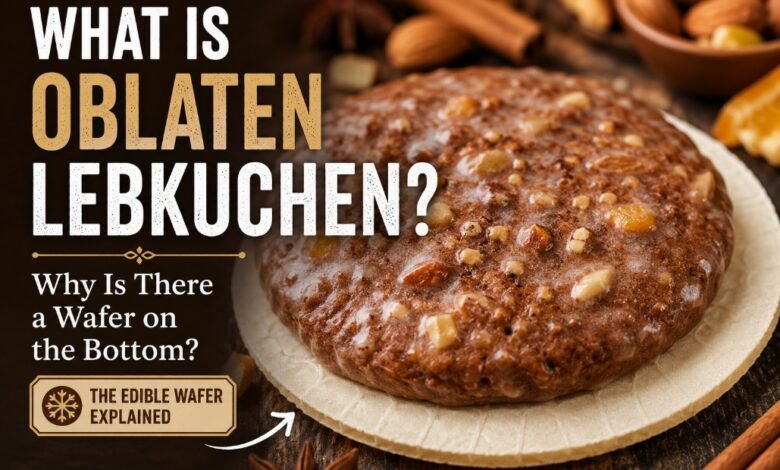
Oblatenlebkuchen is a type of German Lebkuchen baked on a thin, edible wafer called an Oblate. The wafer is part of the pastry, not packaging, parchment or a paper liner. It supports the soft or sticky dough during baking, gives the finished piece a clean base and makes a tender, nut-rich Lebkuchen easier to handle without adding a strong flavor of its own.
You are supposed to eat the wafer together with the Lebkuchen. It is normally pale, dry and almost neutral in taste, so it can look unfamiliar to someone opening an imported German Christmas box for the first time. Peeling it away is unnecessary and may remove part of the soft pastry attached to it.
The word Oblatenlebkuchen describes a broad structural category rather than one exact recipe. Some pieces are simple and flour-forward, while others are exceptionally soft, rich in almonds or hazelnuts and sold as premium Elisenlebkuchen. They may be plain, decorated with almonds, covered in sugar glaze or finished with dark or milk chocolate. The common feature is the edible wafer underneath.
Find the Lebkuchen Worth Buying
Compare soft Elisen rounds, glazed classics and chocolate-covered favorites before choosing your first box.
What Does Oblatenlebkuchen Mean?
Oblatenlebkuchen literally refers to Lebkuchen baked on an Oblate, or thin baking wafer. In German, the singular form is Oblate and the plural is Oblaten. You may see the product written as Oblatenlebkuchen, Oblaten-Lebkuchen or, in an English-language listing, “Lebkuchen on wafers.”
The name tells you something important about the pastry’s construction, but it does not identify one fixed level of quality. A basic flour-based Lebkuchen can be baked on a wafer, and a luxurious Elisenlebkuchen containing a high proportion of almonds or hazelnuts can also be baked on one. Both belong to the broader Oblatenlebkuchen family because both use the wafer as a base.
This makes the term different from words such as glasiert, which describes a sugar glaze, or schokoliert, which describes a chocolate finish. “Oblaten” tells you what is underneath the dough. The coating tells you what is on top. A single piece can therefore be an Oblatenlebkuchen and also be glazed, chocolate-covered, almond-decorated or classified as Elisenlebkuchen.
| Package term | What it tells you |
|---|---|
| Oblatenlebkuchen | The Lebkuchen is baked on an edible wafer |
| Elisenlebkuchen | A premium composition with a strong emphasis on nuts and limited flour |
| Glasiert | The top has a sugar glaze |
| Schokoliert | The piece is finished with chocolate |
| Natur | The dough is presented without a major chocolate or sugar coating |
| Sortiment | The package contains an assortment of finishes or varieties |
Most shoppers recognize Oblatenlebkuchen as a round German Christmas pastry. Round pieces are extremely common because the dough can be portioned directly onto circular wafers before baking. Rectangular and other shapes also exist, so shape should not replace the written product name when you are identifying a package.
Oblatenlebkuchen is strongly associated with Nuremberg baking, but the word itself describes the wafer-based form. When the protected regional wording Nürnberger Lebkuchen appears, it adds a geographic identity. The most precise product descriptions may combine several terms, such as “Nürnberger Elisenlebkuchen on wafers, dark chocolate-coated.”
For a broader introduction to the entire category, including flour-based shapes, filled styles and regional differences, begin with What Is Lebkuchen?. The current guide stays with the wafer-based branch and explains why that apparently simple bottom layer matters so much.
Why Is There a Wafer on the Bottom of Lebkuchen?
The wafer gives soft Lebkuchen dough a stable baking and handling surface. Traditional nut-rich dough can be sticky, moist and too delicate to shape like a standard rolled cookie. Placing the portion on a thin wafer helps keep it together, reduces direct contact with the baking surface and creates a base that can be lifted, coated, packed and served more cleanly.
Think of the wafer as part baking tool and part edible support. It performs some of the work that a firmer flour dough would otherwise perform. The baker does not need to make the Lebkuchen drier or add enough flour to create a rigid cookie simply so that it can be moved from a tray into a box.
It helps control sticky dough
Many soft Lebkuchen formulas contain ground nuts, eggs, sugar or honey, candied citrus peel and spices. This mixture behaves differently from a conventional butter cookie dough. It may be spooned, piped or shaped as a mound rather than rolled and cut. Without a base, the mixture can stick, spread unevenly or become difficult to lift while still tender.
The wafer provides a defined bottom from the moment the dough is portioned. During baking, moisture moves into the wafer and the two layers bond. After cooling, the baker can handle the piece by its base instead of pressing fingers into the delicate surface.
It supports a softer finished texture
A bakery could make dough easier to handle by increasing flour or baking it until very dry. Neither choice is desirable when the target is a tender, rich Lebkuchen. The wafer allows the center to remain softer because the pastry does not have to support itself in the same way as a crisp freestanding cookie.
This is particularly valuable in nut-rich recipes. Ground almonds and hazelnuts provide richness and moisture, but they do not form the same elastic structure as wheat flour. The wafer offers stability without forcing the recipe to abandon its soft character.
It creates a clean edge for coating and packaging
Once baked, Oblatenlebkuchen may be brushed with glaze, partially coated or dipped in chocolate. The wafer gives the confectioner a comparatively clean area to hold or rest. It also separates the moist dough from packaging material and helps prevent the bottom from leaving sticky crumbs inside the box.
The result is not perfectly mess-free. Sugar glaze can crack, chocolate can melt and soft dough can still adhere to wrappers. The wafer simply improves the pastry’s structural reliability and makes commercial packing more practical.
Diana’s comparison: the Oblate is less like a cracker added for flavor and more like an edible baking platform. Its job is to help the Lebkuchen stay soft, round and easy to handle.
It gives the product a recognizable identity
The pale wafer visible beneath a dark, glazed or chocolate-covered round has become one of the most recognizable signs of traditional Oblatenlebkuchen. Even before the box is opened fully, the contrast between the neutral base and the aromatic pastry signals that this is not an ordinary American-style gingerbread cookie.
That visual identity is useful, but it should not be confused with a guarantee of premium composition. A wafer identifies the form. The ingredient list and quality designation identify what the bakery has placed on top of it.
Do You Eat the Wafer or Peel It Off?
Eat the wafer together with the Lebkuchen. It is intentionally edible, and the finished pastry is designed to be bitten through from coating to soft center to wafer. Removing it usually adds no benefit and may tear away part of the bottom layer of dough.
First-time buyers sometimes mistake the wafer for paper because it is thin, pale and relatively dry. The confusion is understandable, especially when a package does not include an English explanation. Unlike a paper candy cup or parchment liner, however, the wafer is bonded directly to the pastry and has no tab or loose edge intended for peeling.
What should the wafer feel like?
A fresh wafer can feel slightly papery on the exposed edge but softer where it touches the Lebkuchen. It may bend rather than crack sharply because it has absorbed some moisture from the dough. The center of the wafer can become nearly invisible during chewing, while the outer rim may retain a faint dry wafer texture.
The wafer should not dominate the bite. If it seems very thick, tough or strongly flavored, the product may simply use a different wafer specification than you expected. Individual bakeries choose different diameters and thicknesses, and moisture changes during storage can alter the way the base feels.
What happens if you remove it?
Peeling the wafer away can expose a sticky underside and pull out pieces of the soft crumb. With a heavily coated piece, the damage may also cause the chocolate shell or sugar glaze to crack. The pastry will still be edible, but its intended balance and structural support will be lost.
Some people remove the wafer because they dislike its texture or need to inspect the product more closely. That is a personal choice, not the traditional serving method. For an ordinary tasting, there is no preparation step: unwrap the Lebkuchen and eat the whole piece.
The wafer is food, not packaging: bite through it with the Lebkuchen.
Should you cut through the wafer when sharing?
Yes. Use a small sharp or lightly serrated knife and cut through the complete piece. A dull knife may compress the soft center and drag the wafer away from the bottom. For a large round, cutting it into two or four wedges gives each person some coating, crumb and wafer.
Allow chocolate-coated pieces to reach a comfortable room temperature before cutting if they have been stored in a cool place. Very cold chocolate can crack unevenly, while very warm chocolate smears. A clean cut is easiest when the coating is firm but not brittle.
What Is a Lebkuchen Wafer Made From?
Modern baking wafers are usually made from a simple mixture based on flour or starch and water. Exact recipes vary, and wheat is common. This is why the presence of a wafer is important when evaluating gluten, wheat and allergen questions.
The ingredients are mixed into a thin batter and baked between heated plates to create a very light, dry sheet. The sheet can then be cut into circles or other shapes. Because the mixture contains little fat and is not intended to act like a sweet cookie, the resulting wafer has a neutral flavor and a pale color.
Is the wafer sweet?
Usually, the wafer contributes little noticeable sweetness. The Lebkuchen dough, glaze and chocolate provide the dominant flavor. A plain baking wafer tasted by itself may seem almost flavorless, lightly floury or similar to the neutral wafer used beneath certain European confections.
This neutrality is intentional. A strongly flavored or heavily sweetened base would compete with the cinnamon, cloves, citrus peel, nuts and chocolate above it. The Oblate is there to support those ingredients, not become a separate cookie layer.
Is it the same as a communion wafer?
Lebkuchen wafers are related in appearance and basic concept to very simple sacramental wafers, and historical explanations often connect the baking method with monastery traditions. Modern commercial baking wafers, however, are produced for culinary use in specific sizes and shapes. Shoppers should buy products labeled as baking wafers or Backoblaten when cooking rather than assuming that every visually similar wafer is interchangeable.
For the person eating packaged Oblatenlebkuchen, this distinction requires no action. The manufacturer has already selected an edible baking wafer appropriate for the product. It becomes relevant mainly when someone is baking Lebkuchen at home and searching for the correct base.
Why can the ingredient list be longer than expected?
Some commercial wafers include more than flour and water. Starches, processing aids or other ingredients may be used to achieve a consistent release, strength and shelf performance. Product labels also differ in how they group the wafer ingredients within the full Lebkuchen declaration.
Do not assume that every wafer has an identical formula. Read the specific package if wheat, gluten or another ingredient matters to you. A general description of traditional Backoblaten cannot replace the manufacturer’s current allergen statement.
| Wafer characteristic | What to expect |
|---|---|
| Color | Pale cream, white or very light beige |
| Flavor | Neutral, mild and slightly floury |
| Texture before baking | Dry, thin and lightweight |
| Texture under Lebkuchen | Softer in the center, sometimes drier at the exposed rim |
| Common ingredient concern | Wheat or gluten may be present |
| Purpose | Baking support, cleaner handling and structural stability |
How the Wafer Changes the Texture and Structure
The wafer allows Oblatenlebkuchen to behave more like a soft miniature cake than a rolled cookie. The center can remain moist and nut-rich while the bottom stays flat enough to stack, coat and package. This contrast is one reason a good piece feels substantial without being dry.
The wafer does not make the dough soft by itself. Softness comes from the recipe, baking time, moisture level, sweeteners, nuts and storage. The wafer makes that softness easier to manage. A basic Oblatenlebkuchen can still be relatively firm, and a premium Elisenlebkuchen can be extremely tender.
The center and edge do not feel identical
The middle of the wafer sits beneath the thickest part of the dough and absorbs more moisture. It may merge almost completely into the bite. The outer edge receives less moisture and may remain lighter, drier and more noticeable. That change across a single round is normal.
A slightly exposed rim also helps show the diameter of the original wafer. Some bakers spread the dough almost to the edge; others leave a narrow pale border. Neither presentation alone proves better quality.
The base can affect how the coating breaks
Chocolate-coated Oblatenlebkuchen combines three different structural layers: a firm shell, a soft center and a thin supportive wafer. When bitten, the chocolate may crack first, the center may compress slightly and the wafer may bend. The result is more complex than a uniformly crisp chocolate cookie.
Sugar-glazed pieces create a different contrast. A thin glaze may crack delicately while the Lebkuchen remains tender. Because the wafer is underneath, the piece can be held without touching the sticky or fragile top surface.
The wafer helps preserve the round form
Soft dough tends to spread. A circular wafer gives the baker a visual boundary and a consistent portioning surface. The dough may extend close to the rim, but the base encourages a recognizable disc rather than an irregular puddle.
This does not mean every round is perfectly uniform. Artisan products may vary slightly in height and spread, while commercial products can be extremely consistent. Shape is one quality consideration, but aroma, freshness and ingredient balance matter more than mathematical symmetry.
Texture expectation: the wafer should support the Lebkuchen without turning the whole piece into a sandwich cookie. Most of the eating experience should still come from the aromatic dough and its coating.
The Main Types of Oblatenlebkuchen
Oblatenlebkuchen appears in several finishes and quality levels. A mixed box is often the easiest way to understand the category because it lets you compare how the same wafer-based structure changes under sugar glaze, chocolate or a plain nut-decorated surface.
Plain or natural Oblatenlebkuchen
A plain piece exposes the underlying dough most clearly. You can see the ground nuts, citrus peel, spice flecks and baked surface without a coating hiding them. This is useful for judging whether the pastry tastes genuinely aromatic or depends mainly on chocolate and sugar.
“Plain” does not always mean undecorated. Almond halves or slivers may be arranged on the top, and a light surface wash may still be present. Read the product description instead of assuming that every package uses the word natur in exactly the same way.
Sugar-glazed Oblatenlebkuchen
Sugar glaze creates a thin sweet shell that can look translucent, white or slightly pearly. It adds sweetness without covering the spice profile as heavily as milk chocolate. The glaze may develop fine cracks during storage, especially when the soft center expands and contracts with changes in humidity.
This is often the best choice for someone who wants a classic festive appearance but still wants to taste citrus, nuts and spices. A very thick glaze can dominate a modest dough, while a fine glaze complements a strong nut-rich center.
Dark-chocolate Oblatenlebkuchen
Dark chocolate adds bitterness, cocoa depth and a firmer outer shell. It pairs particularly well with cloves, cinnamon, roasted hazelnuts and candied orange peel. The contrast between dark coating and soft center can make the piece feel more luxurious and less overtly sweet.
Chocolate quality and coverage vary. Some pieces are fully coated on top and around the sides, while the wafer remains visible below. Others receive a thinner chocolate layer. Chocolate bloom caused by temperature changes can affect appearance without automatically making the product unsafe, although any unusual smell or clear moisture damage should be treated separately.
Milk-chocolate Oblatenlebkuchen
Milk chocolate makes the pastry sweeter, creamier and more immediately familiar to many first-time buyers. It softens the perception of cloves and bitter citrus peel. This can be appealing in a gift assortment, especially when the recipient prefers candy-like desserts.
The tradeoff is that milk chocolate can hide subtle spice and nut differences. For a serious tasting, compare a milk-chocolate piece only after trying plain, glazed or dark-chocolate versions.
White Lebkuchen
White Lebkuchen is usually associated with a pale sugar finish and visible almonds. It has an elegant traditional appearance and can be softer in flavor than a dark-chocolate piece. The exact dough and decoration vary by bakery, so “white” should be read as a product style rather than a universal formula.
Mini Oblatenlebkuchen
Mini pieces use smaller wafers and are convenient for parties, office trays and mixed tastings. They provide a higher ratio of edge and coating to soft center, which can make them feel slightly firmer or sweeter than large rounds from the same general product family.
Mini packages are also easier to portion, but they are not always the best value by weight. Individually wrapped minis may cost more because of additional packaging and labor.
Oblatenlebkuchen vs Elisenlebkuchen
Oblatenlebkuchen and Elisenlebkuchen are not opposite categories. Oblatenlebkuchen describes Lebkuchen baked on a wafer. Elisenlebkuchen describes a premium compositional category known for a high proportion of nuts and very limited flour. An Elisenlebkuchen is commonly baked on an Oblate, which means one piece can belong to both categories at the same time.
This distinction resolves one of the most common package-reading mistakes. A shopper may see “Elisen” and “Oblaten” on different boxes and assume the manufacturer is offering two mutually exclusive types. In reality, the Elisen package may also use wafers but emphasize the more prestigious quality name on the front.
| Question | Oblatenlebkuchen | Elisenlebkuchen |
|---|---|---|
| What defines it? | The edible wafer base | The premium nut-rich composition |
| Can it contain flour? | Yes; the amount varies widely | Only limited flour is permitted within the category |
| Is it always nut-rich? | No | Yes, nuts are central to the classification |
| Can it be glazed? | Yes | Yes |
| Can it be chocolate-covered? | Yes | Yes |
| Can one piece be both? | Yes: Elisenlebkuchen is often baked on an Oblate | |
A basic Oblatenlebkuchen may contain more flour and a smaller percentage of nuts. It can still be enjoyable, especially when fresh and well-spiced, but its crumb may be more cake-like or bread-like than the dense, moist nut structure of an Elisen piece.
Elisenlebkuchen often feels heavier for its size because ground almonds and hazelnuts provide much of the body. The center may be moist, softly chewy and almost marzipan-like in richness, although it should not be assumed to contain marzipan unless the label says so.
Price often reflects the difference. Nuts are costly ingredients, and premium Elisen assortments may also use better chocolate, decorative tins and more careful finishing. Packaging can increase cost independently, so compare the product weight and ingredient list rather than treating price alone as proof of superior dough.
The dedicated Elisenlebkuchen vs Regular Lebkuchen guide explains the composition and quality distinctions in greater detail. For the present article, the key point is simple: the wafer answers “how is it supported?” while Elisen answers “what quality and ingredient structure does the dough meet?”
How to Read an Oblatenlebkuchen Package
Begin with the full product name, not the largest decorative words on the box. Imported packaging may highlight “German gingerbread,” “Christmas selection” or “chocolate assortment” while the useful details appear in smaller German text.
Look for the exact structural term
The clearest wording is Oblatenlebkuchen or Oblaten-Lebkuchen. An English description may say “Lebkuchen on wafers” or “wafer gingerbread.” Product photography can support the identification, but it should not replace the written name because not every image shows the bottom clearly.
Identify the quality category
Look for words such as fein, feinste or Elisen. These terms may correspond to compositional quality levels rather than vague marketing praise. The full legal product designation is more useful than a general front-of-box adjective such as “premium.”
Check the coating distribution
A mixed package may contain several finishes. Look for descriptions such as glazed, dark chocolate, milk chocolate, white or natural. The box may list the number of pieces in each finish, but some packages state only the total net weight.
If you strongly dislike milk chocolate or sugar glaze, do not rely on the photograph. Decorative images can show several varieties without making the exact ratio obvious.
Compare net weight, not tin size
Gift tins can be intentionally spacious to protect decorated pieces and create a premium presentation. A large container does not necessarily contain more Lebkuchen than a compact cardboard package. Compare net weight, number of pieces and price per unit of weight when value matters more than presentation.
Read the ingredient order
The placement of nuts, flour, sweeteners, citrus peel and chocolate helps explain the product’s texture. A nut-rich dough generally lists almonds or hazelnuts prominently. A more basic style may place wheat flour higher in the list.
Ingredient order alone does not reveal exact quality when compound ingredients are grouped differently. Chocolate, glaze and candied peel may each have their own sub-ingredients, making the panel look more complicated than the underlying recipe.
Check the wafer ingredients
The wafer may be identified separately as Oblate or included within the full list. This is where wheat can appear even when the Lebkuchen center itself seems largely nut-based. Never infer gluten-free status from a low-flour dough.
Oblaten or Backoblaten: edible baking wafers.
Zartbitter: dark or bittersweet chocolate.
Vollmilch: milk chocolate.
Glasiert: sugar-glazed.
Natur: plain or minimally finished, depending on the producer.
Gemischt: mixed.
Sortiment: assortment.
Mit Mandeln: with almonds.
How to Recognize Good Oblatenlebkuchen
A good Oblatenlebkuchen should smell aromatic, feel intentionally soft or tender and show a balanced relationship between dough, wafer and coating. The wafer should support the piece without becoming the most noticeable part of the bite.
Aroma should appear before sweetness
When the package is opened, you should notice warm spice, nuts, citrus or chocolate rather than only refined sugar. Cinnamon may be dominant, but high-quality Lebkuchen usually develops beyond one-dimensional cinnamon sweetness. Clove, cardamom, coriander, anise, nutmeg and candied peel can add complexity depending on the recipe.
A weak aroma may indicate an intentionally mild formula, prolonged storage or packaging that has been open too long. Spice naturally fades with time, even when the pastry remains technically edible.
The center should match the promised style
A product sold as soft should yield when pressed gently and should not shatter like a dry biscuit. A basic Oblatenlebkuchen may be firmer than premium Elisenlebkuchen, but it should still feel coherent rather than powdery or stale.
The crumb may be fine, slightly coarse from ground nuts or dotted with pieces of candied citrus. It should not feel raw, wet or gummy. Moistness is desirable; underbaked stickiness is not.
Nuts should taste fresh
Almonds and hazelnuts bring richness but can develop unpleasant flavors when old or poorly stored. Fresh nuts taste sweet, roasted and rounded. Rancid nuts can taste bitter, sharp, waxy or similar to old oil.
A strong chocolate coating can partially hide stale nuts at first, so pay attention to the aftertaste. Premium pricing is not meaningful when the underlying nut flavor has deteriorated.
Citrus peel should create contrast
Candied orange and lemon peel can add sweetness, brightness and a small amount of pleasant bitterness. Large tough pieces that dominate every bite may feel unbalanced, but completely invisible citrus can leave the pastry tasting flat.
Some people simply dislike candied peel. In that case, choose a product with a smoother ingredient profile rather than assuming the presence of citrus represents poor quality.
The wafer should be integrated
The wafer may remain visible, especially around the edge, but it should be attached securely to the dough. A little separation can happen if the piece bends or dries, yet a wafer falling away from an otherwise soft center may indicate rough handling or moisture imbalance.
The center portion of the wafer should soften enough to chew comfortably. An exposed rim can remain slightly dry. A musty smell, damp discoloration or unusual spotting is not a desirable characteristic and should not be dismissed as normal wafer behavior.
The coating should complement the center
Sugar glaze should add a delicate sweet crust rather than forming a thick chalky layer. Chocolate should taste like a real part of the pastry instead of a waxy covering used to hide bland dough. Dark chocolate is particularly effective when it balances sweet citrus and rich nuts.
Small cracks in glaze or cosmetic chocolate bloom can happen during shipping and temperature changes. Appearance should be considered together with smell, texture, packaging condition and the stated best-before information.
How to Serve and Taste Oblatenlebkuchen
Serve Oblatenlebkuchen at room temperature so that the aroma, nut oils and chocolate can express themselves fully. Cold storage can make the center feel firmer and mute the spices, while excessive heat can soften chocolate and make the pastry sticky.
Start with an uncoated or glazed piece
If you are comparing several varieties, begin with plain or lightly glazed Lebkuchen. This makes it easier to evaluate the dough before chocolate influences the palate. Continue with dark chocolate and finish with milk chocolate or heavily decorated pieces.
Take a small bite that includes the center and wafer. Notice how quickly the wafer disappears, how soft the dough feels and whether the spice develops immediately or during chewing.
Cut large rounds into wedges
Large Oblatenlebkuchen can be rich. One round may be more than a casual single-cookie portion, especially when it is nut-heavy and covered in chocolate. Cutting it into halves or quarters lets several people compare finishes without becoming overwhelmed by sweetness.
Use a clean sharp knife and wipe the blade between chocolate and glazed varieties. This keeps the presentation tidy and prevents dark chocolate crumbs from covering pale pieces.
Pair with unsweetened drinks
Black coffee emphasizes roasted nuts and dark chocolate. Black tea offers a cleaner background for citrus and spice. Earl Grey can echo orange peel, while a malty tea supports caramelized notes. Unsweetened cocoa is often too similar in flavor to chocolate-coated Lebkuchen to function as a neutral comparison drink.
Milk can soften spice and make the pastry feel sweeter and gentler. It is a good choice for children or anyone who finds cloves and dark chocolate intense, provided dairy is suitable for the individual.
Add simple fruit rather than more candy
Fresh apple, pear and orange provide acidity and moisture. They refresh the palate between rich nut-heavy pieces. Dried fruit can work, but it adds more concentrated sweetness to an already sweet tasting board.
For an elegant holiday plate, combine two Oblatenlebkuchen finishes, sliced pear, unsalted roasted almonds and black tea. The arrangement needs no additional frosting, caramel sauce or sweet dip.
| Oblatenlebkuchen style | Good drink pairing | Useful food contrast |
|---|---|---|
| Plain nut-rich | Black tea | Fresh pear |
| Sugar-glazed | Unsweetened coffee | Tart apple |
| Dark chocolate | Espresso or malty tea | Orange segments |
| Milk chocolate | Black coffee | Unsalted almonds |
| White almond style | Earl Grey | Fresh citrus |
Gluten, Allergens and Other Dietary Questions
Oblatenlebkuchen should not be assumed to be gluten-free, vegan, dairy-free or safe for a nut allergy. Recipes vary, and the wafer itself commonly contains wheat. Premium nut-rich dough can still use a wheat-based Oblate or contain a small permitted amount of flour.
Gluten and wheat
The word “wafer” is an immediate reason to inspect the label. Many Backoblaten use wheat flour or wheat starch. Even when the main dough contains little flour, the complete piece may still contain gluten.
A product is appropriate for a gluten-free diet only when the specific manufacturer identifies it accordingly and provides suitable allergen information. Do not remove a wheat-based wafer and assume the remaining center becomes safe because crumbs and direct contact remain.
Tree nuts
Almonds and hazelnuts are common and often central to premium Oblatenlebkuchen. Walnuts, marzipan, nut decorations or traces of other tree nuts may also appear. Mixed boxes can contain several formulas produced on shared equipment.
Someone with a tree-nut allergy should not rely on appearance. A smooth flour-based piece may be packed beside nut-rich Elisenlebkuchen or manufactured in the same facility.
Eggs
Eggs frequently help bind and aerate soft Lebkuchen dough. The amount and form vary. Vegan versions may use alternatives, but traditional appearance alone does not reveal whether egg is present.
Milk
Plain or sugar-glazed dough may be dairy-free in some recipes, but milk chocolate, certain glazes and compound coatings can introduce milk. Dark chocolate can also contain milk or carry a cross-contact warning depending on the manufacturer.
Soy
Chocolate coatings commonly use soy lecithin or another emulsifier. Soy may be present even when the Lebkuchen center does not contain an obvious soy ingredient.
Vegan status
Oblatenlebkuchen is not automatically vegan. Eggs, honey, milk chocolate and dairy-based ingredients may be used. A sugar glaze may look vegan but still belong to a dough containing egg or honey.
Only a clearly labeled product should be treated as vegan. Review the current ingredient panel because manufacturers can change recipes.
Dietary safety rule: check the complete package, including the wafer, coating and advisory statements. The soft nut-rich appearance of a Lebkuchen does not prove that it is gluten-free, vegan or safe for any allergy.
How to Choose Your First Oblatenlebkuchen Box
Choose a mixed assortment containing plain or glazed and dark-chocolate pieces if you want to understand the category. Choose Elisenlebkuchen if you already know that you prefer moist, nut-rich pastries. Choose a simpler fine Oblatenlebkuchen package when budget and casual snacking matter more than premium composition.
Best first choice for most people
A mixed package of medium or large rounds offers the clearest introduction. Look for at least two finishes rather than a box in which every piece is covered in milk chocolate. Plain, glazed and dark chocolate provide a useful progression.
The package should clearly identify the product as Oblatenlebkuchen and provide a readable ingredient and allergen panel. A decorative photograph without a precise product description is not enough for an informed purchase.
Best choice for a soft-cookie lover
Look for Elisenlebkuchen or another description emphasizing high nut content and a tender texture. Large rounds often provide more soft center relative to edge and coating than mini pieces.
Check recent reviews carefully when buying from a marketplace, but confirm that the reviews correspond to the exact selected package. Some listings combine several sizes, coatings and seasonal editions on one page.
Best choice for a chocolate lover
Dark-chocolate Oblatenlebkuchen is usually the better tasting choice when spice and nuts still matter. Milk chocolate is sweeter and more familiar but can dominate delicate dough.
Consider shipping weather. Chocolate-coated Lebkuchen can soften or develop bloom when transported through heat. This may be a cosmetic issue, but severe melting can cause pieces to stick together and damage the surface.
Best choice for a gift
A decorative tin protects the pastry and creates a reusable presentation. Check the net weight and internal assortment before paying a premium for the container. A beautiful tin filled mostly with one coating may not suit a recipient who wanted variety.
Individually wrapped pieces are practical for offices, travel and gifts that will be opened gradually. They create more packaging waste but reduce repeated air exposure after the outer box is opened.
Best choice for value
Compare price per ounce or kilogram rather than package dimensions. Cardboard boxes and simple rolls often provide better pastry value than ornate tins. Broken pieces or less decorative formats can also be economical when available, although the exact products vary by seller.
Questions to check before ordering
Is the product actually Oblatenlebkuchen? Confirm that the listing identifies an edible wafer base.
Is it Elisen or a basic quality level? Do not assume every wafer-based piece is premium.
Which coatings are included? Check the ratio of plain, glazed, dark and milk chocolate.
What is the net weight? Gift packaging can make the box look larger than the food quantity.
Is the stock from the current season? Verify best-before information when possible.
How will it be shipped? Chocolate requires extra attention during warm weather.
Does the label meet your dietary needs? Check the wafer as well as the dough and coating.
Availability in the United States is often seasonal, with the broadest selection appearing in autumn and before Christmas. German specialty stores, European groceries, Christmas markets, bakery importers and online sellers may carry different brands and package sizes.
Use the Best Lebkuchen Near Me guide to compare current buying channels, seasonal sellers and online options. Call before making a special trip because a store may stock one generic Lebkuchen package without carrying true Oblatenlebkuchen or premium Elisen rounds.
The Wafer Is a Small Detail That Explains the Whole Pastry
Oblatenlebkuchen is Lebkuchen baked on a thin edible wafer. The wafer prevents sticky or tender dough from bonding directly to the baking surface, gives the pastry a clean base and allows nut-rich recipes to remain soft without becoming impossible to handle.
You should eat the wafer. It is deliberately mild and becomes part of the finished texture. It is not paper, parchment or a wrapper, and removing it can tear the bottom of the pastry.
The presence of a wafer does not automatically mean that the Lebkuchen is Elisen quality, gluten-free or expensive. Oblatenlebkuchen is the broad structural family. Elisenlebkuchen is a premium nut-rich classification that is often—but not exclusively understood simply by being—baked on a wafer.
For a first purchase, choose a clearly labeled mixed assortment with plain or glazed and dark-chocolate pieces. Read the ingredient list, identify the quality category and check the wafer for wheat or other dietary concerns. Once those details are understood, the pale disc beneath the Lebkuchen stops looking strange and starts looking like the practical foundation of one of Germany’s most distinctive Christmas pastries.
What is Oblatenlebkuchen?
Oblatenlebkuchen is German Lebkuchen baked on a thin edible wafer called an Oblate. The wafer supports soft or sticky dough during baking and remains attached to the finished pastry.
Why does Lebkuchen have a wafer on the bottom?
The wafer gives soft, moist or nut-rich Lebkuchen dough a stable baking surface. It reduces sticking, helps preserve the round shape and makes the finished piece easier to coat, package and handle.
Are you supposed to eat the wafer on Lebkuchen?
Yes. The wafer is edible and is intended to be eaten together with the Lebkuchen. It is not paper or packaging, and peeling it away may remove part of the soft pastry.
What is the Lebkuchen wafer made from?
Commercial baking wafers are generally made from a simple mixture based on flour or starch and water. Wheat is common, but the exact formula varies, so the package should be checked when gluten or allergens are a concern.
Is Oblatenlebkuchen the same as Elisenlebkuchen?
No. Oblatenlebkuchen is the broad category of Lebkuchen baked on a wafer. Elisenlebkuchen is a premium nut-rich category with limited flour. Many Elisenlebkuchen are also Oblatenlebkuchen, so one piece can belong to both categories.
Is the wafer on Oblatenlebkuchen gluten-free?
It should not be assumed to be gluten-free. Baking wafers commonly contain wheat flour or wheat starch. Only a product specifically labeled and verified as gluten-free should be considered suitable for a gluten-free diet.
Does the wafer add flavor to Lebkuchen?
The wafer is usually very mild and nearly neutral. Its main purpose is structural, so most of the flavor comes from the Lebkuchen dough, nuts, citrus peel, spices, glaze or chocolate coating.
Can Oblatenlebkuchen be covered in chocolate?
Yes. Oblatenlebkuchen may be plain, sugar-glazed or covered with dark or milk chocolate. The wafer remains underneath regardless of the finish placed on top.
Why is the wafer soft in the middle but dry around the edge?
The center of the wafer absorbs moisture from the thick Lebkuchen dough above it, while the exposed rim receives less moisture. A slightly drier edge and softer center are therefore normal.
Where can I buy Oblatenlebkuchen in the United States?
Look in German specialty stores, European grocery stores, seasonal Christmas markets and online import shops. Search for the exact terms Oblatenlebkuchen, Nürnberger Oblatenlebkuchen or Lebkuchen on wafers, and call before visiting because selection is seasonal.