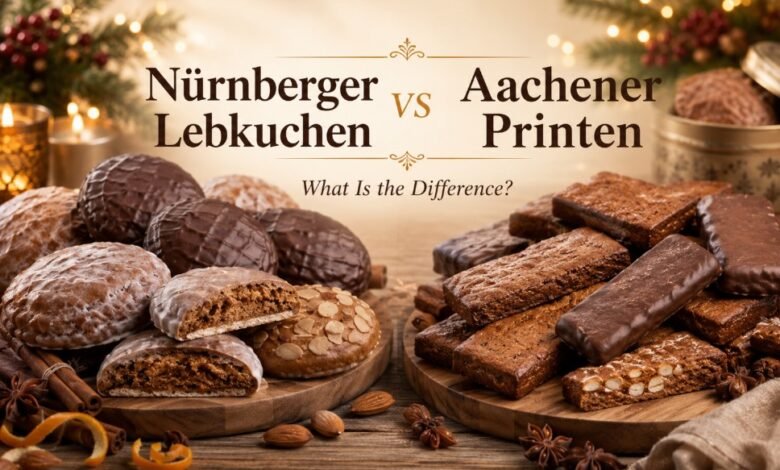
Nürnberger Lebkuchen and Aachener Printen are two distinct German regional baking traditions, not interchangeable names for the same cookie. Nürnberger Lebkuchen is generally associated with round, aromatic, often nut-rich cakes made in Nuremberg, while Aachener Printen is associated with molded or cut brown gingerbread from Aachen that can range from crisp and firm to deliberately soft and chewy. Both names carry protected geographical status, but the eating experience can be dramatically different.
The practical choice comes down to texture and flavor structure. Choose Nürnberger Lebkuchen when you want a tender, rounded, often nut-forward piece with citrus peel, warm spice and an optional wafer base. Choose Aachener Printen when you want a denser, darker, more caramelized style with a pronounced syrup character, a firmer bite or a chewy “soft Printe” texture.
This comparison is designed for shoppers trying to understand unfamiliar German packaging, gift assortments and seasonal bakery displays. Recipes vary by producer, so the front label and ingredient panel matter more than assumptions based only on shape or coating.
Find the Lebkuchen Worth Buying
Compare soft Elisen rounds, glazed classics and chocolate-covered favorites before choosing your first box.
The Essential Difference Between Nürnberger Lebkuchen and Aachener Printen
The main difference is structural: Nürnberger Lebkuchen is typically conceived as a soft or tender spiced cake-cookie, often round and frequently baked on an edible wafer, while Aachener Printen belongs to the brown gingerbread tradition and is usually denser, darker and more visibly shaped, cut or molded.
Nürnberger Lebkuchen often places nuts, candied citrus and aromatic spice at the center of the eating experience. Flour may play a smaller role in premium nut-rich versions, particularly Elisen-style products. Aachener Printen generally begins with a firmer flour-and-syrup dough whose sweetness can feel more caramelized, mineral and direct. The contrast is not simply “soft versus hard,” because soft Printen exist and some Lebkuchen can dry out. The more accurate distinction is between two different dough systems.
| Characteristic | Nürnberger Lebkuchen | Aachener Printen |
|---|---|---|
| Regional identity | Nuremberg, Bavaria | Aachen, North Rhine-Westphalia |
| Typical shape | Round or sometimes rectangular | Bars, rectangles, figures or molded pieces |
| Common base | Often an edible wafer | Usually no wafer base |
| Texture direction | Tender, cakey, moist or softly chewy | Crisp-firm, dense-chewy or deliberately soft |
| Flavor center | Nuts, citrus peel and rounded spice | Dark syrup, caramelized sweetness and spice |
| Common coatings | Sugar glaze, dark chocolate, milk chocolate or plain | Chocolate, sugar glaze, nuts or plain herb-spiced surface |
A shopper who dislikes hard gingerbread should not automatically dismiss Aachener Printen. Packages labeled Softprinten, Saftprinten or otherwise described as soft can be dense but pleasantly yielding. Likewise, a shopper seeking extremely crisp gingerbread should not assume every Nürnberger product will provide that snap. The name identifies a regional tradition; the subtype tells you what the individual piece is designed to feel like.
Diana’s practical shortcut: picture Nürnberger Lebkuchen as the choice for a soft, aromatic dessert plate and Aachener Printen as the choice for a stronger, darker gingerbread bite. Then check the subtype, coating and ingredient list before buying.
Two Protected Regional Identities, Not Two Marketing Labels
Both names are protected geographical indications. In practical terms, the regional wording is not meant to function as a loose flavor description that any producer anywhere may freely place on a package. Nürnberger Lebkuchen is tied to production in Nuremberg, while Aachener Printen is tied to its protected production area around Aachen.
This point matters because English-language retailers sometimes organize every imported spiced cookie under a broad “German gingerbread” heading. That retail category is convenient, but it can erase the distinctions that German packaging preserves. A box may contain Lebkuchen, Printen, Pfeffernüsse and other seasonal pastries, yet those names do not describe identical doughs.
Why Nuremberg became identified with Lebkuchen
Nuremberg’s history as a commercial center helped make imported spices available, while regional honey production supported a strong baking tradition. Over time, the city became so closely associated with Lebkuchen that the geographic name developed commercial and cultural value of its own.
The protected name does not mean every ingredient must be grown in Nuremberg. It means the product carrying the protected geographic wording must satisfy the geographic production requirement. This distinction is useful when reading claims such as “made with imported almonds” or “spices from several countries.” Imported raw materials do not automatically conflict with the regional identity of the finished product.
Why Aachen developed its own Printen tradition
Aachener Printen grew from a different branch of the European molded gingerbread family. The name is connected with the historical practice of pressing dough into carved molds or forms that left an impression. Modern Printen are not always ornate picture cookies, but the visual language of straight edges, bars, rectangular pieces and molded shapes remains part of the tradition.
Aachen’s style also became associated with a dark sweetening system involving sugar, candy fragments or beet-derived syrup, depending on the recipe. That produces a different flavor architecture from the softer nut-heavy Lebkuchen many American shoppers first encounter in holiday assortments.
The regional names therefore answer “where and within which tradition was this made?” They do not, by themselves, answer every question about softness, nuts, coating, sweetness or allergens.
Shape, Wafer Base and Dough Structure
Shape is the fastest visual clue, but the base and internal crumb provide the more reliable identification. Nürnberger Lebkuchen is frequently sold as a round disc, often resting on a thin edible wafer called an Oblate. Aachener Printen is commonly presented as a bar, strip, rectangle, figure or broken piece without that wafer.
The wafer beneath Oblatenlebkuchen is not packaging and does not need to be removed. It is an edible baking component that helps support sticky, soft or nut-rich dough. It can also make the bottom easier to handle and prevent the mass from bonding directly to the baking surface. Its flavor is intentionally neutral, so it usually disappears into the overall bite.
Aachener Printen does not normally depend on that support. Its dough is sufficiently structured to be rolled, pressed, cut or molded. Even soft versions generally retain a more self-supporting, bread-like or chewy body than a delicate nut-rich Lebkuchen round.
Round piece on a thin wafer: most likely Oblatenlebkuchen from the Nürnberger family.
Dense rectangular bar with a dark interior: likely Aachener Printen or another brown gingerbread style.
Round piece without a wafer: still possible for Lebkuchen; check the exact label.
Chocolate-coated rectangle: shape alone is not enough because both traditions include chocolate-covered products.
Embossed or figured piece: visually consistent with the molded heritage of Printen, although decorative Lebkuchen shapes also exist.
The crumb of Nürnberger Lebkuchen may show ground nuts, pieces of almond or hazelnut, small fragments of candied orange peel and a moist, slightly sticky matrix. Premium rounds can feel almost like a compressed flourless nut cake, although formulations differ and shoppers should never assume that “low flour” means gluten-free.
The interior of a Printe is usually more uniform and bread-cookie-like. A hard Printe may break with a definite crack and then soften gradually in the mouth. A soft Printe bends or yields more readily but can still feel compact. It is not necessarily fluffy or cake-like; “soft” is relative to the traditional firm style.
How the Taste and Texture Experience Changes
Nürnberger Lebkuchen usually tastes rounder, fruitier and more nut-driven. Aachener Printen usually tastes darker, more direct and more caramelized. Both can contain cinnamon, cloves, cardamom and other warm spices, but the surrounding dough changes how those spices register.
The Nürnberger Lebkuchen experience
A tender Nürnberger piece often begins with a soft aromatic sweetness rather than a sharp sugar hit. Ground nuts create body and a lingering roasted character. Candied orange or lemon peel may contribute bright, slightly bitter citrus notes that stop the sweetness from feeling flat. Cinnamon and clove tend to sit within that nut-and-fruit base rather than floating above it.
When glazed, the first impression becomes sweeter and lightly crisp before the soft center takes over. Dark chocolate adds bitterness and gives the spices a deeper finish. Milk chocolate makes the piece feel rounder and more confectionery-like. An uncoated piece exposes the dough more clearly and is often the easiest way to judge the underlying spice balance.
The Aachener Printen experience
Aachener Printen can deliver a stronger initial aroma of baked sugar, dark syrup and spice. Depending on the producer, the sweetness may suggest molasses, caramel, brown sugar or toasted candy rather than honeyed cake. A firm version rewards slower eating: the cookie resists at first, then dissolves and releases more spice as it is chewed.
Soft Printen offer a different experience. They retain the dark, compact flavor profile but remove much of the challenge associated with a hard bite. Some are coated in chocolate or topped with nuts, which adds richness and makes them more approachable to shoppers accustomed to confectionery-style holiday cookies.
Nürnberger is often aromatic and plush; Aachener is often dark, dense and assertive.
Neither description is a universal rule. A heavily chocolate-coated Nürnberger round may taste more like chocolate than citrus, while a nut-topped soft Printe may feel richer than an uncoated flour-forward Lebkuchen. The comparison becomes most useful when it helps you predict a direction rather than pretending that hundreds of bakery recipes are identical.
| Sensory question | Choose Nürnberger | Choose Aachener |
|---|---|---|
| Do you want a soft cake-cookie? | Usually the safer first choice | Look specifically for a soft variety |
| Do you enjoy a firm gingerbread bite? | Not the defining feature | Choose classic firm Printen |
| Do you prioritize nuts? | Especially suitable in nut-rich styles | Choose a nut-topped or nut-containing variety |
| Do you prefer dark caramelized sweetness? | Possible, but usually less central | A defining attraction |
| Do you like candied citrus? | Common and often noticeable | Can appear, but may be less dominant |
| Do you want chocolate? | Widely available | Widely available |
How the Ingredient Logic Differs
The most useful ingredient distinction is not a single spice. It is the relationship among flour, nuts and sweetener. Nürnberger Lebkuchen—particularly premium Elisen-style products—can build much of its structure from ground nuts. Aachener Printen generally relies more clearly on flour and a syrup-based sweetening system to produce a firm, shapeable dough.
Nuts in Nürnberger Lebkuchen
Almonds, hazelnuts and sometimes other nuts are central to many Nürnberger products. Ground nuts contribute fat, moisture, tenderness and a slightly coarse crumb. They also soften the perception of spice by wrapping cinnamon, clove and citrus in a rich roasted base.
This is one reason premium Nürnberger Lebkuchen may feel more like a small dessert than a plain cookie. It can be substantial despite its soft texture. The richness does not depend only on chocolate coating; it begins inside the dough.
Nut content varies, however. Not every piece labeled Nürnberger Lebkuchen is an Elisenlebkuchen, and not every assortment uses the same nut proportion. For a more focused explanation of that distinction, see the guide to Elisenlebkuchen vs regular Lebkuchen.
Syrup and structure in Aachener Printen
Printen recipes commonly use dark sugar components such as beet syrup, brown sugar or candy fragments, depending on the formulation. These ingredients do more than sweeten. They influence color, chew, hardness, moisture retention and the deep caramelized flavor associated with the style.
A firm Printe can feel relatively lean compared with a nut-heavy Lebkuchen because the dough’s identity does not depend on a high level of added fat. Chocolate, almonds, nuts or other toppings can still make individual varieties much richer.
Citrus and spice
Both traditions can include cinnamon, cloves, cardamom, anise, coriander, ginger and citrus components. There is no universal spice formula shared by every producer. Bakery blends are part of each maker’s character, and packaged ingredient lists may identify spices collectively rather than providing exact proportions.
In Nürnberger Lebkuchen, candied orange and lemon peel are often easy to perceive because they are embedded in a softer, nutty crumb. In Printen, the darker sweetener and firmer bake can push caramelized and roasted notes forward. The same cinnamon can therefore taste gentle in one product and sharper in another.
Chocolate and glaze do not define the region
Chocolate coating is not exclusive to either tradition. The same is true of sugar glaze. A package labeled Schokoladenlebkuchen tells you that chocolate matters, but it does not replace the regional name. Similarly, Schokoladenprinten remains Printen even though the first visible layer is chocolate.
To compare coatings themselves, use the separate glazed vs chocolate-covered Lebkuchen guide. On this page, coating is treated as a secondary choice layered over the more important regional dough difference.
Allergen reminder: both products may contain wheat, nuts, eggs, milk, soy or other allergens depending on the recipe and coating. A wafer base can contain wheat. Always read the specific package and contact the manufacturer when cross-contact is a concern.
Varieties You May See on a Box
The regional name is only the first level of information. The subtype often tells you more about the expected bite. Learning a few German package words prevents the common mistake of buying a firm product when you wanted a tender one—or paying for a premium nut-rich assortment when you actually prefer simple dark gingerbread.
Common Nürnberger Lebkuchen descriptions
Oblatenlebkuchen: Lebkuchen baked on an edible wafer. The wafer is eaten with the cookie.
Elisenlebkuchen: a premium, typically nut-rich category associated with a particularly tender and substantial crumb.
Glasiert: covered with a sugar glaze.
Schokolade or schokoliert: chocolate-covered or chocolate-finished.
Zartbitter: dark or bittersweet chocolate.
Vollmilch: milk chocolate.
Natur: plain or without a major coating, depending on the producer’s wording.
Sortiment or Mischung: an assortment or mixed selection.
Common Aachener Printen descriptions
Kräuterprinten: herb-spiced Printen; “herb” here refers to the aromatic spice style rather than a savory product.
Hartprinten: firm or hard Printen with a deliberate crisp-resistant bite.
Softprinten: softer Printen intended for easier chewing.
Saftprinten: a moist or juicy-soft style; the exact texture varies by producer.
Schokoladenprinten: chocolate-covered Printen.
Nussprinten: Printen featuring nuts, often as a topping or prominent addition.
Prinzessprinten: a named Printen style that may involve a sweeter finish or glaze, with details varying among producers.
Bruch: broken pieces. This can offer the same flavor in irregular shapes and may be practical for casual serving.
Package translation is not always perfectly standardized. One producer’s “soft” piece may still feel firmer than a tender Lebkuchen round. One bakery’s “natural” assortment may include a light finish that another shopper would consider a glaze. Product photography, ingredient lists and texture descriptions should be read together.
Which One Should You Buy?
Buy Nürnberger Lebkuchen first if you want the most accessible introduction to soft German holiday gingerbread. Buy Aachener Printen first if you are specifically curious about a darker, denser regional style and do not mind reading the label to choose between hard and soft varieties.
Best first choice for a cautious beginner
A mixed box of soft Nürnberger Oblatenlebkuchen is usually the lower-risk choice for someone who has never tried either tradition. A selection containing plain, glazed and dark-chocolate rounds lets the buyer compare finishes without changing the central dough style.
The wafer may look unfamiliar, but it is not difficult to eat. The soft crumb and rounded sweetness are also closer to the cake-cookie texture many American shoppers expect when they hear “soft gingerbread.”
Best choice for a traditional firm gingerbread fan
Classic firm Aachener Printen is the stronger choice for someone who enjoys crisp speculoos, firm ginger snaps, dunking cookies or slowly dissolving old-fashioned gingerbread. The darker syrup profile and resistant structure make the product feel purposeful rather than simply stale.
That last distinction matters. Traditional hardness is designed into the product. It should not be confused with a soft cookie that has been left open until it dried out.
Best choice for a chocolate lover
Either tradition can work. Chocolate-covered Nürnberger Lebkuchen usually delivers a softer, richer center beneath the shell. Chocolate-covered Printen delivers a sharper contrast between coating and dense gingerbread. Dark chocolate highlights spice and roasted notes; milk chocolate reduces bitterness and makes both styles feel sweeter.
Best choice for a nut lover
Nut-rich Nürnberger Lebkuchen—especially Elisen-style rounds—is the more direct recommendation. Nuts may form a major part of the dough rather than appearing only as decoration. Aachener nut varieties are still worth trying, but the dark flour-and-syrup base remains more structurally obvious.
Best choice for a gift
Nürnberger assortments often create an immediately luxurious presentation because round pieces, wafers, glazes and chocolate finishes can be arranged in decorative tins. Aachener Printen makes a more distinctive gift for someone interested in regional food history or stronger gingerbread flavors.
The recipient’s teeth and texture preferences matter. A box of hard Printen can be a frustrating surprise for someone expecting a soft cookie. For an unknown recipient, choose soft Printen or a mixed assortment with clear English texture descriptions.
| Shopper profile | Better starting point | What to look for |
|---|---|---|
| Soft-cookie fan | Nürnberger Lebkuchen | Oblaten or Elisen style |
| Firm gingerbread fan | Aachener Printen | Classic or hard Printen |
| Nut lover | Nürnberger Lebkuchen | High nut content and Elisen labeling |
| Dark caramel flavor fan | Aachener Printen | Plain spice or dark chocolate variety |
| First German holiday-cookie tasting | Mixed selection of both | Plain, glazed and dark-chocolate examples |
| Recipient with texture concerns | Soft Nürnberger or Softprinten | Avoid unlabeled hard assortments |
How to Read Labels Without Confusing the Two Traditions
Start with the protected regional name, then identify the subtype, coating, nut content and package format. Do not let a large word such as “chocolate” distract you from the smaller words that explain the actual dough.
A package may display a festive English phrase on the front while placing the legally meaningful product name in smaller German text. Look near the ingredient panel, product description, country-of-origin statement or manufacturer address.
A five-step label check
1. Find the regional name. Look for “Nürnberger Lebkuchen” or “Aachener Printen,” not merely “German gingerbread.”
2. Identify the structural subtype. Words such as Oblaten, Elisen, Softprinten or Hartprinten tell you what kind of bite to expect.
3. Check the coating. Plain, glazed, dark chocolate and milk chocolate can change perceived sweetness substantially.
4. Read the ingredient order. The relative prominence of flour, nuts, syrups and chocolate helps explain the product’s body.
5. Check allergens and advisory statements. Regional tradition does not guarantee suitability for any medical diet.
The manufacturer’s address is useful but should be interpreted carefully. A distributor in the United States may appear on a sticker even when the product was manufactured in Germany. Conversely, German-language branding alone does not prove that the protected regional name applies.
For mixed tins, inspect whether the nutrition and ingredient panel describes every variety together or lists separate formulas. One assortment can contain plain, glazed, milk-chocolate and dark-chocolate pieces with different allergens.
What the PGI indication does—and does not—tell you
The protected geographical indication supports the authenticity of the regional name. It does not automatically mean handmade, organic, gluten-free, vegan, premium-priced or superior to every unprotected product. It also does not guarantee a single historical formula shared by every bakery.
PGI should therefore be treated as an origin and tradition signal. Product quality still depends on ingredients, production choices, freshness, packaging and personal taste.
Serving Nürnberger Lebkuchen and Aachener Printen
Both products can be served at room temperature, but they benefit from different handling. Soft Nürnberger Lebkuchen is often ready to plate as soon as the package is opened. Firm Aachener Printen may be more enjoyable in smaller pieces, with a hot drink or after a short rest in a normal indoor environment.
A simple side-by-side tasting
Serve one plain or lightly glazed Nürnberger piece and one plain Aachener Printe before introducing chocolate. This allows the dough difference to remain visible. Cut large pieces into two or three bites, but leave enough surface area for the texture to be recognizable.
Taste the Nürnberger piece first if it is delicate and nut-rich. Follow with the darker Printe. Reverse the order only when the Nürnberger piece is heavily covered in sweet milk chocolate, because that coating could overwhelm a plain Printen sample.
First: plain or lightly glazed Nürnberger Lebkuchen.
Second: plain soft Aachener Printen.
Third: firm Printen, eaten slowly or with tea.
Fourth: dark-chocolate versions.
Last: milk-chocolate or heavily decorated pieces.
Drinks that clarify the difference
Unsweetened black tea is one of the best neutral partners because it refreshes the palate without introducing a competing dairy or cocoa flavor. Coffee works especially well with nut-rich Nürnberger Lebkuchen and dark-chocolate Printen. Milk softens spice and can make a hard Printe easier to enjoy, though it also reduces the contrast between the two traditions.
A citrus-forward tea can echo the candied peel in Nürnberger Lebkuchen. A maltier tea can support the darker syrup character of Printen. Very sweet seasonal drinks should be used carefully because they can make both pastries seem flatter and sweeter than they really are.
Fruit, cheese and other accompaniments
Fresh pear and crisp apple provide moisture and acidity without competing strongly with the spice. Orange segments reinforce citrus notes, although pairing them with chocolate-coated pieces can dominate the tasting. Roasted unsalted nuts are useful beside Nürnberger products, but salted nuts may obscure the bakery’s own nut balance.
A mild creamy cheese can work with firm Printen in the same way cheese works with fruit bread or dark crackers. Use a thin portion rather than turning the tasting into a cheese board. The goal is to soften and contrast the dark gingerbread, not cover it.
For a larger purchase or regional comparison box, use the Best Lebkuchen Near Me guide to compare current seasonal sellers, imported options and delivery channels in the United States.
How to Judge Quality in Each Style
A good Nürnberger Lebkuchen should taste integrated: spice, citrus, nuts, sweetener and coating should feel like parts of one pastry. A good Aachener Printe should deliver deliberate density and a clear dark-spice character without tasting merely burnt, dusty or stale.
Quality signs in Nürnberger Lebkuchen
The aroma should be noticeable before the piece reaches the mouth. Cinnamon may lead, but it should not erase citrus, nuts and deeper spices. A soft piece should bend or yield without feeling wet, gummy or raw. Ground nuts may create a gently textured crumb; they should not taste rancid, oily or bitter.
The wafer should be intact enough to support the pastry. It may soften slightly where it touches the moist dough, but it should not smell musty. A sugar glaze can show small natural cracks without indicating spoilage. Chocolate may develop cosmetic bloom after temperature changes, but any unusual odor or evidence of moisture damage should be treated separately from harmless appearance changes.
Quality signs in Aachener Printen
A firm Printe should break cleanly or resist with purpose. It should not crumble into flavorless dust. As it is chewed, the piece should release spice and dark sweetness rather than remaining one-dimensional. Hardness by itself is not proof of quality, but a controlled dense texture is part of the traditional experience.
A soft Printe should feel compact and moist enough to chew comfortably. It should not be sticky in a way that suggests damaged packaging or excessive heat exposure. Dark syrup notes should taste caramelized, not scorched. Chocolate coating should complement the spice instead of functioning as a cover for a bland base.
Signs of age or poor storage
Soft Lebkuchen that has become unusually rigid, shrunken or dry may have lost moisture. Printen requires more judgment because firmness may be intentional. Compare the actual piece with the package description: a product sold as soft should not feel like a hard cracker.
Stale spice pastries often lose aroma before they develop an obviously unpleasant flavor. A piece that smells primarily of cardboard or old packaging will rarely improve in the mouth. Nut-rich products also deserve attention because old nuts can produce a persistent bitter or paint-like aftertaste.
Once opened, protect both styles from prolonged exposure to dry air. Detailed storage methods are covered separately in How to Store Lebkuchen So It Stays Soft and Fresh.
Common Mistakes When Comparing the Two
The biggest mistake is reducing the comparison to “Nürnberger is soft and Aachener is hard.” That sentence describes a common contrast, but it fails as a buying rule because soft Printen exists and individual Lebkuchen products vary.
Mistake: assuming every round cookie is Nürnberger Lebkuchen
Round shape is common, especially for Oblatenlebkuchen, but many German and Central European gingerbread products use round forms. Read the protected name rather than identifying origin from silhouette alone.
Mistake: treating the wafer as paper
The thin disc beneath Oblatenlebkuchen is edible. Peeling it away can remove part of the pastry and create unnecessary mess. The wafer is intentionally mild and is meant to be eaten.
Mistake: assuming chocolate makes the products similar
Chocolate can visually hide the dough, but the center remains structurally different. A chocolate Nürnberger round may be soft, nutty and citrus-rich. A chocolate Printe may remain dark, dense and syrup-driven.
Mistake: confusing traditional firmness with staleness
Classic hard Printen is made to have a firm bite. The relevant question is whether the product is supposed to be hard. Check the subtype and manufacturer description before judging it against a soft-cookie standard.
Mistake: believing premium packaging proves premium dough
Decorative tins, ribbons and imported gift boxes can add cost without revealing nut content or texture. Packaging matters for gifting, but ingredient composition and subtype remain more useful for predicting the eating experience.
Mistake: assuming regional protection means one recipe
Protected origin does not eliminate bakery individuality. Producers use different spice balances, coatings, sizes and assortment strategies. The traditions have boundaries, but they are not frozen into a single universal formula.
Mistake: using “gingerbread” as a complete translation
Gingerbread is a helpful umbrella term for English-speaking shoppers, but it does not communicate the full difference among Lebkuchen, Printen, Pfeffernüsse and other products. Keep the original German name visible when comparing packages.
Finding Authentic Nürnberger Lebkuchen and Aachener Printen in the United States
Search using the exact regional name rather than only “German gingerbread.” Exact-name searches produce more relevant results and make it easier to distinguish imported protected products from domestic gingerbread inspired by German flavors.
Search for: Nürnberger Lebkuchen, Nuremberg Lebkuchen, Nürnberger Oblatenlebkuchen and Nürnberger Elisenlebkuchen.
Search for: Aachener Printen, Aachen Printen, Softprinten, Kräuterprinten and Schokoladenprinten.
Check: German specialty stores, European groceries, seasonal Christmas markets, bakery importers and official brand shops.
Confirm: the manufacturer, product subtype, package weight, coating and current best-before information.
Call before a special trip: holiday inventory can change quickly, and websites may display products that are no longer on the shelf.
Availability in the United States is usually seasonal. Imported assortments often begin appearing in autumn and become more visible before Christmas. Exact timing varies by retailer, shipment and location, so this article does not assign permanent stock claims to individual stores.
When ordering online, compare the number of pieces and total net weight rather than box dimensions alone. Large tins may contain generous presentation space, separators or individually wrapped pieces. Smaller plain packages can provide more pastry per dollar when gifting is not the goal.
Check whether the listing shows the actual product name or merely uses a generic search phrase in the page title. Marketplace catalog pages sometimes combine reviews from several sizes or varieties. Confirm that the selected option is Nürnberger Lebkuchen or Aachener Printen and that the coating matches the photograph.
Heat is especially relevant for chocolate-covered varieties. During warm weather, chocolate may soften or bloom in transit. That problem affects both traditions and does not reveal anything about the underlying regional authenticity.
The simplest buying plan: order one soft Nürnberger assortment and one clearly labeled soft or firm Aachener Printen package. Compare plain or dark-chocolate examples first. A deliberate two-box tasting teaches more than a large mixed basket in which every piece is heavily coated.
The Better Choice Depends on the Experience You Want
Nürnberger Lebkuchen is the stronger first choice for soft-cookie lovers, nut lovers and shoppers who want an elegant holiday assortment with several coatings. Aachener Printen is the stronger choice for people who enjoy dark syrup notes, firm traditional gingerbread, dense chewy textures or regionally distinctive molded pastries.
Neither style is the “more authentic” German gingerbread. Each is authentic within a different protected regional tradition. The useful question is not which city makes the universal winner. It is which dough structure, sweetness and texture fits the person who will actually eat the box.
Begin with the regional name, then narrow the choice by subtype. For Nürnberger products, check whether the piece is Oblatenlebkuchen, Elisenlebkuchen, glazed or chocolate-covered. For Aachener Printen, check whether the package is firm, soft, moist-style, nut-topped or chocolate-coated. That sequence turns an unfamiliar German label into a predictable purchase.
What is the main difference between Nürnberger Lebkuchen and Aachener Printen?
Nürnberger Lebkuchen is generally softer, rounder and more nut-forward, and it is often baked on an edible wafer. Aachener Printen is generally denser, darker and more flour-and-syrup structured, with varieties ranging from deliberately hard to soft and chewy.
Is Aachener Printen a type of Lebkuchen?
Aachener Printen belongs to Germany’s broader brown gingerbread and Lebkuchen tradition, but Aachener Printen is a distinct protected regional product with its own dough structure, shapes and bakery vocabulary. The two names should not be treated as interchangeable on a package.
Is Nürnberger Lebkuchen always soft?
Many Nürnberger Lebkuchen products are soft, tender or cakey, particularly nut-rich Oblaten and Elisen styles. Texture still varies by subtype, recipe, age and storage, so shoppers should read the product description rather than relying only on the regional name.
Is Aachener Printen always hard?
No. Classic Printen can be firm or hard, but bakeries also sell Softprinten, Saftprinten and other softer varieties. A shopper who wants an easier bite should look specifically for a soft texture description.
Do you eat the wafer under Nürnberger Lebkuchen?
Yes. The thin wafer beneath Oblatenlebkuchen is edible and is intended to be eaten with the pastry. It supports the soft or nut-rich dough during baking and handling.
Which is better for someone trying German gingerbread for the first time?
A soft mixed assortment of Nürnberger Oblatenlebkuchen is usually the most accessible starting point because the tender texture is familiar and the box may include plain, glazed and chocolate-covered pieces. A soft Aachener Printen assortment is a good alternative for someone who prefers darker caramelized flavors.
Which one contains more nuts?
Nut-rich Nürnberger Lebkuchen, especially Elisen-style products, generally places a greater emphasis on ground almonds or hazelnuts within the dough. Some Aachener Printen varieties contain or feature nuts, but nut content must be checked on the specific label.
Are Nürnberger Lebkuchen and Aachener Printen gluten-free?
They should not be assumed to be gluten-free. Aachener Printen commonly contains wheat flour, and Nürnberger products may contain flour or a wheat-based wafer even when the dough is rich in nuts. Only a specifically labeled product should be considered for a gluten-free diet, and cross-contact information should be verified.
Can both varieties be covered in chocolate?
Yes. Nürnberger Lebkuchen and Aachener Printen are both sold with chocolate coatings. The coating does not erase the difference between the underlying soft nut-rich Lebkuchen structure and the denser Printen structure.
Where can I buy Nürnberger Lebkuchen or Aachener Printen in the United States?
Check German specialty stores, European groceries, seasonal Christmas markets, bakery importers and online retailers using the exact regional product name. Inventory is seasonal, so call before visiting a store and verify the selected subtype before ordering online.