Russian Kotleti in Illinois: Where to Eat, Buy & Take Them Home
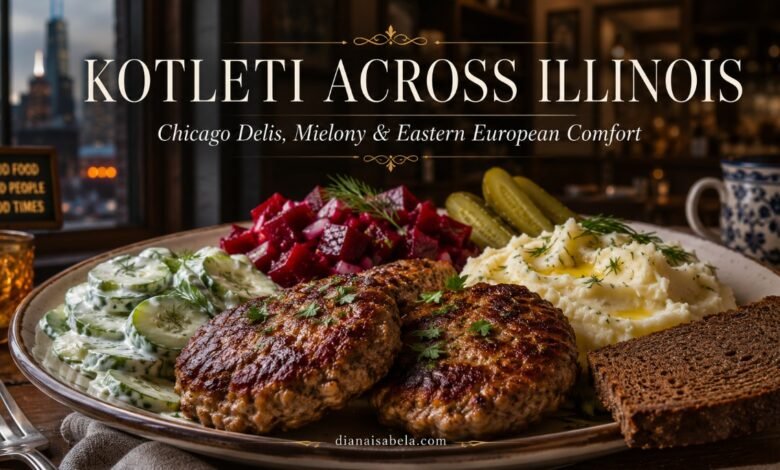
Illinois may be the most entertaining state in America for anyone searching for kotleti, because Chicago has spent generations proving that the word “cutlet” can lead to several entirely different dinners.
Here you can order a Polish kotlet mielony made from ground meat, a kotlet schabowy made from a whole breaded pork cutlet, a chicken cutlet that behaves more like schnitzel, or a Russian-style minced patty that looks instantly familiar to anyone who grew up with kotleti on the family table. The names overlap just enough to create confusion, while the textures are different enough that your fork notices immediately.
That is what makes Illinois such a good place to explore this food. Chicago and its suburbs do not have one neat Russian restaurant district where every answer lives on the same block. Instead, there are Polish restaurants in Schaumburg, Russian dining rooms downtown, Polish groceries in Lemont and Palos Hills, suburban delis in Niles and Prospect Heights, and prepared-food counters where the most useful answer may never appear on a polished restaurant menu at all.
I grew up around a chef, so I learned fairly early that menu terminology only gets you halfway to the truth. If the cook begins with ground pork, chicken or beef, adds onion, perhaps bread or another moisture-holding ingredient, shapes the mixture and browns it in a pan, we are in the same broad domestic world as Russian kotleti. If the cook starts with an intact pork loin and pounds it thin, we have crossed into another branch of the cutlet family.
Both branches deserve dinner. They simply should not be confused with each other.
Schaumburg gives us one of the cleanest current ground-meat cutlet answers through Polish kotlet mielony. Chicago and Lemont are especially useful for ground-chicken catering and prepared food. Downtown Chicago remains excellent for a broader Russian meal. And in the northwest and southwest suburbs, the deli counter is often more useful than a restaurant reservation.
Start with geography
In Illinois, some of the best answers live outside downtown Chicago
Chicago food guides have a habit of treating the suburbs as though they begin only after all interesting civilization has ended. Eastern European food politely ignores that idea. For kotleti, Polish cutlets and prepared deli food, places like Schaumburg, Lemont, Niles, Prospect Heights and Palos Hills can be every bit as useful as downtown Chicago—and sometimes considerably more practical.
This makes Illinois different from a city where one restaurant district dominates the search. The strongest route depends on what you actually want to do. If you want to sit down and order a minced cutlet from a menu, Schaumburg is especially strong. If you want Russian soup, dumplings and a downtown dining room, Chicago works beautifully. If dinner needs to come home in several containers and survive until tomorrow, the suburban market system suddenly becomes the smarter answer.
Opolska serves Polish kotlet mielony made from ground pork, which puts it very close to the texture and domestic logic of Russian kotleti.
Russian Tea Time remains a strong destination for borscht, pelmeni, golubtsi and other comfort food even though the older Pozharskie Kotleti are no longer shown on the current menu.
Celina’s Fresh Market lists Kotlet Mielony z Kury, a ground chicken cutlet, among its catering choices.
Lassak Delicatessen combines Polish hot food with a large European grocery and deli operation.
Deli 4 You spreads the market strategy across several Chicagoland suburbs, which is far more useful than one “best restaurant” if you live nowhere near the Loop.
My practical rule is simple: do not cross half of Chicagoland merely because a restaurant has a prettier website. Start with the strongest evidence near you, then decide whether the trip still makes sense. A good minced cutlet does not become more authentic because you suffered for ninety minutes on I-90.
Northwest suburbs
Schaumburg is where the Illinois search becomes wonderfully uncomplicated
Opolska is one of those places I appreciate because the menu itself explains the vocabulary problem. It lists kotlet mielony as a traditional ground pork cutlet. Nearby on the same culinary family tree are breaded whole-meat cutlets, which makes the distinction visible rather than theoretical.
Opolska Restaurant — Schaumburg
A Polish restaurant with one of the clearest current minced-meat cutlet listings in Illinois: a traditional ground pork kotlet mielony.
How I would order: kotlet mielony with mashed potatoes if I wanted full winter comfort, or buckwheat when I wanted something earthier. Then mizeria, beets or sauerkraut to bring enough acidity and freshness that the plate does not become one uninterrupted conversation about softness.
Restaurant and menu details checked August 2026.
How close is kotlet mielony to Russian kotleti?
Close enough that someone craving Russian-style minced cutlets should take it seriously, but not so close that I want to erase its Polish identity. Both foods belong to the wonderfully practical tradition of turning ground meat into individual patties that can feed a family without requiring an expensive whole cut for every person at the table.
Russian kotleti may be made from beef, pork, chicken or mixtures. Polish mielony is particularly associated with ground pork or pork-heavy combinations. Bread, onion and seasonings can appear in both traditions, and both reward the same kind of sensible cooking: enough moisture, a light hand with the mixture and proper browning without cooking the center until it has the emotional range of cardboard.
To me, the family resemblance is obvious the moment you cut into one. The surface is browned, the center is tender, and the dish makes immediate sense next to potatoes, grains, cabbage, beets or cucumbers. These are not restaurant foods pretending to be domestic. They are domestic foods that happen to be very comfortable in restaurants.
Why catering actually makes perfect sense for this dish
Opolska also offers kotlet mielony as part of its catering selections, and few foods are better designed for a family gathering. The portions are already individual, nobody needs to carve anything, and the same cutlet can sit beside potatoes for one guest, buckwheat for another, and three varieties of salad for the relative who has quietly turned the buffet into a personal research project.
Minced cutlets also reheat far more gracefully than many thin whole cuts of lean meat. For a party, that matters. The objective is not merely to make food that tastes good when it leaves the kitchen. It needs to remain good after conversations run long, somebody arrives late and nobody sits down at exactly the time you imagined when you planned the evening.
Downtown Chicago
Russian Tea Time is worth knowing—but use the current menu, not its digital ghosts
Russian Tea Time is one of Chicago’s established Russian and former-Soviet dining landmarks. It opened in the early 1990s, sits near the Art Institute and Millennium Park, and still offers exactly the kind of food that makes a freezing day in the Loop suddenly feel compatible with human life: borscht, pelmeni, golubtsi, buckwheat and other dishes that understand cold weather intuitively.
Older menu records include Pozharskie Kotleti, delicate ground chicken patties. The current menu I checked no longer lists them. That distinction matters because old restaurant menus have an astonishing ability to survive online long after the kitchen has changed.
Russian Tea Time — Chicago
A longtime downtown destination for Russian and Eastern European comfort food, best approached as a complete dining experience rather than a guaranteed current kotleti stop.
This is one of those occasions where I would happily let dinner change course. If the table already has borscht, pelmeni and something involving mushrooms, butter and potatoes, I am not exactly facing culinary adversity.
Current operation and menu checked August 2026.
Chicago weather has opinions about dinner
January and July do not ask for the same plate. After a winter walk near Michigan Avenue, borscht feels less like a starter and more like municipal infrastructure. Pelmeni with butter or sour cream suddenly seem extremely rational, buckwheat feels comforting rather than austere, and mushroom sauce starts looking like a perfectly reasonable life choice.
That relationship between climate and appetite is one reason Eastern European food feels so natural in Chicago. Immigration history explains how the food arrived; winter explains why some of it feels as though the city was designed around the menu.
Summer changes the balance rather than the cuisine. I still want minced cutlets, but I would rather place them beside cucumber and tomato, chilled cabbage, beets or something pickled than build the heaviest possible plate because tradition supposedly demands it. The same cutlet can work in both seasons. You simply change what surrounds it.
The famous Illinois language trap
Staropolska shows exactly why the word “kotlet” is not enough
Staropolska is useful to this guide because its menu illustrates the problem beautifully. It serves Kotlet Schabowy, which is a breaded pork cutlet made from a whole piece of meat. It also offers chicken and veal cutlets. All belong legitimately to the cutlet family; none should quietly be turned into Russian minced kotleti merely because the English words look convenient.
Staropolska Restaurant — Chicago
A Polish restaurant that makes the difference between minced cutlets and whole breaded cutlets wonderfully easy to understand.
There is nothing disappointing about receiving a beautifully fried pork cutlet unless your imagination had already married a soft minced patty. Most menu heartbreak is really expectation wearing a napkin.
This is also why food words fascinate me. They migrate through languages, pick up regional meanings and sometimes keep several definitions alive at once. Polish can distinguish mielony from schabowy; English often throws them both into “cutlet” and walks away as though its work is finished.
Fortunately, dinner is easier to repair than language. One extra question usually solves the problem.
Chicago & southwest suburbs
Celina’s hides one of the most useful ground-chicken answers inside its catering menu
This is exactly why I do not research dishes like kotleti only through restaurant entrées. Some of the most useful evidence appears in catering menus, prepared-food lists and grocery counters because minced cutlets are fundamentally family food. They scale well, travel well and do not require a dining room to make sense.
Celina’s Fresh Market lists Kotlet Mielony z Kury among its catering meat choices. In plain English: ground chicken cutlet. For someone looking for chicken kotleti-style food—especially for a group—that is a very relevant answer.
Celina’s Fresh Market
A Polish grocery and prepared-food business whose catering menu explicitly includes ground chicken cutlets alongside the sides that make them useful for a full family meal.
A tray of chicken cutlets beside mashed potatoes and cucumber salad is one of those party menus that looks almost modest until everybody quietly goes back for another. “I’ll take half” is usually the opening statement in a negotiation that ends with a full second cutlet.
Catering menu and locations checked August 2026.
Why chicken makes sense for a group
Chicken cutlets are mild enough to sit beside almost any traditional side without fighting for attention. They work with mashed potatoes, buckwheat, beets, cabbage, mushroom sauce and mizeria. They are also easy to portion, which matters more at a buffet than people admit until one relative gets the suspiciously large piece of roast.
The only thing I would protect fiercely is moisture. Chicken does not have the same built-in forgiveness as fattier pork or mixed meat. If the mixture is overworked or overcooked, tenderness disappears quickly. Onion, bread or a panade can help, but technique still decides whether the final cutlet feels delicate or disappointingly dense.
When chicken kotleti are done well, they are not a lighter substitute for the “real” thing. They are their own version, and sometimes exactly the version I want.
Where Chicagoland becomes really useful
The deli counter is not the backup plan—it may be the best plan
Chicago’s Polish and Eastern European food culture is established enough that I would never treat its delis as secondary to restaurants. A good market solves dinner in the way households actually need dinner solved: three cutlets instead of two plated entrées, enough salad for tomorrow, bread, pickles and something frozen for the evening when nobody intends to cook.
This is also where portioning starts to make sense. At a restaurant, food is designed around one person ordering one plate. At a deli, you can buy exactly what your household needs. One person wants one patty, somebody wants two, someone claims not to be hungry and then eats half of yours. The deli has seen this movie before.
Deli 4 You Market — Chicagoland
A European grocery business with several suburban locations, useful when the plan is prepared food and grocery shopping rather than a single restaurant entrée.
The real risk in a Polish market is not leaving without dinner. It is leaving with dinner, breakfast, Sunday lunch, three kinds of sausage and one pastry purchased entirely through eye contact.
Lassak Delicatessen — Palos Hills
A long-running family-owned Polish deli combining homemade hot food with groceries, meats, desserts and catering.
Current business information checked August 2026.
If your natural instinct is to search the deli counter before the dining room, my guide to finding Russian delis is the useful next read.
Choose the evening first
One craving, three completely different Illinois plans
I want a minced cutlet served as dinner
Schaumburg is the strongest straightforward choice. Opolska explicitly identifies its kotlet mielony as a traditional ground pork cutlet, so you do not need to reverse-engineer the menu description. Add potatoes or buckwheat and one bright side, and the problem is solved.
I want several portions to take home
This is where Chicagoland’s deli culture wins. Deli 4 You and Lassak give you the flexibility to buy protein, salad, starch, bread and pickles in household quantities instead of converting every meal into a restaurant event. For kotleti-style food, that may actually be the most natural format.
I need to feed a family or party
Opolska and Celina’s both give you relevant catering routes, with Celina’s especially useful because the menu explicitly identifies a ground chicken cutlet. Before ordering, ask about cutlet size, quantity, lead time and sides rather than trying to calculate portions from a generic “one piece per person” rule. Grandmothers have never standardized serving sizes.
Two Polish words worth remembering
Mielony and schabowy may save you an entire dinner
If you spend any time around Chicago Polish restaurants, two words will eliminate most of the confusion.
Ground or minced
Kotlet mielony is formed from ground meat. This is the Polish cutlet that sits closest to Russian kotleti in construction and texture.
Whole pork cutlet
Kotlet schabowy begins with pork loin, usually pounded and breaded. Think schnitzel family rather than minced kotleti.
That is the practical distinction. One begins as a meat mixture; the other begins as an intact piece of pork. English may happily call both “cutlets,” but your fork will notice the difference immediately.
The reason this happens is historical rather than accidental. The European cutlet family moved through several languages and cuisines, and the meaning evolved differently in different places. Russian everyday usage became strongly associated with minced patties. Polish retained several versions and uses the descriptor to tell you which one is coming.
If you want a deeper comparison, my Russian kotleti vs Russian cutlets guide goes further into the difference.
Bread is not a scandal
Ground cutlets frequently include bread, breadcrumbs or a soaked roll, and I will happily defend this because it is both historically sensible and technically useful. Yes, households used bread to stretch meat. Meat cost money and families needed dinner long before anyone invented “high-protein meal prep.”
But hydrated bread can also help hold moisture and soften the texture. It interrupts the dense structure that ground meat can develop when handled too aggressively. That is one reason a good kotleta or mielony can feel more tender and yielding than a burger even when both begin with minced meat.
The real danger is not the bread. It is continuing to mix the bowl long after everything has come together. I learned that lesson in my father’s kitchen through the deeply scientific childhood method of repeatedly making meat denser than intended until somebody told me to put the spoon down.
Build the plate
Chicago gives minced cutlets an unfairly good supporting cast
The difficulty is not finding a side dish. It is choosing only a few. Polish and Eastern European menus around Chicago make restraint challenging because nearly everything looks as though it belongs beside browned minced meat.
Mashed potatoes
The obvious choice for good reason. They absorb meat juices beautifully and make a particularly convincing partner for pork mielony.
Buckwheat
Earthier and firmer than mashed potatoes, especially good with chicken cutlets or mushroom-heavy sauces.
Mizeria
Cool cucumber salad with creamy tang. It gives pork exactly the freshness and acidity a browned patty appreciates.
Beets
Sweet, earthy and vivid enough to rescue the entire plate from becoming a winter collection in shades of beige.
Sauerkraut
Acidity and crunch beside fatty pork is one of those combinations that requires almost no explanation once you taste it.
Braised cabbage
Warmer, softer and sweeter than sauerkraut, especially good when Chicago weather has stopped pretending to be friendly.
My cold-weather version
On a cold Illinois evening, I would go straight toward kotlet mielony with mashed potatoes and either beets or sauerkraut. Add soup only if you are genuinely hungry, because this is a meal capable of turning “a little something warm” into a three-hour commitment very quickly. Tea afterward makes perfect sense, particularly if you have spent any meaningful time outside.
My summer version
When humidity enters the conversation, I would rather have a ground chicken cutlet with buckwheat, mizeria and perhaps cabbage or tomato. The food stays recognizably Eastern European, but the plate has enough freshness to acknowledge that July exists.
Why Chicago makes this interesting
Eastern European food here is a neighborhood conversation, not one cuisine
Chicago’s immigration history is still visible in the way people shop and eat. Polish food is especially prominent, but the city also carries Russian, Ukrainian, Serbian, Lithuanian, Belarusian, Jewish Eastern European, Georgian and newer Central Asian food traditions. They overlap in grocery aisles, neighborhoods and family histories without becoming interchangeable.
That is the part I find more interesting than treating the entire region as one vague cuisine full of dill and sour cream. Russian kotleti and Polish kotlet mielony genuinely resemble each other. Polish schabowy belongs somewhere else technically. Pelmeni and pierogi are both dumplings, but nobody raised around either needs a lecture to understand that they are not the same thing.
Chicago lets you compare those relationships without flattening them. You can eat a Russian soup downtown, buy a Polish minced cutlet in Schaumburg and bring home Ukrainian or Eastern European groceries from another suburb, all in the same metropolitan area. The differences are part of the pleasure.
When nothing nearby says kotleti
Change the vocabulary before you change the driving radius
In Illinois, the most useful move is often to search differently rather than drive farther. A Polish deli may never use the Russian spelling, yet still sell exactly the minced-meat texture you were hoping to find.
Ask for kotlet mielony. In a Polish restaurant or market, this is the most useful phrase when you want the ground-meat version.
Ask for ground chicken cutlets. This is especially useful at catering counters and prepared-food sections.
Check the hot-food counter before giving up. Chicagoland’s deli infrastructure is too strong to rely only on restaurant menus.
Look in the freezer too. One specialty-market trip becomes much more useful when it solves several future dinners.
Cook them when traffic becomes unreasonable. Eventually a frying pan is a better transportation system than Chicagoland.
For the wider location search, continue with my guide to finding Russian kotleti near you.
If nothing sensible is close, the Russian kotleti recipe is the answer I would choose before spending an evening circling road construction because navigation promised the deli was “only seventeen miles away.”
Protect the texture first. Keep the mixture moist, combine it without overworking it, shape with a light hand and let the first side brown properly before turning. A kotleta does not become more responsible because you keep it in the pan until every trace of juiciness has confessed.
Before you leave home
The five questions that actually prevent disappointment
Do you have kotlet mielony today? This immediately narrows the search to the ground-meat preparation.
Is it pork, chicken or mixed meat? The answer tells you a lot about both flavor and texture.
Is the meat ground, or is this a whole breaded cutlet? One sentence solves most of the terminology problem.
How is it sold? Restaurant plate, individual piece, by weight or as part of a catering order?
Can I order more in advance? Prepared-food counters often need notice if you suddenly decide twenty cutlets sound reasonable.
None of those questions is particularly glamorous. Neither is spending forty-five minutes in traffic only to discover that the cutlet you wanted disappeared after lunch.
Where I would begin
My Illinois shortlist
Opolska first when you want the clearest current restaurant answer: explicitly ground pork kotlet mielony.
Celina’s when ground-chicken cutlets and larger family orders matter more than restaurant service.
Russian Tea Time when you want the wider Russian and Eastern European dinner and do not need kotleti to be the only reason for going.
Deli 4 You when prepared food, groceries and take-home dinner are the real goal.
Lassak when a complete Polish deli experience sounds more useful than one isolated entrée.
If the menu simply says kotlet, do not panic and do not start translating the entire restaurant on your phone. Ask one more word: mielony?
In Illinois, that tiny adjective can save dinner.
Local information checked: August 2026. Restaurant menus, prepared-food selections and catering availability can change, especially at deli counters where food is made in batches. Call before a long trip when one specific cutlet is the reason you are going.
Illinois questions
Russian Kotleti in Illinois FAQ
Where can I find Russian-style kotleti in Illinois?
Schaumburg is one of the strongest places to begin. Opolska Restaurant currently lists Kotlet Mielony, described as a traditional ground pork cutlet. Chicago and Lemont also have a useful ground-chicken catering option through Celina’s Fresh Market.
Where can I find ground-meat cutlets near Chicago?
Opolska in Schaumburg serves Polish kotlet mielony made from ground pork. Celina’s Fresh Market lists Kotlet Mielony z Kury, or ground chicken cutlet, on its catering menu. Polish delis around Chicagoland are also worth checking for daily prepared-food selections.
Is Polish kotlet mielony the same as Russian kotleti?
They are closely related styles of minced-meat cutlet but not identical dishes. Polish kotlet mielony is commonly made with ground pork, while Russian kotleti may use beef, pork, chicken or mixtures. Both are shaped from ground meat and are much closer to one another than either is to a whole breaded pork cutlet.
What is the difference between kotlet mielony and kotlet schabowy?
Kotlet mielony is a ground or minced-meat patty. Kotlet schabowy is made from a whole pork cutlet that is usually pounded and breaded. If you are looking for something similar to Russian kotleti, mielony is the more relevant Polish term.
Does Russian Tea Time in Chicago currently serve kotleti?
The current menu checked in August 2026 does not list the older Pozharskie Kotleti found in historic menu records. Russian Tea Time currently remains useful for Russian and Eastern European dishes such as borscht, pelmeni, golubtsi and chicken meatballs. Call if kotleti are specifically what you want.
Where can I order chicken kotleti for a group in Illinois?
Celina’s Fresh Market lists Kotlet Mielony z Kury, meaning ground chicken cutlet, among its catering meat choices. It has locations in Chicago and Lemont. Confirm quantities, current pricing and required notice directly before planning a large order.
Where should I look for kotleti in the Chicago suburbs?
Schaumburg is especially useful because Opolska serves ground pork kotlet mielony and Deli 4 You also operates a market there. Other useful deli areas include Niles, Prospect Heights, Norridge, Palos Hills and Lemont.
What should I eat with kotleti or kotlet mielony?
Mashed potatoes and buckwheat are excellent warm sides. Mizeria, beets, sauerkraut and cabbage add freshness, acidity or crunch. Pork-based cutlets particularly benefit from something acidic, while chicken cutlets work beautifully with buckwheat and cucumber-based salads.
Should I call a Polish deli before driving there for kotlet mielony?
Yes, especially if the drive is long or minced cutlets are the only thing you want. Deli hot-food counters can rotate dishes or sell out during the day. Ask for kotlet mielony specifically and confirm which meat is used.
What should I do if I cannot find Russian kotleti near me in Illinois?
Try Polish restaurants and delis and ask for kotlet mielony, which is a ground-meat cutlet closely related in style. Prepared-food counters are particularly useful around Chicagoland. If nothing practical is nearby, making Russian kotleti at home may be easier than extending the drive.