Longaniza vs Dominican Salami: What’s the Difference on a Dominican Plate?
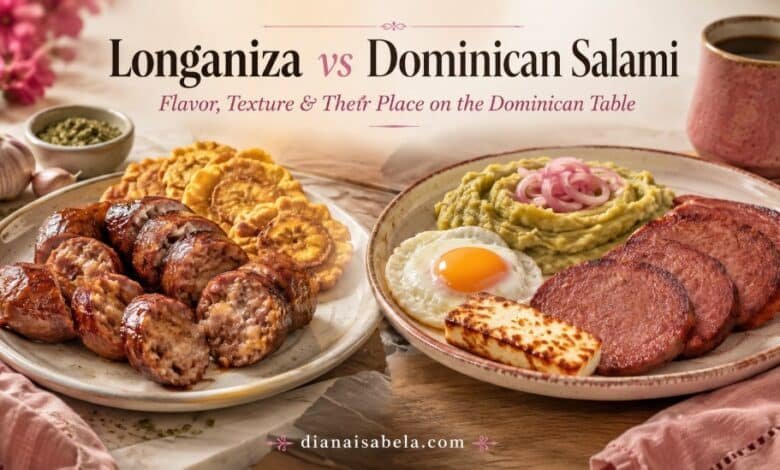
Put Dominican longaniza and Dominican salami on the same breakfast table and I completely understand why a newcomer might assume they are variations of the same thing. Both can be sliced. Both can be fried. Both can land beside plantains. Both are salty, savory and extremely capable of making a sensible breakfast look rather timid.
But they are not interchangeable sausages wearing different outfits.
Dominican longaniza has its own seasoning, casing, texture and strong relationship with fritura, tostones, yuca and other dishes. Dominican salami has a different processed-sausage identity and an especially important place beside mangú, fried cheese and eggs in the classic Dominican breakfast known as Los Tres Golpes.
The easiest way to understand them is not to ask which one is “more Dominican.” Both belong to Dominican food culture. The useful questions are what they taste like, how their textures differ, why frying changes each one differently, which one traditionally belongs in Tres Golpes, what happens when restaurants serve both, and which sausage you should choose when you are staring at a menu and suddenly breakfast feels like an exam.
No. Dominican longaniza and Dominican salami are different sausage products. Longaniza is commonly associated with seasoned pork, garlic, oregano, casing and preparations such as fritura, while Dominican salami has a smoother, more processed texture and is the sausage traditionally associated with mangú in Los Tres Golpes.
They share the table, not the same identity
Dominican Longaniza
Dominican Salami
The confusion makes sense because Dominican cooking gives both products opportunities to meet hot oil and plantain. But once you pay attention to texture and meal context, the distinction becomes much easier.
If you want the longaniza side explained in full before comparing it with another sausage, start with my guide to what Dominican longaniza actually is.
Dominican salami is not deli-counter Italian salami
Dominican salami is its own Dominican sausage product, commonly sliced into rounds and fried rather than served as thin cold charcuterie. That distinction is important because the English word salami immediately makes many readers imagine a dry Italian-style sausage hanging in a deli.
The Dominican breakfast experience is completely different. Thick slices are fried until the surface browns and the edges deepen in color. The interior remains dense and relatively uniform, giving the salami a substantial chew next to very soft mangú.
This is one reason it works so well in breakfast. Mangú itself is deliberately mild and soft. Fried salami arrives with salt, browning, fat and texture. The contrast is almost architectural: one food cushions, the other pushes back.
And because the salami is usually cut into predictable rounds, it is wonderfully practical at the table. One piece of salami, a little mangú, perhaps some onion, a piece of egg — breakfast suddenly becomes a series of small combinations rather than one homogeneous pile.
Longaniza feels much more like sausage in the casing-and-filling sense
Dominican longaniza generally keeps the relationship between casing and seasoned meat very visible. The filling can vary in texture from producer to producer, but the eating experience is still built around that casing, the meat inside it and what happens when the exterior browns.
Longaniza is also more strongly associated with an aromatic seasoning profile. Garlic and oregano recur repeatedly in Dominican preparations, and other acidic or aromatic ingredients may appear depending on the producer or family recipe.
When longaniza is fried, the casing tightens and browns. If the sausage is cut into pieces, exposed surfaces gain their own crisp edges. The interior, meanwhile, still has to remain juicy enough that the sausage does not turn into a very flavorful pencil eraser.
That structure makes longaniza particularly satisfying beside crisp tostones or dense yuca. It also explains why a fried piece of longaniza and a fried round of Dominican salami may both be delicious while offering completely different bites.
The flavor difference is more than “one is saltier”
Dominican longaniza tends to announce its aromatics more clearly. Garlic and oregano are common reference points, while pork richness and rendered fat provide the savory base. Depending on the preparation, acidic seasoning can help brighten that richness.
Dominican salami is also seasoned, of course, but the eating impression is different. Its dense processed texture, salt and frying behavior become a major part of its personality. Especially once browned, it gives mangú a concentrated savory element that does not require a complicated spice explanation to be effective.
Diana’s taste rule: if two foods are both salty, fried and made from meat, that does not mean they taste the same. By that logic, half of brunch would be one ingredient wearing different shapes.
Texture may be the fastest way to understand the difference
Take one bite of each and the taxonomy becomes considerably less annoying.
You are more aware of a casing surrounding seasoned meat. Depending on the sausage, the filling may feel coarse, dense or somewhat crumbly, while frying creates additional variation between the crust and interior.
The inside is generally smoother and more uniform. Frying changes the outside dramatically, but the interior retains that cohesive salami texture rather than behaving like loose sausage filling.
This distinction matters especially when you eat them with mangú. Mangú is so soft that the protein becomes the main source of resistance in the bite. Longaniza adds casing and meat texture; salami contributes dense chew and broad browned surfaces.
Neither is automatically “more tender” or “more authentic.” Producer, slice thickness and frying time matter too much for simplistic rankings.
Hot oil reveals their personalities rather than making them identical
Frying is one reason these two sausages end up visually grouped together. Both look wonderfully at home in a pan. But they respond differently because their structures are different.
Longaniza needs the casing and interior to stay in balance
A good fried longaniza develops browned surfaces while keeping enough moisture inside. Slice it and you create more surface area for browning, which can be delicious, but very small pieces also lose moisture faster.
Overcook the sausage and the casing can become unpleasantly tough while the filling dries. Cook it too gently in an oily environment and you may get pale sausage carrying more grease than crispness.
Salami loves a broad fried surface
Dominican salami is commonly cut into rounds, giving each slice two broad surfaces that can meet the pan directly. Browning on those surfaces intensifies flavor while the edges gain texture.
This shape also makes fried salami especially practical beside mangú. You are not wrestling with a long sausage link at breakfast; you have compact savory rounds ready to combine with plantain, egg and cheese.
The shared word here is therefore fried. The actual fried experience is still different.
Which sausage belongs in Los Tres Golpes?
Dominican salami is the sausage traditionally associated with Los Tres Golpes, not longaniza. The classic breakfast pairs mangú with three fried accompaniments: Dominican salami, queso de freír and egg.
The three “golpes” beside mangú
Mangú is the plantain base around which those three fried companions are assembled. Pickled or sautéed onions commonly add the sharpness that keeps the plate from feeling too heavy.
That distinction is worth protecting because restaurant menus can become creative. A restaurant may add longaniza, replace a protein or offer a larger breakfast combination containing four meats and enough fried food to make the number of “golpes” almost philosophical.
Menu creativity does not rewrite the traditional identity of the original plate. For the dedicated breakfast explanation, see my guide to Los Tres Golpes.
So does longaniza belong at Dominican breakfast? Absolutely
The fact that longaniza is not the canonical salami component of Tres Golpes does not mean longaniza has no business at breakfast. Those are completely different claims.
Dominican restaurant menus can serve longaniza with mangú, eggs, cheese and other breakfast foods, and larger combinations may include longaniza alongside salami rather than forcing diners to choose one sausage forever.
Culinarily, the pairing makes perfect sense. Mangú is soft, relatively mild and excellent at absorbing some of the seasoned richness from longaniza. Onions bring sharpness. Egg softens everything again. Fried cheese contributes another salty texture.
This creates a breakfast that may feel similar in architecture to a classic salami plate while tasting noticeably different because longaniza brings a more aromatic sausage personality.
Which is better with mangú: longaniza or Dominican salami?
Traditional context gives salami the obvious advantage because fried Dominican salami is part of the iconic Tres Golpes combination. But “traditional” and “the only delicious choice” are not synonyms.
Choose Dominican salami
If you want the classic breakfast experience, especially with fried cheese and egg. Its dense texture and salty browned surface are a natural contrast with soft mangú.
Choose longaniza
If you want a more aromatic, sausage-forward plate where casing, garlic, herbs and browned meat play a larger role against the plantain.
If there are two diners, this question becomes delightfully unnecessary. Order both and let the table conduct the comparison.
For the full longaniza-and-plantain logic, I keep that discussion in my longaniza frita with mangú guide rather than turning this comparison into a twenty-minute argument about mashed plantains.
Longaniza has a particularly easy life beyond breakfast
One of the strongest differences in how I think about these sausages is that Dominican longaniza moves very naturally into fritura and composed lunch or dinner plates. Fried longaniza with tostones is an obvious example. Yuca works beautifully with it. Longaniza can also enter rice dishes, mofongo and other preparations where its seasoning influences the rest of the food.
Dominican salami certainly does not disappear after noon. Fried salami can be eaten outside breakfast and used in other Dominican meals. But culturally, its relationship with mangú and Tres Golpes is so recognizable that breakfast becomes one of the fastest ways to explain its role.
Longaniza feels slightly less tied to one iconic plate. It can be breakfast sausage in the morning, fried snack or picadera later, and part of a substantial dinner without seeming to have changed careers.
If the particular craving is a fried restaurant plate rather than a sausage comparison, my U.S. fried longaniza guide is where I keep the location and ordering side of the story.
Can you substitute longaniza for Dominican salami?
You can replace one with the other when the goal is simply to put a flavorful Dominican sausage beside a starch, but the meal will not taste or feel identical.
I distrust any substitution described as “exactly the same.” If the foods were exactly the same, this article could have ended after the second paragraph and I could have gone for coffee.
Which sausage should you actually order?
The answer depends less on which sausage is “better” and more on which part of Dominican food you want to understand.
Order salami when…
You want the iconic mangú breakfast experience, especially with queso frito and egg. This is where Dominican salami has one of its clearest cultural roles.
Order longaniza when…
You want aromatic sausage, browned casing and a plate that can move naturally toward tostones, yuca, fritura or a more sausage-centered meal.
Order both when…
You are sharing breakfast with someone curious and the restaurant offers both. One plate tells you more than twelve adjectives ever will.
For a first Dominican breakfast…
I would start with traditional salami, fried cheese, egg and mangú. Then add longaniza as the second lesson, because understanding the classic makes the variation more interesting.
And no, choosing one does not require joining a sausage team. Dominican food is entirely capable of containing two good ideas at once.
Have a Dominican sausage story I should know about?
I am endlessly curious about the details that live beyond a neat comparison: the longaniza recipe your family swears by, the exact way your mother fries salami, the breakfast combination you always order, a tiny Dominican cafeteria with a wonderful plate, a new restaurant, an unusual way of serving mangú, or a story about why one of these foods matters in your family.
If this article reminded you of a flavor, recipe, place, menu find or Dominican food tradition I should explore, please write to me at info@dianaisabela.com. Photos and local recommendations are welcome too. I will be genuinely happy to hear from you — and together we can keep making this guide to Dominican longaniza, salami and the food around them more useful, delicious and alive.
Is Dominican longaniza the same as Dominican salami?
No. Dominican longaniza and Dominican salami are different sausage products. Longaniza has its own casing, seasoned filling and strong association with foods such as fritura and tostones, while Dominican salami has a smoother, denser texture and an especially important role in traditional mangú with Los Tres Golpes.
Which sausage is used in Los Tres Golpes?
Dominican salami is the sausage traditionally associated with Los Tres Golpes. The classic plate combines mangú with fried Dominican salami, fried cheese and fried egg. Longaniza can appear in larger breakfast combinations or substitutions, but it is not the canonical salami component.
Can you eat Dominican longaniza with mangú?
Yes. Longaniza and mangú make a very natural pairing because mild, soft mashed green plantain contrasts with the sausage’s seasoning, browned casing and meatier texture. It is simply different from the traditional salami-based Tres Golpes combination.
What does Dominican salami taste like?
Dominican salami is savory and salty with a dense, relatively uniform sausage texture. Frying develops browned surfaces and crisp or caramelized edges, making it especially effective beside soft mangú.
What does Dominican longaniza taste like?
Dominican longaniza is typically savory, pork-rich, garlicky and herbal, with oregano commonly associated with its seasoning. Frying adds browned flavor and texture to the casing and exposed meat surfaces.
Which is better with mangú, longaniza or Dominican salami?
Dominican salami is the traditional choice for Los Tres Golpes, while longaniza creates a more aromatic and sausage-forward variation. Both can taste excellent with mangú, but they produce different breakfast experiences.
Can I substitute longaniza for Dominican salami?
You can substitute longaniza when you simply want a flavorful sausage beside mangú or another starch, but the texture and seasoning will change. Replacing salami also means the plate is no longer the classic Tres Golpes combination in its traditional form.
Is Dominican longaniza only a breakfast sausage?
No. Dominican longaniza can be eaten at breakfast, but it is also strongly associated with fritura, tostones, yuca, picadera and other lunch or dinner preparations.
Where can I try fried Dominican longaniza in the United States?
Dominican restaurants, cafeterias, delis and fritura counters are good places to look, particularly in communities with strong Dominican food traditions. Diana Isabela’s U.S. longaniza guide tracks current restaurant options across several states.