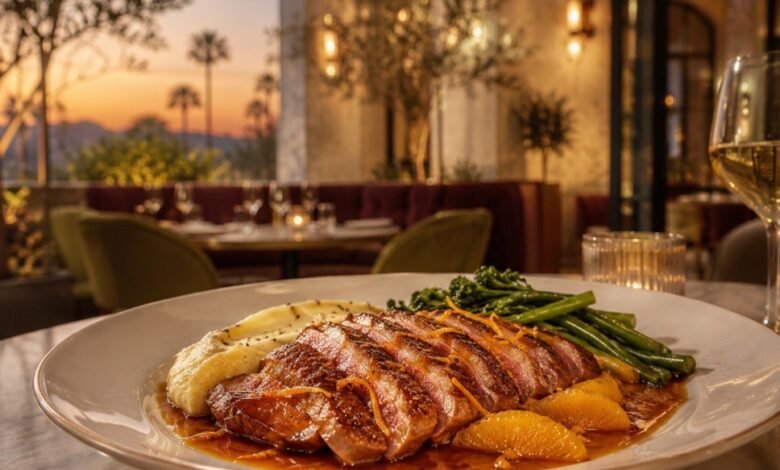
Los Angeles is exactly the kind of city where duck à l’orange should not work as neatly as it does. The weather is too good, the restaurants are too spread out, everyone claims to want lighter food, and somehow a deeply French plate of roasted duck and orange sauce keeps surviving from Santa Clarita to the Valley.
What makes the Los Angeles search interesting is that the current choices sit on different points of the same timeline. Le Chêne is the destination version: an old-school French restaurant among oak trees where roast duck à l’orange still belongs naturally beside a serious wine cellar. Le Sanglier in Tarzana gives you the classic crispy half-duck approach. Mistral in Sherman Oaks has just entered a new era, keeping duck à l’orange but pulling the dish toward confit, acidity and a fresher modern French vocabulary.
So I would not ask only, “Where can I find duck à l’orange in Los Angeles?” I would ask a better question: Do I want the preserved classic, the neighborhood French version, or the restaurant that is actively redesigning the classic for Los Angeles now?
Where Can You Order Duck à l’Orange Around Los Angeles?
The strongest current options I found are not clustered in central Los Angeles. They sit primarily north and northwest of the city core: Santa Clarita, Sherman Oaks and Tarzana. That geography is important enough that I would plan the evening around the restaurant rather than treat these places as interchangeable pins on a map.
Roast Duck A L’Orange in a long-running destination French restaurant with a serious cellar and traditional dining-room atmosphere.
Confit duck leg à l’orange in a newly refreshed French bistro where the new team is deliberately adding more acidity and citrus brightness to classic French food.
Roasted crispy half duckling à l’orange at a French restaurant that has been part of the Valley dining landscape for decades.
If you are searching from Hollywood, Downtown LA, Santa Monica or the Westside, that may sound inconvenient. It also tells you something useful: this is not currently a dish I would chase by simply walking into the nearest fashionable French restaurant. The surviving Los Angeles versions live in restaurants with enough history and menu identity to keep duck à l’orange around.
For the broader national map, including Tampa Bay, New York, Chicago and Florida, see my full U.S. duck à l’orange guide.
Le Chêne: The Los Angeles-Area Version That Still Feels Like a Destination
Le Chêne is not the restaurant I would choose because it is geographically convenient. That would miss the point.
The restaurant opened in 1980 in Santa Clarita and still presents itself as a destination French dining room surrounded by mature oak trees, with an underground wine cellar and a huge French-and-California wine program. The current menu continues to list Roast Duck A L’Orange.
Le Chêne French Cuisine
Diana’s read: This is the version that makes me want to dress for dinner even if nobody technically requires me to. Not because duck à l’orange needs ceremony, but because some restaurants are more fun when you let the room influence the evening. Le Chêne feels less like “I found duck near me” and more like “we are going somewhere for duck.”
The setting changes how I would order
There is something almost geographically rebellious about a French restaurant surrounded by oak trees outside the part of Los Angeles visitors imagine when they hear “LA dining.” I like that.
Le Chêne has spent decades being a destination rather than relying on foot traffic. That makes a dish like roast duck à l’orange feel natural. The menu does not have to explain why French classics belong there; that is already the language of the room.
I would arrive expecting a slower, more complete dinner rather than treating the restaurant as a single-plate mission.
The wine cellar is part of the reason I would go
The restaurant says its cellar holds more than 32,000 bottles and includes more than 900 French and California wines, with Burgundy, Bordeaux, California and Oregon Pinot Noir among the styles represented.
That is unusually relevant to duck à l’orange because the dish is sensitive to wine choice. I would much rather have a server choose between Burgundy, California Pinot or something more aromatic after seeing the actual sauce than order the largest Cabernet on the list simply because roast duck feels expensive enough to deserve one.
Good wine pairing is not a prestige contest. It is flavor engineering with nicer glassware.
Who I would send here
I would choose Le Chêne when:
Mistral: The Most Interesting New Chapter in the Los Angeles Duck Story
Mistral is the restaurant I find most interesting right now because it is not simply preserving itself.
The Sherman Oaks French restaurant originally opened in 1988. After founder Henri Abergel retired in 2025, a new team took over, temporarily closed the restaurant, refreshed the room and reopened it in August 2026. Importantly for us, duck à l’orange survived the transition — but not as an untouched museum piece. The new menu includes confit duck leg à l’orange.
Mistral
*A recent 2026 menu listing shows $51; because the restaurant has just reopened with an updated concept, confirm the current price when reserving.
Diana’s read: If Le Chêne is the archive, Mistral is the redesign studio. The useful part is that the new team does not seem embarrassed by the restaurant’s history. They kept the things worth keeping and then started adjusting brightness, acid and texture — which is exactly how I think good classics should evolve.
The new acidity matters
The reopening team has been unusually clear about what it wanted to change. The kitchen is still French and sauce-driven, but the goal was to add more nuance through vinegars, citrus zest and citrus oils so the food feels brighter and fresher.
That philosophy is almost perfectly suited to duck à l’orange.
The most common failure of the dish is not that duck and orange do not belong together. It is that richness, sweetness and sauce all start moving in the same direction.
More acidity can solve that.
A little vinegar can make duck fat feel less heavy. Orange zest can deliver perfume without adding sugar. Orange oil can intensify citrus aroma without increasing sauce volume. Those sound like small choices, but small choices are often the entire difference between an old dish feeling elegant and an old dish feeling exhausted.
Why confit changes the experience
Confit duck leg is fundamentally different from a sliced breast.
The meat is darker. The texture is softer. The cooking method pushes the duck toward richness and tenderness rather than a rosy center. That means the orange component needs enough brightness to cut through a deeper style of duck.
This is why I would not compare Mistral’s confit price mechanically with a breast or half-duck plate elsewhere.
Same name. Different engineering.
The room has changed too
The refreshed Mistral keeps its French identity but now uses red leather booths, rich wood, custom lighting and French-American artwork. The intention was to make the space feel preserved and refreshed at the same time.
I like that idea more than a total redesign.
Los Angeles destroys and rebuilds itself constantly. Sometimes the most sophisticated thing a restaurant can do is admit that history has texture.
Le Sanglier: The Tarzana Half Duck for People Who Want the Whole French-Bistro Mood
Le Sanglier is the quieter answer.
The Tarzana French restaurant has been around for more than five decades, and its menu continues to include a roasted crispy half duckling à l’orange.
Le Sanglier
*Current menu information lists the half duck at $45; because prices can change, confirm before a special trip.
Diana’s read: This is probably the plate I would choose when I specifically wanted the words “crispy half duck” to mean exactly what they sound like. There is something refreshing about a restaurant menu that is not trying to turn every classic into a concept statement.
Half duck changes the value question
A $45 half duck and a $51 confit leg are not competing purely on price.
The half duck gives you more variety across the bird. Depending on preparation, you may encounter different textures between breast and leg, more skin and a more visibly substantial plate.
Confit, meanwhile, concentrates the experience around dark meat and slow cooking.
One is not automatically better. But if your mental image of duck à l’orange involves an actual roasted bird rather than several precise slices, Le Sanglier is closer to that picture.
The Valley context suits it
Tarzana is not where a visitor automatically goes looking for iconic French cuisine. That is part of why places like Le Sanglier become interesting.
Neighborhood restaurants survive because people return, not because every dinner becomes a social-media event.
There is a different kind of confidence in that.
Which Los Angeles Duck à l’Orange Should You Choose?
I would decide by mood before price.
Why the San Fernando Valley Matters So Much for This Dish
One of the useful conclusions from this search is that the strongest Los Angeles-area duck à l’orange options are not concentrated in Beverly Hills, West Hollywood or Downtown.
They live in the Valley and beyond it.
Mistral is in Sherman Oaks. Le Sanglier is in Tarzana. Le Chêne is farther north in Santa Clarita.
That tells me duck à l’orange survives here less as a fashionable menu keyword and more as part of an established restaurant tradition.
Older French restaurants often developed outside the dining corridors we now think of as “cool.” They built clientele around anniversaries, business dinners, family occasions and repeat guests. Those are exactly the kinds of rooms where a dish requiring a sauce, a proper duck preparation and a little patience can stay alive long after trendier kitchens have moved on.
Then something interesting happens.
Fashion comes back around.
Mistral’s reopening is almost a perfect example. A younger team takes over an old Valley French institution and does not erase the duck à l’orange. Instead, it changes the way the dish speaks.
That is how traditions survive without becoming costumes.
How Much Does Duck à l’Orange Cost Around Los Angeles?
The current and recent menu figures I found place these three versions roughly in the mid-$40s to low-$50s, but they should not be read as identical portions.
*Recent 2026 menu listings. Restaurant prices can change, especially after menu updates or relaunches.
I would not choose Le Sanglier simply because $45 is lower than $51. The half-duck format and confit-leg format create different portion sizes, texture and kitchen work.
What matters is whether you are paying for the dinner you actually wanted.
Classic vs Modern: Los Angeles Gives You Both
I do not think either version wins automatically.
A beautifully rendered half duck with a balanced orange sauce can be more sophisticated than a modern plate containing twelve fashionable ingredients.
And a confit leg with careful acidity can feel far more alive than a technically traditional sauce that tastes like warm marmalade.
Style is not quality.
Execution is quality.
What I Would Actually Check When the Duck Arrives
A menu can tell me the intention. The plate tells me whether the kitchen achieved it.
The complete version of this checklist lives in my guide to judging duck à l’orange properly.
Reservations in Los Angeles: The Drive Matters Almost as Much as the Table
New York restaurant advice is often about subway geography. Los Angeles restaurant advice is about whether you are willing to spend part of your evening staring at brake lights while reconsidering every decision that brought you here.
If duck à l’orange is the reason for the trip, I would do three things before leaving.
How long should you expect to wait for duck?
I would not publish one generic number because it would be fiction.
Confit may require hours of cooking but much of that work happens long before you arrive. Roast duck may involve a completely different mise en place. A half duck could be partly prepared in advance and finished to order. A breast may fit more easily into normal service.
The useful restaurant question is:
That sentence is much more useful than arriving with a stopwatch because someone on the internet declared duck takes exactly 37 minutes.
What Wine Would I Drink With Duck à l’Orange in Los Angeles?
Los Angeles gives you an interesting wine choice because these restaurants represent different versions of the dish.
Mistral also has a curated wine program under sommelier Julia Djaoui as part of its 2026 relaunch, which makes asking for an actual dish-specific pairing much smarter than memorizing one “correct” bottle before arriving.
For cocktails, sparkling options and alcohol-free pairings, I’m keeping a fuller guide at what to drink with duck à l’orange.
What I Would Eat Before and After the Duck
My rule here is simple: if the main course is rich, the rest of dinner does not need to prove anything.
At Le Chêne
I would lean lighter before the duck and let the wine cellar do some of the evening’s drama. This is exactly the sort of restaurant where ordering a rich appetizer, roast duck, heavy side, cheese, dessert and Cognac can begin elegantly and end as a personal endurance sport.
At Mistral
The refreshed menu gives the dinner more opportunities for brightness. An acidic salad, seafood or another lighter starter makes more sense to me before confit duck than doubling down immediately on cream and butter.
I also like the idea of the new adjacent raw bar concept planned for later in 2026: oysters and a cocktail before moving next door for French dinner sounds very Los Angeles in the best possible way.
At Le Sanglier
A half duck is already substantial. I would keep the first course simple and make sure I actually want dessert before ordering it.
I say this as someone who loves dessert.
There is no elegance in eating crème brûlée as an administrative obligation.
For the full side-dish logic, see what I like to serve or order beside duck à l’orange.
Los Angeles Search Results Can Be Messy Too
One of the dangers of searching for a very specific old restaurant dish is that the internet keeps every menu forever like an aunt who refuses to throw away magazines.
Some Los Angeles-area restaurant pages, delivery listings and old reviews continue mentioning duck à l’orange long after a menu has changed.
Taix, for example, appears in recent local discussion around duck à l’orange, but I would not put it into the same “verified permanent current menu” category as Le Chêne without checking the restaurant’s current service status and menu directly. A March 2026 local discussion showed the dish being served, which makes it a useful recent lead rather than enough evidence for me to promise it tonight.
That distinction matters throughout this guide:
Why Duck à l’Orange Fits Los Angeles Better Than It Sounds
The obvious joke is that Los Angeles is supposed to want grilled fish, vegetables, wellness and a dinner that can be eaten before Pilates.
The real city is much more interesting.
Los Angeles has always supported old-school restaurants because the entertainment industry creates its own nostalgia. People care about rooms where things happened. They care about booths, bartenders, old menus, dishes that survived different generations of actors and studio executives.
French restaurants fit that beautifully.
At the same time, LA chefs are unusually comfortable remixing traditions because the city has never been culturally one thing. Citrus, vinegar, Asian ingredients, California produce and lighter cooking techniques slip into French food naturally here.
That is why Mistral’s approach makes sense.
Keep the duck. Keep the sauce. Add more acidity. Add zest. Let the old restaurant stay old enough to have a memory and new enough to stay alive.
That is a very Los Angeles form of preservation.
If I Had One Evening, Which Would I Pick?
If I had never eaten duck à l’orange before, I would probably choose Le Chêne or Le Sanglier first.
I would want to understand the roast-duck grammar before judging a reinterpretation.
If I already knew the dish and wanted the most interesting restaurant story happening now, I would choose Mistral.
The restaurant has just changed hands, changed its room and deliberately changed how it handles richness while keeping the duck à l’orange idea alive. That makes the plate more than dinner. It becomes evidence of how a classic survives a generational handoff.
And that is exactly the kind of food story I love.
Questions About Duck à l’Orange in Los Angeles
Know a Los Angeles Duck I Should Drive For?
Los Angeles is far too large for me to pretend three restaurants are the end of this conversation. If you find a duck à l’orange in the Valley, Hollywood, Beverly Hills, Downtown, Pasadena, the Westside or somewhere completely unexpected, send it to me.
I especially want current finds: restaurant name, neighborhood, menu price, what cut of duck arrived, and whether the dish is permanent or a special. Photos are incredibly useful too — the menu can say “crispy,” but a photograph can tell us whether the skin actually understood the assignment.
If you know a longtime neighborhood French restaurant that search results keep overlooking, I want those names even more. And if your family makes a Los Angeles version with local citrus, wine or a completely different sauce technique, send me that story too.
Write to info@dianaisabela.com. I want this guide to become the kind of local map I would actually trust before committing an hour of my life to the 405.
Where can I get duck à l’orange in Los Angeles?
Current Los Angeles-area options include Le Chêne in Santa Clarita, Mistral in Sherman Oaks and Le Sanglier in Tarzana. Le Chêne offers a traditional roast-duck version, Mistral serves a confit duck leg interpretation, and Le Sanglier lists a roasted crispy half duckling à l’orange.
Does Le Chêne serve duck à l’orange?
Yes. Le Chêne’s current dinner menu lists Roast Duck A L’Orange. The restaurant is located at 12625 Sierra Highway in Santa Clarita and has been serving French cuisine there since 1980.
Does Mistral in Sherman Oaks serve duck à l’orange?
Yes. Mistral’s 2026 menu includes a duck confit preparation with orange and Grand Marnier sauce. The restaurant reopened in August 2026 under a new team that is keeping French classics while adding more acidity, citrus and freshness to the cooking.
Where can I get a half duck à l’orange near Los Angeles?
Le Sanglier in Tarzana currently lists a roasted crispy half duckling à l’orange. Le Chêne also serves a traditional roast-duck à l’orange preparation in Santa Clarita. Confirm the current menu and price before making a special trip.
How much does duck à l’orange cost around Los Angeles?
Recent 2026 menu listings place Le Sanglier’s crispy half duck around $45 and Mistral’s confit version around $51. Le Chêne currently lists Roast Duck A L’Orange on its dinner menu, but menu prices can change, so check directly before visiting.
Which Los Angeles duck à l’orange is the most traditional?
Le Chêne and Le Sanglier are the clearest traditional choices in this guide. Le Chêne offers roast duck à l’orange in a destination French restaurant, while Le Sanglier serves a crispy half duckling. Mistral is the more modern interpretation because it uses confit duck and a refreshed approach to acidity and citrus.
Do I need a reservation for duck à l’orange in Los Angeles?
I recommend reserving if the duck is the reason for your visit, especially because the strongest current options are spread across Santa Clarita and the San Fernando Valley. Check the current menu when booking and ask whether the duck is available throughout dinner service.
How long does duck à l’orange take at a restaurant?
There is no universal wait time. Duck confit, roast duck, half duck and breast preparations use different cooking systems, and much of the work may happen before service. For larger roast preparations, ask whether the dish requires advance notice or extra preparation time.
What wine goes with duck à l’orange?
Pinot Noir is a versatile starting point because its acidity works well with rich duck and citrus. Burgundy, Riesling, Pinot Gris and dry sparkling wine can also work depending on the sweetness and intensity of the sauce. Darker confit preparations may also suit a restrained Syrah.
Is duck à l’orange still popular in Los Angeles?
It is not a universal French-restaurant staple, but several established Los Angeles-area restaurants continue to serve it, and Mistral retained a duck à l’orange interpretation during its 2026 relaunch. The dish survives particularly well in the San Fernando Valley and destination French restaurants.