Why Babydoll Tops Look Frumpy Sometimes—and What Actually Fixes Them

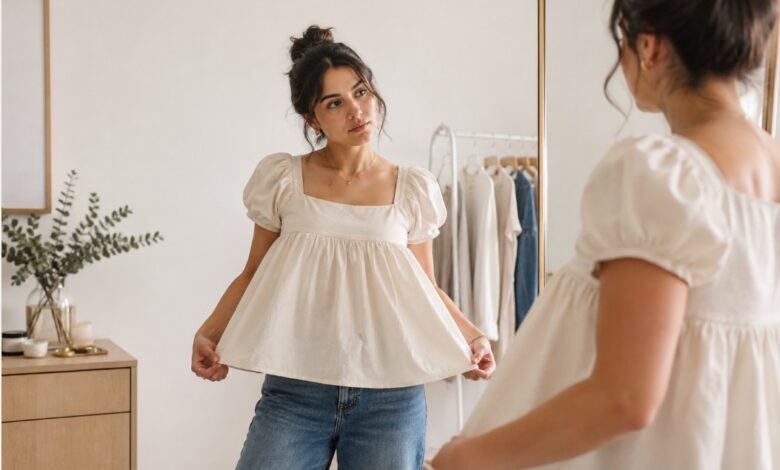
I know the exact fitting-room moment that creates this question.
The babydoll top looks beautiful on the hanger. The neckline is soft, the sleeves have just enough volume, and the fabric falls in that effortless way that makes you imagine wearing it with old jeans, clean flats and possibly a coffee you did not make yourself.
Then you put it on.
Something happens between the mirror and the mood board. The top feels wider than expected. The seam sits somewhere it should not. The sleeves seem to arrive before you do. The hem creates a strange horizontal line across the body, and the jeans that looked perfectly normal five minutes ago suddenly seem involved in a conspiracy.
The immediate conclusion is usually brutal: “Babydoll tops do not suit me.”
I rarely think that is the real problem.
A babydoll top is not one shape. It is a family of shapes built from several moving decisions: where the seam sits, how much fabric is gathered into it, how stiff that fabric is, where the hem ends, how wide the sleeves are, how open the neckline feels, how the top moves when you sit and what the lower half of the outfit is doing underneath it.
When even one of those decisions is wrong, the whole top can appear frumpy. Not because your body is wrong. Not because loose clothing is automatically unflattering. Not because femininity has an expiration date.
The silhouette simply lost its direction.
“Frumpy” is not a body type
Let me begin with the part that matters most: frumpy is not a measurement, a size, an age or a shape of body.
It is an outfit effect.
A size 2 woman can look overwhelmed by a poorly cut babydoll top. A size 18 woman can look beautifully balanced in one with the correct seam and drape. A petite frame may disappear inside stiff tiers, while another petite woman looks elegant in a soft cropped version. A fuller bust can make an under-bust seam sit perfectly when the garment was actually drafted with enough room—or make that same seam ride halfway upward when it was not.
The garment creates the effect. The outfit either supports or interrupts it.
This distinction matters because bad fashion advice often turns a technical clothing problem into a personal body problem. The top pulls across the chest, so the wearer is told her bust is “too large.” The hem sticks out, so the wearer is told she needs to hide her stomach. The sleeves widen the shoulder line, so she is told the shape is “not for her.”
No. Sometimes the top is simply cut badly.
Sometimes the seam is two inches too high. Sometimes the fabric contains enough starch to stand independently. Sometimes the sleeve and hem both expand at the exact same horizontal point. Sometimes the top would be excellent if it ended four inches earlier.
Calling all of that “unflattering” is lazy. We can diagnose it more precisely.
The body is not the styling mistake. The relationship between the garment and the outfit is.
That is also why I do not believe in one universal rule such as “always wear tight bottoms with a loose top.” It sounds helpful until you notice that a beautiful relaxed jean can make a short babydoll blouse look modern, while a skinny jean can make a long stiff top resemble a costume from a decade you did not ask to revisit.
Balance does not always mean one tight piece and one loose piece. It means the eye can understand the silhouette.
That understanding can come from a visible neckline, a clean trouser line, a shorter hem, a structured shoe, a pushed-up sleeve or a fabric that falls inward after moving outward.
Once you stop blaming the body, the outfit becomes much easier to fix.
The hanger hid all the difficult parts
A hanger is very flattering to babydoll tops.
It has narrow shoulders, no bust, no movement and no opinion. The fabric falls directly downward because there is nothing underneath asking it to travel forward, sideways or around a curve.
On the body, everything changes.
The bust pushes the front away from the torso. The under-bust seam may rise. The back may remain longer than the front. The sleeves may lift when the arm moves. A gathered hem that looked fluid on the hanger may project outward because the fabric is now traveling over the chest first.
This is not a failure. Clothing is supposed to change on a body.
The problem begins when the design did not allow for that change.
A well-cut babydoll top gives the bust enough room before the fabric releases. Its seam stays relatively level. The gathered fabric drops rather than launching forward. The armhole allows the sleeve to move without pulling the entire front upward. The hem does not become dramatically shorter in front unless that is an intentional part of the design.
A poorly cut one behaves beautifully only while empty.
The hanger illusion: if the top looks long and fluid on the hanger but becomes short and tent-like on the body, the issue is often insufficient bust depth rather than the overall size. Sizing up may widen the shoulders without giving the front the specific room it needs.
This is why online product photos can be misleading too. The model may be standing with one hip angled, one arm lifted and the fabric manually arranged. The blouse appears to taper because the pose creates a waist that the garment itself does not create.
Turn sideways in the mirror. Sit down. Lower both arms. Let the top settle.
That is when you see the real cut.
The broader babydoll tops wardrobe guide explains the main silhouette family, but here I want to stay with the difficult question: what exactly happens between the hanger and your body that makes one top feel fresh and another feel strangely heavy?
Case one: the seam is trying to define the wrong place
The seam is the control center of a babydoll top.
It decides where the fitted portion ends and where the volume begins. If that line is misplaced, every inch of fabric below it behaves differently.
When the seam sits across the bust
This is the most common problem for fuller busts, but it can happen at any size if the garment is shallow through the front.
The seam is supposed to sit under the fullest part of the bust. Instead, it cuts across it. The gathered section begins too early, so the fabric projects outward from the chest rather than falling below it.
The front becomes shorter. The side seam may pull forward. The blouse can feel both tight and enormous at the same time, which is a particularly insulting combination.
No styling trick can completely correct a seam that is sitting in the wrong anatomical place.
You can sometimes improve the effect by opening the neckline, pushing up the sleeves or using straighter bottoms, but the garment itself remains compromised. A different size may help only if the larger size provides actual bust depth rather than merely extra width.
When the seam sits too low
A low seam can create another kind of heaviness. Instead of releasing just below the bust or high waist, the top remains fitted through part of the torso and then suddenly expands near the stomach or upper hip.
That may work beautifully when the cut resembles a soft peplum. But if the gathered volume is substantial, the seam can create a ledge exactly where you did not want one.
The top may also look as though it was designed for a taller torso.
When the seam curves upward in front
This usually indicates that the bust is borrowing length from the front. The back seam stays level, while the front rises.
Look at the garment from the side. If the hem is dramatically shorter in front and the seam slopes upward, the problem is not simply “too much fabric.” The top needs more room in the front bodice.
I am strict about this because a misplaced seam makes women blame their bodies for a pattern-cutting problem. If the garment cannot locate the bust correctly, the garment failed the fitting test.
Case two: the fabric is not draping—it is defending territory
Two babydoll tops can have the same measurements and look completely different because of fabric.
One falls softly from the seam, moves when you walk and returns toward the body. The other stands outward as if preserving a legally required distance from your torso.
That second top is usually the one people describe as frumpy.
Stiff poplin
Poplin can be crisp and beautiful, especially when the blouse has clean architectural lines. But heavy or highly starched poplin combined with dense gathers can create a lampshade effect.
The fabric does not have enough weight to fall, yet it has enough structure to project.
If the sleeves are also puffed, the top expands in two directions at once: across the shoulder and below the bust.
Thick eyelet
Eyelet looks airy because it contains holes, but the base fabric can be surprisingly firm. Add embroidery around every opening and the material becomes even more structured.
A thick eyelet babydoll top may be lovely in a short, controlled shape. In a long tiered version, it can create more visual weight than expected.
Organza and sheer synthetics
Transparency does not guarantee softness. Organza is sheer but structured. Some polyester chiffons are light but springy. They can float away from the body without falling back.
This may be intentional for a dramatic editorial look. It becomes difficult in an everyday outfit when the rest of the pieces are also soft or voluminous.
Very thin jersey
The opposite can also look frumpy. Fabric that is too limp may collapse under the bust, cling in some places and hang unevenly in others.
Instead of a clear babydoll silhouette, the top looks stretched and tired.
Softness is not enough. The fabric needs enough body to hold the seam and enough drape to fall from it.
The pinch-and-release test: lightly pinch the gathered fabric near the hem and let it go. If it falls back into a soft vertical line, the drape is promising. If it stays projected outward or keeps a hard fold, the top will need more careful styling.
Washing may soften some cotton tops, but do not buy a rigid garment assuming it will transform completely after laundry. Sometimes it relaxes. Sometimes it becomes the same stiff blouse with fewer return options.
Steam can also improve the fall, especially when packaging has created hard folds. But steaming cannot change the basic nature of the textile.
Those fabrics are not automatically perfect, but they are generally easier when you want the babydoll shape without excessive projection.
Case three: the hem is ending exactly where the outfit becomes widest
Hem length can turn a good top into a difficult one within two inches.
A short babydoll blouse may end near the waistband and allow the lower body to continue in a clean line. A medium-length version may cover the upper hip and create a soft, easy proportion. A slightly longer version may stop at the fullest part of the hip or thigh and suddenly make the entire outfit appear wider.
Nothing changed except the stopping point.
The widest-point collision
This happens when the blouse flares outward and ends exactly where the jeans, skirt or trousers also widen.
The eye reads one horizontal line made from the combined width of both garments.
It is especially common with wide-leg pants, low-rise cargos and full skirts. The top does not need to be huge. It only needs to end at the wrong moment.
The front-back imbalance
If the top becomes shorter in front because of the bust, the side hem may slope downward. This can make the blouse look unintentionally high-low and create extra fabric at the back.
From the front, it seems cropped. From the side, it seems long. From the back, it may look as though it is covering an entirely different outfit.
The tunic confusion
Some babydoll tops are long enough to resemble tunics but not long enough to work as dresses. That middle territory can be chic, but it requires a deliberate lower line.
With narrow trousers or leggings, it may look intentional. With medium-wide jeans, the proportions can feel dated because both the top and pants occupy similar visual width.
This does not mean long tops are inherently old-fashioned. It means the hem needs a partner.
When people say a top makes them look wider, the hem is often doing more damage than the gathered volume itself. My article on when babydoll tops create extra visual width goes deeper into that specific concern.
Case four: the sleeves and the hem are both shouting
A babydoll top can handle dramatic sleeves. It can handle a full gathered hem. It can even handle both—if the scale is controlled.
The problem appears when the sleeve volume and body volume begin at similar horizontal points and have similar visual weight.
The shoulder expands. The bust seam expands. The hem expands. The entire upper body becomes one large soft shape with no interruption.
Large puff sleeves
Puff sleeves add width near the shoulders. That can create beautiful balance with a full lower body or make the waist appear smaller by contrast.
But when the blouse also has a high neckline, dense gathers and a long hem, the sleeve may become one volume too many.
Pushing the sleeve slightly upward can help. It reveals the forearm, creates a narrow point and changes the proportion immediately.
Flutter sleeves
Flutter sleeves are lighter, but they can merge visually with the top’s gathered body. If the sleeve falls directly into the side of the blouse, the arm and torso lose separation.
A visible armhole, a little skin at the shoulder or a contrasting camisole can restore structure.
Long balloon sleeves
These can look romantic and expensive when the cuff creates a clear ending. Without a defined cuff, the sleeve may appear as loose as the body of the top.
Roll or push the sleeve to expose the wrist. Add a simple watch or bracelet if you like, but the real styling work comes from showing the narrowest point of the arm.
Cap sleeves
Cap sleeves can create an awkward outward line when they end at the widest point of the upper arm. This is not a body flaw. It is the geometry of the sleeve.
A softer sleeve that falls downward or a slightly longer short sleeve may be more harmonious.
The five-second sleeve test: push both sleeves up or roll them once. If the entire top suddenly looks lighter, the problem was not the babydoll silhouette. It was the amount of unbroken fabric around the arms.
Hair matters here too. Long hair worn fully forward over large sleeves adds another layer of volume near the shoulder. Tucking one side behind the ear or wearing the hair back can reveal the neckline and make the same blouse appear more intentional.
Case five: the neckline has closed the last available window
When a top contains a lot of fabric, the neckline becomes visual breathing room.
A square neck, scoop, soft V or open buttoned neckline reveals a clean area of skin and helps the eye understand where the garment begins.
A high neckline can also be elegant. But when combined with large sleeves, a high bust seam and a full hem, it may close every possible opening in the upper body.
The result can feel heavy even when the fabric is light.
High neck plus puff sleeve
This combination can look romantic and editorial, but it needs simplicity elsewhere. Hair away from the face, no necklace, cleaner bottoms and a narrow shoe can keep it modern.
Square neckline that is too wide
A wide square neck may slide, reveal bra straps or make the shoulders look broader because the horizontal line extends outward.
The issue is not that square necklines are bad. The width simply needs to relate to the shoulder line.
Neckline that collapses
Soft fabric can make a scoop or gathered neckline droop. The top then looks tired rather than relaxed.
Check whether the elastic has enough recovery. If it already looks stretched in the fitting room, it will not become more supportive after wear.
Too many neckline details
Lace, ribbon, ruffle, buttons and a necklace can create visual noise around the face. Remove the necklace first. Open one button if the design allows it. Let one detail remain visible.
Case six: the bottoms are repeating the same sentence
A soft top can work with soft trousers. A loose top can work with loose jeans. A full top can work with a full skirt.
But the two garments should not create exactly the same kind of volume in exactly the same place.
Loose top with baggy jeans
This combination often looks modern, especially when the top is short and the jeans have a clean vertical fall.
It becomes difficult when the blouse covers the upper hip and the denim balloons immediately below it. The outfit has no visible transition.
Choose a shorter top, a more visible waistband or jeans that fall straighter from the hip.
Babydoll top with wide-leg trousers
Wide trousers are not the enemy. The top simply needs enough separation from them.
A cropped blouse, contrasting fabric or defined waistband can create that separation. A long floaty top over equally floaty trousers often needs a stronger shoe or darker color break.
Babydoll top with skinny jeans
This was once treated as the automatic solution: loose top, tight bottoms.
Sometimes it still works. A long tunic-like top with sleek jeans can feel clean and practical.
But skinny jeans can also make the upper volume appear larger by comparison. If the top is short, stiff or highly gathered, the contrast may look more dated than balanced.
Babydoll top with a full skirt
This can be romantic and intentional when the outfit embraces volume. But if you are trying to avoid frumpiness, choose a skirt with a cleaner line: column, straight denim, soft slip or restrained A-line.
A tiered top over a tiered skirt creates repetition. Add puff sleeves and the outfit becomes almost entirely made of expanding horizontal lines.
Shorts and the disappearing hem
If the top is long enough to cover the shorts completely, the outfit may look like an unfinished mini dress. That can be cute, but only when the length and coverage feel deliberate.
Let a little of the shorts remain visible, or choose a shorter blouse.
If the top is short and full: relaxed jeans can work beautifully.
If the top is long and full: try a straighter lower line.
If the pants are very wide: reveal the waistband or shorten the top.
If the skirt is romantic: keep the shoe and accessories quieter.
The broader babydoll styling guide for everyday outfits covers more bottom combinations. Here, the diagnostic question is simpler: are the bottoms continuing the top’s volume without giving the eye a break?
Case seven: the shoes moved the outfit into another decade
Shoes can make a babydoll top look younger, sharper, more romantic, more practical or unexpectedly dated.
This happens because the silhouette already carries associations. Depending on the fabric and details, it can feel bohemian, maternity-inspired, childlike, romantic, Y2K, cottage, minimal or retro.
The shoe confirms one of those stories.
Rounded ballet flats
With a simple modern top and relaxed jeans, they can look delicate and current. With a long floral babydoll blouse, cropped leggings and a soft shoulder bag, they may push the outfit toward an older styling formula.
The difference is not the flat alone. It is the collection of familiar signals.
Heavy platform shoes
A chunky shoe can ground volume, but extremely heavy footwear may make the outfit feel weighed down from both ends.
If the blouse is very full and the pants are cropped, a giant platform can create three separate blocks: top, leg, shoe.
Very delicate sandals
Minimal sandals can make a floaty top feel elegant in summer. But if the trousers are heavy or the top is stiff, the shoe may look too small to support the visual weight above it.
Clean sneakers
These are often the fastest route to a more casual, current look. A slim or moderately substantial sneaker can make a romantic top feel easier without creating a full aesthetic costume.
Loafers
Loafers add structure. They work particularly well with straight trousers, denim and shorter tops.
A very heavy loafer may require a longer pant line, while a slim loafer can work with cropped trousers or a column skirt.
The shoe experiment: photograph the outfit with three shoes—one casual, one structured and one romantic. You may discover that the top is not frumpy at all. It was simply being asked to tell the wrong story.
Case eight: the jacket has crushed the part you liked
Babydoll tops are difficult under layers because their volume often begins exactly where jackets become fitted.
A blazer closes over the bust, compresses the gathers and then allows the hem to escape underneath. A cardigan sits over the puff sleeves and adds another soft line. A short denim jacket ends at the same point as the bust seam and creates a stack of horizontal breaks.
The top may look good alone and frumpy only after layering.
Fitted blazers
A fitted blazer can work if the babydoll top has a low-volume hem and relatively slim sleeves. With a very gathered top, the blazer may create bunching around the waist and hips.
Wear it open, or choose a longer straight blazer that frames rather than compresses the blouse.
Cropped jackets
A cropped jacket can reveal the lower part of the top and create an interesting layered shape. But the jacket hem should not land exactly on the fullest gathered point.
A little separation is useful.
Cardigans
Soft cardigan over soft blouse can become too much softness. Choose a cropped knit, a clear button line or a slightly firmer texture.
Long coats
A long open coat is often easier than a short fitted jacket because it creates vertical lines on both sides of the blouse.
The top remains visible without being squeezed.
Underlayers
A fitted tank beneath a sheer or low-neck babydoll top can improve the silhouette by giving the eye a narrower center.
Choose an underlayer that lies flat. Thick lace edges or multiple straps may add clutter around the neckline.
Before blaming the blouse: take the jacket off and look again. If the top suddenly falls correctly, the layer—not the babydoll shape—caused the problem.
Case nine: every detail is sweet, and none of them gets to be special
A babydoll top may include puff sleeves, lace trim, ribbon ties, tiny buttons, eyelet embroidery, ruffles, a floral print, a scalloped hem and a gathered neckline.
Each detail can be beautiful.
Together, they may make the top look more like a concept than a garment.
The issue is not sweetness. The issue is repetition.
When every part of the blouse is decorative, the eye cannot identify the main feature. Add a delicate skirt, round shoe, pearl jewelry and curled hair, and the outfit becomes visually crowded even if every color is pale.
Choose the leading detail
Maybe the sleeves are the point. Then the neckline can stay clean.
Maybe the lace panel is the point. Then the jewelry can disappear.
Maybe the floral print carries the mood. Then the shoes do not need bows.
Use one practical object
A structured shoulder bag, clean sneaker, straight jean or simple watch can interrupt the sweetness without destroying it.
This is especially useful when the top itself cannot be simplified.
Do not match every motif
A ribbon on the top does not require a ribbon in the hair, bow shoes and a bow bag.
Matching can look intentional. Repetition can also look as though the outfit came as a themed set.
The article on avoiding an overly puffed or cupcake-like babydoll outfit explores this problem from the volume side. Here, the same principle applies to decoration: one lovely idea needs room to be noticed.
Case ten: the palette is soft, but nothing is holding it together
Soft colors suit babydoll tops beautifully. Cream, dusty pink, pale blue, butter yellow, sage, lilac and washed white all support the gentle shape.
But an outfit made entirely of low-contrast soft pieces can lose definition.
Cream blouse, beige pants, pale shoes, blush bag, gold jewelry and loose hair may blend into one warm cloud.
Sometimes that is exactly the desired effect. If it feels frumpy rather than dreamy, add one anchor.
A darker bag
Black may be too sharp for some outfits, but cocoa, charcoal, burgundy, navy or deep olive can give the eye a resting point.
A cooler shoe
Grey, silver or washed black footwear can modernize pale pink, white and cream without dominating them.
Visible denim
Faded blue or charcoal denim introduces texture and familiar structure.
A stronger neckline contrast
A black or grey fitted tank beneath a sheer white top can define the center while preserving the light outer layer.
A single metallic note
Silver earrings, a watch or a small bag buckle can create enough contrast in an otherwise soft outfit.
The goal is not to make every outfit high contrast. It is to give a low-contrast outfit one point of clarity.
The three-mirror test finds the real problem faster than posing
A front-facing mirror is not enough.
Most people adjust a babydoll top from the front until it looks acceptable, take a photo with one knee bent and assume the garment works. Then they see a candid side photo later and wonder where the entire shape changed.
Use three views.
Front: where does the width begin?
Look at the seam, sleeve and hem.
Does the blouse begin widening immediately at the shoulder? At the bust? At the high waist? Does the widest point sit near the arm, chest, stomach or hip?
You are not judging the width. You are locating it.
Side: is the fabric falling or launching?
The side view reveals bust depth, seam placement and fabric projection.
Does the top drop after clearing the bust, or continue outward in a straight line? Is the front much shorter than the back? Does the hem sit level?
This view often explains why a top feels larger than it looks from the front.
Back: is extra fabric collecting somewhere?
Check the yoke, shoulder blades and lower back.
If the top is smooth in front but heavily gathered at the back, the size may be too large through the shoulders. If it pulls across the upper back, the armhole or shoulder width may be too narrow.
The back also reveals whether a bra band, camisole or layer is creating an extra horizontal line beneath thin fabric.
Before buying anything, make four small changes
I love a good shopping solution as much as anyone, but many frumpy babydoll outfits can be improved without adding a single new piece.
Change the sleeve position
Push the sleeve upward, roll it once or expose the wrist.
This creates a narrow point and separates the arm from the body of the blouse.
Change the bag height
A bag hanging at the widest point of the top adds another shape in the same area.
Shorten the strap so the bag sits under the arm, or carry it by hand.
Change the hair
Move the hair behind one shoulder, tie it back or reveal the neckline.
This is especially effective with puff sleeves and high necklines.
Change the shoe
Try the same outfit with a clean sneaker, structured flat or simple loafer.
Shoes often correct the mood even when they do not change the body proportion.
Steam the top
Hard packaging folds can make a gathered blouse project in strange directions. Steam allows the fabric to return to its intended fall.
Remove one accessory
If the top contains several details, remove the necklace, bow, scarf or decorative bag.
The outfit may not need more styling. It may need less competition.
Adjust the waistband relationship
If possible, let a little waistband show. A tiny front lift—not always a full tuck—can create separation between the top and pants.
Do not stuff a thick gathered hem into tight jeans. That creates bulk and distorts the seam.
Try a different bra or underlayer
A bra with a different shape can change where the bust sits relative to the seam. A smoother camisole can prevent lace or thin fabric from catching.
This is not about forcing the body into a new position. It is about checking whether the garment was designed around a different foundation.
My order of operations: sleeves, hair, bag, shoes, waistband. I test those five before deciding the top itself is hopeless. They take less than two minutes and reveal whether the problem is styling or construction.
The fitting room should be slightly unkind
Do not judge a babydoll top only under flattering store lights while standing perfectly still.
Make the fitting room tell you the truth.
Wear the bra you use most often
A top that works only with one special bra may still be worth buying, but you should know that before taking it home.
Bring ordinary bottoms
Try the blouse with jeans or trousers you actually wear. Store styling often pairs difficult tops with the one bottom that makes them look perfect.
Lower your arms
Many product photos and fitting-room poses lift the arms away from the body, which removes fabric from the sides and makes the waist appear narrower.
Stand normally.
Sit
Check whether the seam rises, the neckline opens too far or the hem bunches around the stomach.
Reach forward
If the top pulls across the back or rides upward, the armhole or shoulder width may be wrong.
Look at the side seam
It should remain reasonably vertical. If it swings dramatically toward the front, the blouse may need more room through the bust.
Check the front and back hem
A small difference is normal. A dramatic front rise indicates that the garment is borrowing too much length.
Photograph it without posing
Use the rear camera if possible. Front cameras distort proportions, especially near the edges.
Imagine three outfits
Not fantasy outfits. Real ones.
Can you wear the top with your usual jeans, one skirt or trouser, and shoes already in your closet? If every outfit requires new supporting pieces, the blouse may be a styling project rather than a wardrobe addition.
The diagnosis changes with proportion, not with permission
Different bodies reveal different construction problems. That does not mean certain bodies need permission to wear babydoll tops. It means the same garment behaves differently across height, bust depth, shoulder width, torso length and hip line.
Petite frames
On a petite frame, the most common issue is scale.
The seam may sit too low because the bodice was drafted for a longer torso. The sleeves may contain too much fabric relative to the shoulder. The hem may cover the upper thigh rather than ending near the hip.
A shorter top often helps, but cropped does not need to mean revealing. Look for a compact bodice, a seam that sits high enough and sleeves that do not extend too far outward.
Full-length straight or relaxed pants can lengthen the lower line. Cropped wide pants may create another horizontal break, especially when the top is long.
Smaller accessories are not mandatory, but a compact bag often keeps the outfit from becoming crowded.
Tall frames
Tall women often have more room for long hems and dramatic sleeves, but bodice length can still be wrong.
A seam designed for an average torso may sit too high and create a cropped, maternity-like release. The front may not provide enough vertical room even if the overall size fits.
Look for longer bodices, intentionally extended hems and sleeves that reach the intended point.
Tall frames can carry wide trousers and long skirts beautifully, but the top still needs a clear relationship to the waistband.
Curvy frames
The biggest issue is often simultaneous volume.
If the bust seam is correct and the fabric drapes, a babydoll top can look graceful and easy. If the seam cuts across the bust and the fabric is stiff, the blouse may project from the fullest point and never return inward.
Choose fabrics that fall, necklines that create openness and sleeves that do not add maximum width at the same point as the bust.
Straight or relaxed trousers can create a clean lower line. The goal is not to make the body look smaller. It is to allow the garment’s volume to have a clear starting and stopping point.
Fuller busts
Do not compromise on seam placement.
If the seam sits across the bust, the top is not fitting correctly. A larger size may help, but often the real solution is a style with more front depth, darts, a lower seam or stretch in the fitted bodice.
A V, square or scoop neckline can reduce visual density, though the best neckline is ultimately the one that stays secure and comfortable.
Broad shoulders
Puff sleeves can exaggerate the shoulder line when the sleeve head extends outward. That may be a desired dramatic effect.
For a quieter shape, choose sleeves that fall downward, softer gathers or volume concentrated lower on the arm.
A more open neckline can also prevent the upper body from feeling enclosed.
Narrow shoulders
Some babydoll tops slide or collapse because the shoulder width is too broad. The neckline may gape, and the sleeve seam may sit too far down the arm.
Look for adjustable straps, ties, narrower bodices or styles with a more secure shoulder line.
Short torsos
A high seam may sit very close to the bust and create too much fabric too quickly. A slightly lower, cleaner seam can give the torso more breathing room.
Long torsos
A very high seam may make the top look unintentionally cropped. A longer fitted bodice or lower release point may create better balance.
The point is not to follow a rigid body-type chart. It is to locate the place where the garment’s architecture stops cooperating with yours.
Some tops need styling. Some tops need to go back
Fashion advice sometimes becomes dishonest because it assumes every purchase can be rescued.
Not every babydoll top deserves a styling intervention.
Some are cut badly. Some use the wrong fabric for the amount of gathering. Some place the seam in a location that works on very few bodies. Some look polished only while standing still. Some require so many adjustments that wearing them becomes a part-time job.
Save it when the structure is basically right
The seam sits correctly. The neckline is comfortable. The shoulders fit. The fabric moves. You simply need a different bottom, shoe, sleeve position or accessory balance.
That top is worth experimenting with.
Alter it when one permanent change solves the problem
The blouse is excellent except for length. The sleeves need shortening. The straps need lifting. The body needs slight narrowing at the side seam.
A good tailor can turn an almost-right piece into a wardrobe favorite.
Return it when the seam cannot find your body
If the under-bust seam cuts across the bust, rises every time you move or creates pulling that sizing up does not solve, return it.
Return it when you cannot lower your arms
A top that looks good only in one posed position is not practical clothing.
Return it when the fabric creates a shape you dislike and cannot soften
You should not need to spend months hoping a rigid blouse will become another textile.
Return it when every outfit requires replacement
If the blouse needs new pants, new shoes, a new bra, a new bag and a new personality, it may not belong in your wardrobe.
A difficult garment is not automatically a sophisticated garment.
The best babydoll top feels expressive without becoming exhausting. It gives the outfit movement, softness and shape. It does not ask you to spend the entire day pulling the seam down, rearranging the neckline and checking whether the hem has become a parachute.
When the fit is right, the silhouette looks intentional even when the styling is simple.
That is the real standard.
The mirror does not need a harsher critic. It needs a better diagnosis
When a babydoll top looks frumpy, start with facts rather than insults.
Where is the seam?
What is the fabric doing?
Where does the hem end?
Do the sleeves create another wide line?
Is the neckline giving the outfit any breathing room?
Are the bottoms repeating the same volume?
Did the shoe move the outfit into a mood you did not intend?
Did the jacket crush the shape?
Is every accessory repeating the top’s sweetness?
These questions are useful because they produce real answers. “I look bad in this” produces nothing except a worse afternoon.
You may discover that the top needs different jeans. You may discover that the sleeve looks better pushed up. You may discover that the entire problem was a bag hanging at the widest point. You may discover that the seam is wrong and the blouse deserves to return to the store without another minute of emotional negotiation.
That is still a successful fitting.
Good personal style is not the ability to make every garment work. It is the ability to understand why one does—and why another does not.
Questions and answers
Why does my babydoll top look frumpy?
A babydoll top often looks frumpy when the bust seam is misplaced, the fabric stands away from the body, the sleeves add too much width or the hem ends where the bottoms also widen. Look for the exact point where the silhouette loses direction before changing the whole outfit.
Do babydoll tops make everyone look bigger?
No. The gathered shape adds visible fabric, but that is not the same as making every body look larger. Seam placement, fabric stiffness, hem length and the shape of the bottoms determine whether the volume looks soft and intentional or heavy.
How should the seam of a babydoll top fit?
The seam should usually sit under the fullest part of the bust rather than cutting across it. It should remain reasonably level and should not ride upward every time you move. If the seam crosses the bust, the garment may need more front depth or a different cut.
Can I fix a babydoll top that is too long?
Sometimes. Try straighter bottoms or reveal a little waistband first. If the top fits well everywhere else, professional hemming can improve the proportion. Leave enough length below the gathered seam so the top still keeps its babydoll shape.
What bottoms make a babydoll top look less frumpy?
Straight jeans, relaxed denim with a clean fall, column skirts and softly tailored trousers are reliable choices. Wide-leg pants can also work when the waistband is visible or the top is shorter. The best bottom creates a clear line instead of repeating the top’s widest point.
Why does my babydoll top look good from the front but bad from the side?
The side view may reveal that the bust is pushing the front outward, the seam is rising or the fabric is too stiff to fall back toward the body. Compare the front and back hem. A dramatically shorter front often means the blouse needs more bust room.
Are puff sleeves too much with a babydoll top?
Not automatically. Puff sleeves become difficult when the neckline is closed, the hem is very full and the fabric is stiff. Pushing the sleeves up, exposing the wrist or simplifying the lower half can make the volume feel more deliberate.
Can a tailor make a babydoll top more flattering?
A tailor may be able to shorten the hem, adjust straps, narrow the sides or reduce sleeve volume. Alterations are less useful when the under-bust seam is fundamentally too high, the shoulders are badly cut or the fabric itself creates the unwanted shape.
What shoes make a babydoll top look more modern?
Clean sneakers, simple loafers, structured flats and minimal sandals can make the silhouette feel current. The best choice depends on the bottoms. A very decorative shoe may make a sweet top feel costume-like, while an extremely heavy shoe can overwhelm it.
When should I return a babydoll top instead of styling it differently?
Return it when the seam cuts across the bust, the neckline will not stay secure, the top rides upward with normal movement or the fabric creates a rigid shape you dislike. Styling can improve proportion, but it cannot repair a garment that does not fit its basic structure.