Looking for kisir bulgur salad near me? Start with Turkish restaurants, Turkish bakery-cafés, halal Mediterranean kitchens, and prepared-food counters, then search several spellings: kısır, kisir, Turkish bulgur salad, and Turkish-style tabbouleh. Kısır is not listed consistently, and some restaurants prepare it only as part of a vegan bowl, mezze spread, catering tray, or rotating cold-appetizer selection.
Checked July 29, 2026: menus, prices, addresses, and daily availability can change. Call before making a special trip, especially when kısır appears inside a bowl or on a rotating prepared-food menu rather than as a permanent standalone item.
The most reliable way to find kısır today
The most reliable nearby option is a business whose current official menu names kısır and whose location details can be confirmed. In this guide, Kestane Kebab in Greenpoint, Brooklyn, provides the clearest standalone listing: “Kisir Salad” in the cold-appetizer section for a published price of $10.00. Mezè in Washington, D.C., lists a distinctive beet variation called “Pancarlı Kısır,” while El Turco in Miami identifies kısır as part of its Vegan Bowl rather than promising a separate side.
Best first search: “kisir salad near me” + “Turkish restaurant,” then open the cold appetizers, salads, vegan bowls, mezze, sides, and catering sections.
Kısır is often prepared in batches. A restaurant may still serve Turkish food every day while offering kısır only on selected days, for catering, or until the day’s batch sells out. That is why a phone call matters more for kısır than for a permanent grilled entrée.
The important distinction: a useful near-me guide should not pretend that every Turkish restaurant serves kısır every day. The real skill is learning where the dish tends to appear, how to recognize it under different menu wording, and how to confirm the exact format before driving across town.
Kısır occupies an unusual place in Turkish food culture. It is familiar, affordable, and widely made at home, yet it is not always treated as a permanent restaurant essential in the United States. Many restaurant menus are built around foods that travel predictably through online ordering systems: kebabs, pide, lahmacun, lentil soup, hummus, and baklava. Kısır may be prepared for lunch service, weekend brunch, women’s gatherings, community events, catering trays, or a cold display case without receiving its own indexed page. A weak search result therefore does not necessarily mean the dish is absent from the city. It often means the dish is being sold in a format that search engines do not describe well.
The best search strategy starts with the business model rather than the dish name alone. A formal kebab restaurant may offer one small appetizer portion. A bakery-café may prepare kısır in the morning and sell it by the container until the batch is gone. A Turkish grocery may place it beside mercimek köftesi, stuffed grape leaves, eggplant dishes, and börek in a refrigerated prepared-food case. A caterer may never list an individual serving but may quote a half tray for a party. Each of those sellers answers a different version of the “near me” request, and each requires different questions about quantity, freshness, pickup, and price.
For a first-time diner, the clearest order is a standalone side because the flavor and texture are easy to judge. For someone who already knows the dish, a mezze platter can be more useful because kısır is tasted alongside creamy, smoky, crunchy, and warm foods. A bowl works best when convenience matters more than comparison. Catering is the strongest format for groups because several small restaurant portions can become expensive and may not pack neatly. The guide therefore evaluates the listings by what they help the diner accomplish, not by pretending that one business is universally “best.”
Choose by the kind of order you actually need
Best confirmed standalone order: Kestane Kebab in Brooklyn lists Kisir Salad as its own cold appetizer for $10.00.
Best unusual regional-style variation: Mezè in Washington, D.C., lists Pancarlı Kısır, a Turkish wheat-bulgur salad with beet and chopped vegetables.
Best composed vegan meal: El Turco’s Vegan Bowl includes kısır with cucumber, lettuce, pomegranate sauce, sarma, hummus, köpoğlu, fried vegetables, garlic yogurt, and pide bread. Confirm vegan modifications because garlic yogurt and bread are part of the described bowl.
Best Florida standalone lead outside Miami: Turkish Flame Mediterranean Restaurant in Indian Rocks Beach has an official kısır product page, but the current price is not reliably displayed in accessible menu text. Call before visiting.
Best budget-confirmed option in this guide: Kestane Kebab at $10.00, based on the currently published official listing checked July 29, 2026.
Best format for sharing: A catering tray or mezze spread can be more practical than several small restaurant portions. Ask Turkish caterers whether kısır is available by half tray, full tray, pound, or guest count.
What kısır costs at restaurants and prepared-food counters
The lowest confirmed current price in this guide is $10.00 for a standalone Kisir Salad at Kestane Kebab in Brooklyn. A dependable national price range cannot be calculated from the limited number of current official listings because many businesses omit kısır prices online, include it only inside bowls, or sell it as a rotating prepared food.
Practical price expectation: use $10.00 as a verified standalone reference point, not as a universal average. For bowls, mixed mezze, and catering trays, check the selected location’s current menu or call.
Why prices are difficult to compare
A small cold-appetizer portion is not equivalent to a full vegan bowl, a mixed mezze plate, a deli container sold by weight, or a catering tray. Restaurant prices may also include table service, bread, garnish, or a composed plate, while market counters may charge by weight and package accompaniments separately.
Standalone appetizer: usually the easiest format to compare because the menu names one portion and one price.
Vegan or mezze bowl: the price covers several components, so the cost cannot be assigned to kısır alone.
Prepared-food counter: may be priced per pound, per container, or by portion size.
Catering: may be priced by half tray, full tray, guest count, or pound. Ask what serving utensil, garnish, lettuce, and delivery are included.
Delivery apps: prices and fees may differ from the restaurant’s direct ordering menu.
A compact comparison before you call
Kestane Kebab — Greenpoint, Brooklyn.
Dish: Kisir Salad.
Published price: $10.00.
Format: standalone cold appetizer; dine-in, pickup, and delivery options are promoted by the restaurant.
Phone: (718) 349-8601.
Best for: the clearest low-cost individual order.
Mezè — Adams Morgan, Washington, D.C.
Dish: Pancarlı Kısır, described as Turkish wheat bulgur salad with beet and chopped vegetables.
Published price: check the current menu or call.
Format: shareable Turkish and Mediterranean meze; pickup and delivery links are available.
Phone: (202) 797-0017.
Best for: a beet-forward restaurant variation and a larger meze dinner.
El Turco — Miami Design District.
Dish format: kısır inside the Vegan Bowl.
Published price: check the selected location’s current menu.
Format: composed bowl with several Turkish cold and cooked items; direct ordering available.
Phone: (786) 703-5866.
Best for: trying kısır as part of a full lunch or dinner rather than ordering it alone.
El Turco — Upper Buena Vista, Miami.
Dish format: ask whether the Vegan Bowl and a separate kısır side are available at this location.
Published price: check the current menu or call.
Format: dine-in, pickup, delivery, and catering.
Phone: (305) 846-7510.
Best for: a relaxed Turkish meal with several mezze-style components.
Turkish Flame Mediterranean Restaurant — Indian Rocks Beach, Florida.
Dish: Kisir on the restaurant’s official ordering site.
Published price: check the current menu or call.
Format: Turkish and Mediterranean restaurant; verify pickup and standalone portion details.
Phone: (727) 330-6000.
Best for: a confirmed Florida Gulf Coast lead outside South Florida.
Where to order kısır: detailed restaurant notes
Kestane Kebab — Brooklyn, New York
Address: 208 Franklin St, Brooklyn, NY 11222
Neighborhood: Greenpoint
Phone: (718) 349-8601
Menu name: Kisir Salad
Description: cracked bulgur wheat with onion, cucumber, bell pepper, tomato, parsley, and herbs
Published price: $10.00
Format: standalone cold appetizer
Service: restaurant dining, direct ordering, pickup, and delivery coverage promoted on the official site
Best for: one person trying kısır for the first time, a low-cost add-on to kebab, or a takeout side
Verification: Menu confirmed; price confirmed; address confirmed; phone confirmed; availability requires a call
Checked: July 29, 2026
Kestane Kebab is the simplest option to understand before ordering because kısır is not hidden inside a platter or bowl. The ingredient description points to a vegetable-forward version. The official listing does not promise lettuce leaves, lemon wedges, pomegranate molasses, or bread with the order, so ask what accompanies the portion.
View official Kisir Salad listing · Get directions · Call Kestane Kebab
Mezè — Washington, D.C.
Address: 2437 18th St NW, Washington, DC 20009
Neighborhood: Adams Morgan
Phone: (202) 797-0017
Menu name: Pancarlı Kısır, also presented as Turkish-style tabbouleh
Description: Turkish wheat bulgur salad with beet, tomatoes, cucumber, peppers, spring onions, and parsley
Published price: Check the current menu or call
Format: small-plate meze intended for sharing
Service: dine-in, pickup, delivery, group dining, and catering links are offered by the restaurant
Best for: diners who want a beet-based variation and a full Turkish meze table
Verification: Menu confirmed; address confirmed; phone confirmed; all-halal kitchen confirmed by the restaurant; price requires confirmation
Checked: July 29, 2026
“Pancarlı” means beet-based, so this is not the most neutral benchmark for every version of kısır. The beet can deepen the color, add earthy sweetness, and soften the sharper tomato-and-pepper profile associated with many classic versions. Because Mezè’s menu is designed for sharing, ask how many people one order comfortably serves.
View the official menu · Get directions · Call Mezè
El Turco — Miami Design District
Address: 140 NE 39th St #238, Miami, FL 33137
Area: Miami Design District
Phone: (786) 703-5866
Menu position: kısır inside the Vegan Bowl
Confirmed bowl components: kısır, cucumber, lettuce, pomegranate sauce, sarma, hummus, köpoğlu, fried tomatoes, green pepper, eggplant, garlic yogurt, and warm pide bread
Published price: Check the selected location’s current menu
Format: composed bowl rather than a guaranteed standalone kısır side
Service: dine-in, direct pickup or delivery ordering, and catering
Best for: a complete Turkish vegetarian-style meal with several textures and flavors
Verification: Kısır component confirmed; address confirmed; phone confirmed; separate portion requires confirmation
Checked: July 29, 2026
The name “Vegan Bowl” should not replace a direct allergen or ingredient conversation. The restaurant’s own description mentions garlic yogurt and pide bread among the bowl components. Ask whether the current version is fully plant-based, whether the yogurt is omitted or substituted, and whether kısır can be ordered separately.
Check the official ordering menu · Get directions · Call the Design District location
El Turco — Upper Buena Vista, Miami
Address: 5026 NE 2nd Ave, Miami, FL 33137
Area: Upper Buena Vista / Little Haiti area
Phone: (305) 846-7510
Menu position: check the current location menu for the Vegan Bowl and kısır availability
Published price: Check the current menu or call
Format: likely part of a composed bowl when offered; standalone ordering is not guaranteed
Service: dine-in, pickup, delivery, and catering
Best for: diners combining kısır with sarma, hummus, vegetable dishes, pide, and Turkish drinks
Verification: Restaurant and phone confirmed; group menu evidence confirms the kitchen prepares kısır; location-specific availability requires a call
Checked: July 29, 2026
El Turco operates more than one format and location, so select the correct pickup address before paying. A dish visible at the Design District location may be configured differently or unavailable at Upper Buena Vista on a particular day.
Check El Turco locations and menu · Get directions · Call Upper Buena Vista
Turkish Flame Mediterranean Restaurant — Indian Rocks Beach, Florida
Address: 2699 Gulf Blvd, Indian Rocks Beach, FL 33785
Area: Pinellas County / Florida Gulf Coast
Phone: (727) 330-6000
Menu name: Kisir
Published price: Check the current menu or call
Format: official product listing; confirm portion size and accompaniments
Service: restaurant service and online ordering; verify current pickup details
Best for: a Florida option outside Miami and a meal with kebabs, lahmacun, hummus, or other Turkish specialties
Verification: Official kısır product page confirmed; address and phone cross-checked; price and daily availability require confirmation
Checked: July 29, 2026
The official ordering site confirms the dish name but does not expose enough accessible text to verify the current price or serving details. Ask whether the order includes lettuce, lemon, bread, or garnish and whether it is made daily.
View the official kısır listing · Get directions · Call Turkish Flame
City searches work best in layers. First search the exact name and spelling variants. Then search menu sections and business types. Finally, call the strongest Turkish kitchens even when the dish is absent online. A restaurant with mercimek köftesi, multiple cold meze, women’s brunch catering, or large Turkish group menus is a more plausible lead than a generic Mediterranean restaurant whose menu is limited to hummus, falafel, and shawarma.
Search results should also be checked at the location level. Multi-location businesses may use one promotional page for all restaurants even though menus differ by neighborhood. Delivery platforms may display items from a virtual or outdated menu. Before paying, match the restaurant name, street address, phone number, and selected pickup location. This simple check prevents the common mistake of finding the right dish at the wrong branch.
Searching beyond the four confirmed menus
A city can have many Turkish restaurants and still have few searchable kısır listings. Kebab, hummus, shepherd salad, lentil soup, and baklava are more likely to appear on permanent digital menus. Kısır may remain a home-style, catering, bakery-café, lunch-counter, or rotating mezze item.
New York City and northern New Jersey
Begin with Greenpoint, Sheepshead Bay, Sunnyside, Astoria, Paterson, Cliffside Park, Edgewater, and Jersey City. Search “kisir salad,” “Turkish cold appetizers,” and “Turkish catering tray.” Kestane Kebab is the strongest standalone menu confirmation in this guide.
Washington, D.C., Maryland, and Northern Virginia
Search Adams Morgan, Georgetown, Arlington, Alexandria, and Fairfax-area Turkish restaurants. Mezè provides a confirmed beet-based version. Ask other meze-focused kitchens whether kısır appears on group menus or catering packages even when it is absent from dinner menus.
Miami and South Florida
Search Miami Design District, Upper Buena Vista, North Miami, Boca Raton, Fort Lauderdale, and Turkish catering businesses. El Turco confirms that its kitchen prepares kısır as a bowl component, but location-specific availability should be checked before visiting.
Boston and New England
Look beyond standard restaurant menus. Turkish bakery-cafés, community caterers, and markets in Cambridge, Watertown, Waltham, Brookline, and surrounding areas may be better leads. Ask for “kısır by the pound” or a “kısır catering tray.”
Chicago
Search Turkish restaurants in Wicker Park, Lakeview, Andersonville, and nearby suburbs, then call businesses with broad cold-meze or catering menus. Do not assume that a generic bulgur side is kısır; Chicago menus frequently use bulgur as a warm side for grilled meat.
Los Angeles and Southern California
Check Turkish and Mediterranean restaurants in Westwood, Beverly Hills, Glendale, Orange County, and Long Beach. Use the terms “Turkish bulgur salad,” “kisir catering,” and “Turkish ladies’ tea catering,” because kısır is frequently associated with gatherings and prepared spreads.
San Francisco Bay Area
Search Turkish cafés, caterers, and specialty markets around San Francisco, Berkeley, Oakland, Palo Alto, and San Jose. Prepared-food counters may rotate kısır in and out rather than keeping it on an indexed menu.
What kısır is—and why it does not taste like plain bulgur
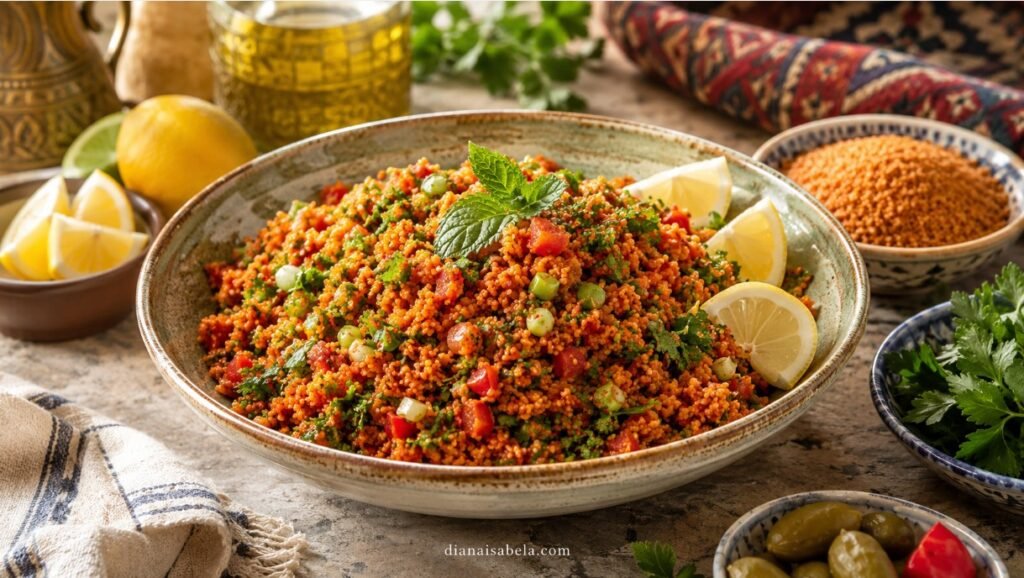
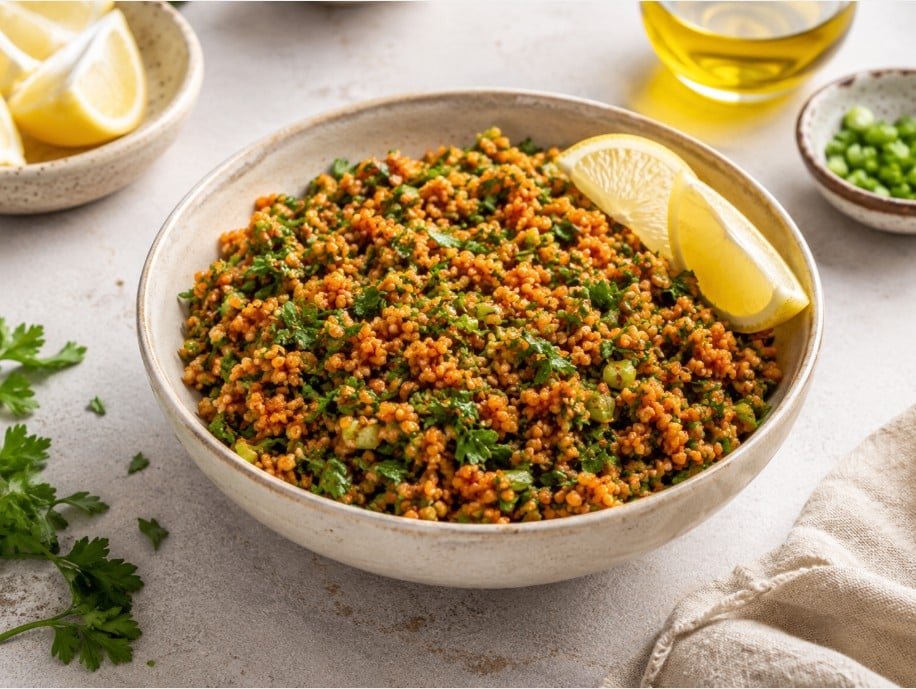
Kısır is a Turkish salad made from fine bulgur seasoned with tomato paste, red pepper paste, lemon, olive oil, herbs, vegetables, and often pomegranate molasses. It is generally served cool or at room temperature as a mezze, side, snack, light lunch, or component of a larger spread.
The fine bulgur absorbs seasoning without being simmered like a warm pilaf. Tomato or pepper paste gives the grains a red-orange tone and concentrated savory flavor. Lemon and pomegranate molasses provide acidity. Parsley, mint, and green onion keep the salad fresh, while cucumber, tomato, lettuce, or other vegetables may appear depending on the cook and region.
What kısır tastes like
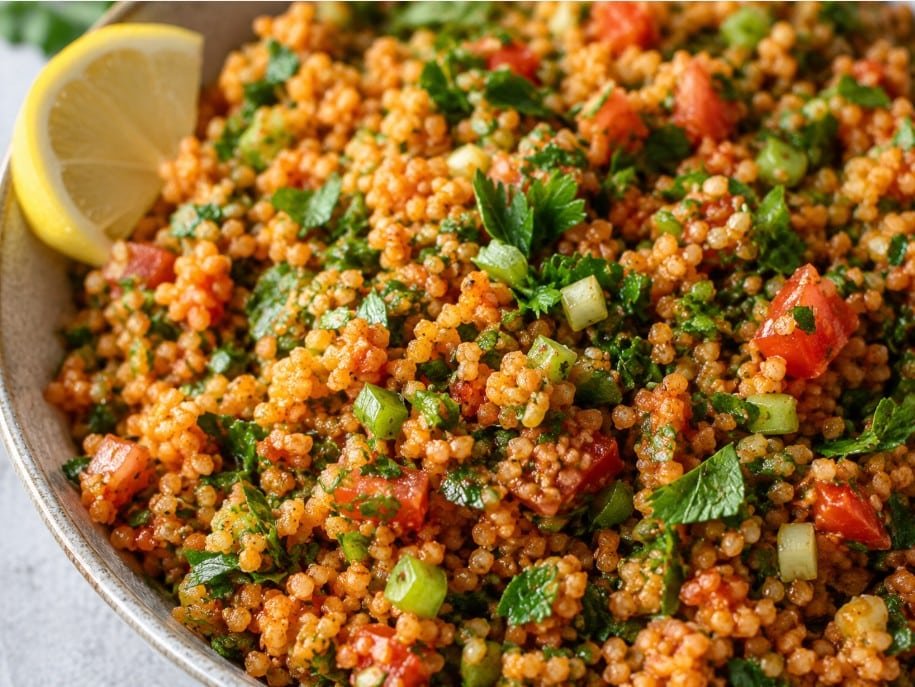
A balanced kısır tastes tangy, savory, herbaceous, and gently spicy. Some versions lean brighter and more lemony; others are deeper, sweeter, and fruitier because of pomegranate molasses. Pepper paste can add warmth without making the dish aggressively hot.
What the texture should be
The grains should be tender but still distinguishable. Kısır should hold together on a fork or lettuce leaf without becoming wet porridge. Fresh herbs and vegetables should add lift and occasional crunch. A dry, chalky center suggests insufficient hydration; a gummy mass suggests too much liquid, rough mixing, or prolonged storage.
How kısır is normally served
Kısır may arrive in a small bowl, shaped scoop, lettuce cup, mezze plate, vegan bowl, or catering tray. Lemon wedges and crisp lettuce are common companions but are not guaranteed. Restaurant versions may add beets, pomegranate seeds, cucumber, chopped peppers, or decorative herbs.
The flavor architecture matters more than a rigid ingredient checklist. Fine bulgur is the body of the dish, but paste, acid, herbs, oil, and resting time determine whether the result tastes lively or flat. Tomato paste contributes depth and color. Red pepper paste can add sweetness, savoriness, heat, or all three depending on the variety. Lemon supplies immediate brightness, while pomegranate molasses can add darker fruit acidity and a rounded sweet-sour finish. Olive oil carries those flavors through the grains. Parsley, mint, green onion, tomato, cucumber, or pepper provide freshness, but the precise combination changes from cook to cook.
That flexibility explains why two authentic restaurant versions can look different. A southeastern-leaning version may be darker, more intense, and more generous with pepper paste. A lighter café version may emphasize lemon, parsley, cucumber, and crisp lettuce. Beet kısır is a modern or restaurant-specific interpretation rather than the single standard by which every bowl should be judged. Some cooks serve kısır loose and fluffy; others knead and rest the mixture until it can be shaped into a neat scoop. Neither presentation alone proves quality. The useful question is whether the grain is fully hydrated, the seasoning is integrated, and the salad still tastes fresh.
Kısır also changes as it rests. Freshly mixed kısır can taste sharp because the lemon, pepper paste, and onion have not settled into the bulgur. After resting, the grains absorb the dressing and the flavors become more unified. Too much storage, however, can flatten herbs, release water from vegetables, and turn the texture dense. That is why asking when the batch was made is not unreasonable at a market counter. A same-day batch is often more important than an elaborate garnish.
Kısır is not simply “Turkish tabbouleh.” The comparison helps unfamiliar diners find the dish, but it can also create the wrong expectation. Tabbouleh is usually parsley-led, very green, and relatively light on grain. Kısır is generally bulgur-led, paste-seasoned, and red-orange. Kısır also tends to feel denser and more substantial on the plate. The two dishes share herbs, bulgur, lemon, and a cool serving temperature, but their proportions and flavor structures are different enough that a diner searching only for tabbouleh may miss the Turkish dish entirely.
Kısır is equally different from warm bulgur pilaf. Pilaf is cooked as a hot side and may use broth, butter, tomato, onions, or peppers. Kısır uses fine bulgur that is softened and dressed for a cool salad. On a digital menu, the words “bulgur,” “cracked wheat,” or “spicy bulgur” are therefore not enough. Look for herbs, lemon, tomato or pepper paste, pomegranate molasses, lettuce, or a cold-appetizer placement. Those signals make kısır more likely.
A Note From Diana: Kısır is the kind of dish I would order to test the whole cold-meze side of a Turkish kitchen. It reveals whether the restaurant understands acidity, fresh herbs, pepper paste, and texture—not just grilling. I would pair one portion with something creamy, something crisp, and one warm item rather than treating it as a lonely side salad.
How menus hide kısır in plain sight
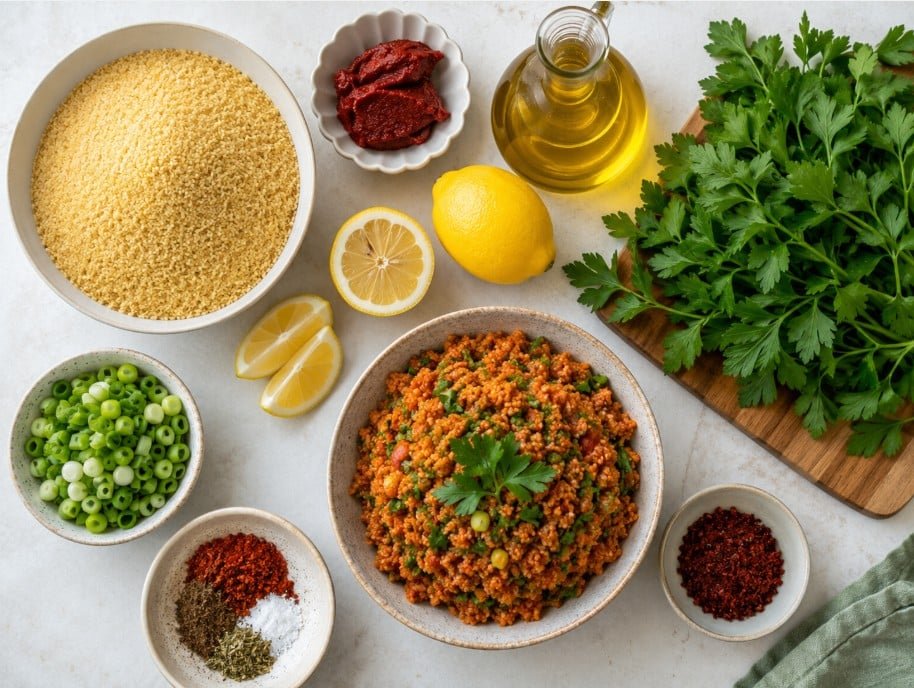
The Turkish spelling uses a dotless “ı”: kısır. Many English-language ordering systems drop Turkish characters and show kisir. A restaurant may also use an explanatory translation that makes the dish searchable to diners unfamiliar with the Turkish name.
Kısır / Kisir: the standard name with or without Turkish characters.
Kisir Salad: usually a standalone salad or cold appetizer.
Turkish Bulgur Salad: may be kısır; inspect the ingredients for fine bulgur, red paste, lemon, herbs, and olive oil.
Spicy Bulgur Salad: often kısır, although “spicy” may mean seasoned rather than hot.
Turkish Tabbouleh: a comparison term used by some restaurants; confirm that bulgur is the main body and that tomato or pepper paste is used.
Pancarlı Kısır: beet kısır.
Vegan Bowl / Mezze Bowl: kısır may be one component rather than an item available alone.
Cold Meze Platter: the selection may rotate. Ask whether kısır is included that day.
By the pound: common at prepared-food counters and catering kitchens.
Half tray / full tray: catering language; ask for approximate guest counts and serving weights.
Do not confuse kısır with warm bulgur pilaf. Pilaf is cooked as a hot grain side and may contain tomato, peppers, or broth, but it lacks the cold dressed-salad format and fresh-herb profile of kısır.
A strong order begins by deciding what role kısır should play. As a tasting portion, it can replace a standard side salad. As part of a mezze dinner, it becomes the grain element that ties together dips, vegetables, pastry, and grilled food. As a lunch, it needs something more substantial beside it: lentil soup, a protein, stuffed vegetables, or several additional meze. Treating every portion as a complete entrée is one of the easiest ways to be disappointed.
When the menu gives no weight or piece count, use the price and category as clues but not guarantees. A cold appetizer around the price of hummus is likely intended for one or two people to share as part of a larger order. A composed bowl is more likely to function as an individual meal. A catering tray should be quoted by weight, tray dimensions, or expected side servings. “Feeds ten” can mean ten small buffet tastes, not ten lunch portions, so ask how the kitchen calculates the number.
For takeout, ask the restaurant to keep lettuce, lemon, bread, and wet sauces separate when possible. Kısır itself travels well because it does not depend on crisp frying or immediate heat, but delicate greens collapse when packed under a dense salad. A level container prevents dressing from pooling in one corner. For a longer drive, carry the order in an insulated bag and refrigerate it promptly after arrival. Restaurant staff should provide the final storage guidance for their preparation.
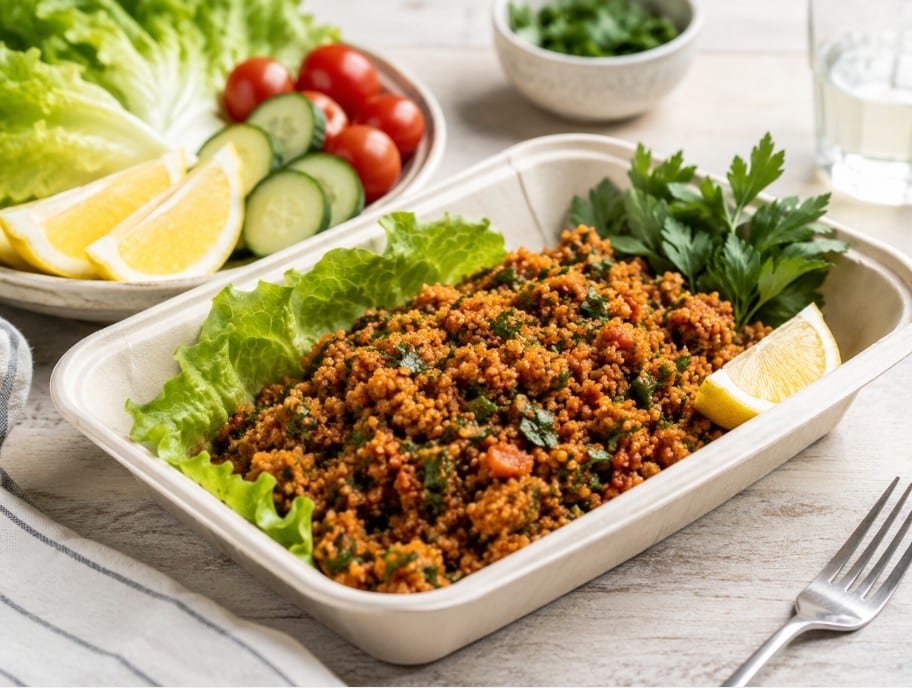
For catering, the most useful questions concern timing and service rather than decoration. Ask whether the tray is made the same day, whether serving utensils are included, whether lettuce cups or lemon wedges are supplied, and whether the salad arrives ready to serve. Confirm the latest safe pickup time and whether the quoted guest count assumes kısır is one of many sides. A modest tray can stretch far on a large mezze buffet but disappear quickly when it is the only substantial vegetarian item.
Portions, takeout, and group ordering
A restaurant’s “one order” can mean a small appetizer, a large salad, a scoop inside a bowl, or a shareable meze. The menu must be read in context. When portion size is not stated, call rather than assuming the order will function as a full meal.
For one person: one standalone appetizer can work as a side or light component. Add soup, börek, grilled vegetables, or protein for a complete meal.
For two people: one shareable kısır plus two or three contrasting meze is often more interesting than ordering two identical portions.
For four people: ask whether two restaurant portions or one small catering container is better value. Add lettuce and lemon only if they are not included.
For a party: request a quoted tray size, approximate weight, expected number of side portions, pickup time, and refrigeration instructions.
Does kısır travel well?
Kısır is generally one of the better Turkish dishes for takeout because it does not need to remain hot and has no fried crust to protect. The main risks are crushed herbs, excessive liquid pooling in the container, warm storage, and missing lettuce or lemon. Transport it level and refrigerate promptly if it will not be eaten soon.
When a bowl is better than a side
A bowl is useful when you want a complete lunch and do not want to choose several separate meze. A standalone side is better when you want to compare kısır directly, pair it with kebab, or build your own spread. Ask whether a bowl component can be doubled or ordered separately before assuming substitutions are available.
Reading the bowl: freshness, balance, and texture
Good kısır should be moist but not wet, tender but not mushy, vividly seasoned, and fresh enough that the herbs still taste alive.
Grain texture: fine bulgur should be fully softened with no hard center, yet individual grains should remain visible.
Acid balance: lemon and pomegranate molasses should brighten the dish without making it harsh, syrupy, or candy-sweet.
Paste integration: tomato or pepper paste should coat the grains evenly rather than appearing in dark clumps.
Freshness: parsley, mint, and green onion should smell fresh, not dull or refrigerator-stale.
Moisture: a small amount of dressing is desirable; a puddle at the bottom suggests over-dressing or vegetable water released during storage.
Heat: chile warmth should support the salad. A good version does not need to be painfully hot.
Color: red-orange is common, while beet kısır may be deeper red or purple. Artificially bright color is not a quality requirement.
Signs the batch may be past its best
Wilted herbs, sour fermented aromas, a watery bottom, swollen gummy grains, dried edges, or a refrigerator taste can signal age or poor storage. A chilled salad may need a few minutes at room temperature for its aroma to open, but it should never be left unrefrigerated for an unsafe period.
Dietary questions that need a real kitchen answer
Traditional kısır is usually plant-based, but it is never gluten-free because bulgur is wheat. Restaurant preparation and platter accompaniments can change the dietary picture.
Vegan: classic ingredients are generally vegan, but bowls may include yogurt, buttered bread, cheese pastries, or non-vegan sauces.
Vegetarian: kısır is commonly vegetarian. Confirm any mixed platter, broth, garnish, or sauce.
Gluten-free: traditional kısır is not gluten-free. Bulgur is made from wheat. A quinoa or cauliflower version is a different adaptation and requires separate cross-contact verification.
Halal: plain kısır generally contains no meat, but strict halal diners should ask about the full kitchen and shared utensils. Mezè states that its menu is all halal.
Dairy-free: the salad itself may be dairy-free, yet yogurt, cacık, labneh, or garlic yogurt can be served beside it.
Nuts: many kısır recipes contain no nuts, but walnuts, pistachios, pine nuts, or nut-containing pomegranate sauces may appear in a restaurant or shared mezze kitchen.
Sesame: kısır itself does not require tahini, but hummus and other neighboring mezze commonly contain sesame.
Allergy safety: never rely on a menu icon alone. Confirm ingredients, garnish, shared equipment, and cross-contact directly with the kitchen.
Building a Turkish meal around kısır
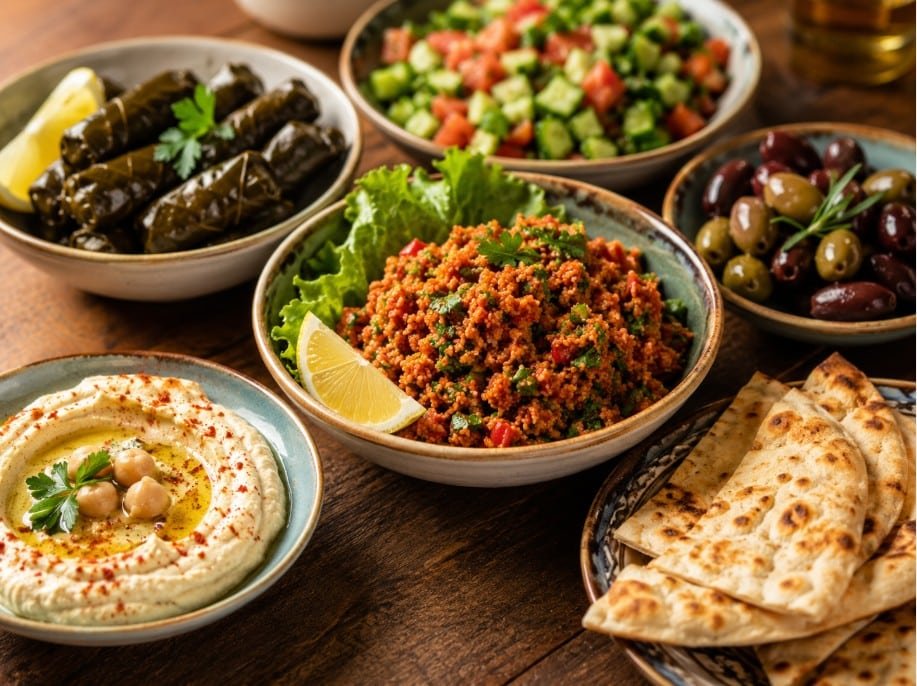
Kısır works best when the rest of the order adds temperature and texture contrast. Its acidity cuts through grilled meat and rich pastry, while creamy yogurt dishes can soften pepper heat.
A balanced first order
Order one kısır, one creamy meze such as cacık or haydari, one warm item such as sigara böreği, and either a grilled vegetable or kebab. Add fresh bread only if it is not already included.
For one diner
Kısır + red lentil soup + one small börek or grilled skewer + ayran. This gives grain, herbs, warmth, protein, and a cooling drink without requiring a large mixed platter.
For two diners
Kısır + hummus or cacık + stuffed grape leaves + one shared grilled entrée + Turkish tea. Ask for lettuce and lemon with the kısır.
For a vegetarian meal
Kısır + imam bayıldı or grilled eggplant + mercimek köfte + shepherd salad. Confirm whether yogurt or bread is included and whether you need vegan substitutions.
For a group takeout order
A catering tray of kısır + börek + dolma + a creamy dip + bread + grilled vegetables is easier to portion than multiple composed bowls. Request serving utensils and label allergy-sensitive dishes.
Dianaisabela.com already has an aperitivo food guide and a Greek tavern food guide that can help readers compare the social logic of shareable Mediterranean-style tables, although kısır remains specifically Turkish.
The phone call that prevents a wasted trip
Kısır can sell out, rotate off the menu, or appear only inside another dish. Use a short, specific description so the employee does not confuse it with pilaf or tabbouleh.
“Do you have kısır—the cold Turkish fine-bulgur salad—available today?”
“Can I order kısır separately, or is it only included in a bowl or mezze platter?”
“What is today’s price, and how large is one order?”
“Is the portion intended for one person or for sharing?”
“What comes with it—lettuce, lemon, bread, sauce, or garnish?”
“Is it available for pickup or delivery from this exact location?”
“Do I need to order ahead for a larger container or catering tray?”
“Does your kısır contain nuts, dairy, sesame, or any ingredient not listed online?”
“Since bulgur is wheat, how do you handle gluten cross-contact for the other foods in my order?”
When buying a ready-made bowl is difficult, homemade kısır becomes the practical option
If no restaurant or prepared-food counter near you has kısır today, the dish is realistic to make at home because the essential ingredient is inexpensive fine bulgur rather than a hard-to-find specialty protein. Homemade kısır does not require restaurant equipment, deep frying, or a long simmer. The most important decision is choosing the correct grain size. Fine or extra-fine bulgur softens quickly and absorbs tomato paste, pepper paste, lemon, olive oil, and pomegranate molasses without turning the salad into a bowl of large chewy grains.
That does not mean every bag labeled bulgur produces the same result. Medium and coarse bulgur are better suited to pilaf, stuffing, soups, and warm grain dishes. They can remain too firm for a salad that is expected to be tender and cohesive. Look for wording such as fine bulgur, extra-fine bulgur, köftelik bulgur, or ince bulgur. A transparent package window is useful because it lets you compare the granules. For kısır, the pieces should look much smaller than ordinary cracked wheat used for pilaf.
The useful shortcut: when a restaurant search fails, do not settle for an unrelated deli salad. Buy fine bulgur, then use a reliable kısır recipe and adjust the acid, herbs, pepper paste, and chile level to your taste. The homemade version can be fresher than a refrigerated counter container because the parsley and scallions are added close to serving time.
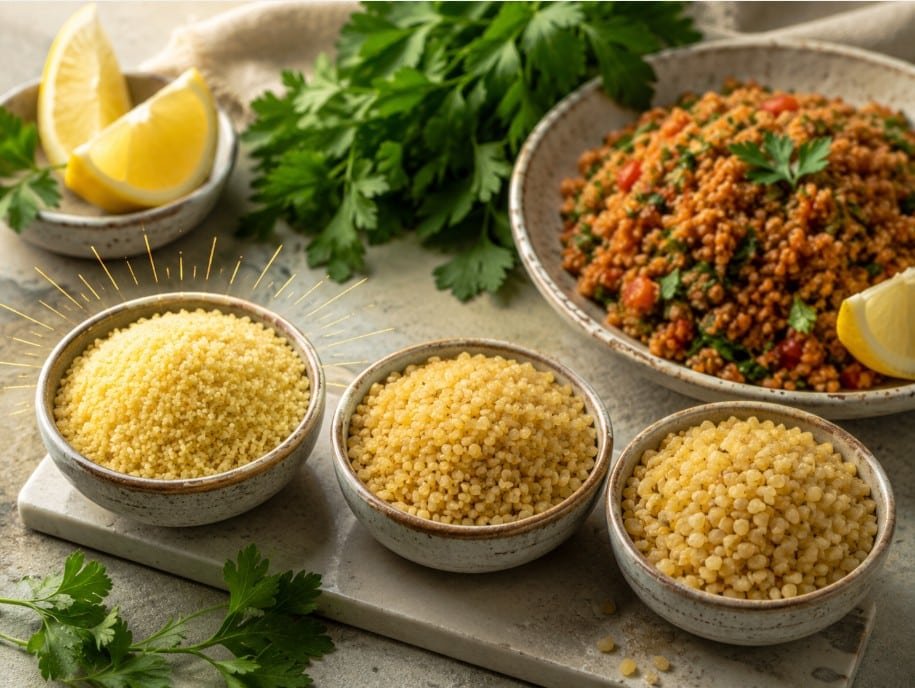
Once the right bulgur is in the pantry, the rest of the ingredient list is flexible enough for normal grocery shopping. Tomato paste is widely available. Turkish red pepper paste and pomegranate molasses create a more characteristic flavor, but the exact balance differs among households and regions. Fresh parsley, scallions, lemon, olive oil, and lettuce are easy to find. Mint, cucumber, tomato, and chile can be adjusted according to the chosen recipe rather than treated as proof of authenticity.
Home preparation also solves the portion problem. A small restaurant appetizer may be perfect for tasting but expensive for a family meal. A batch made from one package of fine bulgur can provide several side portions, work as a lunch component, and support a larger mezze table. The best economy comes from making only as much as will be eaten while the herbs and vegetables are fresh. Kısır is not improved by reheating; it is a cool salad, so leftovers should be refrigerated and served according to the storage guidance in the recipe used.
Readers with allergies should remember that homemade does not make the dish gluten-free. Bulgur is wheat. Home preparation does, however, make it easier to control sesame, nuts, dairy-containing accompaniments, and cross-contact from shared restaurant utensils. Anyone managing celiac disease, wheat allergy, or another serious allergy should choose a recipe and ingredients that meet their own medical requirements rather than treating a general food guide as allergy clearance.
When the dish is not listed nearby
Could not find a fresh bowl nearby? Kısır is one of the most approachable Turkish salads to prepare at home. Start with fine bulgur, then add tomato or pepper paste, lemon, olive oil, and plenty of fresh herbs. The result can be brighter and fresher than a container that has spent hours in a refrigerator case.
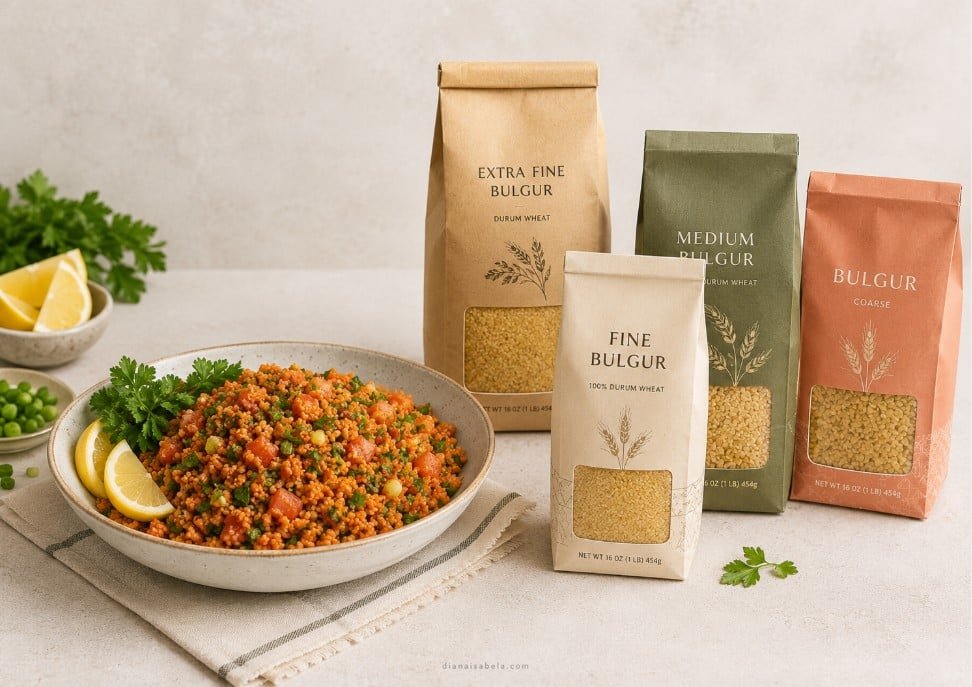
Craving This Salad? Start With the Right Bulgur.
Fine-grain bulgur gives homemade kısır its tender texture and helps every bite absorb the tomato, lemon, herbs, and spices.
An empty map result does not prove that nobody nearby makes kısır. It often means the dish is not indexed under the spelling you searched.
Change the spelling: search kısır, kisir, Turkish bulgur salad, spicy bulgur salad, and Turkish tabbouleh.
Search the business type: Turkish bakery, Turkish market, halal market, Turkish catering, Mediterranean prepared food, and mezze catering.
Ask by ingredient: describe fine bulgur mixed with tomato or pepper paste, lemon, parsley, and pomegranate molasses.
Check catering menus: a restaurant may prepare trays even when it does not sell individual portions daily.
Contact community groups: Turkish cultural associations and local community groups may know licensed caterers or public food events.
Try a nearby city: search the closest metropolitan area rather than limiting the radius to your suburb.
Consider homemade kısır: fine bulgur and Turkish pepper paste are widely available online and at Middle Eastern markets, but a recipe article should be used for precise food-safety and preparation guidance.
When ordering from an unfamiliar home-based or social-media seller, verify the business identity, pickup address, payment method, ingredient list, food-handling practices, and local licensing requirements before paying.
A first-order playbook for diners who have never tried kısır
The safest first order is one standalone portion of kısır plus two contrasting dishes. Choose one creamy item, such as hummus or cacık, and one warm item, such as börek, grilled vegetables, lentil soup, or a kebab. This keeps the order varied without burying the salad under too many similar cold dishes. Kısır contributes grain, acidity, herbs, and gentle chile warmth; the companion dishes should add creaminess, heat, crispness, or protein.
When kısır is available only inside a vegan bowl, read the entire component list before ordering. A bowl may include yogurt, bread, fried vegetables, sauces, or a large amount of lettuce. The presence of kısır does not automatically make the bowl vegan, gluten-free, dairy-free, or suitable for a specific allergy. Ask whether the salad can be ordered separately and whether substitutions change the price.
At a prepared-food counter, ask to see the container size or request an approximate weight. A compact pint container can be enough for several small mezze portions but not for four lunch entrées. Ask whether lettuce, lemon wedges, bread, and serving utensils are included. When the salad is sold by weight, compare the price per pound with the restaurant appetizer only after accounting for the larger quantity and the absence of table service.
For a group dinner, build the order around roles rather than ordering random dishes. Kısır is the seasoned grain. Hummus or yogurt dip supplies creaminess. Shepherd salad or pickles add crunch. Börek or pide adds warm bread and pastry. Stuffed grape leaves add a concentrated savory bite. A grilled dish can be the main protein. This structure prevents the table from becoming six bowls of soft cold food with no contrast.
For a vegetarian meal, kısır works especially well with lentil soup, hummus, eggplant salad, stuffed vegetables, and bread. Confirm whether rice, soup, or pastry contains butter or meat broth. For a vegan meal, confirm yogurt sauces, buttered bread, and fried-food cross-contact. For a lighter lunch, pair kısır with soup and a cucumber-tomato salad rather than adding several bread-heavy meze.
Delivery should be treated differently from dine-in. The best delivery order separates wet sauces, lettuce, and bread from the kısır. Ask whether the restaurant seals the salad in a level container and whether lemon is included. Delivery-app photographs are not reliable proof of portion size, so read the item description and call when the order is expensive or intended for several people.
Best first taste: standalone kısır, hummus or cacık, and one warm item.
Best quick lunch: kısır bowl with a clear ingredient list and a separate sauce.
Best family order: one larger kısır container, two vegetable meze, bread, and one hot main.
Best vegetarian spread: kısır, lentil soup, hummus, eggplant, dolma, and salad.
Best takeout protection: keep lettuce, lemon, wet sauce, and bread separate until serving.
The practical goal is not to order the largest number of Turkish dishes. It is to understand what kısır contributes and then add foods that make the meal feel complete. This approach also makes price comparisons more meaningful because the diner can distinguish a $10 tasting portion from a full bowl or a catering quantity.
How this guide was checked
This guide combines Diana Isabela’s practical food-discovery perspective with official menu research, current restaurant contact details, and location-level verification. A local recommendation can point toward a promising business, but inclusion as a menu-confirmed listing requires an official menu, an official ordering page, or direct business information naming the dish.
Prices are labeled confirmed only when they were visible on an official current listing during the July 29, 2026 check. When a menu confirms kısır but does not expose a dependable current price, the guide says to check the menu or call. Daily availability is never guaranteed because restaurants can change menus, sell out, or offer different items by location.
Where can I find kisir bulgur salad near me?
Search Turkish restaurants, Turkish bakery-cafés, halal Mediterranean kitchens, caterers, and markets with prepared-food counters. Use several spellings: kısır, kisir, Turkish bulgur salad, spicy bulgur salad, and Turkish-style tabbouleh. Then check cold appetizers, salads, vegan bowls, mezze, sides, and catering menus.
How much does kısır cost at a restaurant?
The current official Kestane ordering pages show a $10.00 standalone Kisir Salad in Brooklyn, checked July 29, 2026. Bowls, mixed mezze, prepared-food containers, and catering trays vary too much to support one dependable national average, so check the current menu or call.
Why should I call before visiting for kısır?
Kısır is often prepared in batches, included only inside a bowl, or offered as a rotating cold meze. Calling confirms whether it is available today, whether it can be ordered separately, the current price, the portion size, and the correct pickup location.
Is kısır served hot or cold?
Kısır is usually served cool or at room temperature. It is a dressed fine-bulgur salad rather than a hot bulgur pilaf.
What is the best first order with kısır?
A balanced first order is kısır with one creamy meze such as cacık, one warm item such as börek, and either a grilled vegetable or kebab. This combination shows the salad’s tangy, herbaceous character while adding contrasting temperatures and textures.
Is kısır vegan?
Traditional kısır is usually vegan because it is made with bulgur, tomato or pepper paste, olive oil, lemon, herbs, and vegetables. Restaurant bowls and platters may add yogurt, buttered bread, or non-vegan sauces, so confirm the complete preparation directly.
Is kısır gluten-free?
No. Traditional kısır contains bulgur, which is made from wheat and contains gluten. Diners with celiac disease or wheat allergy should also ask about shared utensils and cross-contact.
What allergens can appear in kısır or its platter?
Wheat is always the primary concern in traditional kısır. Nuts, dairy, sesame, and other allergens may appear in garnishes, sauces, hummus, yogurt dips, bread, or neighboring mezze. Confirm the salad and the entire plate with the kitchen.
What is the difference between kısır and tabbouleh?
Kısır is generally built around fine bulgur and gets a red-orange color and concentrated flavor from tomato or pepper paste. Tabbouleh is usually greener, contains a larger proportion of parsley, and uses less bulgur. Some U.S. menus call kısır Turkish-style tabbouleh to make the dish easier to recognize.
Why is kısır missing from many Turkish restaurant menus?
Kısır is less standardized on U.S. menus than kebabs, hummus, or lentil soup. A restaurant may make it only for catering, weekend service, vegan bowls, special events, or a rotating prepared-food case, and the dish may be listed under another spelling.