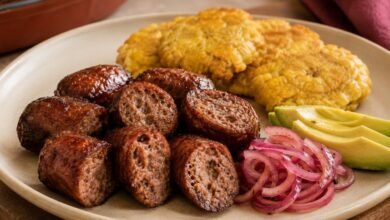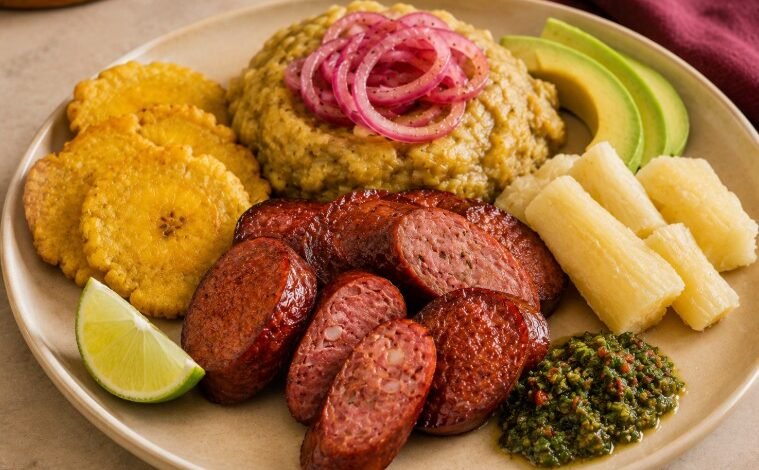
Longaniza frita is not difficult to feed. Give it a plate of hot tostones and it will be perfectly happy. Give it mangú, vinegary onions and an egg and suddenly breakfast has opinions. Put yuca beside it and the sausage settles into something heartier. Add avocado and the whole plate stops feeling quite so committed to frying everything it can see.
The more useful question, then, is not simply what traditionally goes with Dominican longaniza. It is what each side actually does to the sausage.
Fried longaniza brings browned casing, pork richness, seasoning and rendered fat. The best companions either absorb some of that intensity, contrast with its texture or refresh your palate before the next piece. Tostones reinforce crunch. Mangú moves in the opposite direction and gives you softness. Yuca contributes substantial starch. Vinegary onions and lime bring the acidity that rich fried food quietly hopes someone remembered.
So rather than treating this as a giant list of Dominican side dishes, I am going to build the plate according to appetite. Some combinations are perfect for standing over a casual fritura plate with friends. Others make much more sense at breakfast. And a few are what I would choose when I want longaniza but do not particularly want to spend the next hour feeling as though I personally ate the fryer.
The most natural pairings for Dominican longaniza frita include tostones, mangú, fried or boiled yuca, batata, vinegary red onions and avocado. Tostones give you maximum crispness, mangú creates a soft breakfast-style contrast, and yuca makes the meal more substantial. Acidic elements such as onions or lime are especially useful because they balance the rich fried sausage.
Start with one question: what is the sausage missing?
A good piece of longaniza frita already has plenty happening. It is seasoned, fatty, browned and texturally assertive. That means the side dish does not need to arrive wearing sequins and demanding equal billing.
I think of the pairings on a simple spectrum. You can amplify what the sausage already does, soften it with something mild and starchy, or balance it with acidity and freshness.
Three ways to build the plate
The best plates usually use at least two of those ideas at once. Longaniza with tostones is delicious. Longaniza with tostones plus something acidic is more balanced. Longaniza with mangú works beautifully because the soft plantain already moves in the opposite direction from the fried casing, and onions can take that contrast even further.
If you are still learning the sausage itself before deciding what belongs next to it, start with my guide to the flavor and texture of Dominican longaniza.
Tostones are the pairing for people who came for the frying
Crisp sausage, crisp plantain, absolutely no apology
Tostones are green plantains fried, flattened and fried again. Beside longaniza frita, they create perhaps the most immediately satisfying combination because both foods contribute crisp surfaces while their interiors behave differently. The sausage remains juicy and seasoned; the plantain is comparatively mild and starchy.
The tostone therefore does two jobs at once. It reinforces the pleasure of fried texture but gives the longaniza a much less intense flavor to sit beside. A piece of sausage and a bite of plantain can feel substantial without requiring an elaborate sauce or another protein.
BEST FOR: casual fritura, sharing, first-time ordersThis is the pairing I would choose if someone told me, “I have never eaten Dominican longaniza and I want the most obvious introduction.” It does not hide the sausage. Mangú transforms the texture more dramatically; tostones simply stand beside longaniza and say, yes, we are both fried, and we have made peace with that.
What I would add is acidity. A squeeze of lime or a little onion can make the third and fourth bites much more appealing than if the entire plate stays in the same fried register.
Mangú changes longaniza more than any other side on this list
The softest possible answer to a crisp sausage
Mangú is made from boiled green plantains mashed into a soft savory base. Instead of reinforcing the fried texture of longaniza, it removes almost all resistance from the other half of the bite.
That makes longaniza’s casing more noticeable, not less. The sausage gives chew, browning and aromatic pork flavor; the mangú gives enough mild starch to spread that seasoning across the fork.
BEST FOR: breakfast, comfort food, maximum texture contrastMangú also changes the rhythm of the meal. Longaniza with tostones can feel like fritura or casual shared food. Longaniza with mangú immediately moves toward the breakfast table, particularly when onions, egg or queso frito join it.
It is such a distinctive pairing that I gave it a separate guide: why longaniza frita with mangú works so well.
Yuca is what I choose when I want the plate to feel grounded
Denser, earthier and wonderfully good with onions
Yuca, or cassava, can meet longaniza in more than one form. Fried yuca continues the crisp theme, while boiled yuca gives you a softer, denser starch that absorbs sausage flavor without bringing another layer of frying.
For me, boiled yuca becomes particularly persuasive once onions enter the picture. The combination of dense cassava, rich sausage and sharp onion gives every ingredient a clear role.
BEST FOR: substantial breakfast, lunch or dinnerFried yuca is more exuberant. It belongs in the same family of decisions as tostones: browned sausage plus browned starch. Delicious, but I would almost certainly want something sharp or fresh somewhere on the plate.
Boiled yuca is quieter. It lets longaniza remain the main source of browning and fat, which makes it a particularly good option if you love the sausage but do not need every supporting actor to have been submerged in oil.
Batata and avocado solve two completely different problems
Not every side needs to be a plantain or cassava variation. Two other useful companions work almost as opposites.
Batata
Sweet potato introduces a sweeter note against salty pork. When fried, it still belongs comfortably inside a fritura-style meal, but the flavor contrast is stronger than with tostones.
Avocado
Avocado is not crisp, sharp or acidic. Its job is cooler and quieter: creamy freshness beside hot seasoned sausage. It is especially welcome when the plate already contains another fried component.
I would not necessarily build an entire meal around avocado and longaniza alone, but I like avocado as the third element after sausage plus starch. Longaniza, yuca and avocado feels very different from longaniza, fried yuca and queso frito even though both plates begin with the same sausage.
The richest plate usually needs something that can cut through it
This is the section I would not treat as optional decoration. Dominican longaniza can be rich, especially after frying, and the sides most closely associated with it are often starchy or fried too. Acidity is what keeps the meal from becoming monotonous.
My balancing trio
Vinegary red onions bring sharpness and moisture. Lime adds clean acidity without another heavy texture. A garlicky Dominican-style sauce such as wasakaka can bring herbs, garlic and brightness, particularly with fried yuca or batata.
I would use sauce as an accent rather than a disguise. If the longaniza only becomes enjoyable after half a cup of sauce lands on it, we are no longer discussing pairing strategy; we are conducting a rescue mission.
Onions make especially good sense with mangú and boiled yuca because both starches are mild enough to carry the acidic flavor. Lime is easier with a simple fritura plate where you want to preserve the crisp surface of the sausage and tostones.
What you are looking for is interruption. A rich bite, a starchy bite, something sharp, then back to the sausage. The plate stays interesting because your palate is not receiving exactly the same signal ten times in a row.
Breakfast longaniza wants a different supporting cast
At breakfast, mangú becomes the obvious starting point, but the plate can grow quickly from there. Egg adds softness and yolk. Queso frito introduces another salty browned component. Avocado cools things down. Onions provide the acidity that becomes increasingly useful every time another rich ingredient lands on the table.
If I were building a longaniza breakfast
Simple: longaniza + mangú + onions.
Fuller: longaniza + mangú + onions + fried egg.
Weekend appetite: longaniza + mangú + egg + queso frito + onions, with avocado if everyone has collectively abandoned plans for a tiny breakfast.
There is one distinction worth preserving: the classic Los Tres Golpes uses fried Dominican salami, queso frito and fried egg with mangú. Longaniza can replace or supplement salami in breakfast variations, but it is not the canonical sausage of the traditional trio. I explain the plate properly in my guide to Los Tres Golpes.
That distinction does not make longaniza with mangú less Dominican or less delicious. It simply lets two breakfast traditions keep their own identities instead of flattening every fried sausage beside mashed plantain into the same dish.
For lunch or dinner, move away from breakfast architecture
Longaniza is not trapped in the morning. The sausage works perfectly well later in the day, but I would build the plate differently rather than carrying egg, cheese and mangú into every possible meal.
Longaniza + tostones + lime
Direct, crisp and easy to share. Add avocado if you want something cooler on the plate.
Longaniza + yuca + onions
Dense cassava, rich sausage and acidity create a plate that feels complete without requiring another fried protein.
Longaniza + rice + beans
Rice and beans move the sausage into the structure of a larger meal. In this context, I would serve a more restrained amount of longaniza rather than treating it like an endless pile of fried pieces.
Longaniza + fried yuca + sauce
Excellent when that is exactly what you want. Choose a bright sauce or lime so the plate has at least one ingredient interested in contrast.
If you want longaniza without an entire fried supporting cast
I would not call longaniza frita light food, and I see no reason to pretend otherwise. But there is a major difference between eating fried sausage with one thoughtful starch and freshness beside it versus adding every fried component available simply because the menu permits it.
For a less heavy plate, I would keep the longaniza as the only strongly fried protein and build around it.
Longaniza + boiled yuca + onions
Probably my favorite option when I want the sausage to remain rich but the rest of the plate to behave calmly.
Longaniza + mangú + onions
Soft and satisfying, particularly at breakfast, without requiring both fried cheese and another sausage.
Longaniza + tostones + avocado
You still get the crisp pairing, but avocado gives the plate a cool component instead of another fried one.
Longaniza + rice + fresh side
Useful when the sausage is part of lunch rather than the entire conceptual theme of lunch.
This is less about rules than fatigue. If the first bite is excellent and the sixth feels like homework, the plate probably needed more contrast.
A few combinations I would not build automatically
Traditional food does not need me to edit it into minimalism, but neither does every available side need to appear at once. A good combination should make the longaniza easier to enjoy or reveal something new about it.
None of those combinations is forbidden. Food is not a passport office. I simply would not choose them automatically if the goal is to understand the sausage rather than assemble the largest plate photographed that week.
If you tell me the mood, I can tell you the side
My own rule is simple: one good sausage, one starch with a clear purpose and one element that keeps the plate awake. After that, additions should earn their place.
If you now know exactly what you would order beside the sausage but still need somewhere to find it, continue with my guide to finding fried Dominican longaniza across the United States.
What belongs beside longaniza on your table?
This is exactly the kind of food question where family habits are often more interesting than neat lists. Maybe your longaniza always comes with yuca and onions. Maybe you would choose tostones before mangú every single time. Maybe there is a sauce your family makes, a breakfast combination I have missed, a new Dominican restaurant serving an excellent plate, or a way of arranging a shared fritura that everyone in your house considers non-negotiable.
If you have a favorite longaniza pairing, family recipe, serving idea, restaurant discovery, menu photo or local food story, write to me at info@dianaisabela.com. I would genuinely love to hear what ends up beside the sausage on your table. Those details are what make a food guide more useful — and much more delicious — than a list written from a distance.
What is traditionally served with Dominican longaniza frita?
Common pairings include tostones, mangú, yuca, batata and acidic accompaniments such as lime or onions. Fried longaniza can appear at breakfast with mangú or as part of a casual fritura-style plate with fried plantains or cassava.
Are tostones good with longaniza frita?
Yes. Tostones are one of the most natural pairings because their mild green-plantain interior balances the strongly seasoned sausage while their fried exterior reinforces the crisp texture of the meal.
Can you eat longaniza frita with mangú?
Yes. Mangú gives fried longaniza a soft, mild contrast and is especially suited to breakfast. Vinegar-seasoned onions are useful with the combination because they add acidity against the rich sausage and mashed plantain.
Does longaniza go with yuca?
Yes. Both boiled and fried yuca work with Dominican longaniza. Boiled yuca creates a calmer, denser starch pairing, especially with onions, while fried yuca produces a crisp and more indulgent combination.
What sauce goes well with longaniza frita?
Bright, garlicky or acidic sauces work particularly well because they contrast with the richness of fried sausage. Dominican-style wasakaka can be served with fried longaniza and fried root vegetables. Lime and vinegary onions can provide similar balancing acidity without a heavy sauce.
Can you eat avocado with Dominican longaniza?
Yes. Avocado provides cool creaminess beside hot, strongly seasoned longaniza and is particularly useful when the rest of the plate already contains fried foods.
What should I order with longaniza frita for breakfast?
Mangú with red onions is a strong starting point. Fried egg or queso frito can make the breakfast more substantial, although the classic Los Tres Golpes traditionally uses Dominican salami rather than longaniza as its sausage component.
What should a first-time diner eat with longaniza frita?
Longaniza frita with tostones and a little lime or onion is a particularly clear introduction because it keeps the sausage prominent while providing mild starch, crisp texture and enough acidity to balance the pork richness.
Can longaniza frita be eaten for lunch or dinner?
Yes. Fried longaniza is not limited to breakfast. For lunch or dinner it can be paired with tostones, yuca, rice, beans, avocado or other Dominican-style sides depending on how substantial you want the meal to be.