Shchi Soup in Philadelphia: Where to Find Classic & Green Shchi
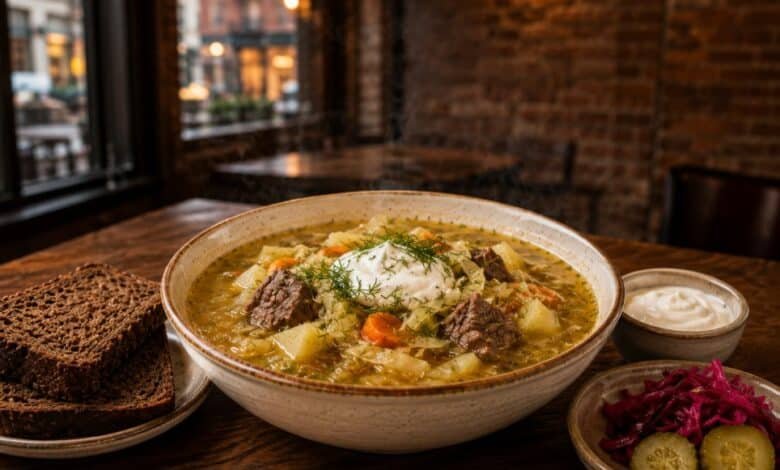
Philadelphia gives shchi a more interesting city life than the usual shorthand “Russian cabbage soup” suggests. On one current menu, the soup is described through sour grass, egg and a beef meatball. On another, the menu simply says Shchi (Щи). On South Street, the dish turns unmistakably green: sorrel, spinach, egg, potato and beef meatballs.
That means Philadelphia is not a city where I would tell you to find the nearest shchi and stop thinking. The useful decision comes one step earlier. Do you want a bowl whose exact current preparation is something to ask about? Do you want the Central Asian restaurant experience around the soup? Or do you specifically want green shchi, where sorrel — not fermented cabbage — drives the acidity?
The city also splits geographically. Northeast Philadelphia gives you the richer Russian-speaking, Central Asian and Eastern European food ecosystem: Roosevelt Boulevard, Bustleton Avenue, prepared-food markets and several kitchens worth combining into one outing. South Street gives you the convenient central-city answer and, at the moment, the clearest green shchi description of the three.
Philadelphia Has Three Current Answers, and I Would Not Rank Them as Though They Were the Same Soup
The simplest way to use this page is to stop asking “Which restaurant is best?” for a moment.
Asia Mix currently gives you a shchi built around tart greens, egg and a beef meatball inside a broad Uzbek-European menu.
Chinar gives you the most literal current listing: Shchi (Щи), starting at a relatively modest price, without a detailed English description forcing the style into one box.
Perfect Together gives you the clearest green shchi: sorrel, spinach, egg, potato and beef meatballs on South Street.
Three current listings. Three different reasons to choose them.
Asia Mix
Choose it when you want shchi inside a larger Uzbek-European meal with plov, manty, kebabs, lagman and other soups around it.
Chinar
Choose it when the simple fact that the menu says Shchi (Щи) is exactly what you wanted to establish before leaving home.
Perfect Together
Choose it when sorrel is the point — or when South Street is dramatically more convenient than a Northeast Philadelphia food expedition.
This is already enough local depth to justify Philadelphia as its own city page beneath the broader Pennsylvania shchi guide.
Philadelphia is not simply Pennsylvania with a smaller radius. The city has multiple current bowls, different styles, different neighborhoods and its own prepared-food culture. That is exactly the kind of independent local value a city page should have.
Northeast Philadelphia and South Street Solve Different Problems
I would not plan these as interchangeable lunch destinations.
Northeast Philadelphia
This is where I would go if the food search itself is part of the pleasure.
Asia Mix sits on Roosevelt Boulevard. Chinar is on Bustleton Avenue. NetCost gives Bustleton a substantial prepared-food supermarket. Other Eastern European businesses, bakeries, markets and Central Asian restaurants make the area feel like a food ecosystem rather than a single destination.
You can eat shchi, buy bread, inspect the prepared-food counter and come home with tomorrow’s dinner without pretending all of those things need to happen at the same restaurant.
South Street
This is the more convenient answer for someone already near Center City, Queen Village, Society Hill or the central part of Philadelphia.
Perfect Together gives the area a real current shchi listing rather than a “maybe this Eastern European restaurant has it” suggestion.
And because its version is explicitly green shchi, the trip has a clear culinary identity rather than simply being the closer address.
If I were visiting Philadelphia specifically for this project, I would devote one meal to Northeast Philadelphia and a completely separate meal to South Street.
Not because three bowls of soup are too intellectually demanding.
Because three bowls of soup are still three bowls of soup.
A useful comparison does not improve when you are uncomfortably full and beginning to resent cabbage on principle.
Asia Mix Is the Philadelphia Bowl With the Most Interesting Translation Problem
This is an important correction to the way local guides sometimes become overconfident.
A phrase looks familiar.
A writer knows sorrel is commonly used in green shchi.
Suddenly “sour grass” becomes “definitely sorrel” in the article.
That is exactly the kind of tiny leap I do not want here.
Asia Mix confirms shchi.
Asia Mix confirms egg and beef meatball.
Asia Mix uses the phrase sour grass.
If you specifically want sorrel, ask.
That is both more accurate and more useful.
Why I would choose Asia Mix
I would choose it when the meal around the soup matters as much as the soup.
The same menu currently includes manty, plov, kebabs, homemade-style potatoes, stuffed cabbage and a long Central Asian soup list.
That makes it particularly good for a table where one person is conducting a shchi investigation and everyone else simply wants dinner.
It also lets you lean into the restaurant’s actual identity rather than constructing a Russian meal inside an Uzbek-European kitchen.
Soup first.
Then share manty or plov.
Add something fresh.
Stop before the menu becomes a dare.
Chinar Is the Most Literal Philadelphia Search Result: Shchi, in Cyrillic, on the Menu
I actually like that the description is minimal.
It reminds us that menus have different audiences.
A customer who already knows what щи means may not need three sentences explaining cabbage, broth and sour cream.
The newcomer does.
Neither audience is wrong.
That is why a local guide can add value without pretending the restaurant failed to explain itself.
Chinar also makes a good Northeast Philadelphia starting point because Bustleton Avenue already puts you inside the part of the city where Eastern European grocery and prepared-food shopping becomes easy to add afterward.
This is the bowl I would choose if the goal were:
Try a current shchi without spending much.
See the traditional name on the menu.
Then explore the neighborhood.
Perfect Together Gives Philadelphia Its Most Clearly Defined Green Shchi
The restaurant itself is also unusual enough to make the soup more interesting.
Perfect Together combines Uzbek Central Asian cooking with Czech food.
So beside green shchi you can currently find Bukharian plov, manti and Uzbek grilled dishes, but also Czech potato soup, goulash soup, svíčková, roast duck, potato pancakes and other Central European dishes.
This is exactly the kind of menu where food borders become visible without needing an academic lecture beside the napkins.
And it creates a surprisingly good mixed-group restaurant.
One person wants green shchi.
Someone else wants plov.
Another wants Czech goulash.
Everyone can remain friends.
Philadelphia’s Real Shchi Personality May Be Green
This is the part of the city story I would emphasize much more strongly than in the older version.
Philadelphia does have a direct generic Shchi (Щи) listing at Chinar.
But two of the most descriptive current shchi menu entries pull toward tart greens rather than a classic fermented-cabbage profile.
Asia Mix
The menu says “sour grass,” egg and beef meatball. That strongly signals a green/tart direction, but I would still ask before translating “sour grass” into a specific herb.
Perfect Together
No ambiguity: sorrel, spinach, egg, potato and beef meatballs. This is an explicitly named green shchi.
That makes Philadelphia an especially useful city for anyone whose only previous image of shchi is cabbage simmered in beef broth.
Green shchi demonstrates how quickly the category expands.
Sorrel brings a sharp, leafy acidity.
Spinach can add body and color without the same tartness.
Egg brings soft richness.
Potato makes the soup more substantial.
Meatballs turn a green broth into a proper lunch.
The result is not “cabbage soup without cabbage.”
It is another branch of the tradition.
My deeper guide to green shchi is the useful follow-up if this is the Philadelphia bowl that surprises you most.
What I Would Not Do With Philadelphia’s Green Soup Evidence
I would not call every sorrel soup green shchi.
I would not call every green borscht green shchi.
I would not assume Asia Mix means sorrel unless the restaurant confirms that “sour grass” refers to sorrel in its current preparation.
I would not turn spinach soup into green shchi because the color matches.
And I would not treat a green version as somehow less authentic simply because it disrupts the easy English translation “Russian cabbage soup.”
Menus reflect family language, regional usage, restaurant translation and the fact that food names have spent centuries moving through multilingual communities long before delivery apps asked everyone to fit dinner into one searchable label.
The reader does not need a perfect taxonomy.
The reader needs enough information to order the bowl they meant to order.
Bustleton Avenue Is Where the Restaurant Search Turns Into Dinner Shopping
Northeast Philadelphia has an advantage that South Street does not need to imitate: the restaurant search sits beside substantial prepared-food infrastructure.
NetCost’s current Philadelphia location information confirms exactly the kind of food infrastructure that makes the shchi search interesting: prepared foods, grab-and-go meals, an onsite deli and an onsite bakery.
What it does not establish is permanent shchi availability.
So I would use the store as a second stop, not write it as a fake confirmed soup destination.
Eat first.
Then inspect the prepared-food section.
Ask what homemade soups are available.
If shchi is absent, ask whether it appears on another day.
This is where the dedicated shchi deli-search guide becomes useful, because a prepared-food counter behaves very differently from a restaurant menu.
There is an important psychological advantage to shopping after lunch.
Eastern European prepared-food counters are extremely convincing when you are hungry.
You arrived for soup.
Then there are cutlets.
Then stuffed cabbage.
Then salads.
Then smoked fish.
Then bread.
Then something layered with cream that clearly expects to come home with you.
Eating first is not only meal planning.
It is financial discipline.
Philadelphia Is a Good City for Learning That “Shchi” Is Sometimes More Precise Than the English Description
Shchi / Щи
Chinar uses both forms. This is the cleanest naming evidence because the restaurant identifies the dish directly without requiring an English culinary translation.
Green Shchi
Perfect Together makes the green identity explicit and then gives the ingredients: sorrel, spinach, egg and potato.
“Sour grass” shchi
Asia Mix gives us an English description that is less precise than the dish name. The correct response is curiosity, not overconfident translation.
This is why I would not search Philadelphia only for “cabbage soup.”
The city’s current shchi inventory itself demonstrates the weakness of that shortcut.
One of the clearest current bowls contains sorrel and spinach.
Another uses a tart green description.
The traditional name can sometimes carry more useful culinary information than an oversimplified English translation.
If you are trying to separate true shchi from all the other cabbage soups that appear across Polish, Ukrainian, Jewish and Central European Philadelphia food traditions, use my Shchi vs Cabbage Soup comparison.
Philadelphia Still Lets Shchi Behave Like Lunch
I like this about the city.
Shchi has not been transformed into a rare heritage experience served in a small designer bowl with a paragraph about ancestral memory and a $26 price tag.
Those prices should not be treated as a strict value ranking because the bowls are not identical.
Perfect Together explicitly includes beef meatballs, sorrel, spinach, egg and potato.
Asia Mix includes egg and a beef meatball.
Chinar’s menu gives us a more concise listing.
Different portion sizes and preparations can make simple dollar comparison misleading.
Still, the current menu picture tells us something useful.
You can try shchi in Philadelphia without making the meal an occasion.
That suits the dish beautifully.
Philadelphia Also Gives You a Better Question Than “Shchi or Borscht?”
The obvious comparison is shchi versus borscht because both appear repeatedly on these menus.
But Philadelphia expands the decision.
You might be choosing between:
green shchi;
red borscht;
mastava;
lagman;
shurpa;
or a Czech soup at Perfect Together.
That changes the useful question from “Which Russian soup is better?” to “What kind of bowl do I want?”
If the real decision at the table is between the two most familiar names, my Shchi vs Borscht guide handles that comparison separately.
I Would Plan Northeast Philadelphia as a Food District, Not a Three-Restaurant Shchi Marathon
There is a bad version of this guide where I tell you to visit Asia Mix, Chinar, NetCost and several other businesses in sequence while heroically tasting everything.
That is not how I would actually eat.
The South Street plan is simpler.
Go to Perfect Together when green shchi is the point.
Eat.
Continue with your day.
That difference in required effort is part of the recommendation.
“Near me” is not only a distance measurement.
It is also how much of the afternoon you are willing to give the soup.
When Should You Actually Call First?
I would not insist on calling every restaurant on this page before every spontaneous lunch.
They currently list the dishes.
If you live nearby, check the current menu and go.
But if you are crossing Philadelphia specifically for one shchi, a quick call becomes sensible.
The fuller menu-language and call-ahead method lives in How to Order Shchi.
Philadelphia’s Three Bowls Deserve Three Different Meal Plans
I do not want to copy the same “rye bread + sour cream + kotleti” paragraph into every local shchi article.
The actual restaurant should change what you order.
Asia Mix
Let the Uzbek-European menu participate.
After shchi, share manty or plov if you still want something substantial.
A fresh salad makes sense because the soup is already described as tart.
I would choose one starch-heavy main, not three.
You do not need lagman after soup simply because lagman also exists.
Perfect Together
Green shchi already gives you meatballs, egg, potato and tart greens.
For lunch, that may be enough with bread or a small appetizer.
For dinner, its Uzbek-Czech menu opens a fun decision: manti or plov on one side, Czech goulash or another Central European main on the other.
I would share the second course.
And Chinar?
Chinar is where I would wait until the bowl arrives before deciding.
Because the menu gives less detail about the shchi itself, let the actual portion and preparation tell you how ambitious dinner should become.
If it is light, add plov or kebab.
If it is substantial, bread and salad may be enough.
This sounds obvious.
It is still better advice than blindly attaching the same traditional pairing list to every version of the soup.
Philadelphia Is One of the Best Examples of Why City Pages Should Exist Only When the City Has Something to Say
This city page is not useful because Philadelphia is large.
It is useful because Philadelphia currently gives us:
- multiple actual shchi menu listings;
- a directly named Shchi (Щи);
- a clearly documented green sorrel shchi;
- another tart-green shchi-style listing worth interpreting carefully;
- a Northeast Philadelphia restaurant cluster;
- prepared-food and deli infrastructure;
- a South Street alternative with a completely different geographic use case;
- and enough variation that a reader has a genuine decision to make.
That is independent city value.
If Philadelphia had only one restaurant and two speculative grocery leads, I would leave those details inside the Pennsylvania page.
Instead, the city has its own culinary question:
which Philadelphia shchi experience do you actually want?
My First Philadelphia Shchi Day Would Probably Be Two Different Days
Day one:
Northeast Philadelphia.
I would choose Chinar or Asia Mix.
Then I would visit NetCost after eating and see what the prepared-food counter makes the neighborhood feel like beyond the restaurant table.
I would buy tomorrow’s dinner.
Then I would go home before curiosity became catering.
Day two:
Perfect Together.
Green shchi.
No need to turn it into a citywide excursion.
Taste sorrel, spinach, egg, potato and meatballs together.
Then compare the memory of that bowl with whatever you tried in the Northeast.
That is a much more useful tasting exercise than ordering three soups in ninety minutes and reaching the sophisticated conclusion that you are full.
Philadelphia, Tell Me What Is Actually in the Pot
Philadelphia is exactly the kind of city where the next useful shchi discovery may not come from another permanent restaurant menu.
It may be a Northeast Philadelphia market that makes the soup one day a week.
It may be a Ukrainian kitchen with a sorrel version in spring.
It may be a Central Asian restaurant whose English menu uses a strange translation that regular customers understand perfectly.
It may be somebody behind a prepared-food counter saying, “We have it Friday.”
If you know one, send it to me.
I want the practical details: business name, neighborhood, address, phone number, how the soup is spelled, current price, whether it uses fresh cabbage, fermented cabbage or sorrel, whether meatballs or beef are involved and whether it appears every day or only on a rotating schedule.
I am especially curious about the Northeast because the restaurant-and-market density suggests there is more to learn there than three online menus can show.
But I also want the unexpected places.
Maybe there is a South Philadelphia deli nobody thinks of as a shchi destination.
Maybe Northeast residents already know a Wednesday soup counter that the rest of us keep failing to find online.
Maybe your family calls the green version something completely different and has strong opinions about whether egg belongs in the bowl.
I love those details.
They make a food guide feel like Philadelphia rather than a database with addresses.
info@dianaisabela.comQuestions About Finding Shchi in Philadelphia
Where can I find shchi soup in Philadelphia?
Current Philadelphia menu options include Asia Mix Restaurant on Roosevelt Boulevard, Chinar Restaurant on Bustleton Avenue and Perfect Together on South Street. Each offers a different reason to visit, from a direct Shchi (Щи) listing to clearly identified green sorrel shchi.
Where can I find green shchi in Philadelphia?
Perfect Together at 738 South Street currently lists Green Shchi with Beef Meatballs made with sorrel, spinach, egg and potato. Asia Mix also currently lists shchi with “sour grass,” egg and a beef meatball, but its menu does not explicitly identify the tart green ingredient as sorrel.
How much does shchi cost in Philadelphia?
Current menu prices in this guide range from $5.99+ for Shchi at Chinar to $9.99 at Asia Mix and $10 for Green Shchi with Beef Meatballs at Perfect Together. Prices can change, so check the current menu if exact cost matters.
Is there shchi near Center City Philadelphia?
Perfect Together at 738 South Street is the most convenient current option in this guide for central Philadelphia and lists a green shchi made with beef meatballs, sorrel, spinach, egg and potato.
Where should I look for shchi in Northeast Philadelphia?
Roosevelt Boulevard and Bustleton Avenue are the strongest current areas in this guide. Asia Mix lists shchi on Roosevelt Boulevard, Chinar lists Shchi (Щи) on Bustleton Avenue, and nearby NetCost Market has prepared foods, grab-and-go meals, an onsite deli and bakery.
Does Chinar Restaurant serve shchi?
Yes. Chinar’s current ordering menu at 9808 Bustleton Ave lists Shchi (Щи) starting at $5.99. The menu does not give a detailed preparation, so ask if fresh cabbage, fermented cabbage or a green version matters to you.
Does Asia Mix serve shchi?
Yes. Asia Mix currently lists Shchi at $9.99 and describes it as made with sour grass, eggs and a beef meatball. Because the menu does not explicitly identify the sour green ingredient as sorrel, ask if that exact ingredient matters to you.
Is every Philadelphia shchi made with cabbage?
No. Perfect Together currently offers green shchi based on sorrel and spinach, and Asia Mix lists a tart-green style with egg and a beef meatball. Shchi can include cabbage-based and green branches, so the exact preparation matters.
Should I call before driving across Philadelphia for shchi?
A call is sensible if the exact soup is the main reason for a long trip. Current menu listings are strong evidence, but dishes can sell out or change, and prepared-food markets may rotate soups by day.
What should I eat with shchi in Philadelphia?
Let the restaurant shape the meal. At Asia Mix or Chinar, Central Asian dishes such as manty, plov or kebabs can follow the soup. Perfect Together’s green shchi already includes meatballs, egg and potato, so a smaller shared second course may be enough.