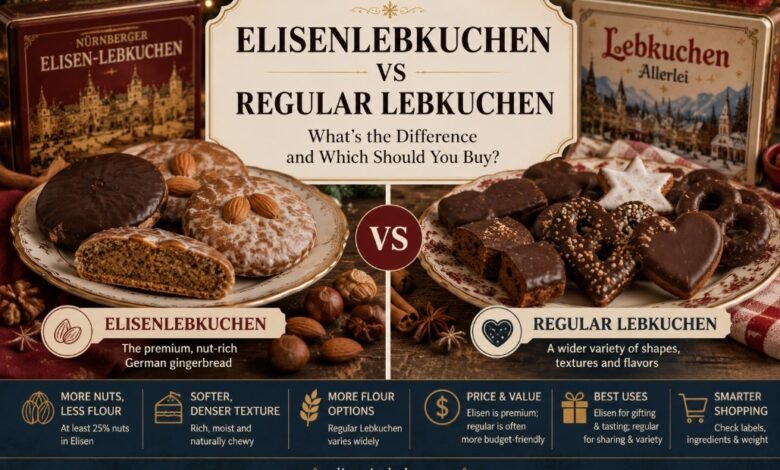
The main difference between Elisenlebkuchen and regular Lebkuchen is the proportion of nuts and flour. Elisenlebkuchen is the premium, soft and nut-rich category: under German fine-baked-goods guidelines, it must contain at least 25% almonds, hazelnuts or walnuts and no more than 10% cereal flour or starch. Regular Lebkuchen is a much broader category and may contain considerably more flour, less nuts and a lighter or firmer texture.
That difference explains why two packages carrying the word Lebkuchen can deliver completely different experiences. One box may contain six substantial, moist Elisen rounds baked on edible wafers. Another may contain twenty small flour-based hearts, stars and pretzels covered in chocolate. Both can be legitimate German Lebkuchen, but they are not interchangeable in texture, richness, price or purpose.
This comparison explains how to recognize each style, which one tastes softer, why Elisenlebkuchen usually costs more and when an ordinary package may actually be the better purchase. Readers who need a broader introduction can begin with what Lebkuchen is, how it tastes and why its texture varies. Readers ready to compare current United States sellers can use the Best Lebkuchen Near Me shopping guide.
The practical answer: Choose Elisenlebkuchen when you want a soft, dense, nut-forward cookie that feels special enough for a tasting or gift. Choose regular Lebkuchen when you want a more affordable, familiar gingerbread assortment for a larger group.
Elisenlebkuchen and Regular Lebkuchen Are Related, but They Are Not the Same Product
Elisenlebkuchen is a legally defined premium type within the wider Lebkuchen family. Regular Lebkuchen is an informal English description that may refer to almost any other spiced German gingerbread product, including wafer-backed rounds, chocolate-coated hearts, filled bars, small shapes and firm decorated cookies.
The easiest way to understand the relationship is to think of Elisenlebkuchen as one specific class inside a much larger category. Every Elisenlebkuchen is Lebkuchen, but not every Lebkuchen qualifies as Elisenlebkuchen.
Elisenlebkuchen must rely heavily on almonds, hazelnuts or walnuts. The permitted amount of cereal flour or starch is tightly limited. These rules create the dense, moist and slightly chewy character associated with premium Nuremberg-style rounds.
Regular Lebkuchen has more flexibility. The dough may contain a larger proportion of wheat flour, rye flour or starch. Nuts may still appear, but they are not always the main structural ingredient. Some inexpensive products contain no obvious nut pieces at all and instead resemble a soft gingerbread cake enclosed in chocolate.
The distinction does not mean that every regular Lebkuchen is low quality. A beautifully spiced honey Lebkuchen, filled fruit bar or carefully decorated market heart can be excellent within its own style. The important point is that these products are designed to achieve different textures and serve different purposes.
Elisenlebkuchen is chosen for the cookie itself. Regular Lebkuchen is often chosen for variety, price, shape, coating or holiday presentation.
A premium Elisen round is usually large enough to eat slowly with coffee or divide into tasting wedges. A standard bag of chocolate-covered hearts, stars and pretzels is designed for sharing more casually. A festival heart may be purchased for its message and decoration rather than its tender interior.
The difference becomes especially important when ordering online. Product photographs can make every chocolate-coated cookie appear equally rich. A dark coating hides the interior, so the words on the package and the ingredient list matter more than the front image.
If a product clearly says Elisenlebkuchen, feinste Elisen or Nürnberger Elisenlebkuchen, the buyer can expect a high proportion of approved nuts and limited cereal ingredients. If the package says only Lebkuchen, Schokoladen-Lebkuchen or Lebkuchen Allerlei, the exact composition may vary substantially.
This is why the question is not simply which category is “better.” Elisenlebkuchen is generally the premium choice for texture and nut content, but regular Lebkuchen may be more useful for children, office bowls, large holiday parties, decorating, baking projects or shoppers who prefer a lighter and more familiar gingerbread flavor.
The Ingredient Difference Begins With Nuts and Flour
Elisenlebkuchen must contain at least 25% almonds, hazelnuts or walnuts and no more than 10% cereal flour or starch. Those ratios are the technical foundation of the category and the main reason an Elisen cookie feels heavier, richer and softer than many ordinary Lebkuchen products.
Ground nuts do more than add flavor. Almonds, hazelnuts and walnuts provide fat, moisture and structure. When flour is restricted, the cookie’s body comes largely from nuts, eggs, sugar or honey and finely chopped candied fruit. The finished crumb feels cohesive and substantial rather than airy.
Regular Lebkuchen may reverse that relationship. Flour can become the main structural ingredient, while nuts serve as a smaller addition or decoration. This produces a dough that is easier to shape, cut, coat and manufacture in large quantities.
A higher flour content also makes it possible to create stars, pretzels, hearts, rectangles and small domes that retain clean edges. Nut-heavy Elisen dough is softer and usually spread onto round edible wafers rather than rolled and cut like conventional cookie dough.
Both categories commonly use a warm spice blend. Cinnamon and cloves are frequent, but coriander, cardamom, anise, ginger, nutmeg, allspice or mace may also appear. The spice mix does not determine whether a product is Elisenlebkuchen. The nut and cereal proportions do.
Honey is traditional in the broader Lebkuchen family, although modern commercial products may also use sugar, glucose syrup, invert sugar syrup or other sweeteners. The presence of honey does not automatically make a cookie premium, and the absence of a strong honey flavor does not prove that the product is inauthentic.
Candied orange peel and citron are especially common in soft premium varieties. German ingredient lists may identify them as Orangeat and Zitronat. They add fragrance, sweetness and a mild bittersweet edge that prevents the nut mixture from tasting flat.
Regular chocolate Lebkuchen may use less visible citrus or process it so finely that first-time buyers barely notice it. Some products lean more heavily toward cocoa, apricot filling, apple purée or sugar syrup, depending on the intended style.
Elisenlebkuchen structure: approved nuts, eggs, sweetener, citrus, spices and very limited cereal ingredients.
Regular Lebkuchen structure: often more flour or starch, with nuts used in smaller amounts or omitted from some styles.
Shared ingredients: spices, sweeteners, candied citrus, cocoa, chocolate, glaze and edible wafers may appear in either category.
What defines Elisen: the nut minimum and cereal maximum, not the shape of the box or the darkness of the chocolate.
The ingredient list is usually printed in descending order by weight. When hazelnuts and almonds appear near the beginning, the product is likely to taste more nut-forward. When wheat flour, sugar syrup and chocolate dominate the first positions, the center will probably resemble a conventional gingerbread cake or cookie.
Buyers should also distinguish between the dough and the total finished product. A package may advertise a percentage of chocolate coating or nuts across the complete cookie. Because the coating contributes weight, the numbers on a retail page do not always translate directly into the percentage of nuts in the uncoated dough.
Official product descriptions occasionally use wording that differs slightly from the general category standard. The safest approach is to read the exact designation and the current package rather than relying on a retailer’s shortened description.
Elisenlebkuchen Is Usually Softer, Denser and More Nut-Forward
Elisenlebkuchen usually has a moist, dense and slightly chewy center, while regular Lebkuchen can range from soft and cake-like to firm and crisp. The texture difference is immediately noticeable when two uncoated pieces are broken open side by side.
A premium Elisen round feels heavy for its size. The interior may show ground hazelnuts, almonds and small pieces of candied citrus. It bends slightly before breaking and remains moist without feeling raw or sticky.
Regular flour-based Lebkuchen often feels lighter. The crumb may be smoother and more uniform, similar to a soft gingerbread cake. Small chocolate-covered shapes sometimes have a springy interior, while thin brown Lebkuchen can be considerably firmer.
The nut content affects flavor as much as texture. Elisenlebkuchen often tastes first of roasted almonds or hazelnuts, followed by citrus, honey and spice. Regular Lebkuchen may present sweetness and cinnamon first, especially when the dough is covered with milk chocolate.
Chocolate can make the categories appear more similar than they really are. A thick coating supplies sweetness and fat, so even an inexpensive flour-based center may initially feel rich. The difference becomes clearer after the chocolate melts and the interior is chewed.
Dark-chocolate Elisenlebkuchen offers contrast: a thin bittersweet shell around a fragrant, soft nut center. Dark-chocolate regular Lebkuchen may offer a similar first bite but a more cake-like or bready finish.
Sugar glaze exposes the dough more honestly. Because the glaze is thin and relatively neutral, the buyer can taste the nuts, citrus and spice without a strong cocoa layer. For this reason, a glazed Elisen cookie is one of the best products for understanding the category.
Plain Elisenlebkuchen may be topped with almonds or left largely uncovered. These versions provide the clearest nut flavor but can dry faster if packaging is poor. Chocolate creates a protective layer that may help the interior remain moist longer.
The most revealing comparison: taste one glazed Elisenlebkuchen beside one glazed standard Oblatenlebkuchen. Chocolate is delicious, but it can hide the difference between the two doughs.
The spice level varies independently of category. Some premium Elisenlebkuchen is delicately spiced so the nuts remain dominant. Some ordinary Pfefferkuchen is darker and more assertive. A stronger clove flavor does not prove that a product contains more traditional ingredients.
Citrus can also influence the impression of freshness. Finely chopped orange and citron create brightness and aroma. Poor-quality or oversized pieces can feel sticky or bitter. The best examples integrate the fruit evenly into the nut mixture.
Neither category should automatically taste dry. A flour-based cookie can remain soft when properly made and packaged, while a premium Elisen cookie can become crumbly after exposure to dry air. Texture should be evaluated in relation to the intended style and storage condition.
Festival hearts create the greatest confusion. Large decorated Lebkuchenherzen are often intentionally firm so they can hold icing, survive handling and sometimes hang from ribbons. Their hardness does not make them fake Lebkuchen, but they should not be compared with soft Elisen rounds as though both were designed for the same experience.
You Can Often Identify Elisenlebkuchen Before Reading the Ingredients
Elisenlebkuchen is commonly sold as a large round cookie baked on an edible wafer, while regular Lebkuchen appears in a wider range of shapes and sizes. Visual clues are useful, but the package designation remains more reliable than appearance alone.
The classic Elisen form is round and relatively thick. Common diameters are approximately 70 to 90 millimeters, although larger specialty pieces exist. The surface may be smooth with sugar glaze, covered in dark chocolate or decorated with almonds.
The underside usually reveals a pale edible wafer. This wafer may extend to the cookie’s edge or remain slightly smaller than the dough. It should not be peeled away like paper.
Regular Oblatenlebkuchen can look almost identical. It may also be round, thick and wafer-backed. This is why shape alone cannot confirm Elisen status. The difference may exist almost entirely in the recipe.
Flour-based assortments often include hearts, stars and pretzels. Chocolate covers most of the surface, making the products visually uniform. A single package may include milk chocolate, dark chocolate and white sugar glaze.
Filled Lebkuchen frequently appears as rectangular bars or domes. A cross-section may reveal apricot preparation, jam or marzipan. These products can be soft and satisfying but belong to a different comparison than an unfilled Elisen round.
Large decorative hearts are easy to recognize because of their piped borders, messages and ribbons. They are associated with fairs, Oktoberfest-style events and Christmas markets. Their visual appeal is central to their purpose.
Likely Elisen clues: large round shape, edible wafer, visible nut texture, almond decoration and a product name that includes Elisen.
Likely standard assortment clues: multiple small shapes, fully coated surfaces, large piece count and a lower price per ounce.
Likely filled Lebkuchen clues: rectangular bars, domes or package descriptions mentioning fruit, jam or marzipan.
Likely festival-heart clues: colorful piped icing, a written message, ribbon and a firm flat shape.
Packaging can mislead buyers. Premium-looking gold foil, nostalgic illustrations and metal tins appear across several quality levels. A beautiful container may hold excellent Elisenlebkuchen, but decoration alone does not establish the recipe.
Likewise, plain cellophane does not indicate lower quality. Small Nuremberg bakeries may sell handmade Elisenlebkuchen in simple bags because customers are paying for the product rather than a collectible chest.
The Package Label Tells You More Than the Front Photograph
The most useful shopping skill is learning a few German product terms. Retailers in the United States do not always translate them accurately, and “premium German gingerbread” is too vague to identify the actual style.
Elisenlebkuchen: the premium nut-rich category with at least 25% approved nuts and no more than 10% cereal flour or starch.
Feinste Elisenlebkuchen: finest Elisenlebkuchen; the wording emphasizes the premium category.
Oblatenlebkuchen: Lebkuchen baked on edible wafers. This term alone does not guarantee Elisen-level nut content.
Feine Oblatenlebkuchen: fine wafer Lebkuchen, a recognized quality description below or distinct from the specific Elisen designation.
Nürnberger Lebkuchen: Lebkuchen produced within Nuremberg under the protected geographical name.
Nürnberger Elisenlebkuchen: Elisen-category Lebkuchen produced in Nuremberg.
Schokoliert: chocolate-coated.
Zartbitter: dark or bittersweet chocolate.
Vollmilch: milk chocolate.
Glasiert: sugar-glazed.
Natur or ungeglasiert: plain or uncoated.
Gefüllt: filled.
Sortiment or Mischung: assortment or mixture.
Allerlei: a mixed selection, often containing several shapes or finishes.
The word Nürnberger and the word Elisen answer different questions. Nürnberger identifies protected geographical production. Elisen identifies a premium recipe category. A cookie can be Elisenlebkuchen without being made in Nuremberg, and a Nürnberger Lebkuchen product can belong to a category other than Elisen.
“Nuremberg-style” on an American bakery page is descriptive rather than identical to the protected geographical designation. It may indicate inspiration from the soft wafer-backed tradition, but buyers should review the ingredients and production location.
Do not assume that Oblatenlebkuchen means flourless. The wafer-backed family includes different quality grades. The edible wafer describes the base, not the precise proportion of nuts.
“Nut Lebkuchen” is similarly broad. A cookie can contain nuts without satisfying the Elisen minimum. Whole almonds arranged on top may be decorative and do not reveal how much ground nut material exists inside the dough.
When a United States importer shortens the name to “Elisen cookies” or “premium chocolate gingerbread,” open the detailed description and ingredient list. Confirm the manufacturer’s full German designation whenever possible.
Why Elisenlebkuchen Costs More—and When the Price Is Worth It
Elisenlebkuchen usually costs more because almonds, hazelnuts and walnuts replace much of the inexpensive flour used in ordinary gingerbread. Large individual size, small-batch production, imported shipping and decorative packaging can raise the price further.
A standard imported Lebkuchen assortment may cost approximately $5–$15 in the United States during the holiday season. Premium Elisen packages often begin closer to $18–$25, while fresh artisan boxes and decorative tins commonly reach $30–$40 or more.
These ranges should not be interpreted as fixed category rules. Retailer promotions, net weight, piece count, shipping and packaging create significant variation. A plain refill package of Elisenlebkuchen may cost less than an elaborate tin containing a more ordinary assortment.
Compare the price per ounce or kilogram when possible. Piece count alone is misleading because one large Elisen round may weigh as much as several small chocolate shapes.
For example, a box containing five dense 80-gram rounds provides a very different quantity from a bag containing fifteen small hollow-looking hearts. The larger piece count may appear more generous while offering less total weight or less costly ingredients.
Nut percentage is another useful value indicator. A product that discloses a high proportion of almonds and hazelnuts gives the buyer a reason for the premium. A vague luxury description without ingredient detail provides less evidence.
Packaging has real but separate value. A collectible Nuremberg tin can be reused, displayed or given without wrapping. That convenience may justify an additional cost for a host gift. For personal eating, the same or similar cookies in a cardboard refill box may be the better value.
Best value for tasting quality: a simple mixed Elisen package without an elaborate chest.
Best value for a large party: a substantial regular Lebkuchen assortment with several shapes and coatings.
Best value for gifting: a medium reusable tin with clearly stated Elisen contents.
Worst value risk: paying a premium for oversized packaging without checking net weight and product type.
Elisenlebkuchen is worth the higher price when the eater appreciates nuts, citrus, restrained spice and a dense texture. It may not be worth the premium for a child who mainly wants milk chocolate, an office where cookies will be eaten quickly without comparison or a decorating project that requires firm shapes.
Regular Lebkuchen can offer excellent value because it supplies variety and volume. A family may prefer a box containing small hearts, stars and pretzels rather than six large rounds. The correct purchase depends on the occasion, not only the formal quality category.
Chocolate and Glaze Change Both Categories, but They Do Not Define Them
A chocolate coating does not turn regular Lebkuchen into Elisenlebkuchen, and an uncoated cookie is not automatically more traditional. Coatings describe the finish, while the dough determines the category.
Dark chocolate is especially popular on Elisenlebkuchen because its bitterness balances honey, nuts and candied citrus. A thin shell gives the first bite a slight snap and then melts into the soft center.
Milk chocolate makes both categories sweeter and creamier. It can be appealing for first-time tasters, but the stronger sweetness may hide subtle spice and nut flavors.
Sugar glaze forms a thin translucent layer. On Elisenlebkuchen, it allows the texture and color of the dough to remain visible. The glaze may develop fine cracks without indicating staleness.
Plain or almond-topped Elisenlebkuchen shows the recipe most clearly. Without a full coating, the buyer can evaluate aroma, moisture, nut texture and citrus directly. The tradeoff is that the surface may lose moisture more readily after opening.
Regular Lebkuchen benefits from chocolate in a different way. A coating can keep small flour-based shapes tender and make a budget assortment feel richer. The chocolate may represent a larger proportion of each small piece than it does on a large Elisen round.
White coatings require closer reading. A pale exterior may be sugar glaze, white chocolate or a fat-based confectionery coating. These finishes differ considerably in sweetness and dairy content.
For the fairest comparison: compare two products with the same finish. A glazed Elisen round versus a glazed standard wafer Lebkuchen reveals the dough difference more clearly than comparing dark-chocolate Elisen with a plain budget cookie.
Assorted boxes are particularly useful because they reduce the influence of personal coating preference. Someone who dislikes sugar glaze may discover that the same dough works beautifully with dark chocolate.
Check whether “assorted” refers only to coatings or to completely different baked goods. Some gift chests mix Elisenlebkuchen with filled bars, Stollen, Spekulatius and chocolates, making a direct quality comparison difficult.
Which Type Should You Buy for Your Actual Situation?
Buy Elisenlebkuchen for a focused tasting, premium gift or slow coffee break. Buy regular Lebkuchen for variety, decorating, casual sharing or a lower-cost holiday table.
For a first serious tasting, Elisenlebkuchen is the more informative purchase. It shows why German Lebkuchen cannot always be reduced to the English phrase “gingerbread cookie.” The nut structure, edible wafer and candied citrus create an experience far removed from a crisp gingerbread man.
For children or people unfamiliar with candied peel, a regular milk-chocolate assortment may be more approachable. Small pieces are easier to portion, and familiar shapes make the box feel festive.
For a host gift, choose a mixed Elisen tin containing glazed and dark-chocolate rounds. The assortment avoids assuming one coating preference, while the tin provides presentation without additional wrapping.
For an office, school staff room or large family gathering, ordinary assorted Lebkuchen may be more practical. Large Elisen rounds require cutting or individual commitment, while small shapes can be shared casually.
For a German-themed tasting board, use both categories. Include one premium Elisen round cut into wedges and several smaller standard shapes. Add crisp Spekulatius or vanilla crescents so guests can compare textures rather than eating four similar soft cookies.
For decorating, choose a firm flour-based Lebkuchen or dedicated gingerbread dough. Elisen dough is too soft and nut-heavy for sharp cutout figures, houses or long piped messages.
For someone avoiding excessive sweetness, plain or dark-chocolate Elisenlebkuchen is often the better choice. Milk-chocolate regular assortments can taste considerably sweeter, although individual recipes vary.
For someone who dislikes nuts, Elisenlebkuchen is the wrong category by definition. Search instead for a clearly labeled flour-based or nut-free gingerbread product, while still checking cross-contact warnings.
Choose Elisenlebkuchen for: premium texture, nut flavor, a sophisticated gift and a revealing first taste.
Choose regular Lebkuchen for: budget, volume, small shapes, decorating and casual family sharing.
Choose both for: an educational tasting or German Christmas dessert board.
Choose neither without checking: when allergies or strict dietary requirements are involved.
A Note From Diana: I would buy Elisenlebkuchen when the cookie is meant to be the experience—not just one sweet among twenty others. For a crowded party table, however, a good mixed box of smaller chocolate Lebkuchen can be more useful and less wasteful. Premium does not always mean practical.
How to Recognize Quality Within Either Category
The Elisen name establishes important ingredient standards, but it does not guarantee that every Elisen cookie will suit your taste or arrive in perfect condition. Freshness, spice balance, citrus quality, coating and storage still matter.
Good Elisenlebkuchen should smell clearly of toasted nuts, citrus and warm spices when the package opens. The center should remain moist and cohesive. It should not crumble like dry bread or feel greasy and underbaked.
The nuts should taste fresh rather than bitter or stale. Hazelnuts and walnuts can develop unpleasant flavors when stored poorly, so even a technically premium recipe depends on ingredient quality.
Candied fruit should be finely integrated. Large tough pieces or an artificial perfume can distract from the cookie. Some buyers prefer more citrus, while others favor a predominantly nut-and-chocolate profile.
The coating should be even and thin enough to complement the interior. Gray streaks on chocolate may indicate temperature-related bloom. Bloom is not necessarily a food-safety problem, but it reduces visual and textural quality.
Regular Lebkuchen should be judged according to its intended style. A soft chocolate heart should spring slightly and retain moisture. A crisp brown Lebkuchen should snap cleanly. A festival heart should be firm enough to hold its decoration.
Strong spice does not automatically equal quality. Clove, anise and cinnamon should work together rather than producing a medicinal or bitter finish. A mild cookie can still be well balanced.
Excessive sweetness is one of the most common problems in budget products. Thick milk chocolate, sugar syrup and a sweet filling can overwhelm the spice. Pairing the cookie with unsweetened tea helps, but the dough should still contribute recognizable flavor.
Good Elisen signs: prominent nut aroma, moist dense center, balanced citrus and a clear spice finish.
Good standard Lebkuchen signs: appropriate softness or snap, clean coating, recognizable spice and no stale flour flavor.
Storage warning signs: broken seal, condensation, melted coating, weak aroma or unexpected dryness.
Packaging warning sign: no clear product designation, weight or ingredient list on an expensive imported item.
Always check the best-before date and the seller’s “peak quality” guidance where provided. Lebkuchen often has a longer shelf life than fresh cream pastries, but that does not mean every package remains equally aromatic for months after opening.
Elisenlebkuchen and Regular Lebkuchen Have Different Allergen Patterns
Elisenlebkuchen is especially unsuitable for people with tree-nut allergies because almonds, hazelnuts or walnuts are required in substantial quantities. Regular Lebkuchen may contain fewer nuts, but it cannot be assumed to be nut-free.
Tree nuts are not a minor garnish in Elisenlebkuchen. They form a significant part of the dough. Removing them would fundamentally change the category.
Regular flour-based Lebkuchen may be safer only when the exact product is labeled accordingly. Manufacturers can use nuts, marzipan, almond decoration or shared production equipment even when nuts are not visible.
Gluten presents the opposite pattern. Elisenlebkuchen contains limited cereal flour or starch, but the permitted maximum does not equal zero. The edible wafer may also contain wheat.
Some producers offer specifically gluten-free Elisen-style cookies using gluten-free wafers or no conventional cereal ingredients. Shoppers with celiac disease must verify certification and cross-contact rather than assuming every high-nut product is safe.
Regular Lebkuchen commonly contains wheat flour and is therefore more predictably unsuitable for a gluten-free diet unless specially formulated.
Eggs frequently bind Elisen dough. Honey is also common, which means traditional Elisenlebkuchen is rarely vegan without deliberate reformulation.
Regular Lebkuchen may contain eggs, dairy, honey or animal-derived glazing ingredients depending on the recipe. Vegan versions exist in both premium and standard styles, but the label must state this clearly.
Milk is especially relevant to chocolate coatings. Milk chocolate contains dairy, while dark chocolate can still include milk traces or be produced on shared equipment.
Never use category assumptions as allergy advice. Elisen means high nut content and limited cereal ingredients; it does not mean gluten-free. Regular means broader recipe flexibility; it does not mean nut-free or vegan.
People monitoring sugar should compare nutritional panels rather than assuming that a nut-rich cookie contains less sugar. Nuts may make the cookie more satisfying, but sugar, honey, glaze and chocolate still contribute substantially.
Reduced-sugar and no-added-sugar products require their own ingredient review. Sugar alcohols, alternative sweeteners or naturally occurring sugars may affect flavor and digestion.
How to Serve, Gift and Store Each Type
Elisenlebkuchen is best served at room temperature in smaller portions, while regular Lebkuchen is often easier to place directly into a shared cookie bowl.
A large Elisen round can be served whole with coffee, but cutting it into four or six wedges creates a more useful tasting. Guests can compare glaze and chocolate without eating several full cookies.
Regular small hearts and stars require no cutting. They work well on casual holiday trays, in lunch boxes and alongside other cookies.
Black coffee and unsweetened tea pair particularly well with Elisenlebkuchen because bitterness balances the nuts, honey and coating. Milkier drinks can soften the spice of ordinary chocolate Lebkuchen.
Fresh pear, orange and tart apple provide contrast. Avoid surrounding premium Lebkuchen with too many heavily frosted sweets, because its more subtle citrus and spice can disappear.
For gifting, protect Elisenlebkuchen from drying and crushing. A sealed tin or sturdy box is useful. Large rounds should not move freely inside the package.
Regular Lebkuchen shapes are often more durable, although chocolate can melt during warm-weather shipping. A summer preorder should not be confused with immediate summer delivery.
After opening, reseal either type according to the manufacturer’s instructions. Store it away from heat, direct sunlight and strong odors. Chocolate-coated cookies should not be placed beside strongly scented foods.
Freezing may be possible for some homemade or uncoated products, but commercial packages should follow producer guidance. Decorative glaze and chocolate can develop condensation after thawing.
Elisen serving idea: one glazed and one dark-chocolate round cut into wedges with black tea and sliced pear.
Regular Lebkuchen serving idea: mixed chocolate hearts, stars and pretzels with coffee, fruit and crisp butter cookies.
Comparison-board idea: Elisenlebkuchen, standard Oblatenlebkuchen, Spekulatius and Aachen Printen labeled separately.
For a café-style winter afternoon, present a limited selection rather than opening every package. The site’s cozy European café food guide offers additional ideas for creating a relaxed coffee-and-dessert setting.
A Shopping Checklist for Choosing Between Elisen and Regular Lebkuchen
A good package should answer basic questions before the buyer pays. The front design creates desire, but the back label reveals whether the product matches the intended experience.
1. Read the exact name. Does it say Elisenlebkuchen, Oblatenlebkuchen, Nürnberger Lebkuchen, filled Lebkuchen or only German gingerbread?
2. Check the ingredient order. Are almonds and hazelnuts prominent, or does flour lead the list?
3. Confirm the coating. Is it dark chocolate, milk chocolate, sugar glaze or a mixed assortment?
4. Compare net weight. Do not judge value from piece count or box dimensions alone.
5. Look for the wafer. Oblaten indicate a wafer-backed style but do not alone prove Elisen quality.
6. Check the filling. Fruit or marzipan changes both sweetness and texture.
7. Review allergens. Confirm nuts, wheat, eggs, milk, soy and shared-equipment warnings.
8. Check origin wording. Nürnberger refers to protected production in Nuremberg; Nuremberg-style does not mean the same thing.
9. Separate packaging value from food value. Decide whether you actually need a collectible tin.
10. Confirm seasonal timing. A preorder may not ship for several months.
For a first premium experience, choose a small Elisen assortment with both glazed and dark-chocolate rounds. For a family party, choose a larger regular assortment with clearly stated weight and several small pieces.
When shopping in person, ask the employee whether the store carries Elisenlebkuchen specifically. Asking only for Lebkuchen may lead to the general seasonal shelf, where products of every quality level are grouped together.
When shopping online, compare the manufacturer’s official description with the importer’s page. The original producer may explain the dough, nut content and coating more precisely.
When buying from a Christmas market, ask whether the cookie was baked locally, imported from Germany or designed mainly as a decorative heart. All three can be enjoyable, but the answers set the correct expectations.
The final decision: Buy Elisenlebkuchen when you care most about soft texture, nuts and a premium tasting. Buy regular Lebkuchen when you care most about affordability, variety, small portions or decorative shapes.
Elisenlebkuchen vs Regular Lebkuchen in One Clear Summary
Elisenlebkuchen is the premium nut-rich category within the larger Lebkuchen tradition. It must contain at least 25% almonds, hazelnuts or walnuts and no more than 10% cereal flour or starch. It is commonly baked as a large soft round on an edible wafer and finished with sugar glaze, dark chocolate or a plain almond decoration.
Regular Lebkuchen includes a much wider range of recipes. It may contain more flour, less nuts and a lighter, cake-like or firmer texture. It can appear as small chocolate hearts, stars, pretzels, filled bars, wafer rounds or large decorated festival hearts.
Elisenlebkuchen usually costs more because nuts replace much of the flour and because the cookies are often larger, heavier or sold in premium packaging. Regular Lebkuchen is usually more affordable and practical for casual sharing.
Neither category is universally better for every situation. Elisenlebkuchen is the stronger choice for a focused first tasting, elegant gift or slow coffee break. Regular Lebkuchen is often the smarter choice for a party, children, decorating or a large mixed holiday plate.
Once the preferred category is clear, compare current bakeries, importers, seasonal stores and price ranges in the Best Lebkuchen Near Me guide.
What is the main difference between Elisenlebkuchen and regular Lebkuchen?
Elisenlebkuchen must contain at least 25% almonds, hazelnuts or walnuts and no more than 10% cereal flour or starch. Regular Lebkuchen is a broader category and may contain considerably more flour, fewer nuts and a lighter or firmer texture.
Is Elisenlebkuchen softer than regular Lebkuchen?
Elisenlebkuchen is usually soft, dense and moist because ground nuts provide much of its structure. Regular Lebkuchen can be soft and cake-like, but some styles are intentionally firm or crisp, especially decorated hearts and brown gingerbread shapes.
Why is Elisenlebkuchen more expensive?
Almonds, hazelnuts and walnuts cost more than cereal flour, and Elisenlebkuchen requires a substantial proportion of these nuts. Large cookie size, artisan production, imported shipping and decorative tins can increase the price further.
Is Elisenlebkuchen flourless?
Not necessarily. The category permits a limited amount of cereal flour or starch, with a maximum of 10%. Some individual recipes are flourless, but buyers should check the exact ingredient list and edible wafer.
Is regular Lebkuchen lower quality?
Regular Lebkuchen is not automatically poor quality. It is a broader category that includes flour-based chocolate shapes, honey Lebkuchen, filled bars and decorative hearts. These products serve different purposes and may be excellent within their intended style.
Does an edible wafer mean the cookie is Elisenlebkuchen?
No. Both Elisenlebkuchen and other Oblatenlebkuchen may be baked on edible wafers. The wafer describes the base, while the nut and cereal proportions determine whether the dough qualifies as Elisenlebkuchen.
Is Nürnberger Lebkuchen the same as Elisenlebkuchen?
No. Nürnberger Lebkuchen identifies Lebkuchen produced in Nuremberg under a protected geographical name. Elisenlebkuchen identifies a premium recipe category. A product can be both Nürnberger and Elisenlebkuchen, but the terms describe different qualities.
Which type of Lebkuchen is best for a first-time buyer?
A small mixed box of glazed and dark-chocolate Elisenlebkuchen gives the clearest premium introduction. A regular chocolate assortment may be better for someone who prefers familiar, sweeter gingerbread or needs many small pieces for sharing.
Which type has more allergens?
Elisenlebkuchen necessarily contains substantial tree nuts and commonly contains eggs, wheat in small amounts or in the wafer, and dairy in milk-chocolate versions. Regular Lebkuchen often contains wheat and may also contain nuts, eggs, milk and soy. The exact label must always be checked.
How should Elisenlebkuchen and regular Lebkuchen be served?
Both are normally served at room temperature. Large Elisen rounds can be cut into tasting wedges and paired with coffee or tea. Small regular Lebkuchen shapes can be placed directly on a shared holiday cookie plate.