Shchi Soup Near Me: Where to Find Russian Cabbage Soup
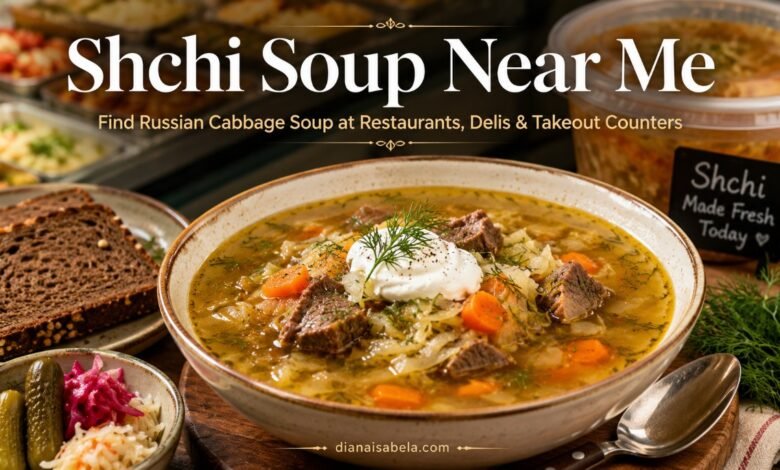
Shchi is one of those foods that becomes strangely difficult to find the moment you decide you specifically want it. Borscht gets the famous name, the jewel-red color and a reasonably uncomplicated relationship with restaurant menus. Shchi is quieter. It may appear as shchi, щи, Russian cabbage soup, sour cabbage soup, green shchi or sorrel soup — and sometimes it does not appear online at all because today’s pot is sitting behind the hot-food counter of a Russian or Ukrainian deli.
That is why I do not think a useful “shchi soup near me” guide can simply collect restaurants with the word shchi on a permanent menu and call the job finished. This is home-style food. It belongs to neighborhood restaurants, immigrant grocery stores, prepared-food kitchens, deli counters and the sort of culinary shops where people stop for lunch three times a week and expect the soup to change often enough that Tuesday does not taste exactly like Thursday.
So this guide looks wider. It begins with the United States, then moves through the United Kingdom, India, Brazil, South Korea and Indonesia, while the American search goes deeper into Pennsylvania, Philadelphia, Illinois, Washington, New York, New Jersey, Florida, California, Maryland and Texas. Just as importantly, I want you to understand what you are looking for before you drive across town: which menu names matter, how fresh-cabbage and sour-cabbage shchi differ, why green shchi complicates every tidy definition, what a good bowl should taste like, how to judge a deli lead and when a phone call is much smarter than blind optimism.
The Hunt Starts Somewhere Between a Restaurant and a Grocery Store
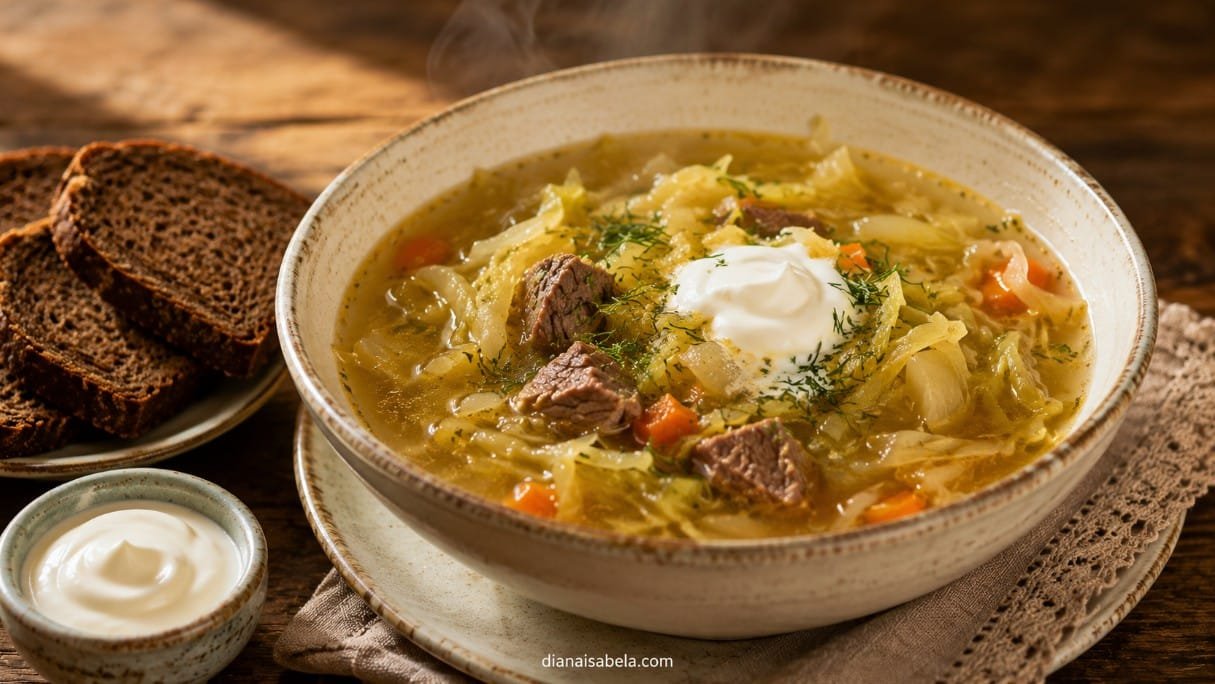
If I wanted shchi tonight, I would not search only for “Russian restaurant.” I would search for Russian food, Ukrainian food, Eastern European deli, Slavic grocery, prepared foods, homemade soup, hot-food counter, Uzbek restaurant, Bukharian restaurant and Russian grocery. Then, if the place looked promising but the current soup list was missing, I would call before putting on shoes that require effort.
That broader approach matters because shchi belongs just as naturally to everyday cooking as it does to restaurant cooking. A polished dining room can serve a beautiful bowl. So can a grocery-store kitchen that makes lunch for people from the neighborhood every day. The second business may have no interest whatsoever in building a dedicated webpage for Thursday’s soup, because its customers already know to look behind the glass.
There is a very modern assumption that if food cannot be found on a business website, it must not exist. Prepared-food counters are excellent at proving otherwise. A deli can be actively cooking several soups, kotleti, stuffed cabbage, buckwheat, mashed potatoes and salads while its online presence consists of opening hours, three photographs and a phone number someone remembers to update every leap year.
For shchi, that is not an edge case. It is part of the landscape. The dish is unusually compatible with a rotating counter because it makes sense in a large pot, travels well and fits naturally into lunch or a take-home dinner. A kitchen serving repeat customers also has every reason to rotate it. One day may be shchi, another borscht, another chicken soup, rassolnik, mushroom soup or solyanka. If people eat there several times a week, variety is not a marketing gimmick; it is how lunch stays interesting.
This also changes what “near me” should mean. I am not interested only in the nearest address that happens to contain the phrase someone typed into a directory. I want the places where finding a good bowl is realistic: restaurants with the soup listed now, delis known for daily soups, Eastern European groceries with genuine prepared-food programs and Russian or Central Asian kitchens where menu overlap makes shchi a reasonable dish to investigate.
There is an important difference between a place that sells Eastern European groceries and a place that actually cooks. Shelves of buckwheat, jars of pickles, sour cream and imported candy may be useful if you plan to make dinner yourself, but they do not automatically imply a hot-food counter. When I am hunting shchi, I want signs of a kitchen: soup kettles, steam tables, prepared salads, refrigerated meals, trays of kotleti, stuffed cabbage, cooked grains, mashed potatoes, dumplings and recent customer photographs that look like somebody ate lunch rather than restocked a pantry.
For a wider starting point, my guide to finding Eastern European food nearby helps identify the kinds of neighborhoods and businesses worth searching. Shchi often lives inside a larger food ecosystem rather than inside a restaurant whose entire personality revolves around cabbage soup.
If you are completely new to the dish, the most important thing to understand is that shchi is not one rigid recipe frozen in time. Fresh white cabbage can give it one mood. Sauerkraut can give it another. Meat, mushrooms, potatoes, aromatics and herbs vary. Green shchi takes the conversation toward sorrel and other greens. Family cooking does not behave like a corporate product specification, and a useful guide should not pretend otherwise.
That is why I separate the basic identity of the soup into a deeper guide to what shchi actually is. Here, I want enough culinary understanding to make the search intelligent without turning a location guide into a history textbook wearing an apron.
Where I Would Start Looking Around the World
The practical search changes by country, so this page is an international doorway rather than an attempt to list every bowl on earth. A useful country guide can investigate its own cities, immigrant food communities, grocery stores, prepared-food businesses and restaurant habits without forcing one global page to become a 300-address telephone directory wearing a soup costume.
The United States has the deepest first layer because there are several different kinds of businesses worth investigating: Russian and Ukrainian delis, large Eastern European supermarkets, Uzbek and Bukharian restaurants, small culinary shops and city corridors where multiple traditions share the same menu landscape. The United Kingdom has a particularly interesting deli and ready-meal angle. India, Brazil, South Korea and Indonesia require a more selective approach because a country can have Russian restaurants without every Russian restaurant making shchi.
The broadest first search: restaurants plus Russian, Ukrainian, Central Asian and Eastern European prepared-food culture. The national guide then breaks the hunt down by state and city where there is enough real food infrastructure to justify going deeper.
London is the obvious starting point, but specialist Eastern European groceries and delis are especially important. Ready-to-heat cabbage soup can be a more realistic find than a permanent restaurant bowl.
Dedicated Russian cooking exists in major cities, but shchi should be verified rather than assumed. Borscht, pelmeni and cutlets make a kitchen worth investigating; they do not automatically prove that today’s soup is shchi.
The search needs Portuguese as well as English terminology and should follow real Russian and Eastern European food communities rather than simply the largest cities on a map.
Seoul’s international restaurant scene and Central Asian food presence make the search interesting, but local-language menu research and transliteration matter much more than they do in an English-only search.
Here I would be selective: identify genuine Russian or Eastern European kitchens, look for soup programs and then verify the dish. A promising address is worth investigating; possibility should not quietly become certainty.
A current U.S. example: Chinor in Illinois
Chinor Restaurant — Carol Stream, Illinois
This is exactly why I do not want the search trapped inside the phrase “Russian restaurant.” A current menu can lead to shchi through a Central Asian kitchen because food communities and restaurant menus do not organize themselves according to the neat categories we invent for directories.
A current UK example: the deli route
Babushka — UK Eastern European grocery
This is the British search in miniature. If you look only for a bowl arriving from a restaurant kitchen, you can miss the simpler answer: an Eastern European grocery may already have shchi packaged for dinner. That does not replace a restaurant search; it expands what “finding shchi” actually means.
Those two examples also explain why I do not want to force every country into the same architecture. In one place, restaurant menus may be the strongest path. Somewhere else, a deli or packaged fresh-food business may be more useful. In another country, the best result may be a promising Russian kitchen that requires a phone call because shchi appears seasonally rather than permanently.
The useful standard is not visual consistency between country pages. It is whether a hungry person can make a better decision after reading one.
The U.S. Search Gets Better Once You Stop Treating the Country Like One Neighborhood
The American search now has enough depth that simply saying “look in New York, California and Chicago” is no longer useful. Different states produce different kinds of leads. New York has dense Russian-speaking and Eastern European food corridors. New Jersey combines restaurants, specialty markets and suburban prepared-food businesses. Illinois gives us Chicago-area Eastern European and Central Asian food networks. Washington can introduce sorrel and green-soup terminology. Texas is geographically huge, which makes the difference between a confirmed bowl and a merely plausible kitchen especially important when the drive involved can become a minor expedition.
So instead of treating every U.S. result as one long national list, I use local guides where there is enough substance to justify them.
These are not rankings. A state with fewer listings can still contain the better answer if one kitchen clearly serves the soup you want. Use the local page closest to you, then judge the actual business, menu status, soup style and distance rather than assuming more listings automatically mean better shchi.
Philadelphia is the clearest example of why a city page sometimes deserves to exist underneath a state page. Pennsylvania is useful as a broad search because food infrastructure is not limited to one city, but Philadelphia has enough of its own restaurant and Eastern European food geography to justify a closer look. That does not mean every large U.S. city automatically needs its own page. A city page should solve a genuinely more specific problem, not merely repeat the state article with a shorter radius.
The same discipline matters when you live in a large state. California and Texas are obvious examples. Someone in Dallas does not benefit much from discovering a soup in Houston unless they are willing to travel. Someone in Northern California does not experience Los Angeles as “nearby” merely because both locations fit inside the same state border. The state page helps identify where the useful pockets are; the final decision is still local.
I also prefer honest scarcity to invented abundance. If one state has one confirmed shchi and several kitchens worth calling, I would rather say exactly that than inflate the page with generic Russian restaurants that have never shown any evidence of making the soup. A small list built on reality is more valuable than a long list built on cuisine adjacency.
The Places Most Likely to Have Shchi May Be the Least Interested in Advertising It
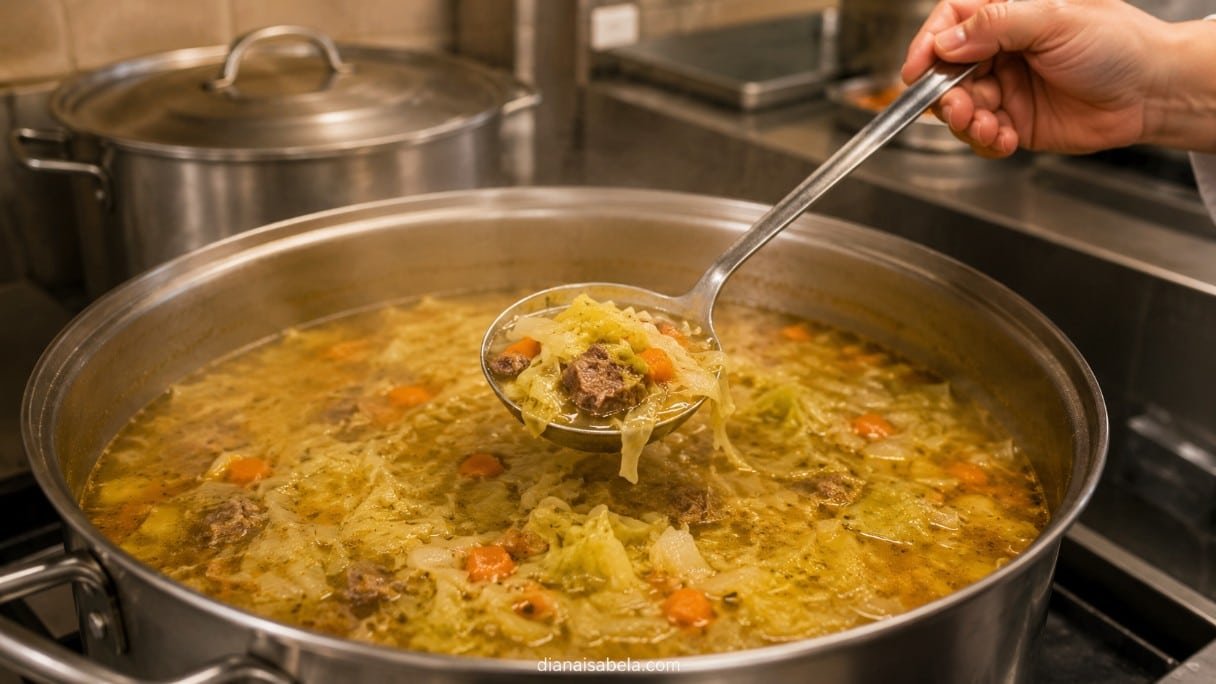
This is the part of the search I find most useful because it reflects how people actually eat this food. A Russian or Ukrainian deli with a serious hot-food counter is not necessarily trying to persuade a first-time visitor to cross town for one photogenic bowl. It may be feeding people who stop in every few days, buy lunch, pick up dinner for the family and already understand that the soup changes.
That changes the kitchen logic. If regular customers appear several times a week, serving one identical soup every day would make the counter less useful. A cook can make a generous batch of shchi, sell through it, then move to borscht, chicken broth, rassolnik, mushroom soup, solyanka or whatever fits the season and ingredients. The following week, shchi returns. Nothing about that rhythm requires a permanent online menu item.
And that is why I do not classify these businesses as weak leads simply because they fail the internet test.
The cleanest case. Confirm the address, price, style and current business status, then decide whether the place is worth your trip.
A strong practical lead. Call for today’s soup and ask whether shchi has a usual day in the rotation.
Worth investigating even if the website focuses on packaged groceries. A real prepared-food kitchen can contain far more useful information than the site navigation.
Promising, not confirmed. If the restaurant makes several home-style soups, ask whether shchi appears seasonally or as a special.
There is also a middle category that deserves attention: refrigerated or ready-to-heat soup. For someone who searched “shchi near me” because they wanted to eat shchi rather than because they specifically wanted table service, this is a legitimate answer. Bring it home, warm it properly, add sour cream and herbs, cut some dark bread and dinner is no less real because nobody handed you a linen napkin.
The prepared-food counter also gives you something restaurant results cannot: an immediate picture of the meal around the soup. A tray of kotleti tells you what the second course could be. Buckwheat and mashed potatoes solve the side-dish question. Pickles and salads bring acidity and freshness. Rye bread may be sitting three meters away instead of hiding behind a separate bakery search.
If this is your preferred way to find home-style food, the dedicated guide to finding shchi at Russian and Ukrainian delis goes deeper into soup rotation, what to look for behind the counter and how to distinguish a true prepared-food kitchen from a grocery store that happens to sell imported cabbage.
The little grocery store rule
I love a beautiful restaurant. I also trust the sentence, “There is this little grocery store…” more than many professionally photographed menu pages.
If a shop has an active kitchen, trays of prepared meals, regular customers and a soup area that genuinely changes, ask questions. Ask what is fresh. Ask what sells out first. Ask whether shchi appears on a certain day. Ask whether green shchi shows up in spring. Ask whether they package soup for the fridge.
That is useful local knowledge. It is also the kind of knowledge generic directories tend to lose because it does not arrive neatly formatted in a permanent menu feed.
One practical signal I like is variety across recent customer photographs. If every photo shows shelves of packaged groceries and no prepared food, I lower my expectations. If the recent gallery moves between soups, meat dishes, salads, cooked grains and people carrying meal containers, the business starts looking much more relevant. A rotating kitchen leaves a visual trail even when the website does not bother documenting every Tuesday lunch.
Another clue is how customers describe the place. “Great imported products” tells me one thing. “The homemade food sells out,” “good lunch counter,” “fresh soup every day,” or “ask what they cooked today” tells me something much more useful when shchi is the goal.
Five Questions That Can Save a Completely Pointless Drive
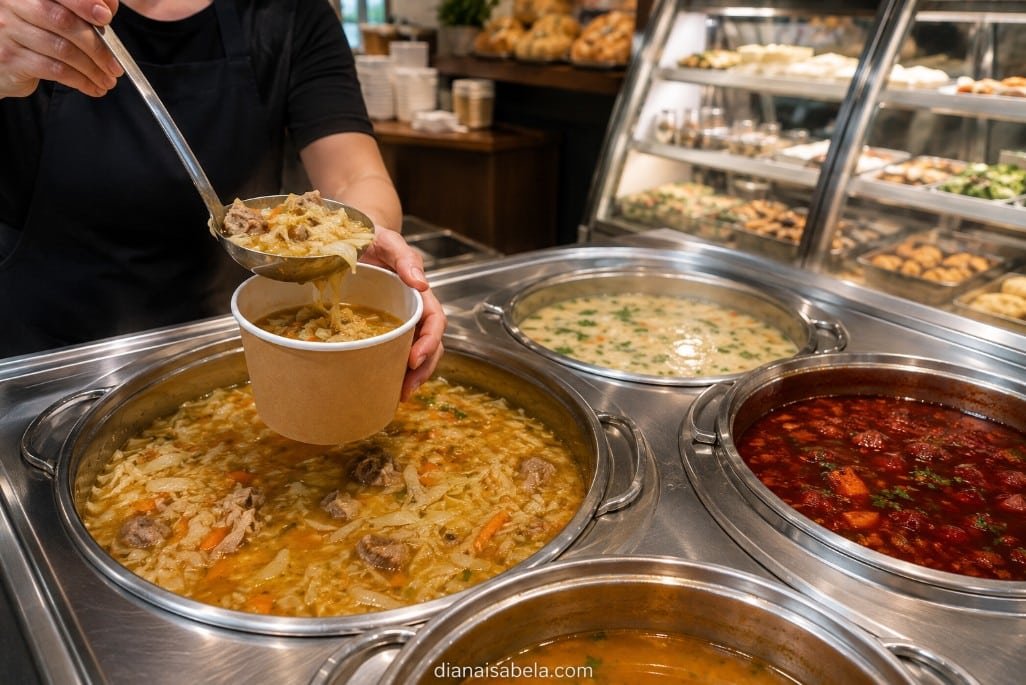
If shchi is the reason you are travelling rather than something you will order if you happen to see it, call first. This advice has almost no glamour and an extremely good success rate.
Do not overcomplicate the conversation. You do not need to explain the history of cabbage soup to the person answering the phone. You need to discover whether there is soup worth putting your coat on for.
What I would actually ask
The obvious beginning remains the useful beginning.
A no can become the most useful answer of the week.
Because those are not interchangeable cravings.
Some kitchens treat it as seasonal and may not connect it with the cabbage version unless you ask separately.
Especially sensible when one morning batch has to survive the lunch rush.
If English is not the kitchen’s first language, simpler is usually better. “Shchi today?” may accomplish more than an elaborate explanation. The Russian spelling щи can also help when you are showing a menu or typing a message rather than speaking.
I would also ask whether the soup contains meat if that matters to you. Shchi can appear with beef, other meat, mushrooms or in meatless forms, and a translated menu description may not always make the broth obvious. The fact that cabbage is the star does not mean every bowl is vegetarian.
Portion is worth asking about when the menu gives you no clue. A small soup cup is a starter. A generous deli container with bread can become lunch. If you are bringing food home for several people, asking about container size is much more useful than discovering at the counter that your “family dinner” plan is holding 12 ounces of soup and optimism.
The separate how to order shchi guide goes deeper into menu spellings, portion questions, fresh versus sour cabbage, meat, sides and exactly what to ask when the menu description tells you almost nothing.
If the person tells you shchi appears on Fridays, write it down. Rotating-food knowledge is absurdly easy to forget until the following Wednesday, when you suddenly remember the soup and repeat the entire investigation.
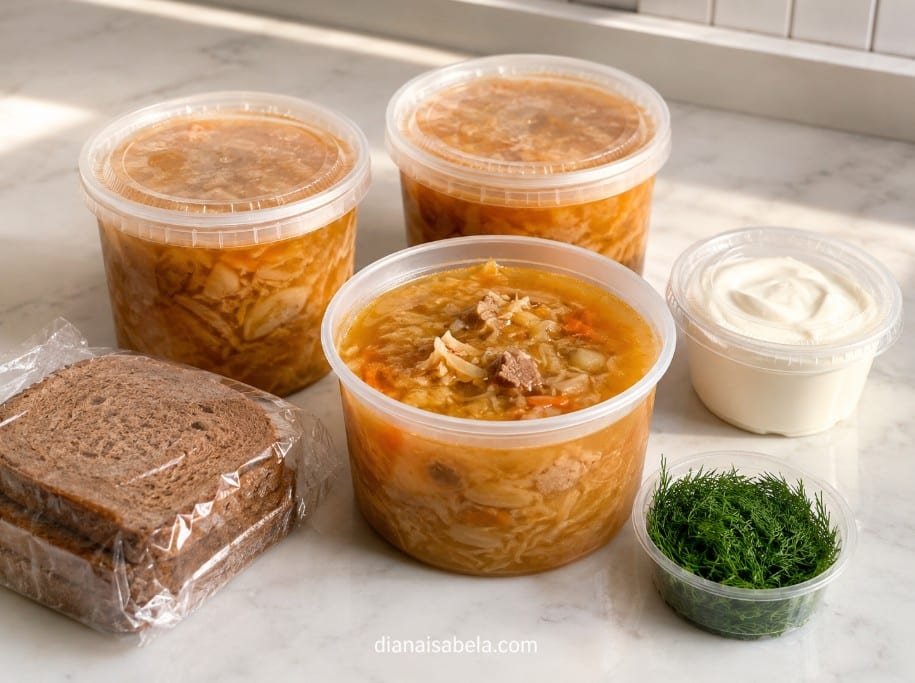
Fresh, Sour and Green: Shchi Refuses to Wear One Uniform
The easiest mental picture is cabbage simmered into a savory soup with vegetables, broth and, in many versions, meat. That is a perfectly useful starting point. It is not a definition capable of surviving contact with an actual family kitchen.
Fresh white cabbage gives one character. Fermented cabbage gives another. Green shchi can move away from white cabbage and toward sorrel. Mushroom versions can be substantial without meat. Beef, pork, poultry or different stocks alter the body of the soup. Families and restaurant kitchens make different decisions about potato, tomato, garlic and herbs. Even the point at which sour cream enters the bowl changes the impression.
Fresh-cabbage shchi
Fresh cabbage usually gives a cleaner vegetable sweetness and gentler acidity. The broth may be rich or fairly light depending on the kitchen, but the flavor of cooked cabbage remains central without the fermented edge of sauerkraut.
Sour-cabbage shchi
Fermented cabbage pulls the bowl toward a deeper, tangier profile. Long cooking can mellow that acidity and bring out sweetness, so the best versions do not simply taste aggressively sour; they feel layered.
These are not two completely separate soups, but choosing between them can matter enormously when you are craving a particular style. The difference is substantial enough to deserve the dedicated fresh-cabbage shchi vs sour-cabbage shchi comparison.
Then green shchi walks into the room and ruins every tidy definition
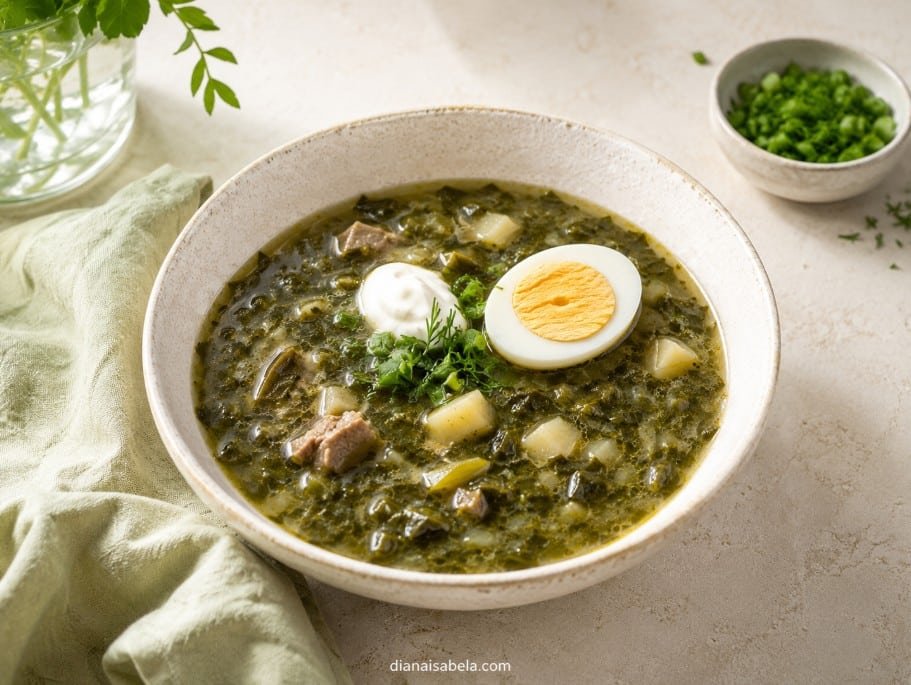
Green shchi, or zeleny shchi, is commonly associated with sorrel. Its acidity feels brighter and more herbal than sauerkraut acidity, and its color makes it look as though it belongs to another branch of the family entirely. Egg is a familiar companion. Potatoes may appear. Meat may appear. Recipes can include other greens depending on household, region and season.
For someone searching a restaurant menu, the important lesson is that the word shchi may be secondary. A kitchen can advertise “sorrel soup” first and place “green shchi” in the description, or do the reverse. Another kitchen may use green borscht terminology for a related sorrel soup. That overlap is real enough to be useful and messy enough that I do not like pretending the names are universally interchangeable.
I give the green version its own treatment in What Is Green Shchi?, because calling it “the same soup but green” is the culinary equivalent of describing every black dress as identical because the color matches.
What matters when ordering is expectation. If you want the deep tang of fermented cabbage, green shchi is a different craving. If you want bright sorrel acidity, fresh cabbage will not magically become it. Learning the family makes it easier to stop judging a perfectly good bowl for failing to be the bowl you imagined.
Why Shchi Makes So Much Sense in a Big Pot
There is a culinary reason shchi fits the prepared-food world so well: the soup benefits from cooking that lets ingredients settle into one another. This is not a dish whose personality depends on a piece of fish being seared precisely forty seconds before service or a crisp garnish remaining mathematically crisp.
At its most basic, several jobs are happening together. The broth provides body. Cabbage contributes bulk, sweetness or acidity depending on whether it is fresh or fermented. Aromatics fill in the savory background. Potatoes may make the soup more substantial. Meat can enrich both the broth and the final texture. Herbs and sour cream arrive late enough to remain recognizable.
The order and timing vary by recipe. That variation is exactly why I am suspicious of anyone claiming one small modern formula is the only legitimate shchi. Home cooking rarely behaves that politely.
But one principle is easy to taste: ingredients need enough time to stop feeling separate.
Fresh cabbage that barely cooks can taste like salad accidentally wandered into soup. Fermented cabbage handled without any thought can make the entire pot sharp and flat. Meat cooked badly can be dry even when surrounded by liquid. Aromatics added only for appearance can smell fresh while leaving the broth underneath strangely blank.
Good shchi, by contrast, feels unified. The cabbage is still identifiable, but it belongs. The broth tastes as if it knows why the vegetables are there. Acidity has had a chance to round out. Meat, when present, contributes flavor to the liquid rather than simply occupying space inside it.
This is also why the historical idea of long-cooked sour-cabbage shchi is so fascinating. In older techniques, soured cabbage could receive extended cooking before stock completed the soup. The tradition often described through sutochnye shchi — commonly associated with long resting or a “day” character — points toward an important culinary truth even if household techniques vary: time changes fermented cabbage. Sharpness softens. Savory depth increases. Sweet-sour flavors begin to integrate.
You do not need a historical Russian oven to understand the lesson. Time can turn fermented cabbage from an assertive ingredient into the foundation of the entire bowl.
My father is a chef, so I grew up around one very useful kitchen truth: ingredients do not care how romantic the recipe sounds. They respond to heat, moisture, salt, acidity and time. Shchi is a lovely example because the dish can look humble while quietly depending on all of those things being handled with some intelligence.
Broth matters more than people sometimes expect. A rich beef version can carry considerable body even before sour cream appears. A lighter vegetable or mushroom broth needs its own savory backbone so that cabbage is not simply floating in warm water. Meatless does not have to mean thin; beef does not automatically mean good.
Salt is equally interesting in sour shchi because fermented cabbage may already contribute salinity. A cook who seasons the broth as if the cabbage were completely neutral can overshoot quickly. The same is true of acidity. Sour cabbage brings its own personality, which means balance may come from broth, vegetables, fat and cooking time rather than from simply adding more sour elements.
Sour cream changes the final bowl in another way. Once stirred through hot broth, it rounds acidity, softens sharp edges and gives the liquid more body. But I prefer it as a finish rather than emergency repair. If a soup only becomes pleasant after half a tub of smetana disappears into it, the broth may have had problems before the dairy arrived.
And that is why I would never judge shchi only by whether the bowl arrives photogenic. Soup is one of the foods where the prettiest part of the experience may happen after you stop looking and start tasting.
A Good Bowl Should Taste Like the Ingredients Had Time to Meet
Shchi does not need to be luxurious. It does need to be coherent.
The broth should have enough depth to support cabbage rather than merely wet it. Fresh-cabbage shchi should taste cooked and savory without losing all vegetable character. Sour shchi should have acidity, but acidity is not the same thing as aggression. Green shchi should taste genuinely green and tangy rather than like pale broth with two decorative leaves floating on top.
Texture deserves attention too. There is no single approved cabbage texture because recipes and cooking times vary, but the vegetables should suit the style of soup. A long-cooked sour version can be very tender and still feel right. A fresher style may preserve more shape. What bothers me is not softness; it is accidental texture — vegetables that feel uncooked, potatoes disintegrating for no reason or meat tough enough to turn lunch into jaw training.
Restaurant translation can affect expectations. “Sour cabbage soup” may sound much sharper in English than the finished dish tastes. “Cabbage soup” may sound austere while the actual bowl contains rich beef broth, potatoes and sour cream. Menu language is often descriptive rather than seductive.
The exact sensory differences deserve more than one paragraph, so I separate them in What Does Shchi Taste Like?. That page is especially useful if you have never tried the soup and are deciding whether fresh, sour or green shchi sounds most like your kind of lunch.
A bad bowl can fail in several directions. It may be watery without being delicate. It may be aggressively sour without enough broth underneath. Cabbage can be raw-tasting or cooked into anonymity. Meat can be dry. Potatoes can collapse. Sour cream can be added so generously that every other flavor disappears. None of those failures means shchi itself is boring; they mean somebody made a disappointing pot.
The best versions have restraint. A humble soup does not need to prove itself by becoming overloaded. When broth, cabbage, aromatics, meat or mushroom, acidity and herbs are all doing their jobs, adding more ingredients can make the bowl less clear rather than more impressive.
Shchi Is Not Borscht After a Wardrobe Change
The confusion is understandable. Both soups can appear on the same menu. Both can contain cabbage. Meat, herbs, potatoes and sour cream may enter both conversations. Both are capable of making a cold afternoon look significantly less offensive.
Still: they are not the same soup.
Shchi
In its most familiar forms, cabbage supplies the core identity. Fresh cabbage, fermented cabbage and green variations create a broad family, and beetroot is not required to give the soup its character.
Borscht
Borscht itself has many regional forms, but the red beet-centered version familiar to many diners has a distinctive earthy sweetness, color and balance that immediately separates it from classic cabbage-centered shchi.
Where this matters most is the deli counter. If both are available, do not think of one as the substitute for the other. Decide what you actually want. Borscht can bring beet sweetness and earthiness. Sour shchi can lean fermented and savory. Fresh shchi may feel gentler and cleaner. Green shchi goes in another direction again.
They also behave differently across families and regions, so I do not like rigid comparison charts that imply every Russian grandmother received the same laminated national recipe at birth.
The more useful comparison is sensory: what is driving the bowl?
If beets are creating the color and much of the flavor identity, you are probably in familiar red-borscht territory. If cabbage — fresh or fermented — is the central element, shchi is the more useful frame. If sorrel dominates, you may be looking at green shchi or another sorrel-soup tradition, and the exact kitchen context matters.
I unpack that properly in Shchi vs Borscht, where the point is not to crown one soup the superior Slavic lunch. The point is to help you order the one you thought you were ordering.
And what about solyanka?
Solyanka creates a different kind of confusion because it can also be tangy, rich and deeply savory. But its sourness and structure follow another logic, often involving pickled elements, meat or fish depending on the version and a much more intense salty-sour personality. If sour soup is what attracted you to shchi, you may enjoy both, but they scratch different culinary itches.
The dedicated Shchi vs Solyanka guide is the better place to compare cabbage-driven sourness with solyanka’s sharper pickle-led character rather than trying to compress both soups into one restaurant-menu sentence.
Shchi and a Takeout Container Get Along Surprisingly Well
Some foods begin declining emotionally the second a lid closes over them. French fries know they are on borrowed time. Anything whose entire personality depends on crackling skin should probably be eaten before the parking meter notices you.
Shchi is far more relaxed about the journey home.
Its appeal lives in broth, cooked vegetables, cabbage, meat or mushrooms and the way those elements settle together. There is no delicate crust to steam into sadness. A deli can portion several containers from a morning batch, and the basic experience remains intact when you carry one across town.
That makes shchi unusually useful in several situations.
Lunch you are actually going to eat at your desk
A soup container, rye bread and a separate spoonful of sour cream are straightforward, satisfying and easier to manage than a meal whose sauce needs architectural support. If your office has a microwave, the entire plan becomes suspiciously competent.
Dinner for people who do not feel like cooking dinner
This may be shchi’s modern superpower. Buy a larger container, add bread and something from the prepared-food counter, and you have a meal that feels cooked because someone did, in fact, cook it. You simply had the wisdom to let that person be somebody else.
Buying enough for tomorrow
Soup is one of the rare foods where leftovers are not automatically a downgrade. A settled shchi can taste beautifully integrated after resting. That culinary observation is not permission to improvise with food safety, so refrigerate purchased soup appropriately and follow safe handling guidance.
For the best eating experience, I like sour cream and fresh herbs kept separate until serving. Bread should obviously travel outside the soup container unless your dinner aesthetic is “accidental sponge.” Pickles and salads also deserve their own containers, especially if you want their texture to stay distinct.
If the deli has sold out of hot soup, check whether it has a refrigerated prepared-food section. The UK ready-meal example is a useful reminder that shchi may be sold specifically for reheating rather than ladled hot at the moment you arrive.
Freezing is another question entirely because cabbage, potatoes, dairy additions and green-shchi ingredients can behave differently after thawing. If you are buying or cooking a large batch, use the separate guide to freezing and reheating shchi rather than assuming every version will return from the freezer with exactly the same texture.
If Soup Is Only Act One
A generous bowl of shchi with dark rye bread and sour cream can absolutely be lunch. I am not here to invent additional courses simply because a website benefits from another subheading.
I also know what happens when you are standing in front of an Eastern European hot-food counter and a tray of freshly browned kotleti is sitting next to the soup.
Suddenly we are discussing a two-course meal.
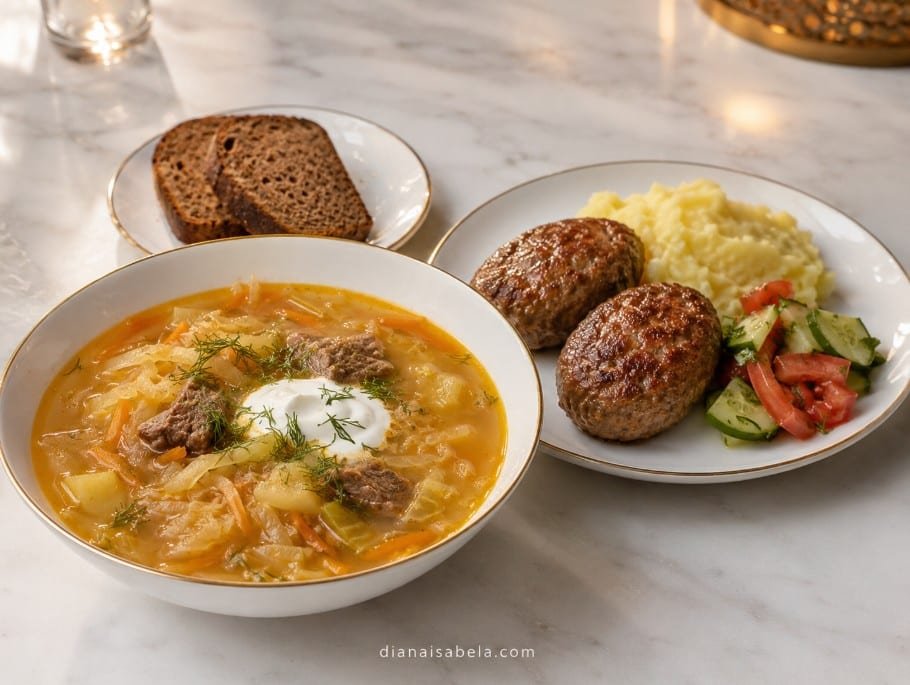
The pairing works because the textures change. Shchi gives broth, cabbage, warmth and, depending on the style, acidity. Kotleti give browned edges and a tender minced-meat center. Mashed potatoes or buckwheat make the second plate more substantial. Pickles, sauerkraut or a cucumber-tomato salad stop the meal from becoming one long beige sentence.
The deli dinner I would build
First: shchi with sour cream and dark bread.
Then: one or two kotleti with buckwheat or mashed potatoes.
Something fresh: cucumber and tomato salad, cabbage salad or a modest portion of pickled vegetables.
Then stop: unless you have spotted excellent syrniki, in which case I refuse responsibility for the next decision.
Kotleti are especially convenient as a bridge from soup to a fuller dinner because the same deli that makes shchi may already have them ready. You do not need the kitchen to synchronize two elaborate restaurant courses. You need a bowl, a cutlet, a side and a container that closes properly.
Pelmeni and vareniki are another natural route. They work particularly well if several people are sharing dinner because you can order soup first and dumplings for the table rather than committing everyone to an enormous individual main. Stuffed cabbage can work too, although shchi followed by cabbage rolls is a confident amount of cabbage for one evening. I respect the commitment.
What I would avoid is building the entire plate out of richness. Shchi, fried cutlets, fried potatoes, mayonnaise-heavy salad and no acid may sound comforting until halfway through dinner when everyone quietly discovers why pickles were invented.
The broader pairing logic — bread, sour cream, kotleti, grains, potatoes, dumplings, pickles and lighter options — is developed in What to Eat With Shchi. That lets this location guide answer the immediate dinner question without becoming a twenty-course menu.
When the Website Is Useless, Customer Photos Become Clues
There is a particular kind of local food business whose website tells you that the establishment exists and then apparently considers its digital responsibilities complete. This can be annoying if you are trying to plan lunch from another neighborhood. It can also make recent reviews and customer photographs unusually valuable.
I do not treat a review as proof that a dish is available today. I do treat recent customer material as evidence that a business is worth investigating.
Suppose the official site says only “European Grocery & Deli.” Not enough. Then recent photographs show a steam table, several soup containers, kotleti, cabbage rolls and customers carrying packaged meals. That tells me there is a real prepared-food operation, not just shelves of imported cookies and mineral water.
If several recent reviews mention lunch, homemade soup, daily specials or food selling out, the lead becomes stronger. If someone specifically mentions shchi, it becomes stronger again — but the date still matters.
A comment from last week saying, “They had shchi on Friday” is useful. A photograph from 2018 with no caption is interesting history. Those are not the same thing.
This is also where local vocabulary can outperform the phrase you originally searched. A customer may never write “best shchi soup near me.” They may write, “The deli had great cabbage soup today,” “They make Russian soup on Fridays,” or “Ask what they have at the back counter.” The wording is less polished and often more useful because it reflects what actually happened.
Signs a prepared-food lead is worth a call
- Recent photographs show several homemade soups rather than packaged canned products.
- Customers regularly mention lunch, hot food, prepared meals or daily specials.
- The business clearly serves Russian, Ukrainian, Eastern European, Uzbek or Bukharian home-style food.
- There are current photographs of kotleti, stuffed cabbage, dumplings, salads or other cooked dishes from the same kitchen.
- The store posts changing food specials even if shchi itself is not currently shown.
- The phone number and opening hours appear active and recent.
Signs I would not build a special trip around yet
- Only an old menu scan mentions shchi.
- The business has no recent evidence of being open.
- A third-party page has preserved a menu long after the restaurant stopped maintaining it.
- The only soup evidence is a generic photograph that cannot be tied to the business.
- The restaurant is Russian but has no evidence of any rotating or home-style soup program.
- The phrase “cabbage soup” appears with no cultural or menu context connecting it to shchi.
I would rather tell you, “This deli looks genuinely promising; call before going,” than send you across a city with false confidence. The first sentence respects your time. The second merely sounds more authoritative.
What I Would Not Trust Without Checking
Local food searching has several recurring traps, and shchi manages to encounter almost all of them.
An old menu with no current business confirmation
Useful as a clue. Not enough for “drive here now.” Restaurants close, ownership changes, menus shrink and soup programs disappear. If a listing is several years old and the business cannot be established as active, it belongs in historical context rather than a confident recommendation.
A restaurant that happens to be Russian
Russian cuisine does not require every kitchen to serve every famous Russian dish. A restaurant can make excellent pelmeni, stroganoff and borscht without cooking shchi at all. Cuisine identity creates a reason to investigate, not a dish guarantee.
The words “cabbage soup” by themselves
Many cuisines make cabbage soup. Polish, Ukrainian, German, Central European and other traditions have their own cabbage and sauerkraut soups. The description, restaurant context or direct confirmation needs to connect the bowl to shchi before I would confidently label it that way.
A beautiful photograph without a useful date or place
Excellent for appetite. Weak for directions. Food photography can survive online much longer than the menu that produced it.
A delivery listing that survives longer than the dish
Ordering platforms can provide useful clues, but listings can become stale. If the restaurant still clearly operates and the item appears active, wonderful. If the page looks abandoned or contradicts newer information, the next step is checking rather than optimism.
A broad result that does not contain shchi at all
This happens more than you would expect. A system can decide that a vaguely related soup or restaurant category is close enough to what you wanted. The result may be geographically near you and culinarily nowhere near shchi.
My standard is simple: a promising lead should remain a promising lead until there is enough information to call it something stronger. Confidence is not a seasoning. Adding more does not improve weak information.
Food Borders Are Messier Than Menu Categories
Shchi is strongly associated with Russian cuisine, but the places where you find it outside Russia do not necessarily fit into tidy national boxes. Migration, Russian-speaking communities, Ukrainian communities, Central Asian restaurant culture and the shared culinary history of the former Soviet space have all shaped the menus people encounter around the world.
That is why an Uzbek restaurant can legitimately have shchi on its current menu. It does not become a Russian restaurant because one soup crossed the table.
Likewise, a Ukrainian grocery may carry or prepare foods that are also familiar in Russian kitchens. I do not need to erase the identity of the business to explain why the soup belongs in the search.
The useful approach is descriptive rather than possessive: identify the business accurately, identify the dish accurately and leave room for culinary overlap without pretending that every shared food has one neat national owner.
This also matters with green shchi and sorrel soup. Sorrel soups exist across several Eastern European cuisines. A Russian menu may call one green shchi. A Ukrainian menu may use a different name for a related bowl. Similar ingredients do not automatically make cultural identity identical.
Food history is full of neighbors borrowing, adapting, arguing and feeding one another. A location guide should be precise enough to respect that complexity without making the reader complete a graduate seminar before lunch.
So when I use “Russian cabbage soup” as an explanatory phrase here, I mean the common English description of shchi. I do not mean that every cabbage soup found inside a Russian-speaking or Eastern European community should automatically be placed under the same name.
Shchi Is Everyday Food, Which Is Exactly Why It Deserves Better Attention
Some foods arrive with obvious ceremony. Shchi rarely does. It is not a dish that needs dramatic tableside service, expensive ingredients or a chef explaining twelve components with tweezers nearby. Its cultural power comes partly from the opposite direction: this is the kind of food that can become normal enough to disappear into daily life.
And normal food is often the hardest food to document well.
A famous tasting-menu dish exists because somebody wants attention. A pot of cabbage soup may exist because it is Thursday, there is cabbage to use, people need lunch and the cook knows exactly how the family likes it. The second meal may carry more memory while producing much less internet evidence.
That gap explains a lot about why “near me” searches for traditional foods can feel strangely unsatisfying. The internet is very good at finding businesses that market a dish. It is less reliable at finding businesses where the dish is simply part of life.
This is also why I do not think a good shchi guide should stop after identifying a handful of restaurants. Understanding the food itself improves the search. Once you know the difference between fresh cabbage and fermented cabbage, understand why sorrel matters, recognize the menu spellings and know that a rotating deli kitchen can be more relevant than a formal restaurant, the city starts looking different.
You begin noticing kitchens instead of just names.
If the Search Turns Into Curiosity, Follow It
Shchi is the sort of dish that starts with a location question and quickly becomes ten other questions. Why does one bowl taste gently sweet while another is sharply fermented? Why is sorrel sometimes called green shchi and sometimes green borscht? Is every cabbage soup remotely related? Why does a soup that looks so simple taste better after the ingredients have spent serious time together?
I would rather give those questions proper space than cram one-sentence answers into this guide, so the deeper shchi collection follows the natural paths people take after finding the dish.
There are also practical questions that deserve their own context. Whether a particular version is nutritionally light or rich depends heavily on broth, meat, sour cream, sodium, portion and recipe; that is why I keep the subject in a separate guide to shchi and nutrition rather than pretending one bowl represents every household pot ever made.
The same principle applies to storage. A soup can be excellent for make-ahead cooking and still contain ingredients that change texture after freezing. Potato, cabbage, sour cream and sorrel are not interchangeable from a storage point of view, which is why freezing deserves more than the lazy answer “yes, soup freezes well.”
What to Do When the Deli Says “No Shchi Today”
First: do not behave as though lunch has personally betrayed you.
Ask what soup is available.
If the kitchen makes shchi at all, the other soups are often part of the same home-style cooking ecosystem. You may find borscht, solyanka, rassolnik, mushroom soup, chicken soup or something the cook made because the ingredients looked right that morning. If you are already there and the food looks fresh, this is an excellent moment to let curiosity win.
Then look at the rest of the counter. The hot-food trays may contain kotleti, holubtsi, buckwheat, stuffed peppers, roast meat, potato dishes or dumplings. A good food search should occasionally reward deviation rather than punish you for failing to reproduce the exact phrase you typed before leaving home.
Then ask when shchi returns.
Now you have lunch today and a plan for Friday.
This is also why rotating kitchens deserve space alongside permanent restaurant listings. A directory that refuses to acknowledge changing prepared-food counters may look beautifully tidy while missing the exact places where home-style soup is most alive.
Both kinds of answer can be useful: “This restaurant currently lists shchi,” and “This deli makes it regularly, but call for today’s pot.” They simply offer different levels of certainty and require different decisions from you.
Know a Shchi Counter I Should Know About?
I want this guide to become better because people actually use it, not just longer because another menu appeared online.
If there is a Russian deli, Ukrainian grocery, Eastern European market, restaurant, small culinary shop, catering kitchen or prepared-food counter in your city where shchi appears — even if it is only every Wednesday, every other weekend or “whenever the cook feels like making a pot” — tell me.
The most useful details are wonderfully unglamorous: the name of the place, city and country, address, phone number, what the soup is called on the menu, whether it uses fresh or sour cabbage, which day it usually appears, whether it sells out early, the current price if you know it, and a photograph of the bowl or counter if you have one.
I am equally interested in family details. Maybe your version always comes with black rye bread. Maybe your grandmother insists it tastes better the next day. Maybe the deli near you makes brilliant green shchi only when sorrel is in season. Maybe you found a tiny grocery five minutes from a train station that nobody looking only at restaurant lists would ever discover.
I love new tastes, old recipes, smart ways of serving familiar food and little local places that deserve to be remembered. If your tip can make this guide more useful to the next hungry person, send it. If you have a good photograph, a family story or a detail about how shchi is made where you live, send that too.
The best local food guides are rarely finished by one person. Someone always knows the counter I missed.
info@dianaisabela.comQuestions About Finding Shchi
Where can I find shchi soup near me?
Start with Russian restaurants, Ukrainian restaurants, Eastern European delis, Slavic groceries, prepared-food markets and Russian or Central Asian restaurants that serve home-style soups. If the business rotates soups, call and ask whether shchi is available today or which day it is usually made.
Why can shchi be hard to find on restaurant websites?
Shchi is often everyday or rotating food rather than a permanent signature dish. A deli or prepared-food kitchen may alternate shchi with borscht, chicken soup, mushroom soup, rassolnik and other soups, so the current selection may never appear on a static online menu.
What other names should I search for besides shchi?
Try shchi, schi, щи, Russian cabbage soup, sour cabbage soup, green shchi, zeleny shchi and sorrel soup. Cabbage soup or sauerkraut soup can also be useful leads, but those broad names do not automatically prove that the dish is shchi.
Is shchi the same as borscht?
No. Although the soups can share ingredients such as cabbage, meat, herbs, potatoes and sour cream, classic shchi is centered on cabbage or, in green versions, greens such as sorrel. The familiar red style of borscht gets much of its identity from beetroot.
Is shchi always made with sauerkraut?
No. Shchi can be made with fresh cabbage or sour fermented cabbage. Fresh-cabbage versions tend to have a gentler vegetable character, while sauerkraut gives the soup more acidity and fermented depth. Recipes vary widely between households and kitchens.
What is green shchi?
Green shchi is a greener, tangier branch of the shchi family commonly associated with sorrel. Depending on the recipe, it may include potatoes, egg, herbs and meat. Menus may list it as green shchi, zeleny shchi or simply sorrel soup.
Should I call a deli before driving there for shchi?
Yes, especially when the deli advertises homemade or daily soups but does not publish a complete current menu. Ask whether shchi is available today, whether it has a regular day in the soup rotation and whether a portion can be held for pickup.
Is shchi good for takeout?
Shchi generally travels better than foods that depend on a crisp exterior because broth and cooked vegetables are already central to its texture. If possible, keep sour cream, fresh herbs and bread separate until you are ready to eat.
What should I eat with shchi?
Dark rye bread and sour cream can be enough for a simple lunch. For a fuller meal, shchi can be followed by kotleti, pelmeni, vareniki or another home-style main with mashed potatoes or buckwheat, plus something fresh or pickled for contrast.
How can I tell if a shchi listing is current?
A current official menu or active ordering menu is the clearest evidence when one exists. For rotating deli counters, direct confirmation is more useful than an old menu photograph. If shchi is the reason for a special trip, a quick phone call is the safest way to confirm that today’s soup is actually the one you want.